
GameBrief · General
The Last Winter Knight Review: A Gothic Ghost Story
The Last Winter Knight review: ENDYSIS's gothic visual novel where you play a ghost knight in an abandoned castle. Released May 11. Melancholy done right.

Reviewing
The Last Winter Knight
ENDYSIS · ENDYSIS
Score
Reviewed build: 1.0
Pros
- Ghost knight premise handled with earned melancholy, not cheap sadness
- Hand-drawn art creates distinctive atmosphere unlike any other 2026 release
- Point-and-click exploration adds spatial depth that pure VNs lack
- Multiple endings reward players who engage with the lore seriously
Cons
- Puzzle difficulty spikes inconsistently, some sections are frustratingly unclear
- Pace slows noticeably in the middle castle wing where content is thinner
Verdict
The Last Winter Knight is a solo developer achievement, hand-drawn, emotionally precise, and unusual enough to stay with you after credits.
Key takeaways
- The Last Winter Knight is a gothic visual novel with point-and-click adventure elements.
- You play a ghost knight haunting a suit of armour in an abandoned castle.
- Hand-drawn art by a solo developer. Multiple endings.
- Puzzle difficulty is inconsistent. Middle section has noticeable pacing issues.
- Rating: 7.8/10. One of the more distinctive narrative indie releases of May 2026.
The game is now released: the Steam snapshot checked September 16, 2026 lists the May 11 launch, a $14.99 price, and Very Positive reviews at 98% from 65 reviews. ENDYSIS also maintains an official press kit, X account, YouTube channel, and itch.io build page for post-launch updates.
What The Last Winter Knight is
The gothic visual novel is a genre with a reasonably well-defined set of conventions: dark architecture, tragedy in the backstory, a protagonist with incomplete knowledge of their own situation, and an aesthetic built around candlelight and decay. The Last Winter Knight uses all of these, but the more interesting question is whether it does something distinctive within those conventions. The answer is yes, specifically in how it handles the ghost knight premise.
ENDYSIS is a solo developer. The Last Winter Knight is a fully hand-drawn gothic visual novel with point-and-click adventure elements: rooms to explore, puzzles to solve, objects to examine. You're not clicking through a series of dialogue screens. You're moving through an abandoned castle, interacting with the environment to surface memory fragments and piece together what happened here.
The ghost knight you're controlling doesn't know why they're haunting this place. That's the central dramatic engine: the slow discovery of what binds them here, what they lost, what broken promise or severed bond is holding them to the physical space. This is the first gothic VN I've played in several years where the amnesia premise (standard as it is) actually generates the right kind of tension rather than feeling like a structural convenience.
The ghost knight premise and how it develops
The more interesting design decision in The Last Winter Knight is the pacing of revelation. The castle holds layered information: environmental details that hint at what happened, dialogue fragments that recontextualize earlier scenes, objects that carry emotional weight before their significance is explained.
The genre lineage here traces clearly to classic point-and-click adventure games that used spatial exploration to externalize psychological interiority, games where the environment was memory. The Last Winter Knight belongs to that tradition more than it belongs to the contemporary visual novel space.
The ghost knight's gradual understanding of their own situation is tracked through what the game calls "memory echoes": brief cutscene-length fragments that surface when you interact with specific objects or reach specific rooms. These fragments don't explain the story linearly. They accumulate. By the third castle wing, you're holding four or five incomplete emotional threads simultaneously, and the game expects you to hold them long enough for them to resolve.
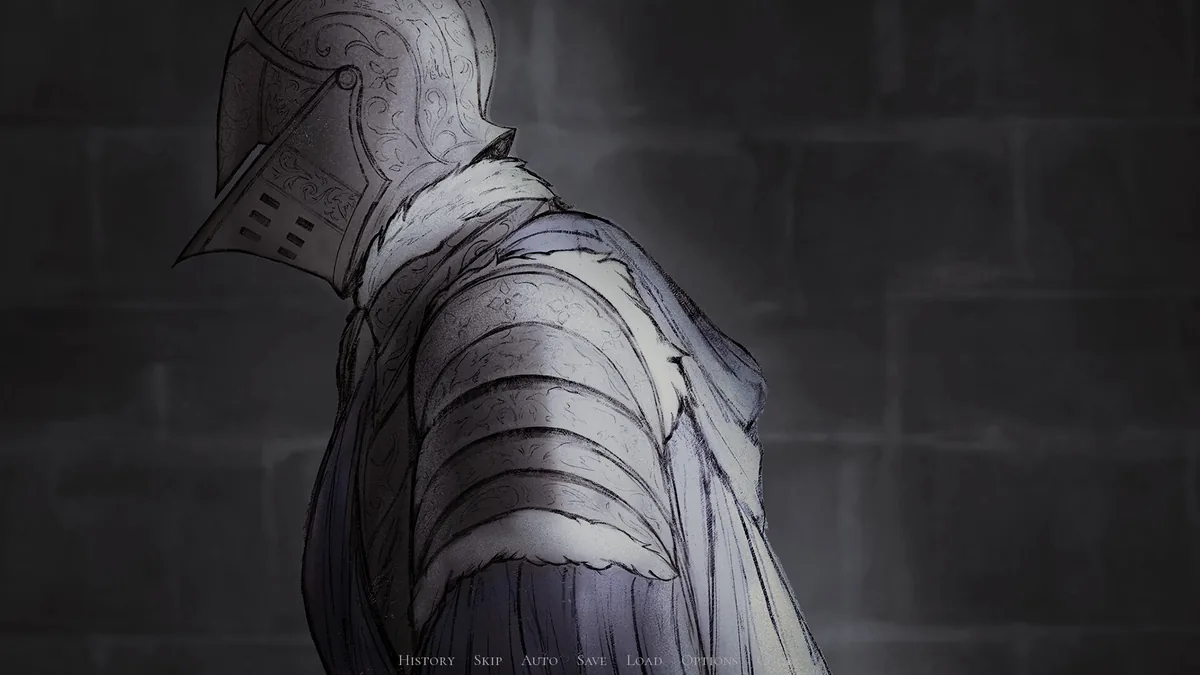 Caption: The hand-drawn rooms in The Last Winter Knight carry the weight of the story. What's in a space tells you as much as what characters say.
This is the right kind of ambition for a solo developer. It's also the kind of ambition that can produce pacing problems when the content density doesn't match the structural requirement, which is exactly what happens in the middle castle wing.
Point-and-click exploration and puzzles
The spatial layer of The Last Winter Knight works well on the whole. Moving through rooms, examining environmental details, tracking which objects have changed after a memory echo: this is more engaging than static scene selection, and it makes the castle feel inhabited in a way that purely text-driven visual novels rarely achieve.
For comparison, NOOK FALL: West Town uses isometric movement to achieve similar spatial presence in a much more gentle tonal register. The two games are solving the same problem (how to give a narrative game physical space) with opposite aesthetic approaches.
The puzzles are where The Last Winter Knight has the most friction. Most puzzles read the game's internal logic correctly: if you've been paying attention to the environmental storytelling, the solution is findable. But several puzzle solutions require combining information in ways that aren't adequately signposted, leading to the specific frustration of knowing you've read everything in a room and still not knowing what the game wants.
Puzzle difficulty in gothic VN hybrids has a known design problem: pace-breaking confusion is fine in an adventure game where exploration is its own reward, but in a narrative game where momentum matters, a 20-minute block on a puzzle solution is a pacing disruption. The Last Winter Knight hits this problem two or three times.
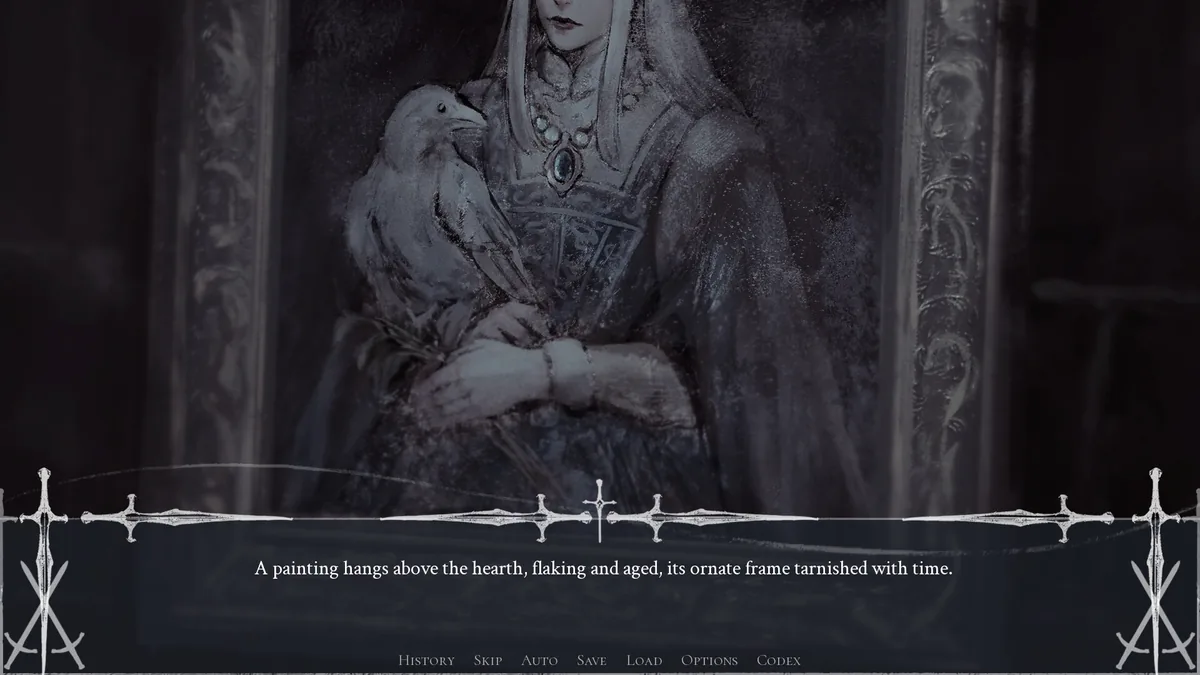 Caption: The snow visible through the castle windows in The Last Winter Knight does consistent atmospheric work throughout. The game knows how to use negative space.
GODEEPER: For comparison on how dark fantasy games use environmental design to carry narrative weight, the Kristala review covers similar structural territory. Kristala Review: Dark Fantasy Done Differently
Art, atmosphere, and solo dev achievement
The hand-drawn art is the most immediately striking thing about The Last Winter Knight. Solo developer visual novels rarely have visual identities this distinct. The character designs carry the weight they need to carry. The castle environments are detailed in ways that reward examination: this is art that was drawn by someone who understood what the story needed rather than produced to a specification.
The atmosphere earns its melancholy. This isn't a game that uses darkness and decay as aesthetic decoration. The gothic elements are doing tonal work: the abandoned castle is abandoned for a reason the game is gradually explaining, and the visual choices support that explanation at every stage.
The middle castle wing is the exception. Content is noticeably thinner in those rooms, and the pacing slows to the point where the emotional momentum built in the first half dissipates before the third act recovers it. This is the kind of problem that appears in solo productions when the development timeline requires allocation choices, and The Last Winter Knight's middle section shows those choices.
Multiple endings are present. The game rewards players who engage with the lore seriously: read the environmental details, track the memory echoes carefully, make choices in dialogue that reflect genuine understanding of what you've learned. Casual playthrough endings and thorough playthrough endings are meaningfully different, which is harder to achieve than most narrative games that claim multiple endings.
GODEEPER: Above the Snow reviewed earlier this year takes a similar solo-dev atmospheric approach to a completely different setting. Above the Snow Review: Atmospheric Survival Done Right
The Last Winter Knight review verdict
The Last Winter Knight is a 7.8. The ghost knight premise, the hand-drawn art, and the spatial exploration structure combine into something genuinely distinctive. This is not a game that occupies the same territory as anything else in May 2026's release window.
The puzzle difficulty spikes and the pacing problems in the middle wing are real limitations. A solo developer shipping a hand-drawn gothic point-and-click visual novel with multiple endings and a coherent emotional arc is doing something worth 7.8, limitations and all.
The ghost knight doesn't know why they're haunting this castle at the start. By the end, the answer is specific, earned, and quiet in the way that good melancholy is supposed to be. That landing is hard to achieve. The Last Winter Knight achieves it.
Frequently Asked Questions
What is The Last Winter Knight? The Last Winter Knight is a gothic visual novel with point-and-click elements by solo developer ENDYSIS. You play a ghost knight haunting a suit of armour in an abandoned castle, uncovering a story about broken promises and bonds beyond death.
Is it hand-drawn? Yes. Fully hand-drawn art by the solo developer ENDYSIS. The visual identity is distinctive and supports the gothic atmosphere throughout.
Does it have multiple endings? Yes. Multiple endings reward players who engage seriously with the lore, environmental details, and dialogue choices.
How long is The Last Winter Knight? 4 to 6 hours for a single playthrough. Additional runs for alternate endings add to that.
Who made it? ENDYSIS, a solo developer. The entire production (hand-drawn art, story, puzzles) is a one-person project.
Is it scary? Gothic and melancholy rather than frightening. The tone is dark fantasy atmosphere and emotional dread, not horror. It aims for sadness and mystery over fear.
Related Reading
- Moomintroll: Winter's Warmth review: another atmospheric winter narrative review.
- Sister Ray review: a character-focused indie review with a different emotional register.
- Kristala complete guide: a broader guide to another dark-fantasy release.
- Kristala game length guide: a practical comparison for players planning a short campaign.
- Above the Snow review: another solo-developer atmospheric comparison.
References
About the author

Critical game theorist with a background in film criticism. Writing for print and digital outlets since 2015. Specialises in genre analysis and design heritage.
- Background in film criticism
- 10 years games coverage
- Genre theory and design history specialist
Keep reading

Disclaimer
This article is published for informational and entertainment purposes. It does not constitute professional financial, legal, or technical advice. Game performance, online services, patch schedules, and store listings change. Verify critical details (pricing, system requirements, regional availability) with publishers and storefronts before you buy. Affiliate links, where present, help support our editorial work and are labelled in our affiliate disclosure.
Comments
Loading comments…