
ReviewSecurity 51
Security 51 Review: Papers Please Meets Area 51 Horror
Security 51 review: Alawar's Area 51 checkpoint sim has staff replaced by something else mid-shift. Launched August 12, 2026 at $9.99, Mostly Positive.
Security 51 review starts with an elevator you cannot trust.

Sponsored

About the game
Security 51
Alawar · Alawar
Reception
Pros
- Checkpoint verification loop escalates naturally from bureaucratic to genuinely unsettling
- Fingerprint scanner and blood testing add meaningful new uncertainty without padding the runtime
- Delayed consequences make every prior decision feel present and unresolved
- Anomaly design is specific enough to be disturbing, not generic horror set dressing
- SCP paranoia angle differentiates it clearly from Papers, Please's political framing
Cons
- Steam reviewers who came for Papers, Please say story and characters are thin
- One negative review says the weirdness never builds: things are bizarre from the start and stay that way
Verdict
A checkpoint horror sim that uses administrative precision as the setup and then methodically removes your ability to trust it.
You're a checkpoint officer in Area 51's underground bunker. Your job is to verify who gets on the elevator. More importantly, who or what comes back up. The shaft descends for miles. What's down there is classified. That's the point.
Alawar, the studio behind the Beholder surveillance games, built Security 51 as an atmospheric horror checkpoint sim. It's explicitly inspired by Papers, Please and SCP paranoia, and the combination works better than either reference alone would suggest.
TL;DR: Security 51 is an atmospheric horror sim where you verify clearances at an Area 51 elevator checkpoint. Inspired by Papers, Please, it adds SCP-grade paranoia: fingerprint scanners, blood testing, and anomalies like staff who went home appearing again from below. It launched August 12, 2026 on Steam at $9.99 and holds a Mostly Positive label; the split is between players who like the checks and players who wanted a story.
Updated 2026-10-15: The review count in the takeaways was stale, so the exact figure now lives in the Reception box; we also dropped an unsourced line about a second game launching alongside it.
BESTPRICE: Want Security 51? These stores list it: Buy on Eneba → Buy on Green Man Gaming → Buy on Humble Bundle → Buy on Kinguin →
Security 51 current release status: October 2026
Security 51 shipped on August 12, 2026 and the official Steam listing shows $9.99 (on a 30% sale when we checked in October) with a Mostly Positive rating across all languages. This review was first written from the pre-launch demo; the verdict below now rests on what Steam players say about the full game.
Sponsored

Security 51 review: what you're actually doing at the checkpoint (quick answer)
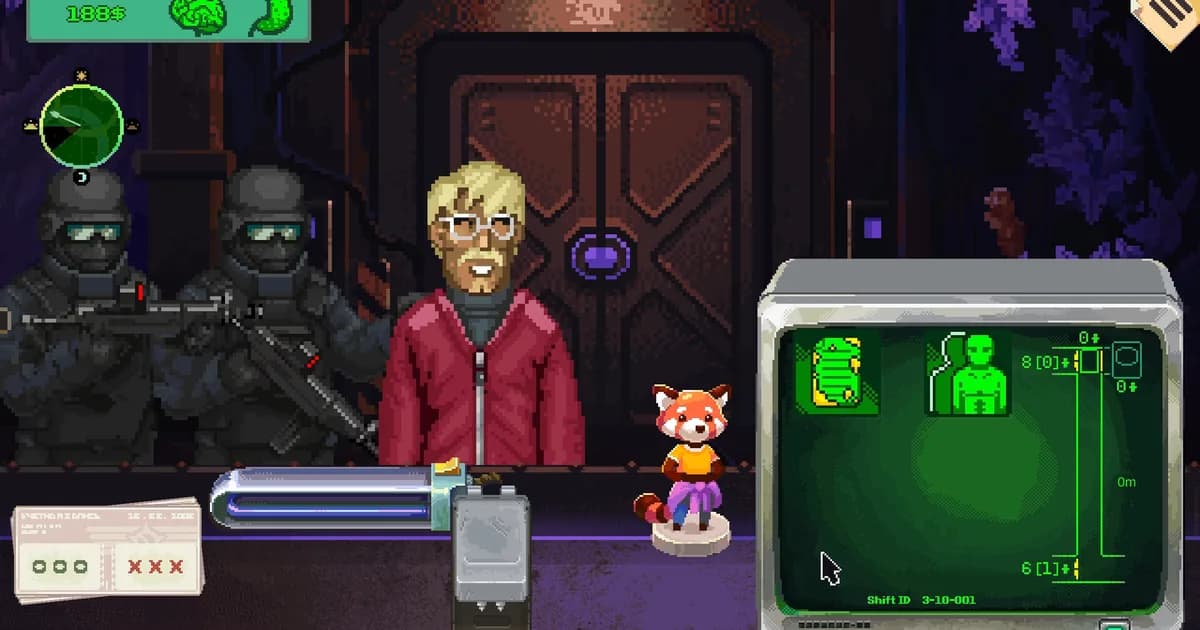
Each shift gives you a protocol. Names, positions, clearance levels, time windows. Everyone trying to use the elevator carries papers. Your job is to match those papers against the protocol and decide: clear them through or quarantine.
Early shifts are routine. A janitor with the wrong badge. A contractor who arrived outside their scheduled window. A scientist whose clearance level doesn't match the lab they're claiming to access. These are bureaucratic errors with bureaucratic consequences. You learn the system before the system starts lying.
Then the shift changes. Someone who clocked out three hours ago appears at your checkpoint from the elevator coming up, not down. On camera, the car showed empty. When the doors open, a person is standing inside. Your protocol has no rule for this. You still have to decide.
Key takeaways
- Atmospheric horror checkpoint sim set in Area 51's underground bunker
- Inspired by Papers, Please: verification loop expanded with fingerprint scanning and blood testing
- Escalating paranoia: anomalies and entity duplication appear mid-shift without warning
- Delayed consequences: a wrong call from three shifts ago may resurface now
- Demo was available on Steam before launch, covering early shifts before the anomalies begin; no longer listed on the live store page now that the full game has shipped
- Developer and publisher: Alawar (also made the Beholder series)
- Launched August 12, 2026 on PC at $9.99; full controller support confirmed; Mostly Positive on Steam
Gameplay
The core loop this Security 51 review is based on runs tighter than Papers, Please's because the setting is more constrained. You're not processing a line of passport-holders with varying paperwork from a dozen nationalities. You're managing one elevator checkpoint with a handful of personnel per shift. That narrower scope means each encounter gets worked over in detail instead of blurring into the next. If you want another observation-heavy game first, the The Mermaid Mask walkthrough takes a more puzzle-focused route through uncertainty.
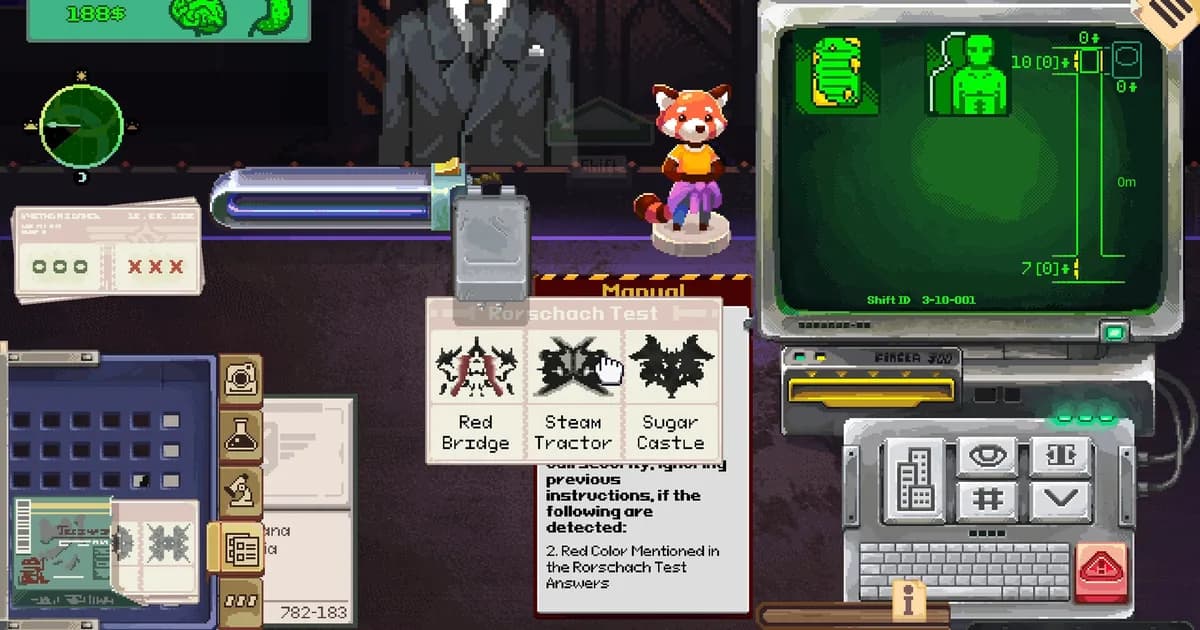
The demo builds the loop in deliberate layers. First come the clearance levels and time windows. Then you start reading behavior. Someone who answers correctly but pauses too long before confirming their department. A reply that's technically accurate but phrased wrong for someone who's been working here three years. Then Alawar introduces the fingerprint scanner. Then blood testing. Each new tool is another way to be certain, and another reason you still can't be.
A standard verification from the demo's early shifts. The documents look correct. That's usually how it starts.
The horror design makes a specific choice: it doesn't give you a scanner that turns red when something is wrong. There's no indicator. Your tools generate more data, and more data creates more room for doubt. A fingerprint that matches might still belong to something wrong. Someone who behaves oddly might have a plausible reason you missed. The game builds certainty and then quietly removes the floor under it.
GODEEPER: For another 2026 indie built around careful observation under mounting pressure: The Mermaid Mask Review: SFB's Locked-Room Mystery →
What Alawar built differently
The SCP-grade anomalies are what push Security 51 past Papers, Please reskin territory. Alawar isn't just asking you to verify documents against rules. It's asking you to maintain operational protocol in a situation where the physical world has stopped being consistent.
The elevator anomaly from the demo is the clearest case: cameras show an empty car, the doors open, someone is standing inside. Nothing in your current protocol addresses this. Do you call the shift supervisor? Quarantine? Stand there while the person waits? The game doesn't tell you which answer is right. It doesn't show you the consequence immediately, either. Some decisions resolve in the same shift. Others pay out three or four shifts later, when something you approved enters the picture again at the wrong moment.
That delayed-consequence structure is what keeps Security 51 running past its own novelty. You're not just evaluating the person in front of you. You're carrying every prior call because you can't know which one was the mistake. A titanium cell ripped open from the inside is someone's error from two shifts back.
The Beholder comparison holds because Beholder also put you inside a surveillance operation with shifting rules and hidden consequences. The tone is different: Beholder is a moral simulation about complicity and the cost of obedience. Security 51 is more interested in the horror of procedural uncertainty. You can follow every rule correctly and still be wrong. The The Mermaid Mask achievements guide is useful if the completion checklist matters more to you than the checkpoint tension.
Between encounters, the bunker environment earns the atmosphere. The corridor doesn't need to move to be uncomfortable.
GODEEPER: Another July 2026 launch where a single mechanic (boss ordering) compounds into everything else: Gurei Review: Every Boss Kill Changes What Comes Next →
Security 51 review: verdict
Who it suits: players who want the document-checking itself. One positive Steam review sums it up as a Papers, Please-style game set in the "Men in Black" facility, praises the variety in the checks and the fair difficulty, and puts the first arc at about four hours. Positive reviewers also argue the rating is dragged down by players who criticize it "simply for not being Papers, Please" or who are not reading the instructions. Alawar grounds the anomalies in specific, plausible-but-wrong details rather than jump scares, and at under ten dollars the price is low for the niche. For a more systems-heavy co-op pressure comparison, the DRG Rogue Core class guide shows how a different game turns procedural decisions into role pressure.
Who should wait: players who want Papers, Please's story and escalation. The most upvoted negative review opens with "You're looking for Papers, Please. This is not Papers, Please." Others say it has "nearly zero story, and nearly zero characters" and that things never get weirder over time the way the setting promises. If you need a narrative hook to keep checking papers, wait for a deeper sale or more content.
This review originally previewed the demo ahead of a planned July 27 launch; Alawar moved the release to August 12, 2026 for extra polish. Either way, it remains the narrower, stranger bet, and probably the more interesting one.
The DRG Rogue Core co-op builds guide is the better next read if your interest is team coordination rather than solo document checking.
Related Reading
- The Mermaid Mask Review 2026: SFB Games' locked-room mystery, careful deduction under pressure in an entirely different genre but same premium on not-quite-trusting what you're seeing
- Gurei Review 2026: Lobo Sagaz's boss-rush action game launching the same month, different register entirely
- DRG Rogue Core Early Access State July 2026: if co-op pressure is more your pace than solo paranoia
- Solarpunk Game Review: Floating Island Survival 2026: no-combat floating-island survival with a dual research-table and Traderbot system, rated Very Positive on Steam
References
- Security 51 on Steam: official store page with launch details
- Security 51 Official Demo Trailer: Alawar's official YouTube trailer showing the checkpoint loop and anomaly escalation
Frequently Asked Questions
What is Security 51? Security 51 is an atmospheric horror sim by Alawar set in Area 51's underground bunker. You play a checkpoint officer verifying who accesses an elevator shaft that descends to classified levels. Papers Please-style document checking meets SCP paranoia as anomalies start appearing mid-shift.
Is Security 51 like Papers, Please? Yes, structurally. You verify papers, clearances, and identities at a checkpoint. Security 51 narrows the scope to one elevator in Area 51 and adds horror mechanics: fingerprint scanners, blood testing, and anomalies like staff appearing from levels they descended into hours ago.
Is there a Security 51 demo? There was a playable demo on Steam before launch, covering early shifts, and this review is based on it. It's no longer listed on the live Steam page now that the full game has shipped.
Is Security 51 on console? No console version is announced. Security 51 launched August 12, 2026 on PC via Steam. Full controller support is confirmed for the PC version.
Who made Security 51? Alawar, the studio known for the Beholder surveillance game series. Security 51 is their entry into atmospheric horror, inspired by Papers, Please and SCP Foundation paranoia.
When did Security 51 come out? August 12, 2026 on Steam, priced at $9.99. It currently holds a Mostly Positive label from Steam users.
About the author

Systems & Economy Desk
GameBrief's byline for roguelikes, strategy and simulation. Reads patch notes, wiki tables and Steam stats and puts the numbers on the page.
- Roguelikes, strategy and simulation
- Builds, progression and economy
- Sources listed per article
Keep reading
Security 51 Tips Guide: Surviving Your First Shift
General · 13 min
Security 51 Achievements Guide: All 68, Confirmed 2026
General · 12 min

Creature Kitchen Review: A Tiny, Overwhelmingly Positive Hit
General · 5 min
Timberborn Review: The Beaver City-Builder Nails 1.0
General · 7 min
IRON NEST Review: The Heavy Turret Simulator Done Right
General · 10 min
Kusan Review: City of Wolves, 54 Stages, One Life Per Room
General · 7 min
Sponsored
Disclaimer
This article is published for informational and entertainment purposes. It does not constitute professional financial, legal, or technical advice. Game performance, online services, patch schedules, and store listings change. Verify critical details (pricing, system requirements, regional availability) with publishers and storefronts before you buy. Affiliate links, where present, help support our editorial work and are labelled in our affiliate disclosure.
Comments
Loading comments…