
ReviewSolarpunk
Solarpunk Game Review: Floating Island Survival 2026
Solarpunk game review: no-combat floating-island survival, Very Positive on Steam. Who the energy grid and Traderbot loop suits, and who should wait.
This Solarpunk game review covers a two-person studio's four-year bet: a floating-island survival game where the enemy is a rain shadow. Solarpunk launched June 8, 2026 on PC, PS5, Xbox Series, and Nintendo Switch 2, and Steam players rate it Very Positive (81% across all languages when we checked in October). That's a real result for a two-person studio, even if it sits below the near-universal praise Cyberwave's early trailers generated.
Sponsored

About the game
Solarpunk
Cyberwave · rokaplay, Metaroot
Reception
Pros
- Weather-driven energy grid creates genuine planning depth
- No-combat design replaces fighting with logistics, not emptiness
- 4-player co-op with separate inventories avoids the bottleneck problem
- Remarkable polish from a two-person, four-year development
Cons
- Island variety thins past the 20-hour mark
- Crossplay arrived after launch; console rollout is still pending
- Narrative spine is thin once the environmental framing wears off
Verdict
Solarpunk earns its Very Positive Steam rating in the first 20 hours; whether the energy optimization loop holds past that depends on how much you enjoy logistics for its own sake.
Here's what it actually is, who the reviews say it works for, and where it doesn't.
Updated 2026-10-01: Update 1.3.0 adds Steam crossplay, while console versions await platform-holder approval and rollout; every player must use the same version.
TL;DR: Solarpunk is a no-combat, floating-island survival game with a weather-driven energy system, 4-player co-op, and farming. Developed by two people over four years. Available on Xbox Game Pass. The core risk is whether its energy/automation loop has enough depth to hold past 20 hours. There is a free Steam demo to check before buying.
BESTPRICE: Want Solarpunk? These stores list it: Buy on Green Man Gaming → Buy on Humble Bundle → Buy on Gameseal → Buy on Kinguin →
Solarpunk game review: short version (quick answer)
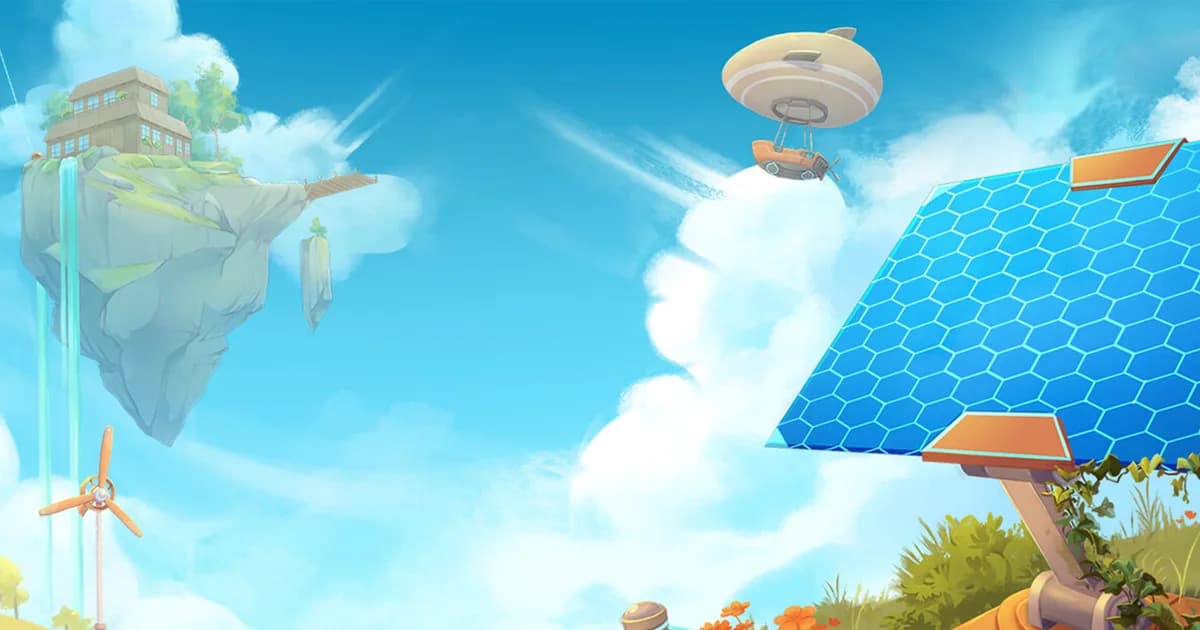
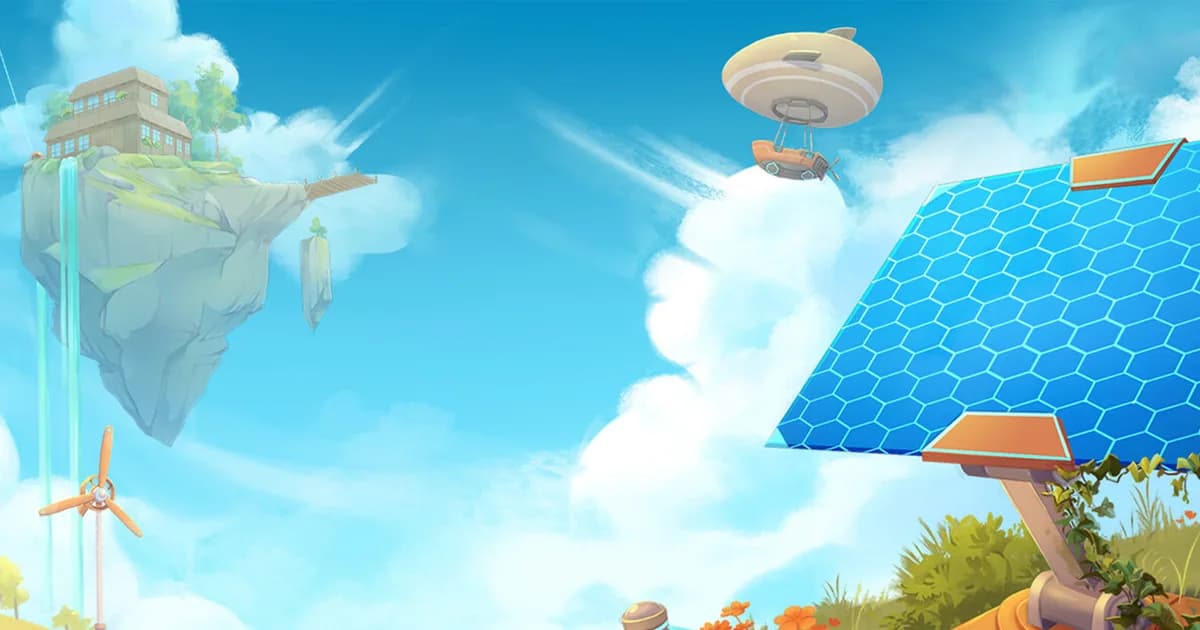
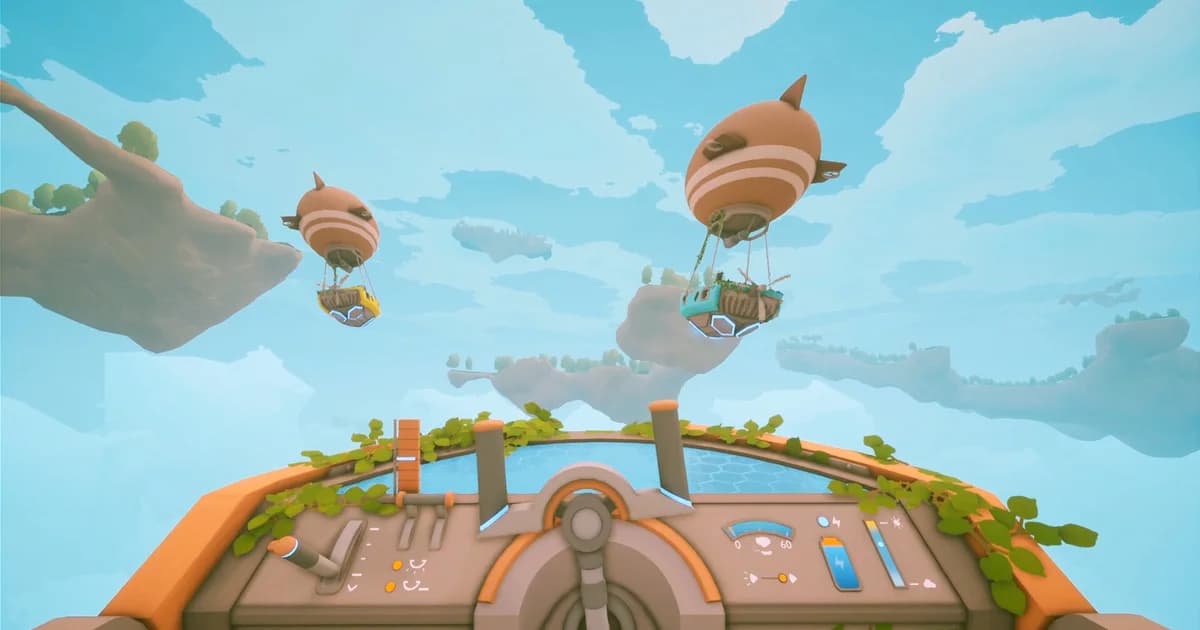
This is a survival-crafting game with no enemies to fight. You land on a floating island, gather resources, build a base, grow food, wire up solar panels and wind turbines, craft an airship, and fly to the next island. The survival pressure is environmental: managing energy output during storms, keeping crops watered, sustaining food supplies. The Steam page sums up the animal side in one line, "There is no exploitation, only coexistence": the animals around you are companions, not resources.
That framing is not a marketing line. It shapes everything: the pacing, the tension points, the type of player who will click with it.
GODEEPER: Windrose is another survival game that leans on environmental systems rather than combat (see how its weather and faction mechanics work before comparing the two. Windrose Beginner Guide) Tips and Best Faction →
Sponsored

The floating island setting actually changes the survival formula
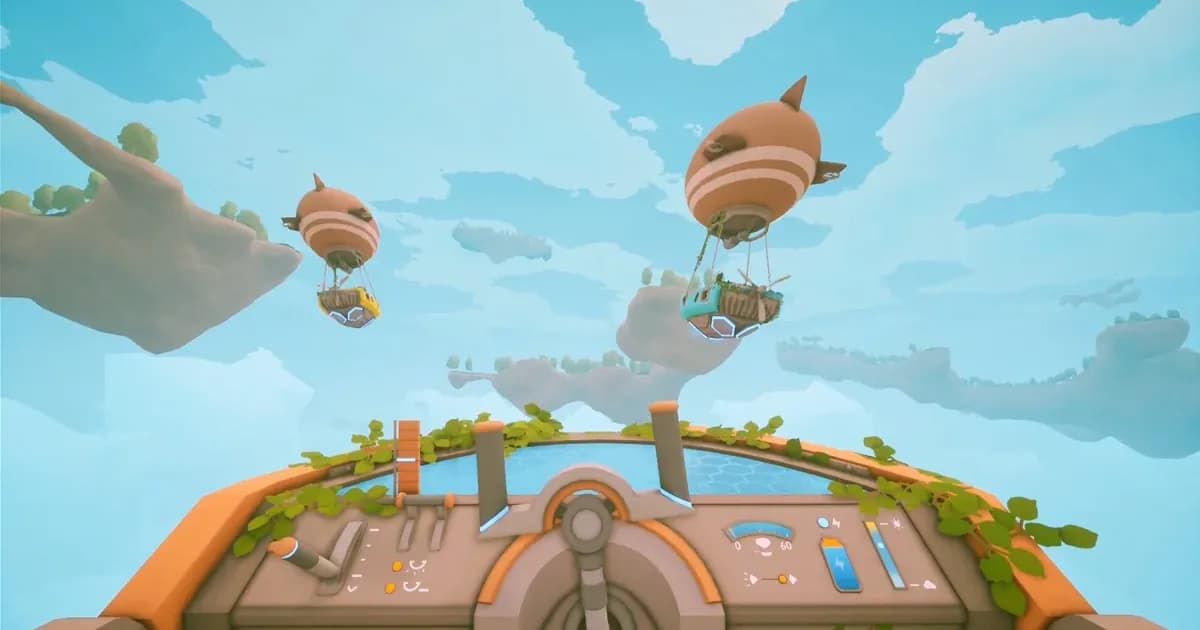
Most survival games use ground-level biomes. You move horizontally: forest to desert to tundra. Solarpunk moves you vertically and discretely: each island is a separate platform in the sky, reachable only by airship. That airship is your own build, not a fast-travel menu.
The island topology forces vertical building -- you're stacking resources, not just spreading outward.
This changes the resource loop in two ways. First, each island has its own profile: you are not carrying everything from everywhere. You go to the island that has what you need, gather, and return. Second, airship travel means your home island matters as a logistics hub in a way that ground-based camps do not. Where you build your base in a typical survival game is about defensibility. Here, it is about distance from resources and prevailing wind patterns for your turbines.
The community comparison to Raft is more accurate than the often-cited Stardew Valley comparison. Raft players will immediately recognize the "home is a moving platform, exploration is the loop" structure, even if the execution is completely different. The Stardew comparison comes from the farming and the non-violent tone, not the mechanics.
The energy system: and why it is the actual heart of the game
Solar panels go dark at night. Wind turbines spin down in still air. Hydraulic generators only run near water. Excess power charges batteries; when the batteries drain, your automation stops.
That fluctuation is designed. Cyberwave built the energy grid so that you have to plan around conditions you cannot fully control. An island in a rain shadow will underproduce solar. A low-altitude island near calm air will kill wind yield. You solve it by diversifying your power mix. That means scouting islands for their conditions before committing to a build location. The airship is not just transport: it is research.
Here is where the Satisfactory comparison the community keeps reaching for lands correctly. The pleasure in Satisfactory is not the factory itself: it is the optimization loop. Solarpunk runs a quieter version of the same drug.
Whether the loop holds for 30 hours or 80 is where Steam reviewers split. One positive review with 25 hours sums it up as "a 20+ hour loop of pick stuff up, combine it with other stuff" and says the aesthetic is what carries it. One of the most upvoted negative reviews, from a self-described target player, calls it "Grinding to Pad Playtime: The Game." The free demo is the cheapest way to find out which side you land on.
GODEEPER: If you're drawn to the automation and logistics angle, Shapez 2's 1.0 launch has a similar optimization-focused loop worth reading about. Shapez 2 Tips Guide for Beginners →
The dual progression system: the part most guides skip
Here is the thing competitors don't make clear enough, and the reason a lot of players report feeling stuck without knowing why.
Solarpunk runs two parallel progression tracks. The Research Table is what you interact with at your home island workbench. The Traderbot blueprint system is what you unlock by trading resources with the robotic merchant who visits your islands. You need both. If you only push one, your save will hit a wall that isn't explained by the game and isn't obvious from looking at what you've built.
Research Table: eight tiers
The Research Table has eight tiers with a partial ninth. In rough order of what they gate:
- Tier 1: Rain Collector, Well, Chest, Beehive, Bed. The bare minimum to not die on your first island.
- Tier 2: The Furnace. This is the critical gate most players undervalue. The Furnace converts ore, sand, clay, and dirty water into processed materials. Every downstream recipe that involves metal, glass, or purified water depends on it. Unlock this early.
- Tier 3: The Airship Dock. You cannot leave your starting island without it. Everything before Tier 3 is prologue.
- Tier 4: Glass and greenhouse construction. Relevant when you're ready to move food production indoors and stop weather-gating your crops.
- Tiers 5-7: Farming systems, animal husbandry, cooking. The Seedspack at Tier 6 is transformative: it lets you create seeds rather than depending on what naturally spawns on an island. Before Seedspack, you are scavenging. After it, you are farming.
- Tier 8: Mostly cosmetic, plus advanced cooking recipes. Pizza is gated here, which matters because it unlocks the final Traderbot blueprints.
Traderbot blueprints: the energy and automation track
The Traderbot is not a vending machine. It's the second half of the progression system. Trading resources with it unlocks Energy Workbench access, silicon production (via quartz), battery storage, automation modules, and advanced dock upgrades that expand your airship range.
If you want the exact research order behind that loop, the Solarpunk progression guide maps the mid-game gates in detail.
The recommended order if you're early in a save: take Energy Workbench first, produce silicon immediately, then prioritize Battery before Animal Transport unless your base is already running stable solar. Skipping Battery when you have power fluctuation creates the kind of failure that looks like a bug but is actually a design consequence: your automation stops without warning during storms and you don't have enough reserve charge to ride it out.
The islands themselves also gate certain crops. Wheat and Sunflowers only grow on specific islands, which you can only reach after Tier 3 Airship upgrades. This creates a bottleneck most players hit around hour 8-12: you need those crops for Research Table tiers 5 and 6, but reaching the islands that have them requires Airship range upgrades that are themselves Traderbot blueprints. It's a deliberate loop, not a bug. Most players who hit it assume they missed something. You didn't. The game just doesn't tell you.
Animal husbandry: what the happiness loop actually does
The game describes animals as companions, which is mostly true, but they're also a production system that most reviews undersell.
You discover animals on sky islands and transport them to your home base. Each animal has two tracked stats: hunger and happiness. When both are high enough, animals produce items passively. The example Cyberwave uses in their own documentation is the pig: a well-fed, content pig will dig up truffles without being prompted. The truffle is not decorative. It's a cooking ingredient tied to late-tier recipes.
Other animals follow similar logic. You're not farming them in the industrial sense: you're creating conditions they like (food sources nearby, appropriate shelter, no crowding) and waiting. The happiness stat climbs slowly, so the payoff is mid-game rather than early-game.
The animals stay a production mechanic: there is no relationship system, no pet interaction, no response beyond producing items. You can't pet them. They don't react to you specifically. If you want animal companions in the Stardew Valley emotional sense, these aren't that. If you want a passive production loop that rewards base layout planning, they are exactly that.
Animal husbandry in Solarpunk is an automation system with a pastoral coat on. If you walked in wanting a production loop, that's what you'll find. If you wanted a relationship, you'll be a little disappointed that the pigs don't even notice you're there.
The Solarpunk base layout guide goes deeper on the space and power planning that keeps this loop manageable.
Co-op: up to 4 players, but read the fine print
Four-player online co-op, each player with a separate inventory and airship. No shared resource pool means no single player bottlenecking the group's supplies. Update 1.3.0 removes the non-shared worlds feature, but its official posts do not document whether that changes the inventory or airship rules described here. In theory, that is smart design: it prevents the "one person does all the farming while others explore" dynamic that kills co-op games.
Co-op sessions up to 4 players share the same island but work different zones -- the energy grid connects them.
At launch there was no cross-play. Update 1.3.0 now adds crossplay to Steam with invite codes, an in-game player list, host kick and ban controls, and an updated multiplayer UI. Every player must use the same version. Console versions are still waiting for platform-holder approval and rollout as of October 1, 2026, and the official posts give no exact date.
What Cyberwave got right that most cozy survival games miss
The "cozy" label in games has become a catch-all for "lower stakes," which usually means "lower depth." Solarpunk's resistance to combat is a genuine design philosophy, not a difficulty reduction. The stakes are just different: resource scarcity, weather unpredictability, energy management failure. The game can stress you out: just not through combat.
That is unusual. Most games that strip combat replace it with nothing. Cyberwave replaced it with logistics. Whether you find logistics relaxing or stressful depends on your personality, which is exactly the kind of honest mismatch the demo exists to reveal.
The game launches in 14 languages. For a two-person studio that is not nothing: rokaplay (the publisher, based in Darmstadt) clearly put budget behind this launch, not just a logo on the box.
Where Solarpunk falls short
The game's critical reception is mixed in a specific way: early players love it, longer-session players find the cracks. Metacritic's critic average sits in the mid-60s, below the Steam figure. The pattern is consistent across the critics: island variety runs thin past 20 hours, the survival tension loosens as automation scales up, and the narrative framing that makes the first hours feel meaningful doesn't compound into anything.
The 12-island ceiling. The game world has approximately 12 islands. That's the hard boundary of the map. For the first 15 hours this feels like plenty: each island holds unique resources, and reaching them requires meaningful Airship upgrade investment. After hour 20, when most of those islands are stripped of discoverable content and your automation loop is feeding the base, the map feels static in a way that open-world survival games don't. Once you've harvested a zone, there's no mechanic drawing you back. Raft handles this with moving narrative momentum. Valheim handles it with biome-specific combat progression. Solarpunk handles it with decoration and crop farming, which is satisfying for a specific kind of player and genuinely thin for another.
The automation ceiling compared to genre peers. The drone and logistics systems work, and for a two-person studio the implementation is genuinely impressive. But the automation complexity has a ceiling, and you hit it before hour 30. In Factorio or Shapez 2, faster machines unlock harder optimization problems, which unlock more complex layouts. That compounding is the loop. Solarpunk's version plateaus: your most efficient setup doesn't expose a harder version of itself underneath. You've solved it, and the game just... sits there. That's a scope call, not a bug. But it will matter to you or it won't.
The Switch 2 version's multiplayer doesn't work reliably. Multiple launch-month reviews flag it, and Cyberwave hadn't pushed a fix as of early July. If Switch 2 is your platform for this, don't buy it for co-op yet. PC, PS5, and Xbox Series are fine.
The no cross-play issue was concrete at launch, but it is no longer a current Steam limitation. Console versions are still waiting for platform-holder approval and rollout as of October 1, 2026, so a split-platform group should check which build each player has before planning a session.
Steam's Very Positive rating tells you most players get enough from the first 20 hours to recommend it. It also tells you it's not the kind of game that converts everyone into evangelists. The players who stay are optimization and logistics fans who find the energy grid endlessly tweakable. The ones who leave wanted Raft-level variety and more to do once the islands are mapped. One reviewer who plays with a partner lists the friction plainly: animals "can randomly get stuck", inventory space is tight, and you can't pause even offline.
The free Steam demo exists precisely to answer which player you are. If the first two hours of the demo feel like a good kind of puzzle, you're the target audience. If they feel like a chore, the late game won't fix that.
For a gentler opening route, the Solarpunk beginner tips guide covers the first session before the deeper progression systems arrive.
Solarpunk game review: verdict
Who it suits: players who want cozy logistics with no combat and are happy to tune an energy grid for its own sake, and co-op pairs with a less experienced partner. One reviewer playing with a little sister who is "not a gamer at all" says she picked up building and farming fast. The polish from two people after four years is real, and Xbox Game Pass subscribers can try it at no extra cost.
Who should wait: players whose threshold is late-game depth or story. The late game is thinner than the trailers suggested, the narrative doesn't develop beyond the environmental premise, and the critics' mid-60s average comes from reviewers who got past the first 20 hours. Switch 2 players who want co-op should hold off too. If you're unsure, the free Steam demo answers the question before you spend anything.
Key Takeaways
- Zero combat: pressure comes from energy, food, and weather management
- Up to 4 players co-op; Steam crossplay is live in 1.3.0 while console rollout is pending
- Energy system uses solar, wind, and hydraulic with weather fluctuation
- Transport drone automation reduces repetitive tasks
- Free demo available on Steam before committing
- Available on Xbox Game Pass day one
- The floating-island airship loop resembles Raft more than Stardew
- Long-term depth is the open question: check the demo to gauge pacing
Related Reading
- Farm to Table Early Access (Is It Worth Buying?) another farming-adjacent early access launch from 2026 with a similar audience overlap.
- Outbound Review 2026: van-based survival with a logistics and co-op focus that shares Solarpunk's co-op design sensibility.
- Best Indie Games Under $20 in 2026: budget picks across genres for players who want value before committing to full price.
- Subnautica 2 Early Access Launch (Details and Price) the other big survival launch of 2026; useful for comparison shopping.
- Mina the Hollower Review: Yacht Club's Gothic New World: Mina the Hollower review: Yacht Club's six-year gothic action-adventure at $19.99. Harder than Shovel Knight, denser than it....
- Cursemark Review: A Roguelite Built Around Rune Depth (2026): Cursemark review: 87% positive on Steam, 7 spell schools and rune-driven builds. CLYDE games hits Early Access with a strong foundation.
- Solarpunk Tips: 9 Things Every New Player Must Know: Solarpunk tips for beginners: 9 things Cyberwave's floating-island survival doesn't explain upfront.
- Solarpunk Base Layout Guide: Animal Care and Zoning 2026: Solarpunk base layout guide: how animal needs, power zoning, and automation placement shape a thriving.
- Solarpunk Progression Guide: Mid to Late Game 2026: Solarpunk progression guide covering research tree tiers 4-8, when to automate, how to scale past.
References
- Solarpunk on Steam
- rokaplay official Solarpunk page
- Gematsu: Solarpunk launches June 8
- dropreference.com: Solarpunk June 8 feature rundown
- Solarpunk on Loaded (sponsored): $18.59 vs Steam's $22.99, same key
Frequently Asked Questions
Is Solarpunk the game on Xbox Game Pass? Yes. Solarpunk launches June 8, 2026 on Xbox Game Pass. It is also available on Steam, Epic, GOG, PS5, and Switch 2.
How many players can play Solarpunk co-op? Up to 4 players can play online. Update 1.3.0 adds Steam crossplay, but every player must use the same version; console versions await approval and rollout as of October 1, 2026. The update removes non-shared worlds, but its notes do not document changes to inventory or airship ownership.
Is there combat in Solarpunk? No. The game has zero combat. Pressure comes from energy management, food, and weather: not enemies.
What kind of energy system does Solarpunk have? Solar panels, wind turbines, and hydraulic generators, with battery storage and wireless power distribution. Weather affects output, so diversifying your energy mix is part of the strategy.
How big is the Solarpunk map? Approximately 12 floating islands explored by personal airship, each with a distinct resource profile. A free Steam demo is available to gauge pace before buying.
Who developed Solarpunk? Cyberwave, a two-person studio, after four years of development. Published by rokaplay.
Does Solarpunk have automation? Yes: transport drones automate resource gathering and crop watering.
About the author

Indie & JRPG Desk
GameBrief's byline for indie, JRPG, visual novel and cozy games. Warm, direct, and willing to say which one to buy.
- Indie, JRPG and visual novels
- Early access and survival
- Sources listed per article
Keep reading
Solarpunk Tips: 9 Things Every New Player Must Know
General · 9 min
Solarpunk Base Layout Guide: Animal Care and Zoning 2026
General · 10 min
Solarpunk Progression Guide: Mid to Late Game 2026
General · 10 min
Solarpunk update 1.3.0 adds crossplay and Lost Cargo
News · 5 min
Solarpunk Roadmap 2026: What Comes After Update 1.3.0
Guides · 8 min
Fatekeeper Review: Buy the Early Access Now or Wait for 1.0?
Reviews · 10 min
Sponsored
Disclaimer
This article is published for informational and entertainment purposes. It does not constitute professional financial, legal, or technical advice. Game performance, online services, patch schedules, and store listings change. Verify critical details (pricing, system requirements, regional availability) with publishers and storefronts before you buy. Affiliate links, where present, help support our editorial work and are labelled in our affiliate disclosure.
Comments
Loading comments…