
ReviewKusan: City of Wolves
Kusan Review: City of Wolves, 54 Stages, One Life Per Room
Kusan review: CIRCLEfromDOT's top-down hardcore shooter launched on PC July 30. One-hit death, War Hand parry upgrades, Korean hip-hop by Loptimist.
Kusan: City of Wolves is a Kusan review of the kind that either excites you or bounces off immediately: one-hit death, 54 stages, a parry mechanic you'll fail hundreds of times before it clicks.
Sponsored

About the game
Kusan: City of Wolves
CIRCLEfromDOT · PQube
Pros
- 54 stages with distinct layouts and escalating mechanical demands
- War Hand parry system creates a real skill loop rather than just shoot-and-dodge
- Bolts economy rewards chaining kills and parries, not just surviving
- Loptimist's Korean hip-hop soundtrack keeps the rhythm when the gameplay already has one
- Pixel art city is dense and specific, not generic cyberpunk neon filler
Cons
- One-hit death will filter out a significant portion of potential players immediately
- Pre-release: final balance and all 54 stages not verified against launch build
Verdict
A hard-edged top-down shooter that earns its difficulty rather than hiding behind it. The War Hand loop is the reason to stay past the initial wall.
CIRCLEfromDOT is a Korean studio. PQube is handling publishing duties. The game launched July 30, 2026 on Steam, PS5, Xbox Series X|S, and Nintendo Switch simultaneously.
Updated 2026-10-14: We removed the review score and the claims that this review was based on a pre-release build we played. Nobody on staff played Kusan; this review rests on the store page, trailers, patch notes and player reports.
TL;DR: Kusan is a hardcore top-down shooter with one-hit death across 54 stages. The War Hand parry system and Bolts upgrade loop give it a skill ceiling that Hotline Miami comparison alone undersells. Loptimist's Korean hip-hop soundtrack carries the vibe when the gameplay is already working. Not for players who want a difficulty slider. Launch date: July 30, 2026.
BESTPRICE: Want Kusan: City of Wolves? Eneba sells a Steam key: Buy on Eneba →
Kusan review: what is this game? (quick answer)
You play Jin. Ex-soldier, gun-for-hire, operating in a pixel art city drenched in rain and neon and corrupt power structures. The job is to find Haru, a girl who's had a city-grade atomic weapon fitted to her by people who had their reasons. The story delivers through comic-panel cutscenes between stages, sharp-framed and paced fast enough that you want to read them rather than skip.
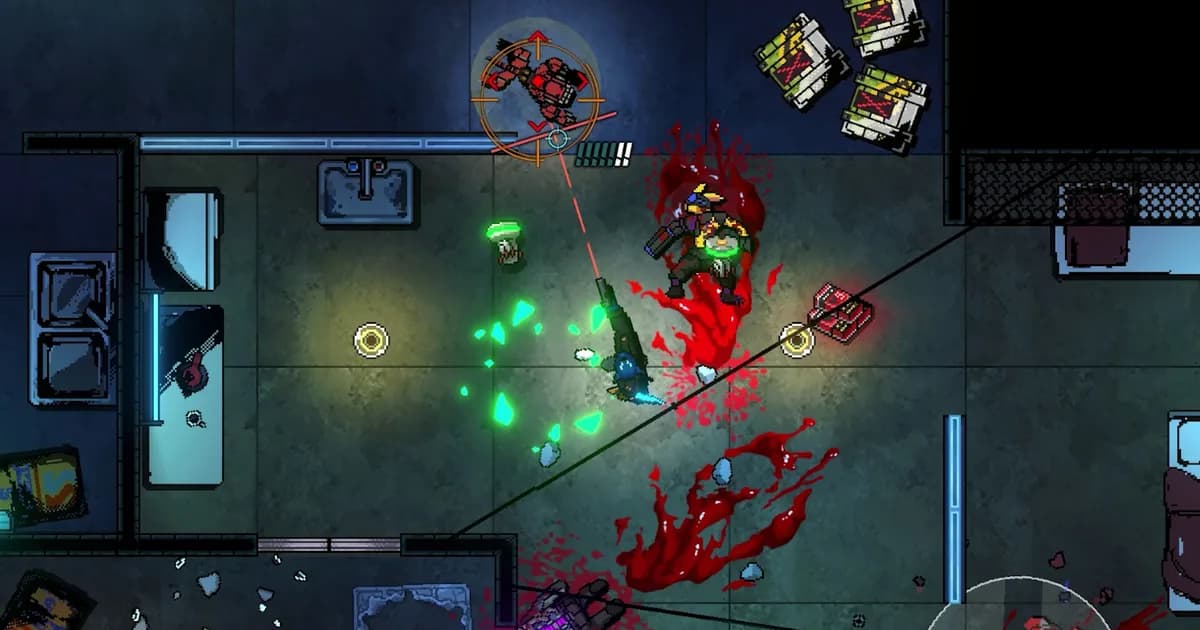
The gameplay is top-down combat in arena stages. Every enemy can kill you in one hit. You can also kill every enemy in one hit. That symmetry is the whole design. You die learning a stage's layout, then you run it again with that knowledge, then you chain the kills and parries clean enough to hit S-rank if that's what you're after.
Sponsored

Key takeaways
- Top-down hardcore action, one-hit death throughout
- 54 stages across multiple chapters, S-rank targets per stage
- War Hand parry system: parries and kill chains earn Bolts for upgrades
- Firearms and blade loadouts unlocked through War Hand progression
- Boss fights built around learning "distinctive mechanics and high-stakes patterns"
- Korean hip-hop soundtrack by Loptimist
- Developer: CIRCLEfromDOT | Publisher: PQube
- Released July 30, 2026 on PC, PS5, Xbox Series X|S, and Nintendo Switch simultaneously
Current status: September 2026
Kusan launched on July 30 and is no longer a preview-only purchase. The Steam snapshot checked for this audit lists a $14.99 base price and Very Positive reviews, with 303 positive and 31 negative reviews in the current review endpoint. Official Patch 1 and Hotfixes 2 through 4 added readability, Limbus, balance, audio, and achievement fixes; Hotfix #4 on September 10 fixed the Error 404: Chains not Found achievement, and the developer announced a public playtest for further visual-clarity changes.
Gameplay
The War Hand is what stops Kusan from being a Hotline Miami comparison and nothing more. In Hotline Miami, you're mostly outrunning chaos. In Kusan, the parry system creates a deliberate rhythm inside the chaos. When you hit a parry, the stage slows for a beat, and if you chain the following kill correctly, you earn Bolts. Bolts fund War Hand upgrades and unlock the firearms and blades that expand your options in later stages.
That loop, parry into kill into Bolts into upgrade, doesn't happen automatically. You're playing a specific way to access it. Early stages teach you the pattern through failure: die without parrying, notice you came out with no Bolts, try again with the parry earlier. By the time you've cleared a stage at S-rank, the timing is ingrained.
That execution-first loop sits closer to the hard-edged side of the indie action spectrum than a comfort roguelite. Players comparing it with other punishing releases can use the Killer Bean Early Access breakdown as a useful contrast in how different games handle repeated attempts.
The corridor design keeps combat readable even when multiple enemies are in play. Distance and angle matter before the first shot.
The 54 stages aren't all the same type. CIRCLEfromDOT builds in skill-based puzzles and specific challenges alongside the combat arenas. Some stages test execution precision. Others test routing, whether you know which enemy to hit first to keep the chain alive. That variance prevents the design from going completely numb after the first dozen stages.
The one-hit death rule holds throughout. There's no health bar and no mid-stage checkpoint. This isn't a game that lets you limp through a stage half-injured. You either run it cleanly or you start over.
GODEEPER: Hotline Miami veterans who want more structure than pure chaos: RUINER is on sale during Steam Cyberpunk Fest →
Bosses and escalation
The boss encounters are designed around learning a specific pattern rather than surviving randomized pressure. CIRCLEfromDOT describes them as bosses with "distinctive mechanics and high-stakes patterns". Each boss introduces a new rule for how combat works in that encounter, something that doesn't appear in the regular stages.
The cinematic presentation during bosses earns the use of that word. Comic-panel framing, motion lines, specific camera choices that emphasize the height difference between Jin and the enemies he's fighting. It doesn't interrupt the flow; it compresses it.
The comic-panel framing appears during boss introductions. It's stylized but doesn't extend long enough to become a load screen in disguise.
Presentation
Loptimist's soundtrack is a genuine asset. Korean hip-hop with heavy 808 bass and head-nodding loops, and it fits the game's rhythm rather than working against it. When the gameplay is clicking and the parries are landing and the chain is building, the soundtrack and the gameplay tempo align in a way that pushes pace instead of commenting on it.
The pixel art city looks lived-in. Kusan doesn't lean on generic neon aesthetics to signal cyberpunk. The environments have specific visual details: rain on surfaces, architecture with actual depth, lighting that comes from sources rather than floating ambiance. For a top-down game where most of what you see is the floor and the characters, the background design does more work than it had to.
GODEEPER: Another 2026 indie that builds its visual identity around lived-in specificity rather than genre shorthand: Security 51 Review →
Kusan review verdict
The Kusan review verdict: the core loop is credible and the difficulty is built in rather than arbitrary. One-hit death is the design, not a mode you toggle on to make things harder. If you want to engage with Kusan on its terms, the War Hand system gives you real skill expression, the Bolts economy rewards execution over pure luck, and the soundtrack keeps the energy when the gameplay already has it.
What the sources can't settle: final balance across all 54 stages, whether late-game loadout variety actually changes how you approach different stage types, and whether the story resolves in a way that justifies following it.
For readers weighing the $14.99 launch price against other compact action games, the best indie games under $20, Killer Bean review, and Tactical Breach Wizards review offer useful comparison points on scope and replay value.
Related Reading
- RUINER Review 2017 (still the genre benchmark): RUINER is in this year's Cyberpunk Fest sale and competes directly with Kusan's audience
- Security 51 Review 2026: atmospheric horror checkpoint sim by Alawar, also launching the same week on July 27
- DRG Rogue Core Early Access State July 2026: if co-op pressure suits you better than solo perfectionists runs
- Solarpunk Game Review: Floating Island Survival 2026: floating-island survival at 81% positive on Steam, with a dual research-table and Traderbot system across 12 islands.
References
- Kusan: City of Wolves on Steam: official store page with trailer and launch date
- Kusan official announcements: Patch 1 and Hotfixes 2 through 4
- PQube official site: publisher page with Kusan press materials
- Loptimist on official channels: Korean hip-hop artist credited in Steam description for the Kusan OST
- Kusan: City of Wolves - Official Launch Trailer: PQube's own YouTube channel, posted at launch
Frequently Asked Questions
What is Kusan: City of Wolves? Kusan is a hardcore top-down shooter by CIRCLEfromDOT, published by PQube. You play Jin, an ex-soldier navigating 54 stages through a rain-soaked pixel art city to save a girl named Haru who's been fitted with a city-scale weapon. One hit kills you.
Is Kusan: City of Wolves like Hotline Miami? Closer to Hotline Miami than most top-down shooters. Both use one-hit death and room-clearing design. Kusan adds the War Hand parry system, Bolts upgrades, and a heavier emphasis on chaining kills for economy. Kusan is slightly more deliberate and less chaotic.
When did Kusan: City of Wolves come out? Kusan: City of Wolves launched July 30, 2026 on PC (Steam), PlayStation 5, Xbox Series X|S, and Nintendo Switch simultaneously. Physical editions ship for PS5 and Switch. Developer CIRCLEfromDOT; publisher PQube.
How many stages does Kusan have? 54 stages across multiple chapters. Each stage has an S-rank time target for completionists. The design includes skill-based puzzles and challenges alongside the main combat arenas.
What is the War Hand in Kusan? The War Hand is Kusan's primary parry and upgrade mechanic. Successful parries and kill chains earn Bolts, which you spend to upgrade the War Hand and unlock new firearms and blades. It's the main progression loop between combat stages.
Is Kusan: City of Wolves difficult? Very. One hit kills you throughout. There's no health bar, no checkpoint mid-stage, and no difficulty selector. The design assumes you'll die repeatedly learning each stage's layout before clearing it cleanly.
About the author

Indie & JRPG Desk
GameBrief's byline for indie, JRPG, visual novel and cozy games. Warm, direct, and willing to say which one to buy.
- Indie, JRPG and visual novels
- Early access and survival
- Sources listed per article
Keep reading
Corsair Cove Review: Vertical Building After Launch
General · 7 min
Creature Kitchen Review: A Tiny, Overwhelmingly Positive Hit
General · 5 min
Security 51 Review: Papers Please Meets Area 51 Horror
General · 7 min
Palworld Review: Is the 1.0 Worth It, and Who Should Wait?
General · 11 min
Winter Burrow Review: Cozy Survival With Real Depth
Reviews · 9 min
Dinoblade Review: A Souls-Like Where You Play the Monster
General · 8 min
Sponsored
More game deals · affiliate links
Disclaimer
This article is published for informational and entertainment purposes. It does not constitute professional financial, legal, or technical advice. Game performance, online services, patch schedules, and store listings change. Verify critical details (pricing, system requirements, regional availability) with publishers and storefronts before you buy. Affiliate links, where present, help support our editorial work and are labelled in our affiliate disclosure.
Comments
Loading comments…