
GameBrief · General
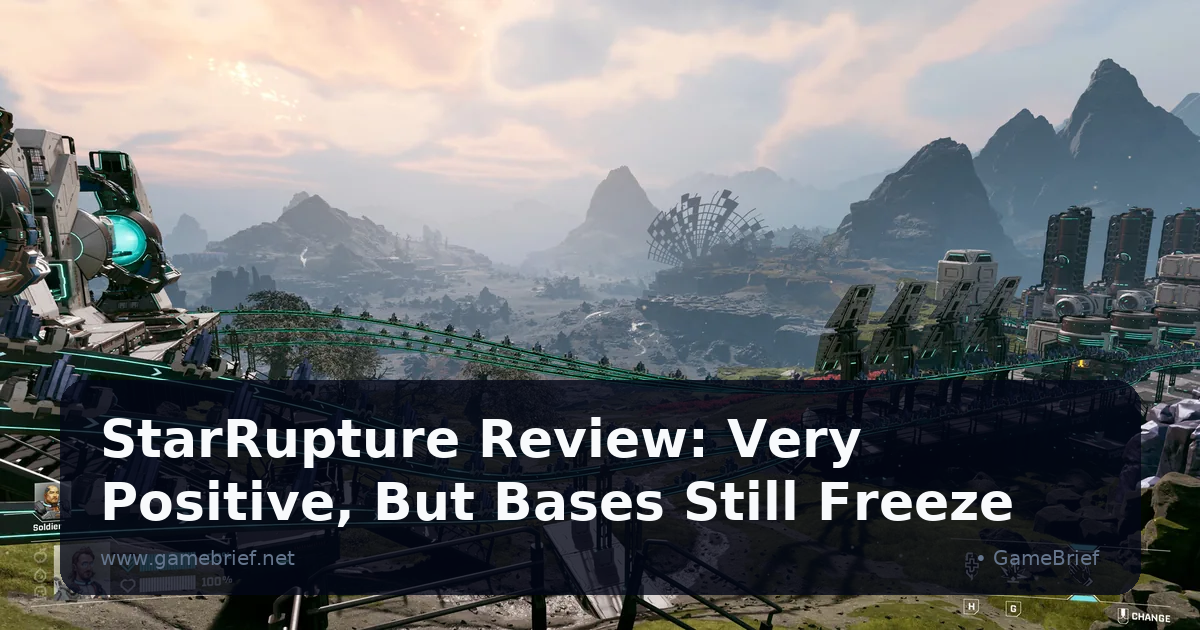
StarRupture Review: Very Positive, But Bases Still Freeze
StarRupture review: Update 2 adds quality-of-life fixes, but large rail-connected bases still carry a serious Early Access performance caveat.
Reviewing
StarRupture
Creepy Jar · Creepy Jar
Score
Reviewed build: Early Access (Update 2, Hotfix 0.3.3)
Pros
- The Fire Wave cataclysm event turns base placement into a real environmental decision, not just a resource-efficiency puzzle
- The rail, drone, and platform power network is genuinely deep once you're past the early hours
- Active post-launch cadence: Update 2 plus official hotfixes through 0.3.3
- Clean 1 to 4-player co-op with dedicated fixes for host/client desync issues
- $19.99 entry price is fair for the amount of system depth on offer
Cons
- Large, rail-connected power networks trigger five to ten second freezes that seven hotfixes have not resolved as of late July
- No fast travel and a thin early tech tree slow the first several hours, especially solo
- Multiplayer join bugs (buildings failing to load, autosave freezes) still turning up in community reports
- The late-game rail-freeze complaint remains a community-reported Early Access caveat even after the newer Update 2 cycle
This StarRupture review starts with what January's launch coverage couldn't have seen yet. StarRupture launched into Early Access on January 6, 2026, and the earliest reviews agreed on one thing: performance held up, even with several bases running side by side. Through late July, r/StarRuptureGame filled with the same complaint: place one more rail segment on a large, power-connected base, and the game locks up for five to ten seconds while it recalculates the network. That remains a community report rather than a developer-confirmed diagnosis. The current-status block below updates the older 0.2.8 snapshot with Update 2 and Hotfix 0.3.3; the review's performance caveat is still about what can happen at scale, not a claim that every current player sees the same freeze.
Current status: September 2026
Steam currently lists StarRupture at $19.99 with 81% positive English reviews from 6,909 reviewers and 74% positive recent English reviews from 301 reviewers. It remains a Windows-only Early Access game with solo or four-player online co-op; the store's Early Access notes target a full release in 2027. Creepy Jar's official feed now lists Update 2's quality-of-life release and Hotfix 0.3.3. The rail-connected base freeze remains a community-reported caveat in this review, not an official statement that Update 2 failed to fix a specific bug.
Key Takeaways
- Released January 6, 2026 into Steam Early Access. Developed and published by Creepy Jar, the Polish studio behind 2019's Green Hell
- $19.99 on Steam, no permanent discount as of this review, though it appeared in a July IndieGala bundle sale at 25% off
- Very Positive on Steam: 81% of 6,909 English reviews are positive, with recent English reviews at 74% of 301
- Solo or online co-op for up to 4 players; first-person open-world base-building with combat and exploration
- Update 2 is live, with the official feed showing Hotfix 0.3.3 as the current visible hotfix
- A rail-network power freeze on large bases remains a community-reported caveat; this review does not treat it as a universally reproduced or officially confirmed defect
StarRupture Review: Overview
Creepy Jar's first game, Green Hell, was a slow-burn survival sim about a man alone in the Amazon. StarRupture keeps the survival bones but rebuilds everything else around industrial scale: instead of one person and a machete, you're dropped onto a hostile alien world with a base-building toolkit meant to eventually support sprawling, rail-connected factories, solo or with up to three co-op partners. If you are comparing the current survival-builder field, our Abiotic Factor complete guide, Valheim Deep North guide, and Windrose ship-building guide cover different answers to the same exploration-and-production problem.
The pitch, per the Steam page, is "explore, build, and fight" on a planet that reshapes itself through recurring elemental cataclysms. That third element, Fight, matters more here than in most automation games. Alien creature swarms threaten bases directly, and Creepy Jar's own Update 1 launch trailer leans hard into that combat side rather than treating it as a side system bolted onto a builder. The Scrap Mechanic review is a useful contrast: it puts building first and combat much further down the priority list.
At $19.99, StarRupture sits in the same bracket as most single-studio survival builders this year (it's Palworld's base price too, before its own post-launch discounting). That's a reasonable ask for a genre where the real content, automation depth and endgame systems, only shows up dozens of hours in. Whether that depth is worth the price is where this StarRupture review starts to disagree with January's launch-week coverage. The Subnautica 2 base-building guide is another comparison point for readers who prefer discovery and habitat construction over industrial logistics.
StarRupture Review: Gameplay Breakdown
The core loop runs on three interlocking systems: exploration for blueprints and resources, base construction for automated production, and combat against alien wildlife that escalates as your footprint grows. None of the three is optional. Blueprints gate what you can build, resources gate what you can automate, and combat gates how far you can push into new territory to get more of both. The Timberborn review is a useful counterpoint for readers who want automation without StarRupture's combat layer.
Base construction starts with a Basic Item Printer crafting simple recipes (Basic Building Material, ammo types) from raw resources, and expands into a Rail and Drone network that moves goods between Base Cores automatically. This is the part the game is actually selling: a "pull demand" system where downstream buildings request the resources they need rather than you manually routing every belt. That's a meaningfully different approach than the push-based conveyor systems in genre peers like Satisfactory, and it's also the exact system behind the freeze issue covered below.
Combat runs on a straightforward but tense loop: alien creatures (the game's spider-like Infectors among the more common threats) swarm in packs, apply an "Infection" status that punishes standing in the open, and hit hardest during and after a Fire Wave event.
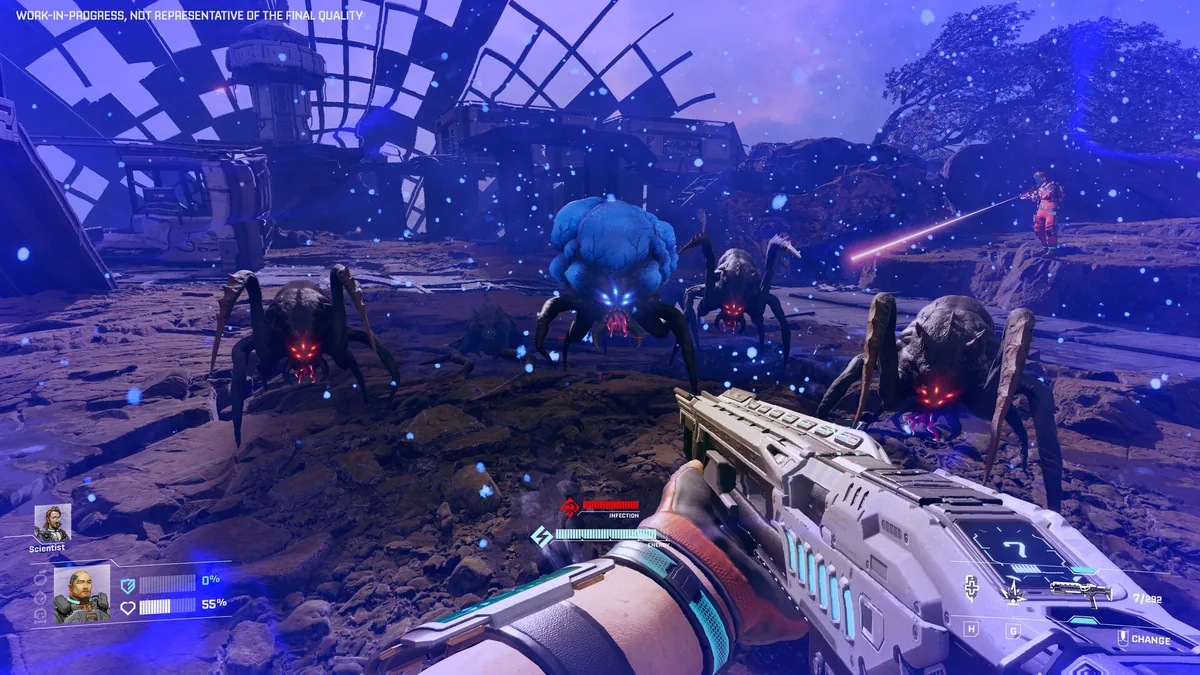 A night-time Infector swarm. The Infection status bar bottom-center is the punishment for standing in the open too long during an encounter like this.
The Fire Wave itself, officially named in Creepy Jar's own patch notes, is a periodic solar eruption that lights up the sky and forces a real decision: shelter in place, reroute power away from exposed Platforms, or push through and risk the creature swarms the event tends to bring with it. It's the single mechanic every one of the January launch reviews called out as the game's best idea, and after seven months it still holds up as the thing StarRupture does that its genre peers don't. Players who prefer a calmer farming-and-factory pace can compare the Timberborn water-mechanics guide.
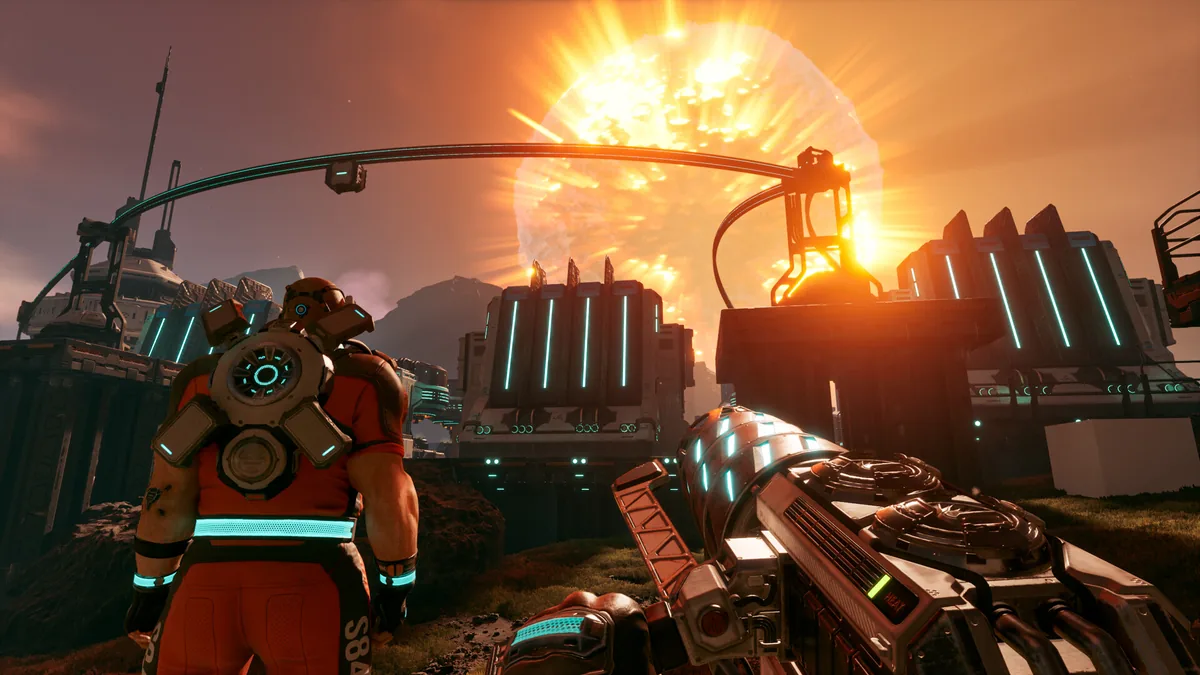 A Fire Wave event mid-eruption. The overhead rail connects two Base Cores, the same rail network tied to the late-game freeze issue below.
Co-op works cleanly at a small scale. Up to four players can share a save, and Creepy Jar has shipped co-op-specific fixes: a Platform power-sync improvement, and a fix for the Zipline Pole's ghost preview visually disconnecting on the client's screen. Both landed in the May 18 hotfix. Community reports from late July still describe join issues on larger, longer-running saves: buildings failing to load in, teleporter names resetting, and autosave triggering a freeze or crash. None of that showed up in January's launch-week reviews, for the simple reason that nobody had a base old enough to hit it yet.
GODEEPER: For a direct look at how another 2026 automation-heavy Early Access title handled its own power and building systems, see our Subnautica 2 deep-sea base guide.
Rubric Assessment
Design Coherence
StarRupture knows what it is: a base-builder that treats its combat and its cataclysm event as core to the loop rather than decoration. The pull-demand rail system and the Fire Wave both reinforce the same idea, that scale creates risk, not just efficiency gains. Where coherence cracks is in the overlap between two systems that weren't designed to interact at the scale players eventually reach: the power network that makes big builds function, and the same network's recalculation cost, which the May 18 hotfix's own "decreased stability cost of Platforms, enabling players to build bigger constructions" change arguably made worse by making bigger builds easier to reach in the first place.
Value per Dollar
At $19.99 with no standard discount, StarRupture is priced in line with genre peers like Palworld and Timberborn at their own Early Access starting points. The automation depth alone (printer recipes, rail routing, drone logistics) justifies the price for anyone who enjoys the genre. The catch: the content you're paying for is exactly the content that currently breaks at scale, so the value proposition depends on Creepy Jar closing that gap.
Onboarding
The early hours are rough in a specific way: the Basic Item Printer's recipe list and the Rail system's pull-demand logic aren't explained with much depth, and January's launch reviews already flagged a shallow early tech tree and no fast travel as pacing problems. Nothing in the patch history since suggests either has changed. Solo players feel this more than co-op groups, since there's no second player to split the early resource grind with.
Technical Quality
This is the dimension that actually separates this StarRupture review from January's. Seven hotfixes shipped between April 22 and June 17, 2026 (0.2.2 through 0.2.8), and the changelogs read almost entirely as stability work: fixed crashes tied to the Fire Wave sequence, fixed crashes tied to Drone movement on Rail Roundabouts, fixed a crash on exiting the game on RTX 40 and 50 series GPUs. That's real, sustained effort. It's also effort that hasn't touched the specific late-game freeze multiple Reddit threads describe as of July 29: placing a new rail segment on a large, power-connected base pausing the game for five to ten seconds while it recalculates the network. One commenter on that thread summarized the community's working theory plainly: "the more platforms you lay down, the more calculations, the more your computer will lag... Creepy Jar will have to do a total rework of how power connects from structure to structure." Creepy Jar hasn't confirmed that specific fix is in progress, and the June 19 dev blog's Update 2 teaser (building copy-paste, a "Drone Roundabout overhaul") doesn't name it directly either.
Replayability
The Fire Wave's escalating unpredictability and the sheer scale a rail network can eventually reach give StarRupture real replay value once you're past onboarding, assuming your save doesn't hit the freeze wall first. Co-op adds a second axis of replayability, since a four-player base grows and specializes differently than a solo one. Whether that holds past the current Early Access build is an open question a seven-month, still-unresolved technical problem can't answer yet.
StarRupture Review Verdict
StarRupture is worth playing right now if you're building solo or in a small group and don't plan to push a base past the point where a full rail grid connects everything you own. Judged purely on its ideas (the Fire Wave event, the pull-demand rail system), it's one of the more distinct Early Access survival builders released this year, and Creepy Jar's patch cadence, a real Update 1 plus seven follow-up hotfixes, shows a studio that's actually reading its bug reports. Judged on whether the late-game experience matches the early-game promise, the answer right now is no. A five-to-ten second freeze every time you expand a connected base isn't a minor annoyance in a genre built around expanding your base. It's a direct tax on the exact activity the game is selling.
This StarRupture review lands where it does specifically because of that split. Recommended for: automation and survival fans comfortable with Early Access rough edges, especially anyone playing co-op. Less certain for: solo players hoping for a smooth 40-hour push toward a maxed-out factory, until Creepy Jar addresses the rail freeze directly.
Rating: 7.3/10
Frequently Asked Questions
Is StarRupture worth buying in Early Access? Yes, for players who want deep automation and don't mind a real technical caveat. Steam currently shows 81% positive English reviews from 6,909 reviewers, but community reports still describe multi-second freezes in large late-game bases.
What causes the freezing and lag in StarRupture? Community reports and Creepy Jar's own patch notes point to the rail-connected power network: every Platform recalculates power draw across the whole connected grid, and that calculation load grows with base size, especially after a May hotfix made big builds cheaper to construct.
Does StarRupture have co-op multiplayer? Yes, up to 4 players online, solo or in a group. Creepy Jar has shipped multiple co-op-specific fixes, including a Platform power-sync fix and a Zipline visual-desync fix for clients, though some join bugs are still reported.
How much does StarRupture cost and is it ever discounted? It's $19.99 on Steam with no permanent discount as of this review. It has appeared in third-party bundle promotions, including a July IndieGala multiplayer sale at 25% off.
What is the Fire Wave in StarRupture? Fire Wave is the game's recurring elemental cataclysm: a solar eruption event that forces players to secure their base and shelter or reroute production before it passes. It's the signature mechanic separating StarRupture from a standard factory builder.
Is StarRupture on Xbox, PlayStation, or Mac? No. As of this review it's Windows-only on Steam, with no Mac, Linux, or console version listed on the store page.
How long is StarRupture? Creepy Jar has not published an official completion estimate. Genre peers often run past 30 hours, but your total depends on base scale, automation goals, and whether you play co-op.
For a look at how another 2026 survival base-builder handled its own Early Access stretch, see the Abiotic Factor complete guide hub. Readers weighing StarRupture against a monster-taming take on the same survival-builder formula can check the Palworld review.
References
- StarRupture on Steam: official store page, current price, and full patch note history
- StarRupture official announcements: Update 2 and the current 0.3.x hotfix feed.
- StarRupture Update 1 Launch Trailer (YouTube, Creepy Jar official)
- Creepy Jar official site: developer press kit, news, and social links
- r/StarRuptureGame: community bug reports, build screenshots, and player discussion
About the author

Senior Critic & Analyst
Former game data analyst turned critic with 11 years covering indie and mid-tier games. Based in Austin. Runs spreadsheets on games most people just play.
- 11 years games criticism
- Former game economy analyst
- Roguelike and strategy specialist
Keep reading

Disclaimer
This article is published for informational and entertainment purposes. It does not constitute professional financial, legal, or technical advice. Game performance, online services, patch schedules, and store listings change. Verify critical details (pricing, system requirements, regional availability) with publishers and storefronts before you buy. Affiliate links, where present, help support our editorial work and are labelled in our affiliate disclosure.
Comments
Loading comments…