
GameBrief · Features
Best Base-Building and Colony Sim Games in 2026: 8 Picks
Best base-building and colony sim games in 2026: Timberborn and Going Medieval lead 8 picks, from proven co-op hits to one reverse city-builder wildcard.
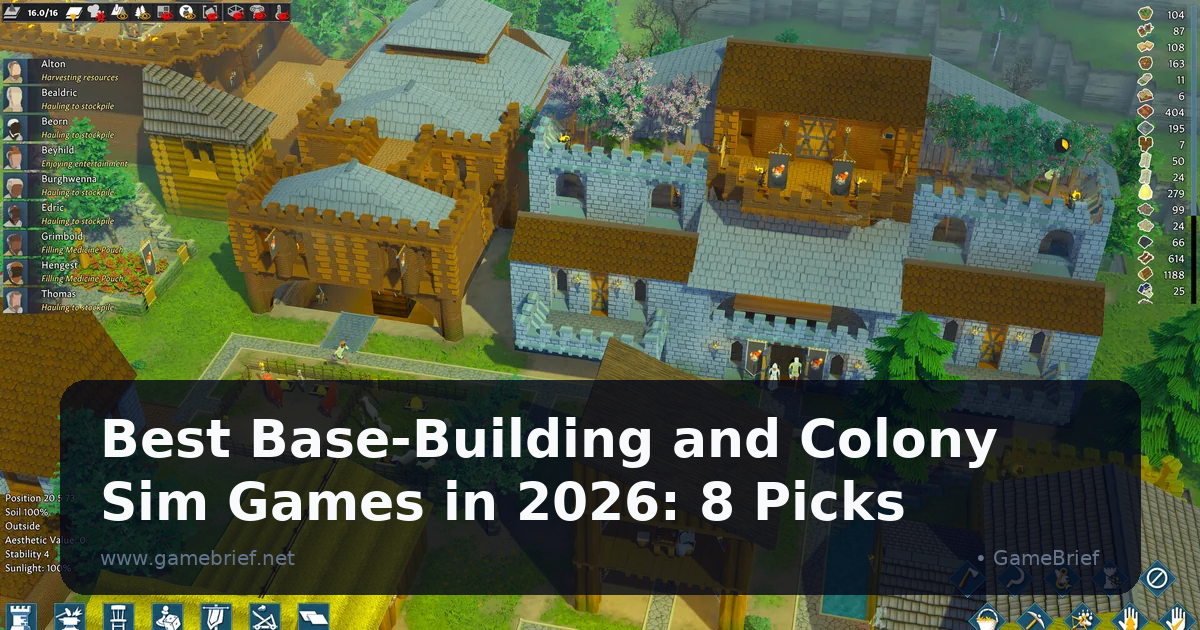
Most "best base-building and colony sim games" roundups this year repeat the same five legacy names and describe each one in a single generic paragraph. This list is different for a specific reason: three of these eight games are ones GameBrief has actually reviewed and run co-op sessions in, including one where our own review is the source for a freeze bug most other outlets haven't caught up to yet. The other five range from the two biggest 2026 releases in the genre to a reverse city-builder most "best of" lists skip entirely because it doesn't fit the mold.
TL;DR: Timberborn (1.0, Overwhelmingly Positive, $34.99 list price) and Going Medieval (1.0 since March 2026, Very Positive, $29.99) are the strongest all-around picks. Against the Storm ($29.99) is the 2023 roguelite classic still worth playing. Romestead ($13.99), Subnautica 2 ($29.99), and StarRupture ($19.99) are GameBrief's own tested Early Access picks. ALL WILL FALL ($29.99 list price) and Terra Nil ($24.99) round out the list with the two most mechanically distinct entries.
Overview: What's the Best Base-Building and Colony Sim Game in 2026? (quick answer)
Timberborn is the strongest all-around pick after its March 2026 1.0 launch added a full automation framework on top of an already-deep water and drought system. Going Medieval, which left Early Access days later that same month, is the closer runner-up for players who want more granular colonist management. Beyond those two, the right pick depends on what you're after: Against the Storm for a roguelite structure, Subnautica 2 or Romestead for co-op, StarRupture if you want factory automation and can tolerate a known late-game bug, and Terra Nil or ALL WILL FALL if you want something the genre doesn't usually attempt.
Current status: September 2026
The biggest change since the original roundup is Timberborn Update 1.1, which went live on September 3 with goods and population statistics, watertight buildings, Tier 4 monuments, a new succulent plant, updated maps, and quality-of-life additions. Steam snapshots at this audit also show the field has shifted in review volume: Going Medieval is Very Positive across 17,000+ reviews, Against the Storm is Overwhelmingly Positive across 19,000+, Subnautica 2 is Very Positive across 71,000+, StarRupture is Very Positive across 12,000+, and Terra Nil is Very Positive across 8,000+. Prices below are standard list prices unless a temporary Steam sale is explicitly called out.
Key Takeaways
- 8 games covered, spanning $13.99 to $34.99 list price, all verified live on Steam at the September 17 audit
- 3 are already reviewed or guided on GameBrief: Timberborn, Romestead, and StarRupture, plus a Subnautica 2 base-building guide
- 5 are fully released 1.0 games (Timberborn, Going Medieval, Against the Storm, ALL WILL FALL, Terra Nil); Romestead, Subnautica 2, and StarRupture are still in Early Access
- Only one, Terra Nil, inverts the genre entirely: you build to restore land, then leave
The proven picks: Timberborn, Going Medieval, and Against the Storm
Timberborn ($34.99) hit 1.0 on March 12, 2026, after roughly four and a half years in Early Access under Polish studio Mechanistry. It sits at Overwhelmingly Positive across more than 40,000 Steam reviews. The premise, beavers rebuilding civilization around vertical terraced districts, does a lot of marketing work on its own, but the actual hook is water: droughts dry up rivers on a cycle, and every dam, levee, and water wheel you place changes where water goes next, sometimes flooding a district you built ten hours earlier. The 1.0 update added a Sensors-Relays-Timers automation framework that turns late-game colonies into genuine logistics puzzles. Our full Timberborn review covers both playable factions and scored it 9.1/10.
Going Medieval ($29.99) left Early Access on March 17, 2026, after several years of community-driven updates, with Foxy Voxel reporting over 1 million units sold before 1.0 even shipped. It's a castle-and-settlement builder in the RimWorld mold: you're reclaiming land from overgrown wilderness, managing colonists with individual skills and moods, and building vertically into cliffs and hillsides using a full layer-by-layer construction system. It holds Very Positive across more than 17,000 reviews. If Timberborn's water puzzle isn't your thing, this is the deepest colonist-management alternative currently at 1.0.
Against the Storm ($29.99) is the oldest game on this list, having left Early Access in December 2023, and it's still here because nothing newer has matched it. Eremite Games built a roguelite city builder around apocalyptic rain cycles: you rebuild settlements across repeated "reclamation" runs as the Queen's Viceroy, leading five distinct species, humans, beavers, lizards, foxes, and harpies, each with different production bonuses and resource needs. It holds Overwhelmingly Positive across more than 19,000 reviews and a 91 Metascore. The run-based structure means a bad settlement doesn't cost you the whole campaign, which makes it a genuinely different pacing option from the other seven picks here.
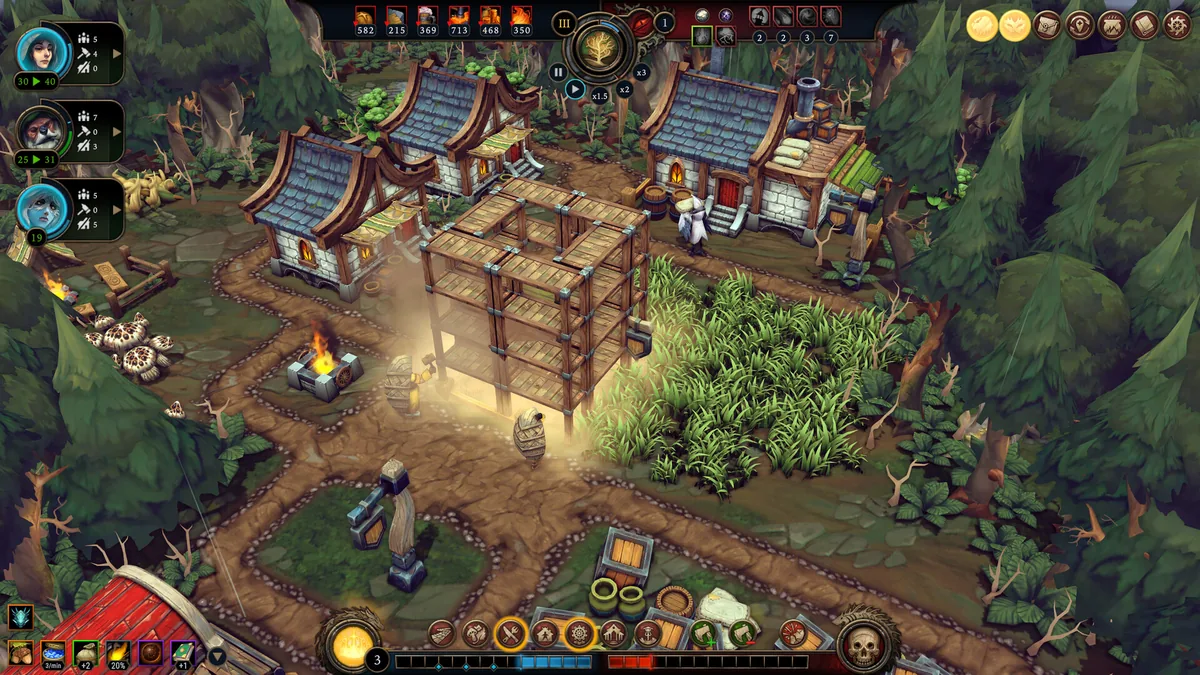 Against the Storm's construction sites stay half-built and vulnerable until you commit the resources to finish them, part of what makes each reclamation run feel like a real gamble.
GODEEPER: If Timberborn's automation framework is the part that hooked you, the genre goes deeper than colony sims. Best Indie Automation and Logistics Games (Steam Train Fest 2026) →
GameBrief-tested: Romestead, Subnautica 2, and StarRupture
These three are all still in Early Access, and all three are games we've spent real hours in ourselves, not just summarized from a store page.
Romestead ($13.99) by Beartwigs is the cheapest entry on this list and the one built hardest around co-op: up to 8 players can share a village, assign villagers to professions, and defend against night raids together. It sits at Mostly Positive across roughly 4,600 reviews, which tracks with a game still filling out its Early Access roadmap, and our Romestead early access review scored it 7.5/10, flagging the same thing the review counts suggest: strong bones, rougher edges than the two 1.0 games above.
Subnautica 2 ($29.99) entered Early Access May 14, 2026 and sits at Very Positive across more than 71,000 reviews, the largest player base on this list by a wide margin. It's base-building turned vertical and submerged: habitat modules have to account for depth pressure, oxygen routing, and creature threats in a way no surface colony sim has to think about. Our Subnautica 2 base-building guide covers module placement and the deeper mechanics the tutorial doesn't fully explain.
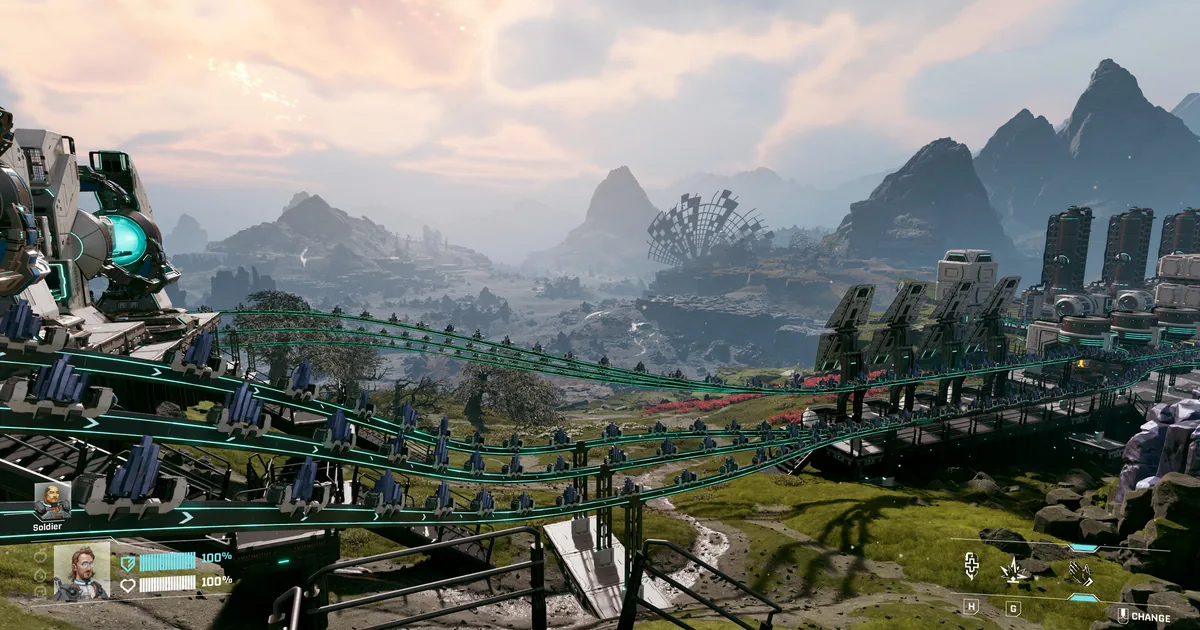
StarRupture ($19.99) by Creepy Jar (the Green Hell studio) entered Early Access January 6, 2026 and holds Very Positive across more than 12,000 reviews. Its hook is a rail, drone, and platform power network layered under a recurring Fire Wave cataclysm event that forces you to secure or reroute production before it hits. The catch, and this is something our own testing caught that most coverage of the game hasn't: once a rail-connected base grows large, placing a new segment can trigger a five-to-ten-second freeze while the game recalculates the whole power network. Seven stability hotfixes between April and June hadn't resolved it as of our StarRupture review, which scored it 7.3/10. Worth buying, not worth ignoring the caveat.
The newer and stranger picks: ALL WILL FALL and Terra Nil
ALL WILL FALL ($29.99) by All Parts Connected, published by tinyBuild, released April 3, 2026 and sits at Mostly Positive across roughly 1,300 reviews so far. It's an ocean-city survival builder, but the mechanic that separates it from everything else on this list is a real-time physics simulation: every beam, platform, and bridge tracks weight distribution, tension, and material strength, and an overloaded structure doesn't just fail instantly. It shows you a countdown, in in-game hours, before the collapse actually happens, then brings down a chain reaction of anything attached to it if you don't reinforce it in time. That's a meaningfully different tension from every other base builder here, where a bad build just sits there looking fine forever. Limbic's Corsair Cove takes vertical building even further in the same spirit, building pirate colonies directly onto cliff-faces instead of flat ground, though it launched on Game Pass rather than Steam Early Access.
Terra Nil ($24.99) by Free Lives and Clockwork Acorn, published by Devolver Digital, has been out since March 2023 and holds Very Positive across more than 8,000 reviews. It earns its spot as the deliberate outlier: instead of building a permanent settlement, you're placing purifiers, wind turbines, and foliators to detoxify soil, clean oceans, and reintroduce wildlife to a dead map, and the win condition is packing everything up and leaving without a trace. Most "best colony sim" lists skip it because it doesn't have a base you defend or grow forever. That's exactly why it belongs here: it's the one game that questions the genre's core assumption instead of extending it.
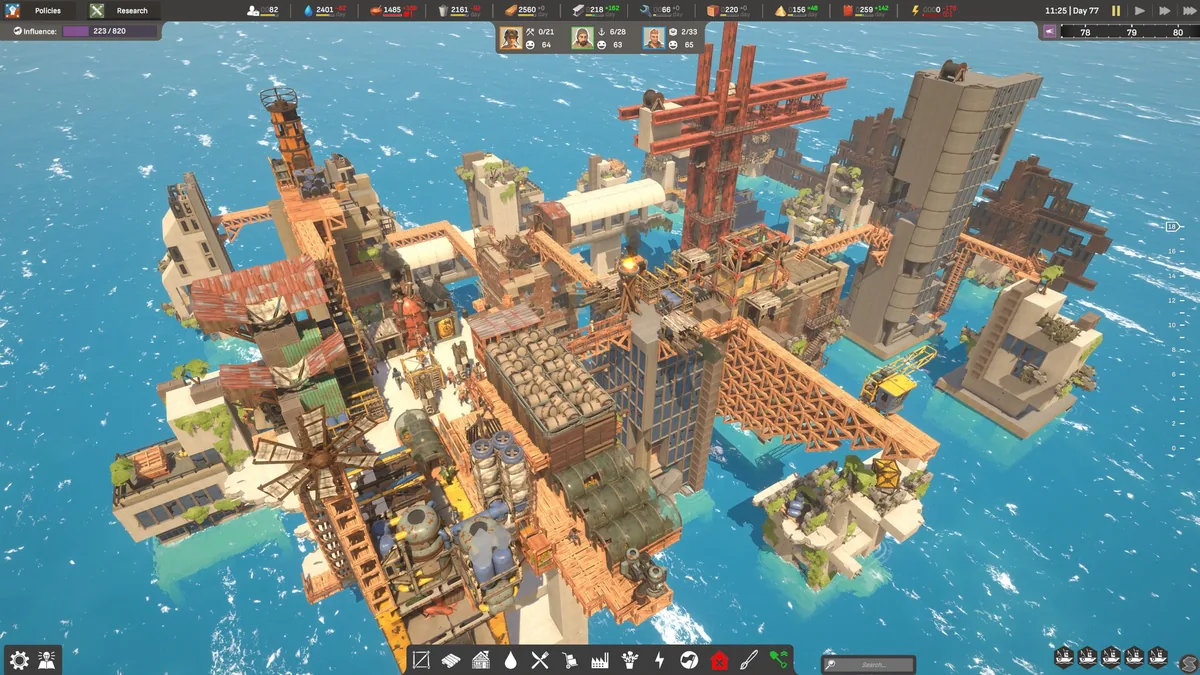 That red support tower is mid-build and unfinished. Leave it under-braced too long and ALL WILL FALL's physics engine will let it, and everything bolted to it, come down.
GODEEPER: ALL WILL FALL's collapse timer isn't the only place physics-driven construction shows up in indie games right now. Windrose Complete Guide: Biomes, XP, Factions and Ships →
Analysis: How These 8 Base-Building and Colony Sim Games Compare on Price, Depth, and Co-Op
Price spread runs from Romestead's $13.99 to Timberborn's $34.99 list price, with most of the field clustered at $29.99. That $29.99 tier (Going Medieval, Against the Storm, Subnautica 2, ALL WILL FALL) is where the genre is most competitive right now, and the deciding factor between them isn't price, it's what kind of pressure you want managing your colony: Going Medieval and Against the Storm are land-based and colonist-driven, Subnautica 2 swaps land pressure for depth and oxygen, and ALL WILL FALL swaps it for structural physics.
Co-op is the other real split. Romestead is the only game here built around a full 8-player village from the ground up. StarRupture supports smaller co-op groups with dedicated desync fixes already shipped. The other six, Timberborn, Going Medieval, Against the Storm, Subnautica 2's core mode, ALL WILL FALL, and Terra Nil, are single-player experiences (Subnautica 2 has an in-development co-op mode, but it's not the base Early Access experience as of this list). If shared building is the point for you, that narrows the field to two or three picks fast.
On raw review volume, Subnautica 2's 71,000+ reviews dwarf everything else here, which says more about franchise recognition than genre depth. Timberborn's Overwhelmingly Positive rate at more than 40,000 Steam reviews is the strongest quality signal on the list by review count, and Against the Storm's 91 Metascore backs that up with critic consensus, not just user sentiment.
Related Reading
- Timberborn Review: The Beaver City-Builder Nails 1.0: Full 9.1/10 review covering both factions and the 1.0 automation update.
- Romestead Early Access Review: 7.5/10 verdict on the 8-player co-op village builder's current state.
- Subnautica 2 Base-Building Guide: Module placement, depth pressure, and habitat design for underwater colonies.
- StarRupture Review: Very Positive, But Bases Still Freeze: 7.3/10 review documenting the rail-network freeze issue in detail.
- Best Indie Automation and Logistics Games (Steam Train Fest 2026): More picks for players who want the automation half of this genre without the colony-survival half.
- Settler's Domain Release: A one-developer city-builder that just released with no reviews yet, worth watching if its Mostly Positive demo carries over.
Frequently Asked Questions
What is the best base-building game in 2026? Timberborn, for most players. It hit 1.0 in March 2026 and remains Overwhelmingly Positive across more than 40,000 reviews, and its drought-and-water-physics loop gives every colony a real failure state. Going Medieval is the closer runner-up if you want deeper colonist management.
Is StarRupture worth buying despite the freeze bug? Yes, at $19.99, but go in informed. Large rail-connected bases trigger multi-second freezes that seven hotfixes haven't fixed as of this list. Smaller and mid-size bases run fine; it's specifically the late-game scale-up that stutters.
Which of these 8 games has the best co-op? Romestead, if you want a full 8-player village. StarRupture and ALL WILL FALL both support smaller co-op groups with less friction. Timberborn, Going Medieval, Against the Storm, and Terra Nil are single-player only.
Is Against the Storm still worth playing in 2026 even though it released in 2023? Yes. It left Early Access in December 2023 and still holds Overwhelmingly Positive across 19,000+ reviews. The roguelite structure, five playable species, and apocalyptic rain-timer haven't been matched by anything newer on this list.
What makes ALL WILL FALL different from other city builders? A real-time physics engine tracks weight, tension, and material strength on every beam and platform. Overload a structure and you get a countdown timer, in in-game hours, before it actually collapses. No other game on this list simulates structural failure that directly.
Is Terra Nil actually a base-building game? It's a reverse city builder: you place purifiers and foliators to restore a dead landscape, then pack up and leave once it's thriving. There's no permanent base to defend, which is exactly why it's worth including as a contrast to the other 7.
Which game on this list is cheapest and best for beginners? Romestead at $13.99 is the cheapest full entry. For onboarding, Terra Nil at $24.99 is the gentlest: short runs, no combat, and a clear win state that teaches the genre's core loop without a 40-hour commitment.
References
- Timberborn on Steam
- Timberborn official announcements: Update 1.1 and September 2026 hotfixes.
- Timberborn 1.0 release-date trailer: official Mechanistry video.
- Going Medieval on Steam
- Against the Storm on Steam
- Romestead on Steam
- Subnautica 2 on Steam
- StarRupture on Steam
- ALL WILL FALL on Steam
- Terra Nil on Steam
About the author

Senior Critic & Analyst
Former game data analyst turned critic with 11 years covering indie and mid-tier games. Based in Austin. Runs spreadsheets on games most people just play.
- 11 years games criticism
- Former game economy analyst
- Roguelike and strategy specialist
Keep reading

Disclaimer
This article is published for informational and entertainment purposes. It does not constitute professional financial, legal, or technical advice. Game performance, online services, patch schedules, and store listings change. Verify critical details (pricing, system requirements, regional availability) with publishers and storefronts before you buy. Affiliate links, where present, help support our editorial work and are labelled in our affiliate disclosure.
Comments
Loading comments…