
GameBrief · General
TetherGeist Tips: Mastering Azae, Angles, and Hard Screens

Reviewing
TetherGeist
TetherGeist tips start with accepting one fact about how the game works: every new Azae resets your understanding of what the level wants from you.
TL;DR: TetherGeist changes its core movement logic with each of the seven Azae, so every new one is a fresh puzzle rather than a difficulty bump. Lean into angle-based tether play instead of fighting the physics, and on hard screens slow down to read the geometry before committing to a swing. Don't carry assumptions from the last Azae into the next.
TetherGeist tips? (quick answer)
Read each screen before moving, identify the exit, and treat every Azae as a new movement rule. Use the frequent checkpoints to test one deliberate angle at a time. For the mushroom and ball-banking sections, trace the route first, then commit instead of repeating an unexamined attempt.
Current status: September 2026
As of September 17, 2026, the Steam snapshot lists TetherGeist at $16.99 with a Very Positive rating from 351 reviews, plus 49 Steam achievements. The official launch announcement confirms the May 7 release on PC and Nintendo Switch. Prices, review totals, and platform listings can change, so use the live store page for the final purchase check.
Key takeaways
- Each of the seven Azae changes the fundamental logic of movement, not just the tools
- Read screens before acting: TetherGeist rewards geometry thinking over reaction speed
- Mushroom Azae requires pre-committing to an angle before leaving the ground
- Ball-banking Azae: trace the full bounce path before throwing
- Checkpoints are dense and retries are instant: use them aggressively
- A failed attempt is information; two failed attempts should change your approach
TetherGeist tips: the core approach
Most precision platformers ask you to get fast enough to execute a known technique. TetherGeist has some of that (later screens expect precise timing) but the bigger ask is adaptability. Seven different Azae across the game's chapters each change how Bao interacts with the world. An obstacle that blocked you two screens ago might be a useful wall now. A surface you swung from last chapter might behave differently when you return to it with a new Azae equipped.
The players who clear TetherGeist quickly are not necessarily the fastest reaction-time players. They're the ones who pause before each new screen, read what the geometry is asking for, and choose an approach rather than attempt-and-fail their way through.
That mindset shift is the biggest single tethergeist tip: this game rewards planning more than most platformers do.
Understanding each Azae before committing
The game introduces each Azae with at least one tutorial-adjacent screen, a space designed to show you the mechanic's limits before it asks you to use it at full difficulty. Pay attention to that screen. The specific rules it's teaching you, range, interaction with obstacles, speed, how it handles environmental surfaces, are the exact rules you'll need internalized when the game pushes harder a few screens later.
The first Azae is a standard projection: extend Bao, teleport to where Bao lands. The range is fixed. The collision is simple. Getting comfortable with how far Bao travels in each direction is worth doing deliberately on the first few screens before the game adds complexity.
The ball-banking Azae changes everything. Bao fires outward in a straight line, bounces off walls at the angle of incidence, and passes through thorns that would kill Mae directly. You're no longer aiming at a landing point. You're calculating where the ball will be after one, sometimes two bounces. Screens that use this Azae look complicated on first view and become obvious once you trace the path.
Step-by-Step: read a hard screen
1. Find the exit: Start at the destination and identify the last surface or obstacle interaction you need.
2. Trace backward: Follow the route toward Mae and mark which wall or mushroom should redirect Bao.
3. Choose the angle: From Mae's current position, aim for the first useful contact rather than the final landing point.
4. Test once: Execute the route, note the actual landing, and change the angle or approach side before retrying.
Slow down on ball-banking screens. Players who throw fast and retry often actually take longer than players who spend 30 seconds reading the screen first.
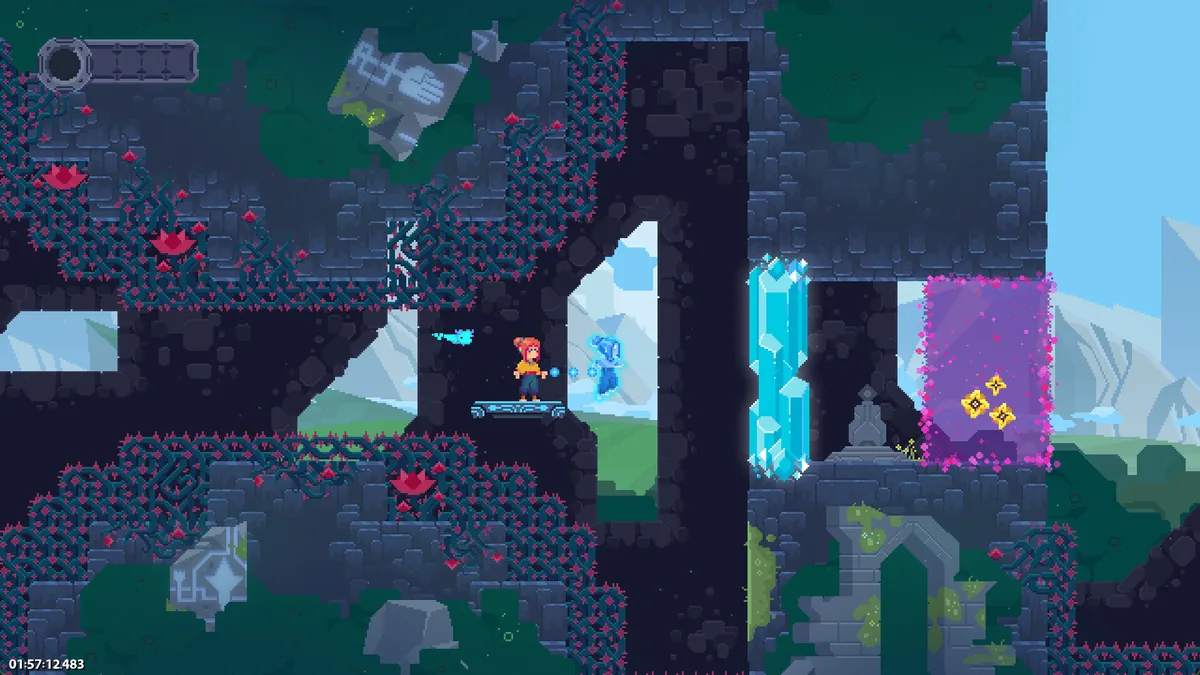 The moment before committing to a projection: reading the geometry before throwing is almost always faster than throwing fast and correcting.
GODEEPER: For a full breakdown of TetherGeist's narrative and mechanical design (including the accessibility approach and how it handles difficulty) the review covers everything before you start. TetherGeist Review: Precision Platforming Worth the Pain →
The mushroom Azae: the game's hardest ask
This Azae bounces Mae toward or away from floating mushrooms based on her approach angle. There is no mid-air correction after you commit. The angle read happens before you leave the ground.
The screens that use mushroom Azae are where most players stall. The mechanic has two things working against quick learning: there's minimal feedback on how far off your angle was (the game tells you that you failed, not by how much), and the required angles are often non-obvious from Mae's starting position.
How to approach a mushroom Azae screen:
First, find your exit. Where does this screen end, and which mushroom do you need to be deflected from to reach it? Work backwards from the exit: identify the last mushroom in the chain, then the one before it, and so on.
Second, visualize the path. Stand at Mae's starting position and mentally trace the angle to the first mushroom. This takes practice but gets faster. The key is understanding that "toward the mushroom" and "away from the mushroom" produce different trajectories: knowing which one the exit requires is the entire puzzle.
Third, attempt once deliberately. Note specifically whether you hit the mushroom and where you went. If you went toward it when you needed away, you're approaching from the wrong side. If you overshot, you're firing at too steep an angle.
Don't attempt the same angle twice expecting a different result. The game doesn't have physics variance: if an angle failed, that angle will fail again.
One practical note: the mushroom Azae's bounce behavior changes based on elevation. Approaching a mushroom from below versus approaching from the side produces different trajectories even at the same angle. This is why some mushroom screens feel inconsistent early on: once you recognize the elevation factor, the behavior becomes predictable.
Checkpoint and retry strategy
TetherGeist's checkpoints are dense: within levels, not just between them. Individual screen segments are roughly 30 seconds of movement. Death sends you back to the last checkpoint, which is usually within the same screen or the start of a multi-screen challenge.
Retries are instant. There's no loading screen, no confirmation dialog, no timer. You fail, you're back. This design decision is intentional: the developers want failure to be information, not punishment. Use it that way.
Two retries should shift your approach. If you've failed the same screen the same way twice, you're executing on a wrong model. Look at the screen from scratch: is there an exit route you haven't considered? A surface that serves a different purpose than you assumed? A physics interaction you've been ignoring?
Three or four retries on the same approach without changing it is a reliable sign you're stuck on a wrong read, not on execution difficulty.
The checkpoint system also makes exploration useful. If you see a surface that might be interactable but aren't sure, try it. The cost of being wrong is a few seconds. TetherGeist's level design rewards players who probe edges: some screens have multiple solution paths, and the obvious one isn't always the intended one.
 Instant retries and dense checkpoints make TetherGeist's difficulty feel earned rather than cruel: the game wants you to fail until you understand.
GODEEPER: If TetherGeist's high skill ceiling is your preference in action games, the Kristala combat guide covers another 2026 release with steep parry-timing depth and precise execution windows. Kristala Combat Guide: Parry Timing and Mana Loop Tips →
TetherGeist tips for each chapter region
The game's regions each introduce a new Azae and then build complexity around it before introducing the next. A useful frame for each region:
In the opening chapters, the projection Azae is the entire toolkit. Master the range and the collision behavior here. These screens are teaching you that TetherGeist is a geometry game, not a reaction game.
When the ball-banking Azae appears, resist the impulse to use it fast. This Azae rewards slowing down more than any other. Screens feel hard when you throw fast; they feel solvable when you trace first.
The mushroom sections come mid-game. This is where most players spend the most time. The angle-without-feedback problem is real: the game could communicate better here. Compensate by building a mental model: label the mushroom you're targeting as either a "toward" or "away" deflector for your intended path, and verify your first attempt was aligned with that label before retrying.
Later chapters combine Azae interactions with environmental hazards that affect Bao differently depending on which Azae is active. A surface that was safe for ball-Bao may stop the projection Azae. When something unexpected happens, check whether the surface is interacting with Bao specifically, or with Mae, or with both. That distinction usually explains the result.
What "learning a level" looks like
TetherGeist expects you to learn individual screens, not just survive them. The distinction matters. Surviving looks like: attempt, fail, adjust, attempt again, eventually pass. Learning looks like: understand the intended path, execute it confidently twice in a row.
Passing a screen barely (scraping through with a solution you don't fully understand) creates problems later. Later screens in the same chapter often reuse the same Azae in a harder configuration. If you haven't internalized the mechanic, the harder version is opaque.
When you pass a screen that felt confusing, take five seconds to replay it in your head. Can you explain what worked? If not, consider whether a second clean run on that screen would be worth it. This sounds slow. It's faster than spending 20 minutes on the next screen because you didn't understand the mechanic you just got through.
This kind of deliberate learning (understanding before repeating) is the same approach the Dead as Disco guide recommends for Beat Kune Do timing: first attempt is research, second attempt uses what you found out.
Frequently Asked Questions
What is the Azae system in TetherGeist? Azae are items that change how Mae's spirit Bao interacts with the world when projected. Seven Azae across the game each change the movement logic fundamentally: not just speed or range, but which obstacles interact with Bao and how to read the geometry.
How do you beat the mushroom Azae sections in TetherGeist? The mushroom Azae bounces Mae toward or away from floating mushrooms based on approach angle, with no mid-air correction. Work backwards from your exit: identify which mushroom you need to be deflected from, then figure out the approach angle from Mae's position. There's no physics variance: wrong angles fail consistently, right ones succeed consistently.
Does TetherGeist have difficulty options? No traditional easy mode, but the game uses frequent in-level checkpoints and instant retries. Death costs seconds, not minutes. Checkpoints are the primary accessibility tool: they make brutal screens feel fair by isolating the challenge.
How long does TetherGeist take to beat? A first playthrough runs 6-10 hours depending on how quickly the Azae mechanics click. Players who find geometric angle-reading intuitive tend to finish faster; those who struggle with mushroom Azae sections can easily sit at the high end.
What does the ball-banking Azae do? It fires Bao as a ball that banks off walls at the angle of incidence and passes through thorns that would kill Mae. You're calculating the path after the bounce, not just the aim point. Trace the full path before throwing: these screens reward planning over speed.
Is TetherGeist similar to Celeste? Both are hard precision platformers with story-focused narratives. The difference: Celeste builds muscle memory, TetherGeist changes the movement rules per chapter so you're always relearning. Some players find TetherGeist mentally harder even on shorter screens.
What platforms is TetherGeist on? Steam (PC) and Nintendo Switch launched May 7, 2026. The current Steam listing is the safest source for the PC platform details; no additional console release is confirmed in the sources linked below.
Related Reading
- TetherGeist Complete Guide: Azae, Tips and Walkthrough
- TetherGeist Review: Precision Platforming Worth the Pain
- Dead as Disco Guide: Beat Kune Do Timing
- Kristala Combat Guide: Parry Timing and Mana Loop Tips
- Motorslice Launch Guide
- Mixtape Launch Guide
- Mina the Hollower Complete Guide
- Tales of Seikyu Complete Guide
- Wax Heads Review
References
- TetherGeist on Steam: official store page
- TetherGeist official Steam news: developer launch announcements
- TetherGeist mushroom and Azae player guide: community walkthrough for the route-specific mechanic details
- O. & Co. Games official site: developer page and press kit
Was this guide helpful?
About the author

Indie & JRPG Critic
Indie game evangelist and lifelong JRPG fan covering small studios since 2017. Mumbai-born, London-based. Writes the way she talks.
- 7 years indie games coverage
- JRPG and visual novel specialist
- Narrative design focus
Keep reading




Disclaimer
This article is published for informational and entertainment purposes. It does not constitute professional financial, legal, or technical advice. Game performance, online services, patch schedules, and store listings change. Verify critical details (pricing, system requirements, regional availability) with publishers and storefronts before you buy. Affiliate links, where present, help support our editorial work and are labelled in our affiliate disclosure.
Comments
Loading comments…