
GameBrief · General
Gambonanza Best Builds: 3 Gambit Pairings That Work

Reviewing
Gambonanza
Blukulélé
The gambonanza best builds question isn't answered by a single tier list. Knowing Thunder's Gambit is S-tier doesn't tell you what to pair it with, and a strong Gambit sitting alone in your loadout does less work than two Gambits and a tile choice that reinforce each other.
This guide covers three Gambit pairings that hold up across community strategy write-ups: Thunder's Gambit with Falling Crown's Gambit for a pawn-tempo build, Chemist's Gambit with a strong first tile trigger for board-wide scaling, and the Banana Peel's/Silver Fork's/Demon's Gambit skip-turn package for tempo denial. None of these require a rare unlock or a specific run seed: all three are buildable from common shop offers.
TL;DR: Three Gambit pairings carry: Thunder's Gambit plus Falling Crown's Gambit turns pawns into both tempo pieces and promotion engines, Chemist's Gambit plus a strong first tile trigger (Blessed, Protective, or Gold) turns one good tile into a board-wide plan, and the skip-turn package (Banana Peel's, Silver Fork's, Demon's Gambit) stacks chance-based turn denial. Buy for the board you actually have, not the pairing that sounds strongest in the abstract.
Key takeaways
- Thunder's Gambit (pawn captures skip the enemy turn) pairs naturally with Falling Crown's Gambit (waiting promotes a pawn): pawns become both attackers and a promotion engine
- Chemist's Gambit copies your first triggered tile onto a random tile: trigger your best tile first, not whatever fires accidentally
- The skip-turn package (Banana Peel's, Silver Fork's, Demon's Gambit) stacks three unreliable chances into meaningfully better turn-denial odds
- Collection tracks 200 total unlocks across six categories (Gambits, Pieces, Tiles, Enemy Modifiers, Bosses, Strains); more unlocked expands what later runs can draw from
- Kev Borclick's STASIS modifier blocks captures on 2 of his own pieces each turn: plan around it, don't attack into it
- You can hold up to five Gambits at once, so a pairing doesn't have to be your whole loadout
Overview: what makes a Gambonanza build work
A Gambonanza build works when two or three Gambits (or a Gambit and a tile choice) answer the same question instead of pulling in different directions. Two unrelated Gambits and no tile synergy still function, but they ask you to solve more problems per turn than a focused pairing does.
The Collection screen matters here more than it looks. Collection tracks unlocks across six categories: Gambits, Pieces, Tiles, Enemy Modifiers, Bosses, and Strains, out of 200 entries total. Progress in Collection is what determines which Gambits and pieces a future run can actually offer you, which is the practical reason to check it between sessions even when you're not chasing one specific unlock.
Starting pieces come from a slot-machine style Piece Wheels screen: three spinning reels and a Stop button, drawing from whatever your Collection has unlocked so far. Stop as soon as a queen shows in any reel; queens are the strongest baseline piece and worth locking in over gambling for a second one.
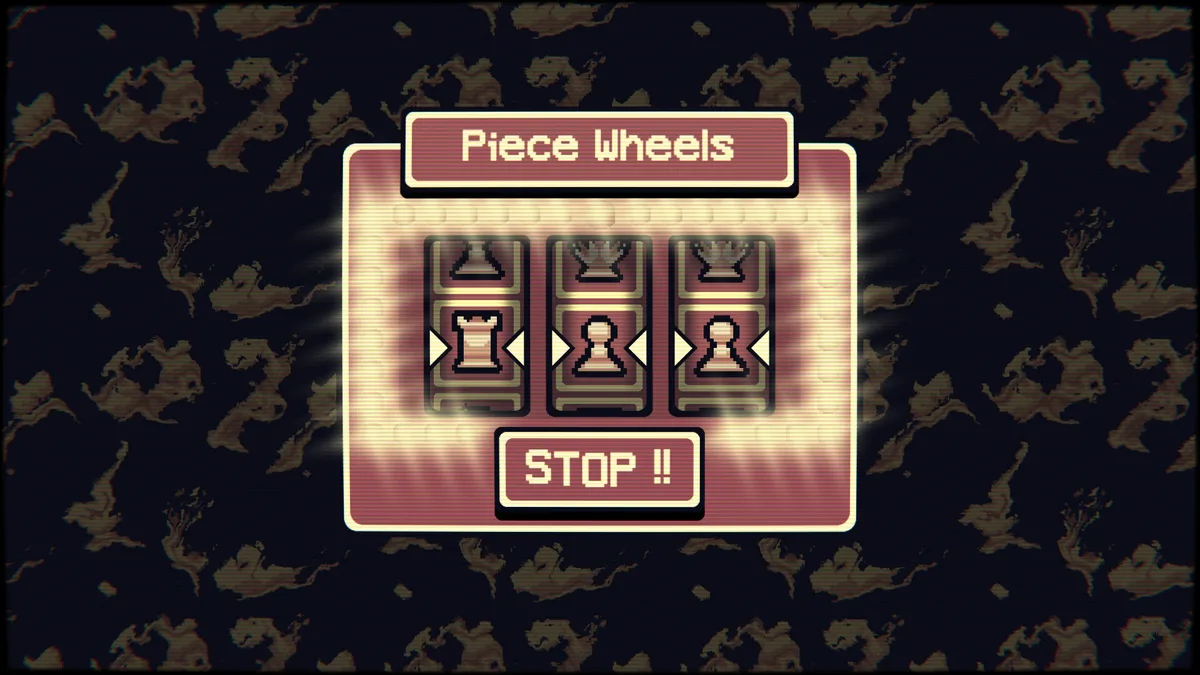 The Piece Wheels screen: three reels of chess pieces and a Stop button decide your starting pieces for the run, drawing from whatever your Collection has unlocked.
Pairing 1: Thunder's Gambit + Falling Crown's Gambit
Gambit priority: Thunder's Gambit first if pawns are already active, Falling Crown's Gambit second once you have pawns to spare.
Thunder's Gambit (Legendary, $9) makes pawn captures skip the enemy turn. Falling Crown's Gambit (Epic, $10) turns a safe wait into a pawn promotion. Together, pawns stop being a single-purpose piece: they capture for tempo when a capture is available, and they promote on the turns where waiting is the safer move.
The pairing breaks down if you take Falling Crown's Gambit and then wait recklessly. Waiting is only free when the enemy can't punish it and Crumble pressure isn't already climbing. Falling Crown's Gambit rewards a safe wait; it doesn't make every wait safe.
GODEEPER: The full tier placement and cost/rarity table for every documented Gambit, including where Thunder's and Falling Crown's Gambits rank against the rest of the pool. Gambonanza Tier List: The Best Gambits Ranked 2026 →
Adding Berzerker's Gambit (Common, $6, money on a safe first-turn capture) as a third piece works well here: if your first capture is already one you wanted to make, Berzerker's Gambit converts that same turn into recovery money on top of Thunder's tempo.
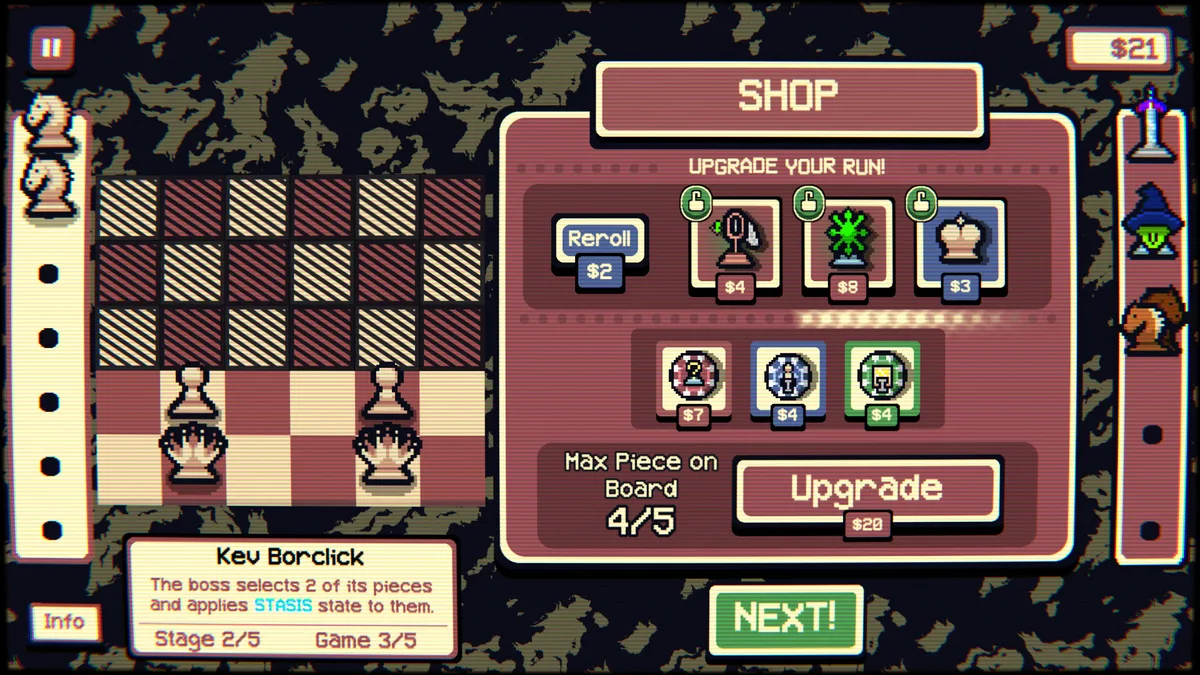 The shop screen between games: check the boss preview panel before committing to a pairing, since a modifier like Kev Borclick's STASIS can change what's worth buying that stage.
Pairing 2: Chemist's Gambit + a strong first tile trigger
Gambit priority: Chemist's Gambit as early as it appears, then deliberately trigger your best available tile before anything else that stage.
Chemist's Gambit (Common, $6) copies the first tile you trigger in the game onto a random tile. That makes it less about the Gambit itself and more about tile choice: Blessed tiles add recovery squares for valuable pieces, Protective tiles add safe entry squares for risky captures, and Gold tiles add economy routes. All three are strong first triggers.
The rule that matters: after buying Chemist's Gambit, don't let a random weak tile trigger by accident. Plan your next few moves around triggering the tile you most want duplicated. A Trap tile duplicated at the wrong moment stops dangerous enemies just once instead of building into a repeatable defense.
This pairing is patient by design. It does nothing on the turn you buy it: the payoff comes from the tile choice you make afterward, not the Gambit slot itself.
Pairing 3: the skip-turn package (Banana Peel's, Silver Fork's, Demon's Gambit)
Gambit priority: pick up all three as they appear in the shop; none requires the others to function, but together they compound.
| Gambit | Rarity/cost | Trigger |
|---|---|---|
| Banana Peel's Gambit | Common, $6 | 1-in-10 chance to skip the enemy turn after you play |
| Silver Fork's Gambit | Rare, $7 | After moving a knight, 1-in-2 chance to skip the enemy turn if it captures 2+ pieces |
| Demon's Gambit | Rare, $8 | When one of your pieces is captured on a black tile, skip the enemy turn |
None of the three is a reliable defense by itself. Banana Peel's Gambit fires roughly one time in ten. Silver Fork's Gambit needs a specific kind of knight move. Demon's Gambit needs you to lose a piece on the right tile color, which means it rewards a planned sacrifice more than an accidental one. Stacked, the package raises the odds that somewhere in a given sequence of turns, the enemy loses one, without depending on any single trigger to land.
Add Thunder's Gambit to this package if you also have pawns active: Thunder gives a guaranteed pawn-capture skip instead of a chance-based one, which anchors the package with something dependable while the other three add upside.
GODEEPER: How Kev Borclick's STASIS modifier and the wider boss rotation interact with tempo-denial builds, including why boss order isn't fixed between runs. Gambonanza Tier List: The Best Gambits Ranked 2026 →
Boss prep: Kev Borclick and STASIS
Kev Borclick selects 2 of his own pieces each turn and applies STASIS to them. STASIS blocks those specific pieces from being captured until enough waiting turns remove the state: it does not change how they move, and it does not apply to your own pieces.
For any of the three pairings above, the practical adjustment is the same: don't spend attacks trying to capture a STASIS'd piece. Clear Kev's other threats first, then create safe turns to wait out the state before finishing him off. The shop shows his modifier in preview before you spend, so check it before committing that stage's purchase to something that doesn't help against him specifically.
Step-by-step: building a pairing from a fresh shop
Step 1: Identify what your current pawns and tiles already support
If you have several pawns still on the board, Thunder's Gambit plus Falling Crown's Gambit is usually the strongest available direction. If you already have a strong tile down (Blessed, Protective, or Gold), Chemist's Gambit is worth prioritizing instead.
Step 2: Buy the anchor Gambit first
Thunder's Gambit or Chemist's Gambit are the anchors for pairings 1 and 2. For the skip-turn package, there's no single anchor: buy whichever of the three appears first and add the others as they show up.
Step 3: Follow with the piece that completes the pairing
Falling Crown's Gambit after Thunder's. A deliberate tile trigger after Chemist's. The next skip-turn piece after the first, if you're building the package.
Step 4: Check the boss preview before your next purchase
If Kev Borclick's STASIS modifier is coming up, prioritize a Trap or Protective tile that gives a key piece a safer turn over an additional Gambit that doesn't answer STASIS directly.
Step 5: Reassess at the next shop, not before
A pairing that isn't coming together (no pawns left for Thunder's plan, no strong tile for Chemist's) is a signal to pivot, not to force the purchase anyway.
Frequently asked questions
What are the best builds in Gambonanza? Three Gambit pairings hold up well: Thunder's Gambit with Falling Crown's Gambit for pawn tempo and promotion, Chemist's Gambit with a strong first tile trigger for board-wide scaling, and the Banana Peel's/Silver Fork's/Demon's Gambit skip-turn package for tempo denial.
How do Thunder's and Falling Crown's Gambits work together? Thunder's Gambit makes pawn captures skip the enemy turn. Falling Crown's Gambit turns a safe wait into a pawn promotion. Together, pawns capture for tempo and promote on turns you'd otherwise waste.
What tiles work best with Chemist's Gambit? Blessed, Protective, and Gold tiles are the strongest first triggers, since Chemist's Gambit copies whichever tile you trigger first onto a random tile. Trigger your best tile deliberately rather than letting a weak one fire by accident.
Is the skip-turn package worth building around? Yes, if your board already has tempo pressure. None of Banana Peel's, Silver Fork's, or Demon's Gambit is reliable alone, but stacked they meaningfully raise the odds of denying the enemy a turn somewhere in a sequence.
What is the Collection screen and how does it affect future runs? Collection tracks unlocks across six categories (Gambits, Pieces, Tiles, Enemy Modifiers, Bosses, Strains) out of 200 total entries. More unlocked expands what future runs can offer you, which is why checking it between sessions is worth doing.
Does Kev Borclick's STASIS modifier affect build planning? Yes. He selects 2 of his own pieces each turn and blocks them from capture until enough waits remove STASIS. Clear his other threats first and plan safe waiting turns rather than attacking the frozen pieces.
Related Reading
- Gambonanza Complete Guide 2026: hub for all Gambonanza guides, including tier lists, gambit pairings, tips, and the vs-Balatro comparison.
- Gambonanza Review: Chess Balatro or Something Better?: the Mostly Positive verdict and the friction points worth knowing before a first run.
- Gambonanza Tier List: The Best Gambits Ranked 2026: full S-to-B tier breakdown with cost, rarity, and trigger condition for every documented Gambit.
References
- Gambonanza on Steam: store page, release data, review score, feature list
- Gambonanza Steam Community Discussions: player-reported build strategies and Collection unlock discussion
Was this guide helpful?
About the author

Indie & JRPG Critic
Indie game evangelist and lifelong JRPG fan covering small studios since 2017. Mumbai-born, London-based. Writes the way she talks.
- 7 years indie games coverage
- JRPG and visual novel specialist
- Narrative design focus
Keep reading




Disclaimer
This article is published for informational and entertainment purposes. It does not constitute professional financial, legal, or technical advice. Game performance, online services, patch schedules, and store listings change. Verify critical details (pricing, system requirements, regional availability) with publishers and storefronts before you buy. Affiliate links, where present, help support our editorial work and are labelled in our affiliate disclosure.
Comments
Loading comments…