
GuideGambonanza
Gambonanza Boss Guide: All 8 Bosses and How to Beat Them

About the game
Gambonanza
Blukulélé · Sidekick Publishing, Stray Fawn Publishing
This Gambonanza boss guide covers the 8 stage bosses with confirmed modifiers in available documentation. Every stage ends with a boss, and each boss has a mechanic that warps the fight in a specific way. The shop between stages shows you what's coming. That preview is the game's most important tool and most players scroll past it.
TL;DR: Gambonanza has 8 stage bosses with confirmed modifiers: Hikarul the Banished, Botezarro, Jawby Fisher, M3CH4GNU5 C4RL53N, Judit Polgeisha, Kev Borclick, Tàl the Cursed, and Mighty Kasparov. A run has roughly 25 games with 5 boss checkpoints, and which bosses you face is not fixed between runs. Key mechanics to know: Kev Borclick applies STASIS to 2 of his own pieces per turn (blocking capture, not changing movement); Tàl the Cursed curses tiles to downgrade pieces; M3CH4GNU5 C4RL53N shuffles piece positions mid-fight; Hikarul the Banished disables your stock. The shop before each fight shows the boss. Read it before spending.
Gambonanza boss guide: quick answer
Eight stage bosses have confirmed modifiers in available documentation, and a run has roughly 25 games with 5 boss checkpoints. Which bosses you face, and in what order, is not fixed between runs based on available footage. Some players describe a distinct final "Grandmaster" encounter, but it is not independently confirmed here, so treat it as a community-reported detail rather than a guaranteed fixture.
The shop between stages always reveals which boss is coming. This matters more than anything else in the shop decision: you're not buying generically good upgrades, you're buying specifically against a mechanic you're about to face.
Key takeaways
- 8 stage bosses have confirmed modifiers; a distinct "Grandmaster" final boss is community-reported but not independently confirmed here
- Boss order is not fixed between runs, based on available footage
- The shop between stages previews the next boss ability
- Kev Borclick (STASIS), Tàl the Cursed (tile curses), M3CH4GNU5 C4RL53N (shuffles), Hikarul (disables stock) are the mechanically demanding ones
- 15-second unskippable cutscene per boss intro (not patchable at the time of writing)
- Boss mechanics don't change between difficulty levels; the board pressure does
Run structure and boss placement
A Gambonanza run runs roughly 25 games with 5 boss checkpoints, about every 5th game. Between stages, you visit the shop: spend coins on Gambits, piece upgrades, or board enhancements.
Which of the 8 confirmed bosses you face, and in what order, is not fixed between runs based on available footage: you might get Kev Borclick and Tàl in the same run, or you might face neither. This variance is part of what drives replayability; the Gambit decisions that beat a Kev Borclick stage look different from the decisions that beat a Tàl stage.
The boss preview appears in the shop UI. It's shown in the lower-left corner alongside the upgrade options. Players who skip reading it are making upgrade decisions without the most relevant piece of information. Read the boss mechanic first. Then decide how to spend.
The shop between stages shows the next boss before you spend. Kev Borclick's STASIS detail here changes what piece upgrades are worth buying.
GODEEPER: The Gambit system is what separates Gambonanza from standard chess. Dozens of Gambits affect piece behavior, capture conditions, and tile effects, and the boss fight outcome often depends on the Gambits you've built around. Gambonanza Review: Chess Balatro or Something Better? →
All Gambonanza bosses
The 8 stage bosses and their mechanics:
Kev Borclick: Applies STASIS to 2 of its own pieces each turn. STASIS pieces can't be captured by normal means. Routes that would go through a STASIS piece are blocked. Build around capture paths that don't rely on going through a single square, because Borclick will put STASIS on whichever pieces anchor your cleanest line. Gambits that generate multiple capture angles are more valuable going into this fight.
Tàl the Cursed: Curses tiles during the encounter. Pieces that land on cursed tiles are downgraded to pawns. Against a standard setup, queen lines are dangerous here because losing a queen to a tile curse mid-fight is difficult to recover from. Positional flexibility beats raw power in this fight. Keep capture routes that don't require landing on contested squares.
M3CH4GNU5 C4RL53N: Shuffles pieces on the board mid-fight. If your Gambit build depends on specific piece arrangements, this mechanic breaks it. The shuffle isn't random in a way you can predict round to round. Builds that maintain capture capability from multiple piece types hold up better than one-piece strategies that require a queen (or other single piece) in a specific position.
Hikarul the Banished: Disables your stock. The reserve columns along the board edges are where you hold pieces off-board for precise deployment. Against Hikarul, those columns are unavailable. Builds that rely heavily on reserve timing (holding a knight off-board until a fork position opens, then deploying it) lose that option. Hikarul rewards on-board positioning over setup chains.
Judit Polgeisha: Randomizes your piece formation at the start of the match, and the enemy's formation stays hidden during setup. You can't place every piece against exact enemy threats going in. Start with flexible coverage instead of a narrow tactic, then reassess enemy queens, rooks, bishops, and promotion threats once the formations reveal. Your first move should reduce danger, not just take the closest available piece.
Jawby Fisher: Punishes your reserve and stock directly, including destroying stock pieces after capturing them. You can't rely on stock during this fight the way you can in others, so commit your important pieces to the board before starting rather than holding them in reserve. Flexible pieces and simple formations hold up better than setups that depend on precise off-board timing.
Botezarro: No specific mechanic documentation available from public sources yet. Listed here for awareness rather than guessed-at strategy.
Mighty Kasparov: Same situation as Botezarro: named and confirmed to exist, but specific encounter mechanics aren't confirmed in current public sources.
A note on "The Grandmaster"
Some community discussion describes a distinct final-boss encounter beyond the 8 stage bosses above, sometimes called The Grandmaster, fought across multiple phases. This guide cannot independently confirm that encounter from available documentation, so treat any specific claim about it (phase count, unique mechanics, when it appears) as unverified until a current-version source confirms the details. If you've fought it yourself, the safest approach going into any unconfirmed late-run fight is the same as the confirmed bosses above: build Gambits around multiple capture angles rather than a single-piece plan the fight could disrupt.
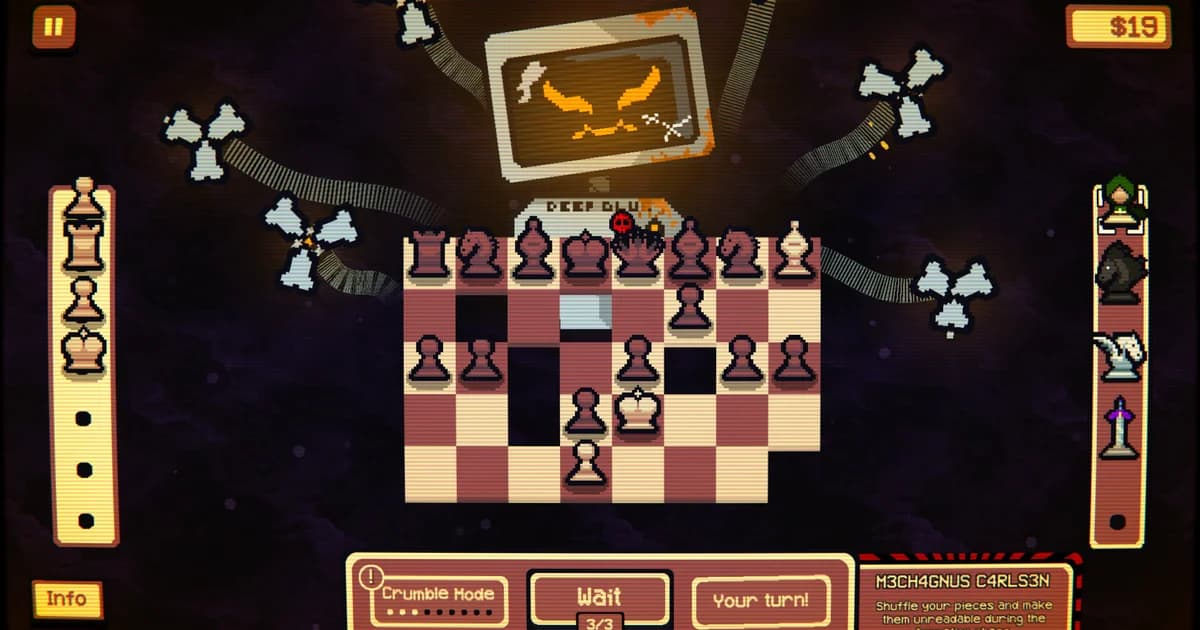
Gambonanza's board mid-fight. Boss mechanics change which squares are dangerous each turn, making Gambit flexibility more valuable than raw piece power.
How to use the shop preview
This is the highest-leverage behavior change available to new Gambonanza players. The shop between stages shows the next boss ability. Most players read it briefly and make the same upgrade decisions they'd make anyway. That's leaving an advantage unused.
GODEEPER: Tàl the Cursed, Kev Borclick, and M3CH4GNU5 C4RL53N can all appear in the same run on difficulty 4, which creates a tight Gambit selection problem. Best Roguelike Games 2026: 6 Picks Under $20 →
Read the boss mechanic first. Then ask: which of my current capture routes does this ability break? The answer tells you what to buy.
For Kev Borclick: buy Gambits or piece upgrades that create additional capture angles. Don't spend on reinforcing a single piece that STASIS will block.
For Tàl the Cursed: mobility-focused Gambits (pieces that can capture without landing in the cursed square) are more valuable than raw piece power. Spending $3 on a pawn upgrade that puts it in the line of cursed tiles is a waste.
For M3CH4GNU5 C4RL53N: the shuffle invalidates position-dependent setups. Spend on Gambits that maintain general-purpose capture capability rather than ones that require your pieces to be in specific squares.
For Hikarul: if you've been building a reserve-heavy strategy, reconsider. The $5 piece upgrade that makes your on-board pieces stronger is better than holding coins for reserve deployments that won't be available.
Boss tips
Save a Reroll for the Gambit pool before a boss you're unprepared for. The Reroll is cheap relative to the shop window. If the shown Gambits don't address the boss mechanic, rolling once is usually worth it.
Don't over-spend on tile upgrades before a Tàl fight. Ghost tiles, blessing tiles, and board enhancements add value across stages, but Tàl curses tiles during the fight, which can overwrite or interact with your placed enhancements in ways that negate the investment.
Queens remain the strongest baseline piece, but every boss in the pool has a mechanic designed to pressure queen-centric play. A run that reaches stage 4 with only one piece type developed and no backup capture routes is exposed to whichever boss happens to appear. Gambit builds around non-queen pieces are more resilient against the bosses that target specific capture patterns.
The 15-second boss intro cutscene can't be skipped at the time of writing. Plan around it: don't close the shop before confirming your upgrade decisions are done, because the cutscene fires the moment you leave the shop screen.
Related Reading
- Gambonanza Review: Chess Balatro or Something Better?: Full assessment of the game's Gambit system, board-crumble pressure, and what works at launch.
- Best Roguelike Games 2026: Where Gambonanza ranks against the 2026 roguelite wave including Die in the Dungeon and All Hail the Orb.
- Die in the Dungeon Tips Guide: Similar dice-roguelite structure if you want a comparison of how a different game handles its stage escalation.
- Black Jacket Boss Guide: Morgan, Niv, Ivel Curse Counters: Black Jacket boss guide: how to beat Morgan, Niv, and Ivel, what each boss curse punishes, and the....
- Kristala Lophi Boss Guide: Parry Timing & How to Win: Kristala Lophi boss guide: why his yellow attacks should be parried not dodged, when to dodge the jump....
- Windrose Israel Hands Boss Guide: Foothills Fight & Loot: Windrose Israel Hands boss guide: how to beat the Foothills boss, parry his combo, dodge the Poison Dash....
References
- Gambonanza on Steam: store page, release data, features list, and community discussions
- Gambonanza Steam Community Hub: player-reported boss mechanics, Gambit interaction threads, difficulty discussion
- Stray Fawn Publishing on Steam: publisher portfolio and related releases
Frequently asked questions
How many bosses are in Gambonanza? 8 stage bosses have confirmed modifiers in available documentation. A run has roughly 25 games with 5 boss checkpoints, and which bosses you face is not fixed between runs. Community mentions of a further "Grandmaster" encounter exist but aren't independently confirmed here.
What does Kev Borclick do? Applies STASIS to 2 of its own pieces per turn. STASIS pieces can't be captured by normal means, so you need capture routes that don't rely on going through a single STASIS square. The shop preview tells you before the fight.
What does Tàl the Cursed do? Curses tiles during the fight. Landing on a cursed tile downgrades that piece to a pawn. Avoid capture lines that require landing on contested squares and prioritize Gambits that provide positional flexibility over raw piece power.
What does M3CH4GNU5 C4RL53N do? Shuffles piece positions mid-fight. Position-dependent setups break. Builds that capture from multiple piece types hold up better than single-piece strategies.
Is the boss order the same every run? No. Which of the 8 confirmed bosses you face, and in what order, varies between runs based on available footage. You can see the next boss in the shop before each stage.
What's the best Gambit strategy for bosses? Read the boss preview in the shop before spending. Spend against the specific mechanic, not generically. Multiple capture angles beat single-piece dominance when any boss can disrupt your primary line.
Was this guide helpful?
About the author

Senior Critic & Analyst
Former game data analyst turned critic with 11 years covering indie and mid-tier games. Based in Austin. Runs spreadsheets on games most people just play.
- 11 years games criticism
- Former game economy analyst
- Roguelike and strategy specialist
Keep reading

Gambonanza Tier List: The Best Gambits Ranked 2026
General · 10 min
Gambonanza Gambits Guide: Chess Roguelike Tips 2026
General · 15 min
Gambonanza Best Builds: 3 Gambit Pairings That Work
General · 9 min

Gambonanza vs Balatro: Which Roguelike Is Worth It?
Guides · 10 min
Gambonanza Tips: Crumble Mode, Reserve, and Gambits
General · 9 min
Gambonanza Review: Chess Balatro or Something Better?
General · 8 min
Game deals · affiliate links

Disclaimer
This article is published for informational and entertainment purposes. It does not constitute professional financial, legal, or technical advice. Game performance, online services, patch schedules, and store listings change. Verify critical details (pricing, system requirements, regional availability) with publishers and storefronts before you buy. Affiliate links, where present, help support our editorial work and are labelled in our affiliate disclosure.
Comments
Loading comments…