
GameBrief · General
Gambonanza Gambits Guide: Chess Roguelike Tips 2026
Gambonanza gambits guide: Crumble Mode, reserve tactics, tier picks, and chess roguelike tips for stronger runs, smarter shops, and better builds in 2026.

This Gambonanza gambits guide starts with the central rule change: capture every piece, not just the king. In practice, it eliminates the most fundamental chess tactic that existed: sacrifice. You cannot trade a pawn to open a diagonal. The pawn is gone, and the board doesn't care that you got something valuable from it. Every piece you lose is gone for the rest of the run.
One rule change, completely different game. Below: the Crumble Mode counter, the reserve as a positioning tool, the Gambit pairings that actually hold up in community strategy write-ups, and why players kept comparing it to Balatro when it launched in May 2026.
Gambonanza Complete Guide: Key Takeaways
- Developer: Blukulélé | Publisher: Sidekick Publishing, Stray Fawn Publishing
- Release: May 1, 2026 | Platforms: PC, Mac, Linux
- Run length: roughly 20-40 minutes per run
- Review score: Mostly Positive, 74% from 1,627 Steam reviews; recent reviews are 72% from 73
- Steam price: $14.99 in the US snapshot checked September 28, 2026
- Core loop: chess board, all-piece capture win condition, Crumble Mode pressure, Gambit modifiers, 200-item Collection across six categories
- Gambit pairings that work: Thunder's + Falling Crown's, Chemist's + a strong tile trigger, the Banana Peel's/Silver Fork's/Demon's skip-turn package
What Gambonanza Is (and Isn't)
Blukulélé shipped Gambonanza May 1, 2026 through Sidekick Publishing and Stray Fawn Publishing. It's a short-session roguelike built around Gambit modifiers that compound across a run, layered onto a chess board rather than a hand of cards.
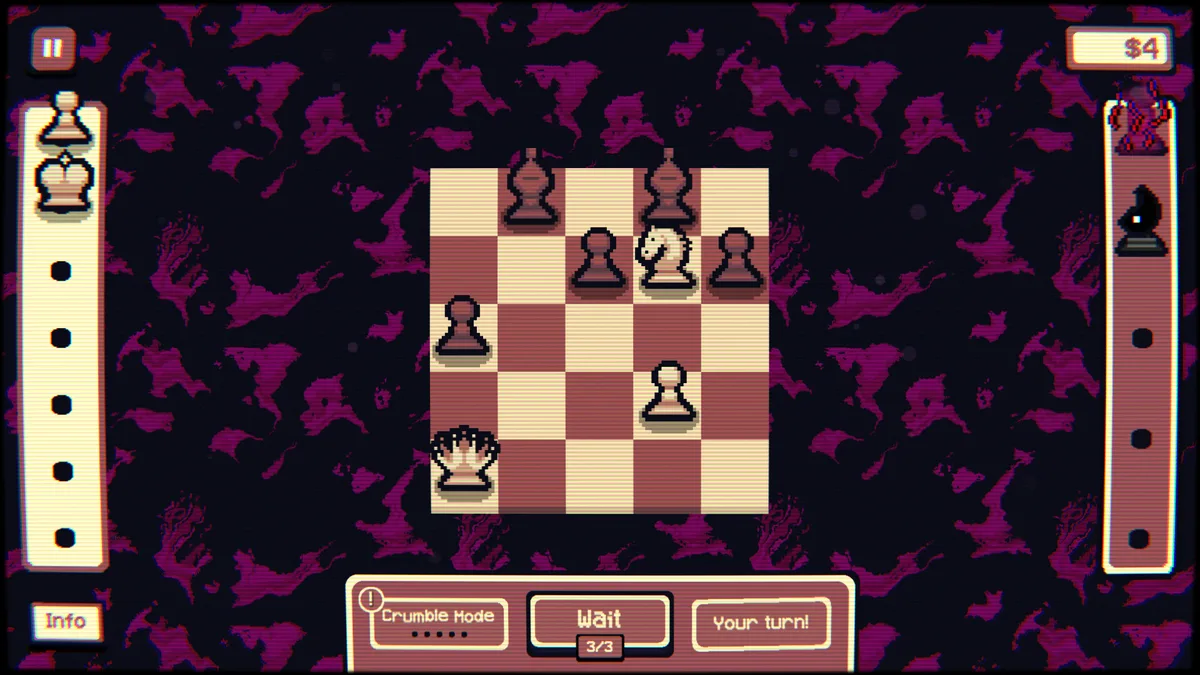 A Gambonanza board mid-run. The Crumble Mode counter (bottom center) is at 3/3, and the right reserve column is holding a piece off-board while the left one sits empty.
You play a chess board until every enemy piece is captured, picking Gambits from a shop pool as you go and spending coin between games on piece upgrades, board tiles, and other run enhancements. A run runs roughly 25 games with 5 boss checkpoints along the way, each boss adding a specific modifier that changes how that fight plays.
The Balatro comparison that followed launch is structurally accurate: both games layer escalating rule modifiers onto low-value starting pieces in ways that feel discovered rather than scripted, and both expand their modifier pool through a Collection system as you play more runs. Where Gambonanza diverges is the board. Balatro builds a hand from cards. Gambonanza builds a position across squares, and that position is under time pressure from the Crumble Mode counter.
For new players, the full Gambonanza review covers what the first runs actually look like, including the friction points that matter before you buy.
- Gambonanza Review: Chess Balatro or Something Better?: the Mostly Positive verdict and the friction points worth knowing before you buy.
- Gambonanza vs Balatro (Which Is Worth Playing in 2026?): full comparison of price, replayability, and cognitive load between both games.
- Gambonanza Tips: Crumble Mode, Reserve, and Gambits: Gambonanza tips: Crumble Mode's 3/3 counter, reserve deployment timing, and Gambit priorities.
- Gambonanza Boss Guide: All 8 Bosses and How to Beat Them: Gambonanza boss guide: 8 confirmed stage bosses, what each modifier actually does
- Gambonanza Best Builds: 3 Gambit Pairings That Work: Gambonanza best builds: pair Thunder's with Falling Crown's for pawn tempo, Chemist's with Blessed or Gold tiles, or stack the skip-turn trio.
Gambonanza Complete Guide: Core Systems
Crumble Mode: the 3/3 counter
A small counter tracks Crumble Mode. Every move you make without capturing an enemy piece increments it by one. At 3/3 without a capture, the board degrades from the edges: outer tiles crumble away, shrinking the play area. Any capture resets the counter.
The common mistake in early runs is reading it as a death timer. You don't lose immediately when the board crumbles. You lose because the reduced play space eliminates the capture lines you needed further into the position. The damage is positional and delayed.
At 0 and 1 on the counter, maneuver freely. At 2, a capture needs to happen in the next move or two. When nothing clean is visible at that point, take any capture. A suboptimal pawn taken now is better than hitting 3/3 and losing the diagonal you needed a few moves later.
The counter rewards aggression. It's not punishing bad positions. It's punishing hesitation inside a bad position.
The reserve system
Two column panels run alongside the board. Pieces stored there are off the board entirely: the enemy can't capture them, they take no turns, and they contribute nothing until you deploy them.
The reserve isn't emergency storage. It's a pre-positioning tool for captures that don't exist yet. A piece held in reserve costs nothing per turn, but it also isn't making captures, so the Crumble counter can climb faster on a thin active board. The trade-off is exact: you're betting the capture you'll generate on deployment is worth the passive turns your other pieces will need to cover in the meantime.
The clearest example is the knight. Hold one in reserve and wait for an enemy piece to step into L-shape range from a specific position. The instant that position opens, deploy directly into the fork. If the knight were already on the board in a different square, repositioning to that fork costs extra moves, and each of those is a Crumble counter tick.
What breaks the strategy: holding most of your pieces in reserve because you're unsure where to put them. A board with few active pieces generates few captures per turn, and the fork setup you planned never materializes because the board crumbled before the position opened.
The Gambit pool
Every run, you choose from a selection of Gambits at the start and sometimes between games. Steam's current store description advertises more than 150 Gambits. Thirteen Gambits have confirmed effects, costs, and rarities in this guide: this is a first-clear priority list, not a claim that it is the full pool. The current Gambonanza Wiki roster documents 203 Gambits in total.
Thunder's Gambit (Legendary, $9) makes pawn captures skip the enemy turn: the safest beginner pick. Chemist's Gambit (Common, $6) copies the first tile you trigger onto a random tile. Falling Crown's Gambit (Epic, $10) turns a safe wait into a pawn promotion. Valkyrie's Gambit (Common, $7) turns a spare pawn into a random piece when a queen lands. Berzerker's Gambit (Common, $6), Beth's Gambit (Rare, $7), and Jump's Gambit (Rare, $8) round out a solid A-tier, alongside the skip-turn package: Banana Peel's Gambit (Common, $6), Silver Fork's Gambit (Rare, $7), and Demon's Gambit (Rare, $8), which stack chance-based enemy-turn denial. Throne's Gambit, Wrecking Ball's Gambit, and Resurrection Stone's Gambit (all $6) are B-tier: solid only in a build that already needs what they do.
GODEEPER: Full cost, rarity, and trigger condition for every documented Gambit, ranked S to B. Gambonanza Tier List: The Best Gambits Ranked 2026 →
The shop economy
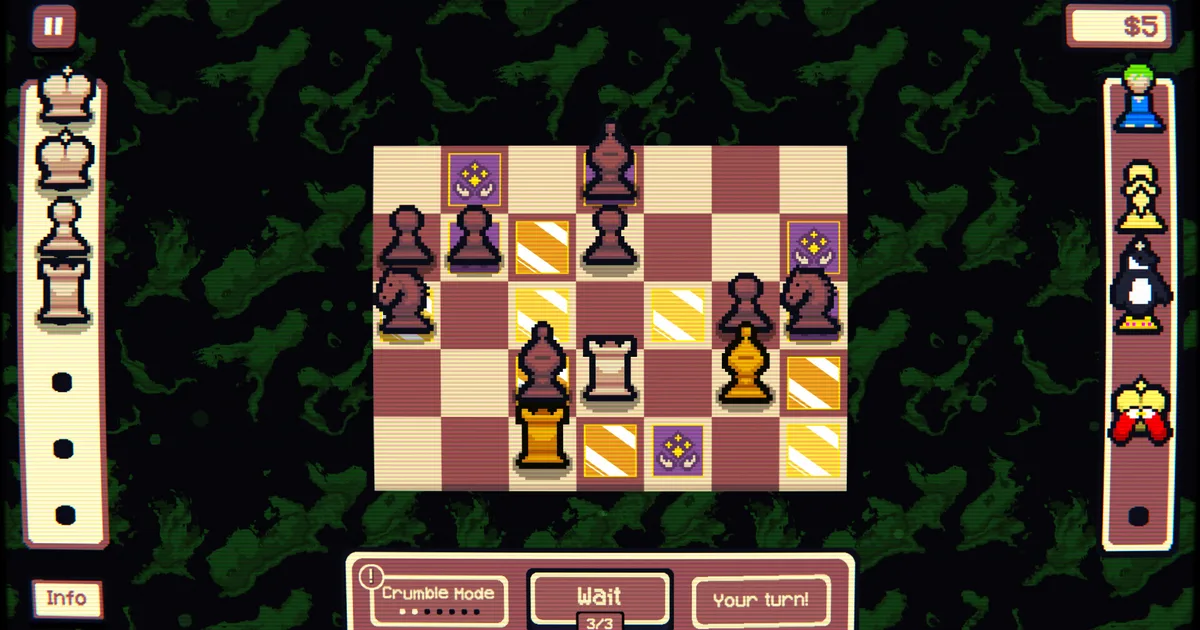
Coin comes from captures and Gambit bonuses. The shop between games sells piece upgrades, board tiles (Blessed, Protective, Gold, Trap, Phantom), rerolls, and a board-size upgrade.
Before spending anything, check the boss preview: the next boss's modifier is visible in the shop before you commit. Kev Borclick, for example, selects 2 of his own pieces each turn and applies STASIS to them, which blocks those pieces from being captured until enough waiting turns remove the state. It's a capture-block, not a movement change, so the right response is clearing his other threats first rather than spending on upgrades that don't answer STASIS directly. Patch 1.4.0 also changed the counter math around this fight specifically: waiting out a Stasis enemy no longer increases the Crumble Mode counter, so routing around a stalled piece is safer than it used to be.
GODEEPER: All 8 confirmed stage bosses, their modifiers, and the shop-prep window for each fight. Gambonanza Boss Guide: All 8 Bosses and How to Beat Them →
- Gambonanza Boss Guide: All 8 Bosses and How to Beat Them: every confirmed boss modifier, including Kev Borclick's STASIS, with the shop-prep window for each fight.
Getting Started: the First Few Runs
Your first couple of runs are about learning the win condition. Capturing the king does nothing. You need every piece, and losing your best piece early costs you the run because there are no replacements.
By your third or fourth run, you're hitting Crumble Mode without understanding why. The tips guide maps that learning curve directly: Gambonanza Tips: Crumble Mode, Reserve Timing, and First-Run Mistakes.
When your opening Gambit selection isn't obvious, Thunder's Gambit is the safest default if you have pawns active: it works without demanding a specific positioning strategy first, and it keeps shop options open while your run direction clarifies.
Check the Collection screen between sessions. It tracks unlocks across six categories, Gambits, Pieces, Tiles, Enemy Modifiers, Bosses, and Strains, out of 200 entries total. More Collection progress expands what future runs can actually offer you in the shop.
- Gambonanza Tips Guide: Crumble Mode, Reserve Timing, and First-Run Mistakes: the learning curve mapped directly, with Gambit defaults and shop spend order.
Gambonanza complete guide: Gambit pairings that work
Three Gambit pairings hold up across community strategy write-ups, and none of them require a rare unlock or a specific run seed.
GODEEPER: The full pairing breakdown with Gambit priority and step-by-step shop sequencing. Gambonanza Best Builds: 3 Gambit Pairings That Work →
Thunder's Gambit + Falling Crown's Gambit gives pawns two jobs: Thunder's Gambit makes pawn captures skip the enemy turn, and Falling Crown's Gambit turns a safe wait into a pawn promotion. Pawns capture for tempo when a capture is available, and promote on the turns where waiting is the safer move.
Chemist's Gambit + a strong first tile trigger turns one good tile into a board-wide plan. Chemist's Gambit copies the first tile you trigger onto a random tile, so a Blessed, Protective, or Gold tile triggered deliberately as your first one becomes a repeating asset rather than a one-off.
The skip-turn package (Banana Peel's, Silver Fork's, Demon's Gambit) stacks three individually unreliable chance effects into meaningfully better odds of denying the enemy a turn somewhere in a sequence. None of the three needs the others to function, but together they compound.
- Gambonanza Best Builds: 3 Gambit Pairings That Work: full breakdown of all three pairings with Gambit priority and shop-spend sequencing.
Tier List and Meta
The Gambit pool isn't flat. Thunder's, Chemist's, Falling Crown's, and Valkyrie's Gambits sit at S-tier, though each of the latter three needs a specific board state (a good tile, spare pawns, a safe turn to wait) to pay off. Berzerker's, Beth's, and Jump's Gambits, plus the skip-turn package, sit at A-tier. Throne's, Wrecking Ball's, and Resurrection Stone's Gambits sit at B-tier, useful only in the build they specifically support.
For the full cost, rarity, and trigger table across all thirteen documented Gambits: Gambonanza Tier List: The Best Gambits Ranked 2026.
Which Gambits actually show up in your shop depends on Collection progress, tracked across six categories: Gambits, Pieces, Tiles, Enemy Modifiers, Bosses, and Strains, out of 200 entries total. A run's starting pieces are decided by a Piece Wheels screen, a slot-machine-style pull of three reels that draws from whatever your Collection has unlocked so far. Stop as soon as a queen shows in any reel rather than gambling for a second one; queens are the strongest baseline piece in every archetype above.
- Gambonanza Tier List: The Best Gambits Ranked 2026: full S-to-B tier breakdown with cost, rarity, and trigger condition for every documented Gambit.
Is It Like Balatro?
The Chess Balatro comparison appeared within hours of launch, and it's partially accurate. Both games start you with low-value pieces (pawns here, jokers in Balatro) and build escalating rule modifiers across a run in ways that feel discovered rather than scripted. Both expand their modifier pool through a collection system as you play more. Both use coin to fund acquisitions between games.
Where they split is everything spatial. Balatro has no board: you select cards from a hand and score them, so the decision is what to play, not where anything goes. Gambonanza's Crumble Mode creates time pressure Balatro has no equivalent for, and the reserve system requires anticipating positions that don't exist yet.
Players who found Balatro too focused on number optimization tend to prefer Gambonanza's spatial format. Players who prefer Balatro's pure selection economy find Gambonanza's board-state demands harder to engage with. These are genuinely different games that share an escalation structure.
The full comparison (price, replayability, session length, Gambit depth vs joker depth) is at Gambonanza vs Balatro: Which Should You Play in 2026?.
What Needs Patching
Gambonanza's community discussion flagged two friction points through most of its first three months on Steam. The current build has moved through several official patches since the older 1.4.0 notes this guide originally summarized.
Animation timing was the most common complaint through the summer: gacha-style item openings and boss introduction cutscenes couldn't be skipped, which made marathon sessions more tiring than they needed to be. Patch 1.4.0, released August 5, 2026, addressed this directly: it added an option to skip boss introductions and another to skip Gachapon and Piece Wheel animations, plus a new settings toggle to show algebraic notation on the board. Two follow-up hotfixes (1.4.0e on August 7, 1.4.0f on August 10) landed the same week for a controller navigation bug and a Graveyard UI issue. Later official patches added Steam Deck Verified status and more UI/readability work in 1.5.0, fixed Barter, Key of Life, Stalemate, and letterboxing issues in 1.5.1, and fixed an invisible cursor on Linux in 1.5.2b on September 10. Patch 1.5.3 followed on September 17 with controller navigation fixes, Gambit collection optimization, and interface fixes.
Stage board repetition is the friction point still open. Community reports describe some boards as authored rather than fully randomized, so extended play can start to feel like memorized responses to known positions rather than fresh puzzles every time. Patch 1.4.0 added new enemy formations to the pool to increase run variety, which is adjacent to this complaint but isn't a direct fix for board layout repetition specifically.
Patch 1.4.0 also added two opt-in systems worth knowing about before you assume the game plays the way this guide describes above. Enhanced AI mode (Settings, Extras) makes enemies play more conventional, less blunder-prone chess, has them actively avoid crumble tiles, and disables the ELITE modifier for a stricter game. The Graveyard holds your last 5 lost pieces on PAWN difficulty and lets you spend coin to buy them back, at rising cost per piece recovered; it disappears at higher Strain tiers by design. Both are optional, and achievements and extra rewards are disabled while Enhanced AI is active. The current official patch line is 1.5.3 as of this audit, released September 17, 2026.
Check the Steam discussions and the official patch notes for anything that's shifted since.
Frequently Asked Questions
What is Gambonanza? Gambonanza is a chess-based roguelike by Blukulélé, published by Sidekick Publishing and Stray Fawn Publishing. Released May 1, 2026 on PC, Mac, and Linux, it replaces chess's win condition with a harder one: capture every enemy piece on the board. It adds Gambits, a reserve system, Crumble Mode pressure, and a 200-item Collection to unlock across runs.
How does Crumble Mode work in Gambonanza? Crumble Mode runs a 3/3 counter that increments with each move made without capturing an enemy piece. At 3/3 without a capture, the board starts degrading from the edges, shrinking the play area. Any capture resets the counter. The system prevents indefinite maneuvering and forces aggression even when the position isn't ideal.
What are the best Gambit pairings in Gambonanza? Three pairings hold up well: Thunder's Gambit with Falling Crown's Gambit for pawn tempo and promotion, Chemist's Gambit with a strong first tile trigger for board-wide scaling, and the Banana Peel's/Silver Fork's/Demon's Gambit skip-turn package for tempo denial.
How does Gambonanza compare to Balatro? Both games build escalating rule modifiers from low-value starting pieces. Balatro modifies poker hand scoring via joker cards with no positional element. Gambonanza modifies chess piece behavior via Gambits and adds board-state pressure through Crumble Mode and spatial positioning that Balatro has no equivalent for.
Is Gambonanza worth buying? Yes, particularly for players who want a roguelike with spatial decisions rather than pure score accumulation. It holds a Mostly Positive rating at 74% across 1,627 Steam reviews, with recent reviews at 72% from 73. Main community complaints are stage boards some players report repeating on extended play; the older unskippable-animation issue has official skip options now.
How long does it take to complete Gambonanza? A single run takes roughly 20-40 minutes. The 200-item Collection across six categories represents the full content scope, which takes most invested players many hours to fill out.
Does Gambonanza have controller support? Yes. Steam lists Full Controller Support plus dedicated DualShock and DualSense support, alongside mouse and keyboard on all platforms. Patch 1.4.0 (August 2026) also improved controller navigation in the Settings menu.
Related Reading
- All Gambonanza coverage: every Gambonanza guide, review, and news post published on GameBrief, in one index.
- Gambonanza Review: Chess Balatro or Something Better?: the Mostly Positive verdict and the friction points worth knowing before you buy.
- Gambonanza Boss Guide: All 8 Bosses and How to Beat Them: every confirmed boss modifier and the shop-prep window for each of the 8 stage bosses.
- Gambonanza Tips Guide: Crumble Mode, Reserve Timing, and First-Run Mistakes: the learning curve mapped directly, with Gambit defaults and shop spend order.
- Gambonanza Best Builds: 3 Gambit Pairings That Work: full breakdown of Thunder + Falling Crown, Chemist + tiles, and the skip-turn package.
- Gambonanza Tier List: The Best Gambits Ranked 2026: full S-to-B tier breakdown for every documented Gambit.
- Gambonanza vs Balatro: Which Should You Play in 2026?: full comparison of price, replayability, and cognitive load between both games.
References
- Gambonanza on Steam: current $14.99 price and review snapshot checked September 28, 2026, plus release date and feature list
- Gambonanza Steam news and patch notes: official patch history, including Patch 1.4.0's skip-animation options, Enhanced AI mode, and the Graveyard system
- Gambonanza Steam community announcements: official 1.5.0, 1.5.1, 1.5.2b, and 1.5.3 patch notes
- Gambonanza Wiki Gambits: current 203-item Gambit roster and the costs, rarities, and effects for the thirteen entries documented above
- Gambonanza Wiki Bosses: all 8 stage bosses and their fight modifiers
- Gambonanza Steam achievements: official achievement roster confirming the eight named bosses
- Gambonanza Steam Community Discussions: player-reported mechanics, animation timing feedback, build strategies, Collection unlock threads
About the author

Critical game theorist with a background in film criticism. Writing for print and digital outlets since 2015. Specialises in genre analysis and design heritage.
- Background in film criticism
- 10 years games coverage
- Genre theory and design history specialist
Keep reading




Disclaimer
This article is published for informational and entertainment purposes. It does not constitute professional financial, legal, or technical advice. Game performance, online services, patch schedules, and store listings change. Verify critical details (pricing, system requirements, regional availability) with publishers and storefronts before you buy. Affiliate links, where present, help support our editorial work and are labelled in our affiliate disclosure.
Comments
Loading comments…