
GuideRIFTSTORM
RIFTSTORM Weaver Guide: All 5 Launch Weavers Explained
About the game
RIFTSTORM
This RIFTSTORM Weaver Guide covers all five Weavers the game shipped with when it entered Steam Early Access on August 11, 2026, and Confiction Labs has already said in writing that five is a starting number, not a finished roster. If you're deciding who to main before your first deployment, that distinction changes how you should think about the pick.
TL;DR: RIFTSTORM ships Early Access with five Weavers: Rook (generalist), Starling (sustained-fire marksman), Hertz (frontline disruptor), Botsy (turret technician), and Caracal (marksman with a drone). Confiction Labs has confirmed two more Weavers are coming later in Early Access, and the in-game Weaver Center screen already shows two locked, unreleased character slots. Squads cap at three players. Rook is the safest first pick for a new group because his kit covers offense, crowd control, and squad support without a steep learning curve.
RIFTSTORM Weaver Guide: How Many Are There? (quick answer)
Five Weavers are playable at Early Access launch: Rook, Starling, Hertz, Botsy, and Caracal. Confiction Labs' own August 11 launch post states plainly that "following launch, we plan to introduce two additional Weavers as soon as we are ready," so treat five as the opening roster, not the ceiling. The studio has also warned it may temporarily pull a Weaver from play if a kit turns out to be broken during early balance passes.
RIFTSTORM Weaver guide: key takeaways
- Five Weavers at launch: Rook, Starling, Hertz, Botsy, Caracal. Two more are officially planned for later in Early Access.
- Squads cap at three players. You can deploy solo or with up to two friends.
- Each Weaver has a defined role rather than interchangeable stats: generalist, sustained-fire specialist, frontline disruptor, turret technician, and drone-assisted marksman.
- Failing to extract triggers Weapon Scarring: you lose the mission's loot, and weapons you brought take a random negative mod instead of disappearing outright.
- Confiction Labs has publicly acknowledged it may temporarily disable a Weaver mid-Early Access if balance testing finds a kit is broken.
- The in-game Weaver Center recruitment screen already shows two additional, silhouetted character slots beyond the five playable Weavers.
- No official tier list exists, and a five-Weaver roster at this stage is too small for rankings to mean much yet.
What is RIFTSTORM?
RIFTSTORM is a co-op PvE looter-shooter built around the "Mythic Protocol," a fictional agency that keeps supernatural threats from crossing into the ordinary world. Developed by Confiction Labs and Agate and published by Confiction Labs and Gamersky Games, it entered Steam Early Access on August 11, 2026 at $14.99. In mid-August 2026 it was discounted 20% to $11.99, though Steam pricing and sales change without notice, so check the store page before you buy.
You play as a Weaver, an operative sent into unstable "rift" zones to fight escalating waves of Mythic enemies, collect weapons and Lythogram upgrades mid-mission, and decide how long to keep pushing before extracting. Steam listed the Early Access reviews as Mostly Positive when this guide was written, with 332 of 472 total reviews positive, a number that will keep shifting as more players weigh in on a two-week-old release.
This guide covers what Confiction Labs has actually confirmed about each Weaver's role, plus specific ability and kit details independently documented by the fan-run RIFTSTORM Wiki, verified directly rather than assumed. Where the wiki and Confiction Labs' own materials disagree or a detail isn't published anywhere yet (notably Caracal's exact kit), this guide says so instead of filling the gap with a guess.
How to pick your first Weaver (step-by-step)
You don't need to master all five Weavers before your first mission. You need one you can commit to for a few runs while you learn RIFTSTORM's systems. Here's the actual decision process.
1. Decide if you're queuing solo or with a set group. Hertz is explicitly built to be forgiving alone: his taunt-and-damage-reduction skill lets one player hold enemy attention without a dedicated healer backing him up. If you already have two friends locked in, this matters less, since any Weaver benefits from a coordinated trio.
2. Match your pick to what's missing in your squad. RIFTSTORM caps parties at three, so a trio built entirely around ranged DPS has no one absorbing hits, and a trio of frontline picks has no one finishing fights from range. If your friends already called Starling and Botsy, don't stack a third ranged pick, take Hertz or Rook instead.
3. Start with Rook if you're playing alone or your group hasn't sorted roles yet. Confiction Labs describes him as "our adaptable Protocol generalist," and that framing holds up in practice: his kit blends an area-damage grenade, a single-target stagger, and zone-denial mines, so you're never locked out of a fight regardless of what the mission throws at you.
4. Bring a weapon you're willing to risk. RIFTSTORM's extraction-lite structure means a failed mission scars whatever gun you brought, not your account. Don't carry your best roll into your first few runs while you're still learning enemy patterns; carry something replaceable and upgrade once you understand what a clean extract actually requires.
5. Reassess after three or four missions. Early Access balance changes are expected here. Confiction Labs has already said it isn't "above killing (removing temporarily) a Weaver or two when they are broken," so don't over-invest resources into a single kit before you've confirmed it's stable across a patch or two.
If you want a side-by-side look at how another co-op shooter handles a similarly sized launch roster, our DRG Rogue Core class guide breaks down all five Reclaimers the same way, role first, specific kit second.
GODEEPER: Picking a Weaver is only half the decision. See how the launch build actually plays across missions, extraction, and stability in our RIFTSTORM early access review →
The 5 RIFTSTORM Weavers, explained
Confiction Labs' own August 11 launch post gives a short, precise role description for each of the five Weavers, quoted directly below. Where more specific ability names appear, they're documented by the independent RIFTSTORM Wiki, which built out dedicated per-Weaver pages ahead of launch, not by this site, and are flagged as wiki-sourced rather than officially published, since Confiction Labs hasn't put out a matching skill breakdown of its own for every Weaver yet.
Rook, the Protocol generalist
Confiction Labs calls Rook "our adaptable Protocol generalist." He's positioned as the Weaver who doesn't force a single playstyle: useful in a fight regardless of whether your squad needs damage, crowd control, or someone holding a chokepoint.
The RIFTSTORM Wiki documents Rook's active kit as a Protocol-Grenade (area damage), a Protocol-Bolt (a targeted stagger that can interrupt larger enemies), and a Protocol-Mine for zone denial, backed by a passive called Squad Synergy that boosts his attack and move speed while he's near an ally. That last detail rewards staying grouped, which is exactly the habit a new trio needs to build early.
Starling, the sustained-fire Vanguard specialist
The official description calls Starling "a sustained-fire Vanguard weapons specialist," and that's a fair summary of her identity: less about a single big hit, more about maintaining pressure over a longer engagement.
The Wiki lists her skills as Concussive Blast (a staggering cone attack), Kinetic Screen (a buff field that grants allied projectiles bonus crit chance and range), and Sustained Salvo (an ammo refill with piercing rounds), stacked on passives that build "Momentum" the longer she fires without reloading. That Momentum mechanic isn't just a wiki claim: it shows up as literal floating combat text ("Momentum Stack") in RIFTSTORM's own official Steam screenshots, alongside a "Magazine Up" buff stack, confirming the sustained-fire framing is baked into the actual HUD, not just marketing copy.
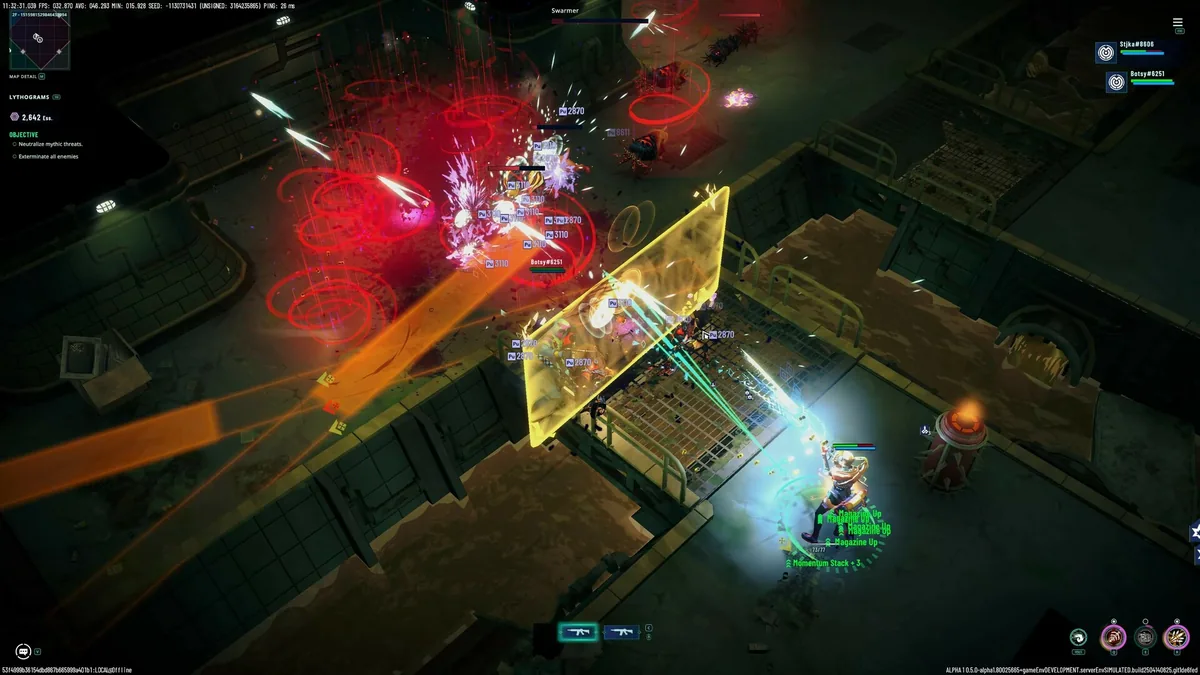 Momentum Stack and Magazine Up are real floating combat text in RIFTSTORM's own screenshots, not fan-wiki speculation, matching the sustained-fire identity Confiction Labs describes for Starling.
Hertz, the Roseguard frontline disruptor
Confiction Labs describes Hertz as "a Roseguard frontline disruptor built to hold enemy attention," which is developer language for a tank, and the Wiki's kit details back that up: a leaping AoE opener (Stage Dive), a slowing aura (Tempo Shift), and a taunt with temporary damage reduction (Freestyle Solo) that the Wiki specifically calls out as RIFTSTORM's answer to solo-queue survivability.
If you're playing without a set group and want the least punishing learning curve for absorbing hits instead of avoiding them, Hertz is the wiki-documented pick, and his taunt kit is the reason.
Botsy, the Containment technician
The official framing for Botsy is "a Containment technician who turns the battlefield into a problem for the enemy," and the Wiki's kit confirms a turret-based playstyle: Roll Call and Hideout summon deployable turrets (capped at two active at once, per the wiki), and Conductive Paint triggers a damaging aura from whatever turrets are already down.
Botsy trades personal mobility for map control, according to the wiki's own framing, which makes him a stronger pick for missions with chokepoints or extraction corridors than open, sprawling arenas.
Caracal, the Interregnum marksman
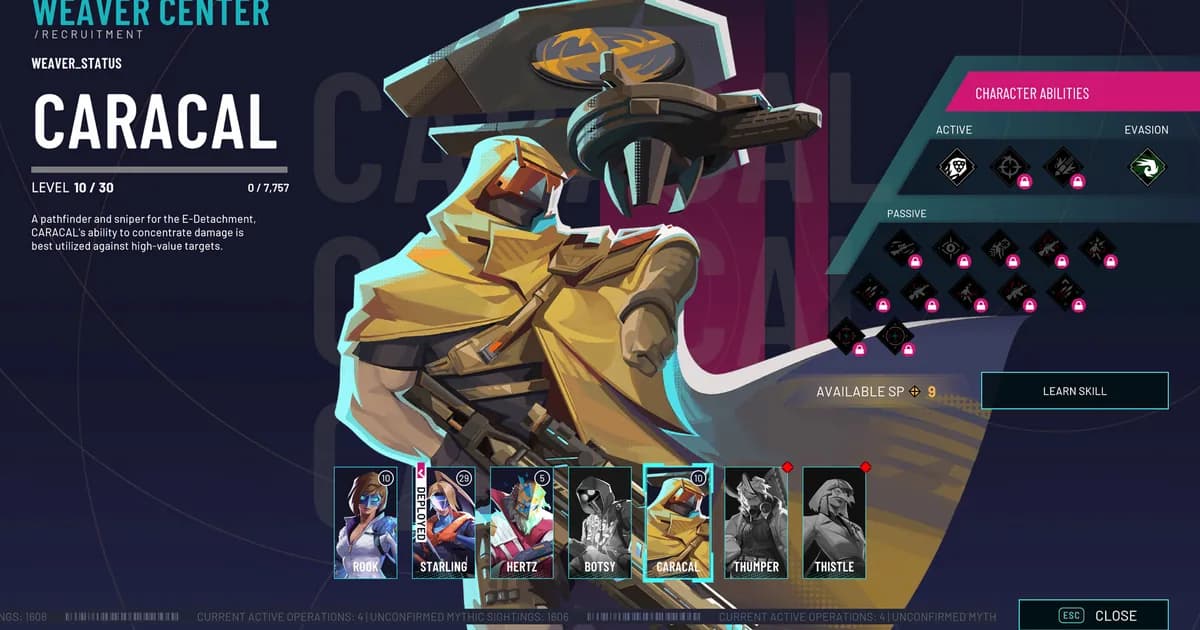
Confiction Labs' launch post describes Caracal as "an Interregnum marksman supported by his Kestrel drone," the clearest official detail about any Weaver's kit beyond role framing. The in-game Weaver Center recruitment screen adds a second, independently verified detail: it describes Caracal in-mission as "a pathfinder and sniper for the E-Detachment" whose "ability to concentrate damage is best utilized against high-value targets."
Caracal is also the one Weaver where the RIFTSTORM Wiki explicitly declines to publish specific ability names, cooldowns, or passive labels, stating outright that his kit "may shift patch to patch" and that fan speculation shouldn't be treated as confirmed until Confiction Labs' own patch notes catch up. That's a more honest gap than most fan wikis leave, and this guide is following the same rule: Caracal fights at range with drone support, and the exact buttons aren't nailed down publicly yet.
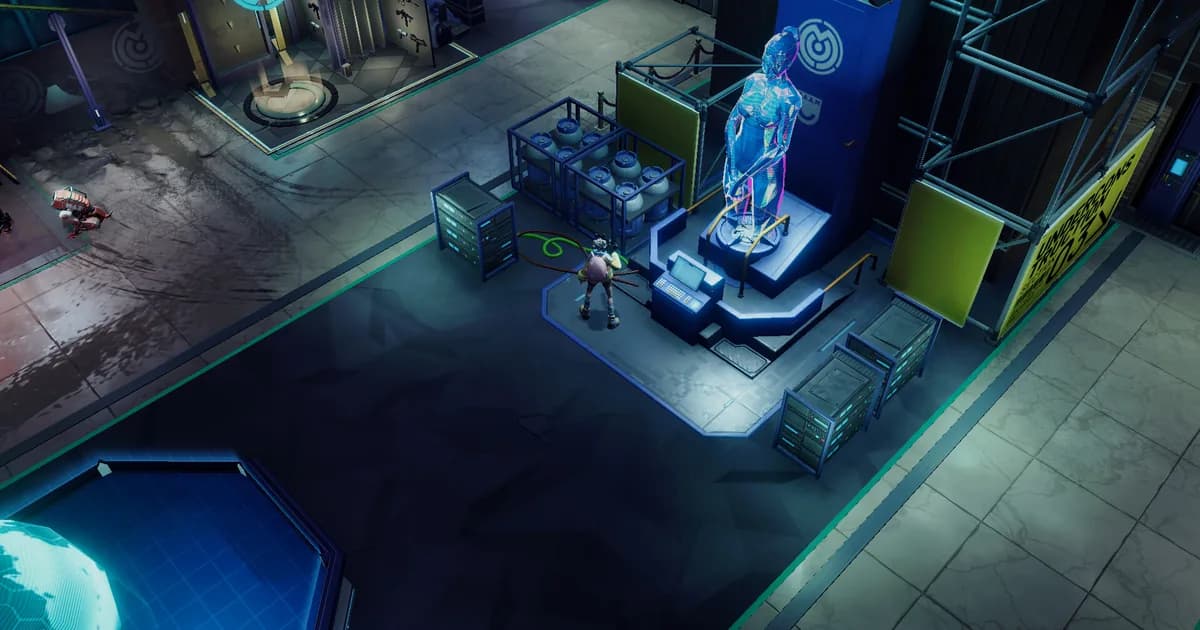
The Weaver Center recruitment screen (see the hero image at the top of this guide) makes the "five is a starting point" framing visible, not just a line in a press release. Scroll through the roster there and you'll see seven character cards, not five: Rook, Starling, Hertz, Botsy, and Caracal in full color, plus two grayed-out silhouette cards labeled Thumper and Thistle with lock icons over them. Those two names match what the RIFTSTORM Wiki separately documents as teased, unreleased Weavers from earlier marketing material, now sitting as reserved slots in the actual game files.
Building a balanced 3-player squad
RIFTSTORM hard-caps co-op at three players, so every seat in your squad has to earn its place. Because Confiction Labs has published role descriptions rather than a stat sheet, squad building here is closer to picking positions than min-maxing numbers, at least until more balance data exists.
A squad built around Rook, Starling, and Hertz covers the basics cleanly: Rook's stagger and mines control space, Starling maintains ranged pressure, and Hertz holds a chokepoint if the fight gets crowded. Swap Hertz for Botsy if your group prefers to fight from fixed positions rather than mobile skirmishes, since Botsy's turrets reward staying near your own deployables instead of chasing the fight.
Caracal is the harder slot to plan around precisely because his kit isn't fully documented yet. Treat him as a flexible marksman pick who pairs naturally with a frontline Weaver like Hertz absorbing attention while Caracal and his Kestrel drone work from range.
The one comp to avoid on a new squad: three ranged, mobility-focused picks with nobody willing to hold a position. RIFTSTORM's missions escalate enemy pressure the longer you stay, and a squad with no one anchoring a chokepoint tends to get spread thin exactly when Rift Exposure Zones start rewarding riskier plays. If you want a deeper breakdown of how a similarly capped co-op roster splits into working comps, DRG Rogue Core's team composition guide walks through the same tradeoff for its five-class roster.
Tips for your first deployment
Don't bring your best weapon into an unfamiliar mission. Weapon Scarring only punishes gear you actually carried in. A weapon sitting safely at the Forge Center can't get scarred, so treat early runs as scouting trips, not gear tests.
Learn one Weaver's kit before splitting attention across two or three. RIFTSTORM's mid-mission Lythogram system rewards recognizing which upgrades synergize with abilities you already understand. Switching Weavers every session resets that learning curve each time.
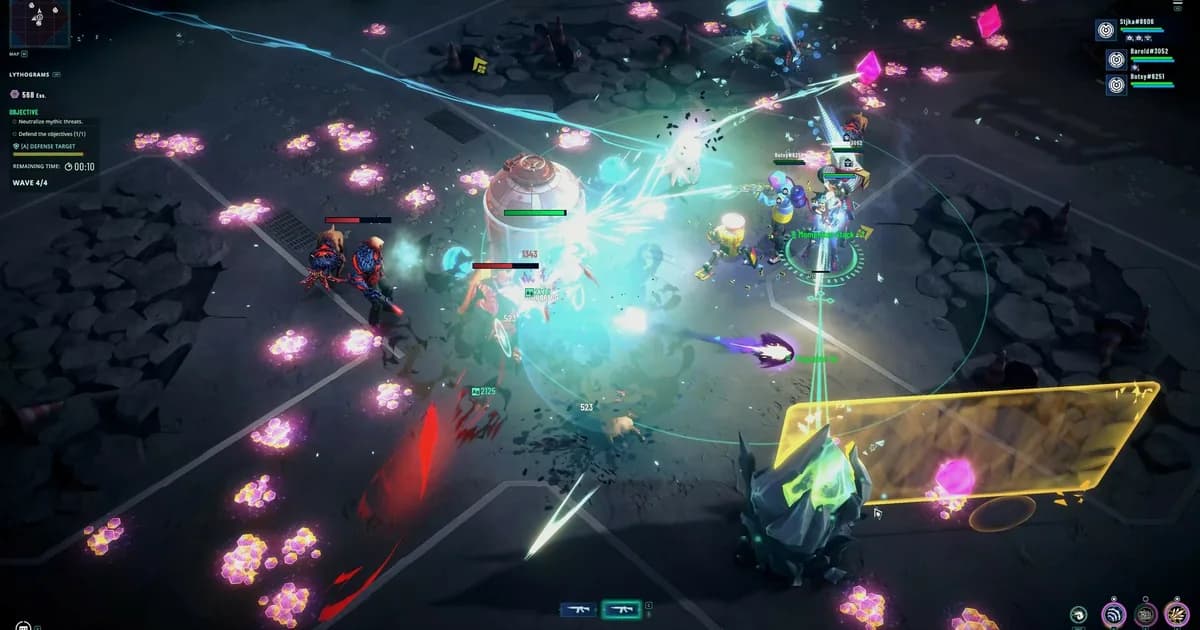
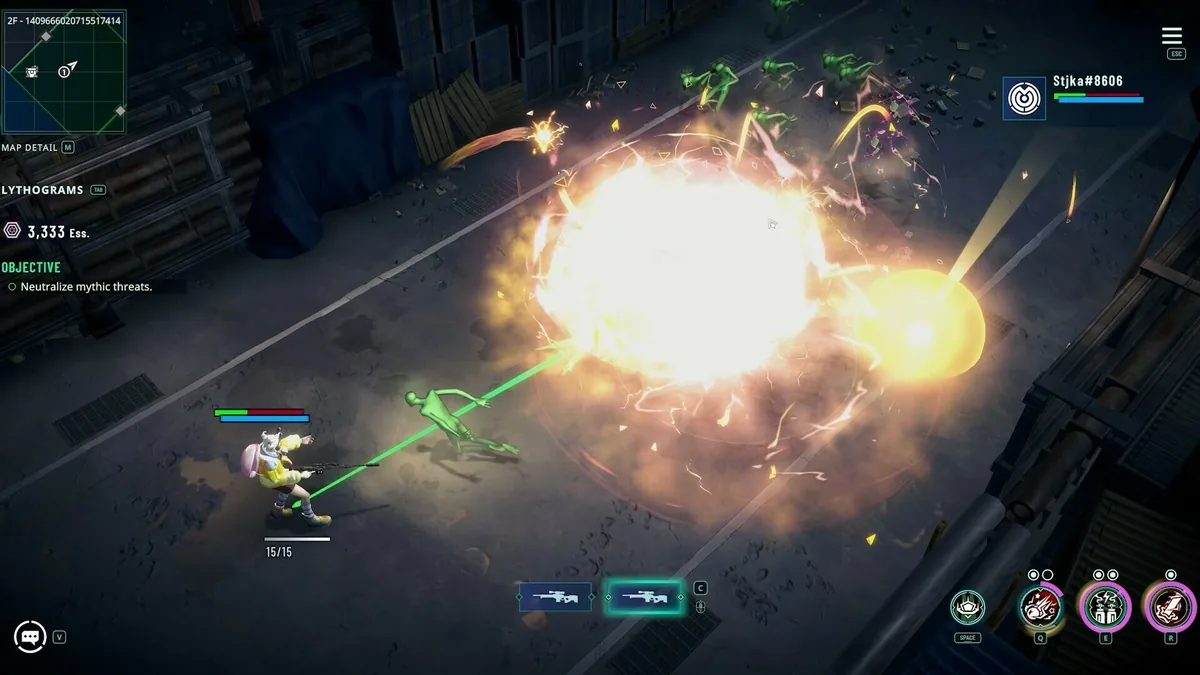 The Lythograms panel and Essence counter sit onscreen through every fight, a running reminder of exactly which upgrades and resources this Weaver's build is currently pulling from.
Communicate before locking Threat difficulty. Higher Threat scales loot and enemy pressure together, and a mismatch between your squad's gear level and the selected Threat tier is one of the fastest ways to turn a mission into a scarred-weapon run for everyone.
Watch for Rift Exposure Zones before committing to them. These are the game's designated high-risk areas: better loot, denser enemy spawns. Decide as a squad whether you're pushing in or extracting with what you already have, rather than letting one player make that call mid-fight.
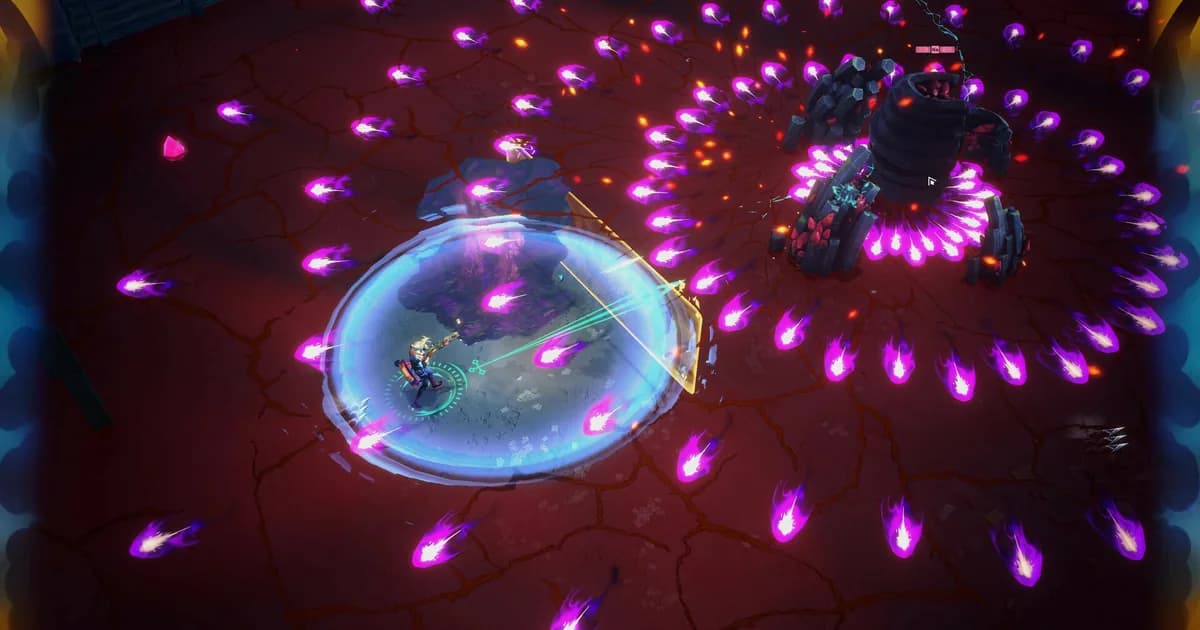
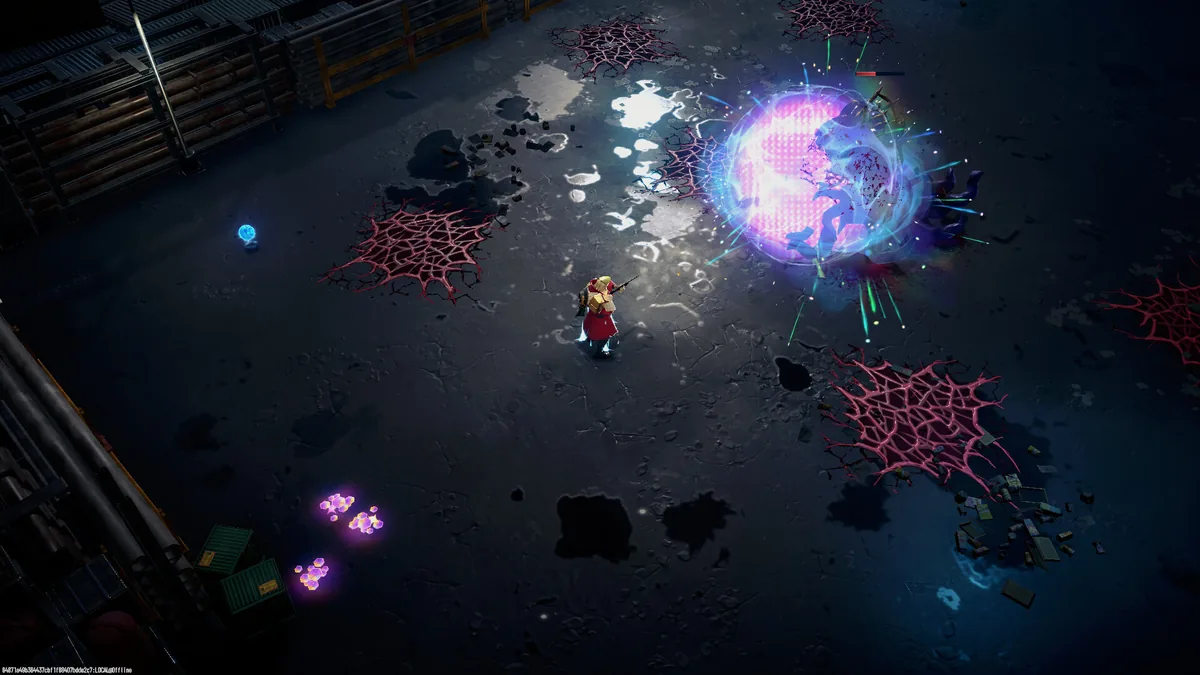 This is a Rift Exposure Zone mid-escalation: hazard patches creeping across the ground and a rift-energy bloom that punishes standing still, exactly the moment a squad needs to decide push or extract.
Track official balance patches, not just wiki pages. Confiction Labs has been explicit that Weaver kits can change, including temporary removals if something is clearly overtuned or undertuned. A guide read a month after publish may already be describing a kit that's been adjusted since.
GODEEPER: The Weaver count in this guide isn't the end state. See the full four-phase plan, including two more Weavers already promised before BLACKSITE, in our RIFTSTORM roadmap breakdown →
Common mistakes new Weavers make
Assuming a "best Weaver" exists at launch scale. Five Weavers with role-based kits doesn't produce a meaningful tier list the way a twenty-character roster might. The better question is which role your specific squad is missing, not which Weaver wins in a vacuum.
Overcommitting Periapt resources to one Weaver too early. Periapt is RIFTSTORM's between-mission account progression, and it's meant to persist across successful runs. Spending everything on a single Weaver's path before confirming that kit is stable through a balance pass risks wasted investment if Confiction Labs adjusts it.
Ignoring Weapon Scarring risk on Threat levels above your squad's comfort zone. Pushing a higher Threat tier with an under-leveled squad is the most common way new players lose weapons they were still upgrading, not the enemy difficulty itself.
Treating fan-wiki ability names as officially locked. The kit details in this guide, and on the RIFTSTORM Wiki, describe the Early Access build as documented in mid-August 2026. Confiction Labs has already flagged that balance changes are coming, so a specific number or cooldown can shift without warning.
Frequently Asked Questions
How many Weavers are in RIFTSTORM? Five at Early Access launch: Rook, Starling, Hertz, Botsy, and Caracal. Confiction Labs has confirmed two more Weavers are planned during Early Access, so this count is expected to grow, not stay fixed.
Which RIFTSTORM Weaver is best for beginners? Rook. Confiction Labs calls him the adaptable Protocol generalist, and his grenade, stagger bolt, and mine kit covers offense and crowd control without demanding a single playstyle from a new squad.
Is RIFTSTORM solo or co-op only? Both. You can deploy alone or with up to two friends for a three-player squad, the hard cap on party size. Solo play is viable but loses any squad-proximity bonuses a Weaver's kit offers.
What happens if a RIFTSTORM mission fails to extract? Weapon Scarring. You lose everything found on that run, and any weapons you brought in survive but get a random negative mod, staying usable but weaker until repaired or replaced.
Will RIFTSTORM add more Weavers after Early Access? Yes. Confiction Labs' roadmap runs through 2028 across four named Contingencies: PADDOCK (now), BLACKSITE (2027), GREYLINE (2027), and STORMSURGE (2028). Two more Weavers are promised within PADDOCK itself, with BLACKSITE and GREYLINE adding further Weavers and new Mythic threats.
Is there an official RIFTSTORM Weaver tier list? Not from Confiction Labs, and a five-Weaver launch roster is too small for a meaningful tier list anyway. Role fit for your squad matters more than ranking five operatives against each other.
What are Periapt and the Forge Center in RIFTSTORM? Periapt is account-level progression that persists between missions. The Forge Center is the hub station where you craft and salvage weapons using materials pulled from successful extracts.
Related Reading
- RIFTSTORM Beginner Guide: Extraction, Lythograms, Scars: a fuller walkthrough of extraction, Lythogram upgrades, and how Weapon Scarring actually works mission to mission.
- RIFTSTORM Roadmap: All 4 Early Access Contingencies: the full PADDOCK-to-STORMSURGE roadmap, including exactly when the two extra Weavers are expected.
- RIFTSTORM Review: Early Access Extraction Shooter, Tested: a hands-on verdict on the launch build, past the Weaver roster into stability and mission variety.
- Outbound Co-op Guide: Roles, Energy, and Van Builds: another co-op-first Early Access title with the same "who does what in a small squad" planning problem.
References
- RIFTSTORM on Steam: official store page, pricing, reviews, and system requirements
- RIFTSTORM Is Now Available in Early Access + Roadmap Reveal: Confiction Labs' own August 11, 2026 launch and roadmap post, the primary source for all five Weaver role quotes and the "two additional Weavers" confirmation
- RIFTSTORM Wiki: independent fan wiki with dedicated per-Weaver pages, cited for kit and ability names not published in official materials
- RIFTSTORM Is Out Now!: official RIFTSTORM YouTube channel, Early Access launch video, August 11, 2026
Was this guide helpful?
About the author

Senior Critic & Analyst
Former game data analyst turned critic with 11 years covering indie and mid-tier games. Based in Austin. Runs spreadsheets on games most people just play.
- 11 years games criticism
- Former game economy analyst
- Roguelike and strategy specialist
Keep reading
RIFTSTORM Beginner Guide: Extraction, Lythograms, Scars
General · 17 min
RIFTSTORM Roadmap: All 4 Early Access Contingencies
General · 10 min
RIFTSTORM Co-Op Guide: How 3-Player Squads Actually Work
General · 12 min
RIFTSTORM Review: Early Access Extraction Shooter, Tested
General · 13 min
Bronzebeard's Tavern 2 Demo: From 1M Downloads to Goblins
General · 11 min

Solarpunk Roadmap 2026: What Comes After Update 1.3.0
Guides · 8 min
Game deals · affiliate links

Disclaimer
This article is published for informational and entertainment purposes. It does not constitute professional financial, legal, or technical advice. Game performance, online services, patch schedules, and store listings change. Verify critical details (pricing, system requirements, regional availability) with publishers and storefronts before you buy. Affiliate links, where present, help support our editorial work and are labelled in our affiliate disclosure.
Comments
Loading comments…