
GuideTetherGeist
TetherGeist Speedrun Guide: Routes, Tech & Practice
About the game
TetherGeist
O. & Co. Games and Out of Space Games
This TetherGeist speedrun guide covers the real route ecosystem: Any%, 100%, level boards, movement tech, Livesplit, and room-by-room practice. TetherGeist is unusually well suited to time attack because the official design pitch is built around short precision rooms, frequent checkpoints, and finding efficient ways to move through the same geometry.
TL;DR: Start on Speedrun.com with Any% and the current rules. Learn the route one level at a time, then add the nectar boost and firecracker techniques once you can reproduce them safely. The community has a route-and-tech sheet, a Livesplit autosplitter setup, and practice saves through
tethergeist_utils. Use 100% only after you understand what that category currently requires.
TetherGeist speedrun guide? (quick answer)
- Speedrun.com lists full-game Any% and 100% categories plus separate level leaderboards.
- The game page currently shows 18 level boards, so a full-game route is not the same thing as a 17-level Atropa sweep.
- The public community guides cover routes and tech, then a separate Livesplit guide covers splits, autosplitting, layouts, and practice saves.
- The hidden Steam achievements identify nectar boost and firecracker tech, with crouch spam as another movement-input challenge.
- The best improvement loop is room practice first, checkpoint consistency second, and full-run resets last.
- Route details can change with category rules and game versions. Read the current leaderboard page before submitting a run.
What makes TetherGeist speedrun-friendly?
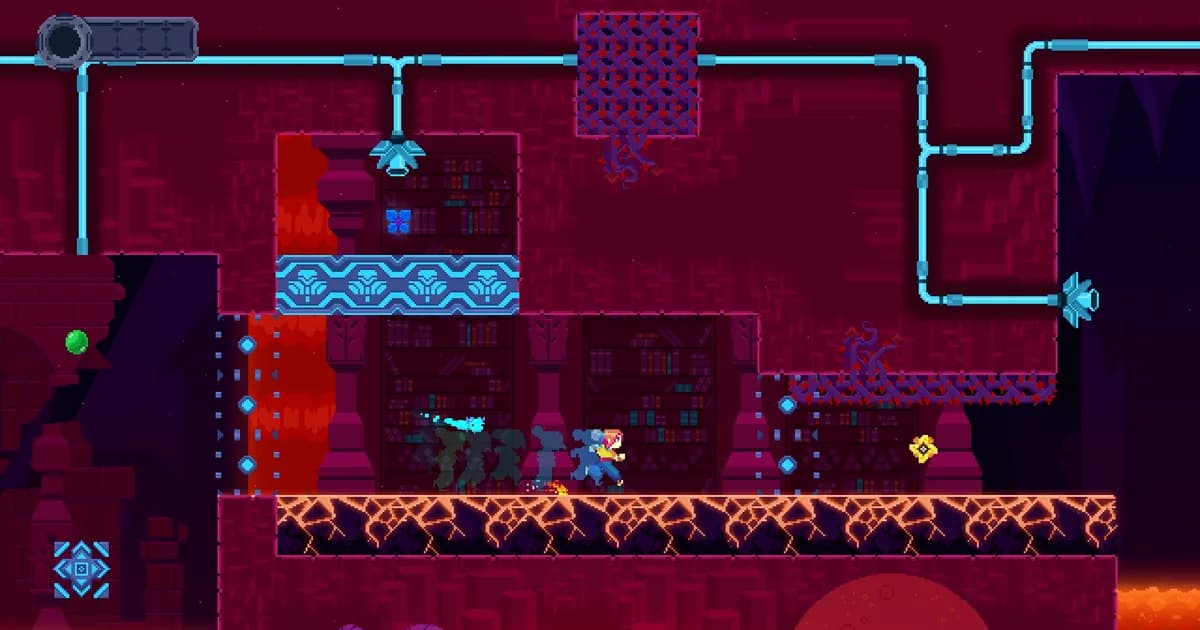
The official Steam page calls TetherGeist a speedrunner's dream and describes timed runs as a way to push the movement system. That claim is not just marketing filler. The game has no combat encounters, inventory screen, crafting loop, or upgrade tree competing for route time. A run is a sequence of deterministic movement decisions through short rooms.
The same design creates a useful practice rhythm. Checkpoints are frequent, retries are quick, and every death tells you whether the problem was an angle, a projection, a bounce, or a missed movement input. You can isolate one decision instead of replaying a ten-minute combat section.
The official press kit makes the same point in different words: the team describes several efficient ways to move through a screen and frames the game as a speedrunner's dream. It does not publish a complete route, split list, or exploit guide. Those details belong to the community boards and route documents, which is why this article links them separately instead of inventing a route from the screenshots.
The TetherGeist complete guide is useful before speed practice because it explains the seven Azae and the checkpoint loop. The speedrun goal is not to skip learning those rules. It is to turn a known rule into a repeatable line.
A speed route still begins with a solved room: the faster line is only useful when its movement decisions are repeatable.
Categories and leaderboards
At the September 28, 2026 audit, Speedrun.com listed full-game Any% and 100% categories alongside 18 level leaderboards. The page also showed an active board with recorded runs and players, which is enough to establish a real scene without treating a moving leaderboard snapshot as a permanent record.
Use the categories like this:
- Any%: the fastest completion under the current category rules. This is the best starting point because it teaches the main route without adding a large collection checklist.
- 100%: a completion category with its own rules. Do not assume it simply means all 262 Atropas or copy the site's completion achievement; read the current Speedrun.com definition first.
- Individual levels: short practice targets that let you compare a movement idea without spending an entire run. The site currently exposes 18 level boards.
The distinction between the Atropa checklist and the 18 level boards is important. The public Atropa guide counts 262 flowers across 17 collectible levels and excludes the final story level. Speedrun.com's level board count is a leaderboard structure, not a statement about collectible distribution. Do not merge those numbers when planning a category.
Before submitting, check the current rules, platform notes, game version, and timing method on the category page. The fastest run can be invalid for a category if it uses an unapproved build or timing convention. A route document is a learning aid; the leaderboard rules are the authority.
Route and tech resources
The Speedrun.com guides page currently links two especially useful resources:
- Tether Geist Routes and Tech: a route document with movement notes and a linked Google Sheets route and tech guide.
- Livesplit Autosplitter and practice setup: a guide that links the tethergeist_utils GitHub repository, splits, a layout, an autosplitter, and room practice saves.
Those guides are more valuable than a generic “hold forward” walkthrough because they preserve the knowledge that actually lowers a time: where a line starts, what tech is safe in a room, and which movement can be practiced in isolation. They are community-maintained, so check the update date and version note before treating a file as current.
The TetherGeist tips guide covers the same core habit from a casual player's side: read the screen before throwing Bao. The speedrun version of that advice is shorter and stricter. Read once, commit once, and reset quickly when the line is no longer viable.
The movement tech worth practicing first
The names below are verified through the Steam achievement data mirror and the public speedrun resources. The achievement list is useful because it confirms that the techniques are real named targets, while the route document explains how runners incorporate them.
Nectar boost
The hidden achievement New Wave asks the player to use the nectar boost speedrun technique. Treat this as a controlled acceleration tool, not a magic shortcut. First learn the room without it, then practice the boost from a repeatable position. A boost that saves a second but causes a reset on half your attempts is not yet a time save.
Practice questions:
- Where must Mae stand before the boost?
- Does the boost change the intended Bao projection, or only the approach speed?
- What is the recovery line if the landing is slightly late?
Write the answers into your split notes. The goal is to turn “use nectar here” into an input sequence with a recognizable failure state.
Firecracker tech
The hidden achievement Firecracker confirms a separate firecracker speedrun technique. Do not assume it is interchangeable with nectar boost. Learn the trigger, the safe setup, and the room where the route document expects it before trying to combine it with a fast segment.
If a tech is inconsistent, slow the room down until the setup is boring. A stable two-second loss is better practice than a flashy attempt that teaches you nothing about why the room failed.
Crouch spam and snap jump
Cut that out. asks you to spam the crouch button, and Snappy asks you to spam the snap jump. These are also achievement conditions, but their value for a serious run depends on the current route. Practice them as input literacy first. Do not add a button mash to a full-game run just because it has an achievement attached.
The same principle applies to Ding Ding, which asks for one spirit to bounce over 50 times in a row in Chapter 4. It is a good control exercise, but not a universal Any% shortcut.
Normal tether lines
Most time saved will come from ordinary projections that you no longer need to re-read. The seven Azae do not behave like a linear upgrade tree. Each chapter asks you to understand a different interaction, and a route only becomes fast after that interaction is automatic.
The achievements guide lists the hidden movement achievements and the chapter-specific milestones. Use it as a checklist, not as evidence that every trick belongs in the fastest category route.
Step-by-Step: Build an Any% practice route
1. Read the current category rules: Open the Any% page on Speedrun.com and note the allowed platform, version, timing method, and reset policy. Save the page or copy the rule notes into your run document.
2. Install the timing tools before chasing a record: Follow the current Livesplit guide and inspect the linked tethergeist_utils files. Confirm that the autosplitter version matches your game build, and back up your save before using practice files.
3. Learn one level at a time: Use the individual level boards and route sheet. Finish the level without resets, then repeat until the line is reproducible. A single fast room is useful only when it survives a bad opening input.
4. Mark the first irreversible decision: For each room, identify the projection, bounce, boost, or firecracker input that commits the route. Practice the setup before the flashy movement. Most failed speed attempts are lost before the player realizes the line is gone.
5. Add tech after consistency: Insert nectar boost or firecracker tech only after the ordinary route is stable. Compare completed attempts, not highlight clips. If the tech causes more resets than it saves seconds, put it back in the practice lane.
6. Connect two levels at a time: A full run is too long to diagnose early. Join the end of one level to the start of the next, then expand the block when the transition stops costing attention.
7. Use full resets intentionally: Reset when the category rules or your own split plan says the run is no longer competitive. Do not reset every imperfect jump during learning; those attempts reveal which mistakes are recoverable.
8. Submit only after a rules check: Re-read the category page, verify your timing file, and keep the raw recording. A personal best is still useful practice, but a leaderboard submission needs the current verification requirements.
Livesplit and practice-save workflow
The Livesplit setup guide links the autosplitter, splits, layout, and room practice saves through the tethergeist_utils repository. Its instructions describe a Windows save path under AppData/Local/TG_Dev, a tgsave file, and room-specific names such as c1p1r1. Because this workflow touches save data, copy your real save somewhere safe first and follow the current repository README rather than relying on an old filename from memory.
The useful practice loop is:
- Load one room.
- Perform the intended route at normal speed.
- Add one technique.
- Repeat until the technique has a predictable setup and recovery.
- Rejoin the room to its level split.
- Only then add the segment to a full run.
Practice saves also expose a common misconception about speedrunning TetherGeist. The goal is not to make every room frantic. It is to remove hesitation from the one decision that controls the room. A runner who reads the geometry once and commits can beat a runner who presses faster but recalculates mid-flight.
A good practice room isolates one commitment: projection angle, landing, or the next safe line through the hazard.
Common speedrun mistakes
Learning a record route before learning the room. If the route document says to use a boost, understand the room's normal line first. Otherwise every failure looks like a tech failure.
Treating the leaderboard time as permanent. Times, version labels, and category rules move. The September 28 snapshot is a research timestamp, not a promise that the same record will still lead when you submit.
Mixing Any% and 100% objectives. The 100% route may require detours that are actively bad for Any%. Keep separate notes and separate splits.
Using a practice save without a backup. The community setup guide is useful, but save manipulation is still a file operation. Back up the real save and verify the build before loading a room file.
Resetting too early. Some misses are recoverable. Learn the recovery line before turning every imperfect jump into a reset, then reset decisively once the run is genuinely outside your plan.
Confusing achievement tech with category tech. New Wave and Firecracker prove that named techniques exist. They do not prove that a specific category requires them or that every room benefits from them.
GODEEPER: Learn the underlying Azae rules before making the route fast. TetherGeist Complete Guide: Azae, Tips & Walkthrough →
GODEEPER: The full completion route is a different problem from Any%. TetherGeist Achievements Guide: All 49 Steam Unlocks →
Frequently Asked Questions
Does TetherGeist have a speedrun category?
Yes. Speedrun.com lists full-game Any% and 100% categories, plus separate level leaderboards. Read the current rules before submitting.
What tech should I learn first?
Start with the normal room line, then practice nectar boost and firecracker tech from the community route materials. Add a technique only after its setup is repeatable.
Is there a Livesplit autosplitter?
Yes. The Speedrun.com guide links a Livesplit setup and the tethergeist_utils GitHub repository with splits, layout, autosplitter, and practice-save resources.
What is the difference between Any% and 100%?
Any% targets a fast finish under current rules. 100% has its own completion requirements, so check the category page instead of assuming it means all 262 Atropas.
Can I practice individual rooms?
Yes. The community Livesplit guide describes Windows room practice saves. Back up your save and verify the files against your current build first.
Are the speedrun achievements required for a run?
No. New Wave, Cut that out., and Firecracker are Steam achievements. A speedrun category follows its published rules, not the achievement list.
Related Reading
- TetherGeist Complete Guide: Azae, Tips & Walkthrough: the movement system that every route builds on.
- TetherGeist Tips: Mastering Azae, Angles, and Hard Screens: casual practice habits for difficult rooms.
- TetherGeist Achievements Guide: All 49 Steam Unlocks: hidden movement-tech achievement conditions.
- TetherGeist Atropa Guide: All 262 Collectible Locations: the separate collection route and level totals.
- TetherGeist True Ending Guide: Is 201 Atropas Enough?: why 100% and ending goals are different.
- TetherGeist Review (2026): the game's difficulty curve and narrative context.
- Mina the Hollower Trinkets Guide: another indie route with room-by-room completion planning.
- Black Jacket Journey Guide: a separate chapter route for comparison.
References
Was this guide helpful?
About the author

Games Critic
Games writer and reluctant optimist who has reviewed over 400 titles across 9 years. Irish, currently in Berlin. Has strong opinions about tutorial design.
- 400+ games reviewed across 9 years
- Platformer and horror specialist
- Narrative design focus
Keep reading
TetherGeist True Ending Guide: Is 201 Atropas Enough?
General · 13 min
TetherGeist Achievements Guide: All 49 Steam Unlocks
General · 15 min
TetherGeist Atropa Guide: All 262 Collectible Locations
General · 13 min

TetherGeist Complete Guide: Azae, Tips & Walkthrough
General · 14 min

TetherGeist Tips: Mastering Azae, Angles, and Hard Screens
General · 9 min

TetherGeist Review: Precision Platforming Worth the Pain
General · 8 min
Game deals · affiliate links

Disclaimer
This article is published for informational and entertainment purposes. It does not constitute professional financial, legal, or technical advice. Game performance, online services, patch schedules, and store listings change. Verify critical details (pricing, system requirements, regional availability) with publishers and storefronts before you buy. Affiliate links, where present, help support our editorial work and are labelled in our affiliate disclosure.
Comments
Loading comments…