
ARC Raiders · Guides
ARC Raiders Currency Guide: Coins, Seeds and the 2.0 Changes
ARC Raiders currency guide: the game uses Coins, not credits. How Coins, Seeds, Raider Tokens and Skill Points work, and what 2.0 changed by removing Cred.

Sponsored

About the game
ARC Raiders
Embark Studios
This ARC Raiders currency guide lists every currency in the game, where each one comes from and what it buys, checked against the ARC Raiders Wiki and Embark's patch notes on October 8, 2026. That date matters: the Frozen Trail update (2.0) removed one currency, added another and changed what one trader takes.
Updated 2026-10-08: rewritten. The earlier version described "credits" and a vendor relationship XP system with level-gated recipes; neither matches the game. The trader currency is Coins, traders have no relationship levels, and Cred was removed in 2.0.
TL;DR: The ARC Raiders currency guide in short: Coins come mainly from selling Topside loot and buy from Tian Wen, Apollo, Lance and, since 2.0, Shani. Assorted Seeds trade with Celeste. Raider Tokens are the premium cosmetic currency. Skill Points come from leveling. Cred was removed on October 8, 2026 and replaced by Reward Points for the new Reward Pass.
 Image: ARC Raiders key art, official site (arcraiders.com). Game art is the property of Embark Studios.
BESTPRICE: Want ARC Raiders? These stores list it: Buy on Eneba → Buy on Green Man Gaming → Buy on Humble Bundle →
What currencies does ARC Raiders use? (quick answer)
The wiki lists six currencies: Assorted Seeds, Coins, Cred, Merit, Raider Tokens and Skill Points. Since the 2.0 update, Cred is gone and Reward Points are new. Coins are the one you will spend most, and you earn them mainly by selling what you extract.
Key takeaways
- Coins are the main trader currency. Selling Topside items is the primary source.
- Assorted Seeds are the currency for Celeste.
- Raider Tokens are premium, used for cosmetics and premium passes.
- Merit only exists during Live Events and does not carry over.
- Skill Points: one per level, 76 in total, plus up to five per Expedition.
- Cred was removed in 2.0 and replaced by Reward Points.
ARC Raiders currency guide: every currency at a glance
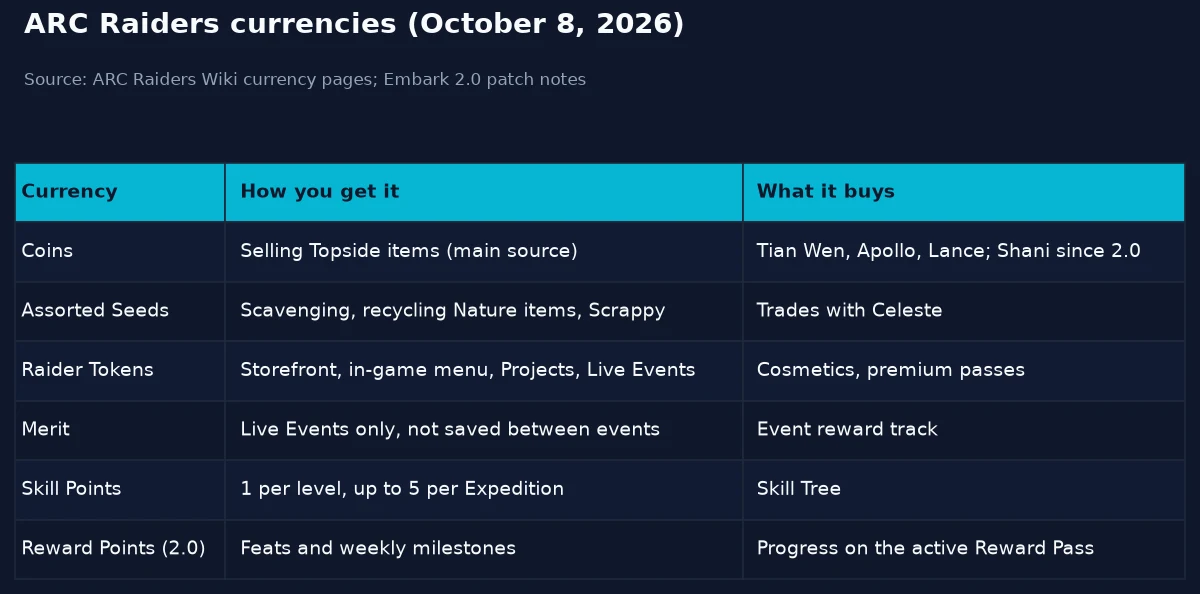 Image: table by GameBrief from the ARC Raiders Wiki and Embark's 2.0 patch notes
Coins. The wiki says Coins buy items from "Tian Wen, Apollo, and Lance" and are used "during the final phase of the Expedition project to determine the total value of items Raiders have." Its key line: "Selling items found Topside is the primary way of gaining Coins." Since 2.0, "Shani's offers are now Coin based." Our ARC Raiders loot guide covers what is worth selling.
Assorted Seeds. A Common item "used as currency to trade with Celeste." You get them from scavenging containers such as fridges, lockers and seed boxes, from "Recycling or Salvaging most Nature items," and from Scrappy. They "cannot be recycled," weigh 0.05, stack to 100 and sell for 100.
Raider Tokens. The premium currency. The wiki says they can be acquired "through your platform's storefront, the in-game menu," by completing Raider Decks, or from Projects and Live Events, and are used "to purchase cosmetics." The 2.0 Collector Set DLC includes 2,400 of them.
Merit. Earned only "during Live Events" and spent on an event reward track. The wiki is blunt: "It cannot be saved between events."
Skill Points. You get "one Skill Point each time" you level up, "for a total of 76," and "up to five Skill Points" per completed Expedition. Resetting the whole tree costs 2,000 Coins per Skill Point on the wiki's current page. The 2.0 update rebuilt the tree's layout, so check our skill tree tier list with that in mind.
GODEEPER: What to keep, sell or recycle decides how many Coins you bank. ARC Raiders Loot Guide →
What the 2.0 update changed
The Frozen Trail update on October 8, 2026 changed the currency side more than any patch before it.
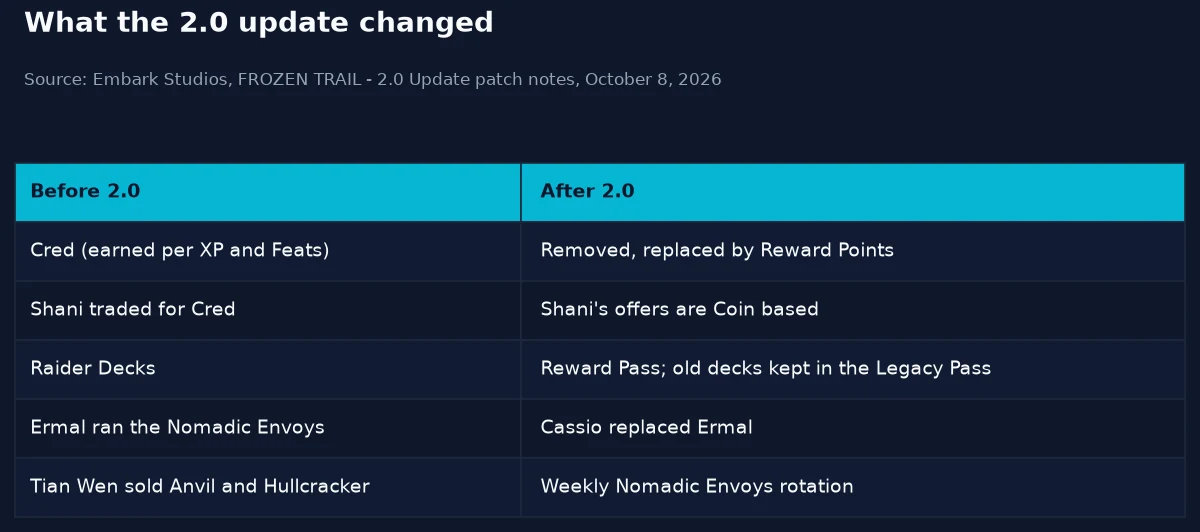 Image: table by GameBrief from Embark's FROZEN TRAIL 2.0 patch notes
Cred is gone. Before 2.0, the wiki describes Cred as a currency spent at Shani or on Raider Deck tiles, earned at "1 Cred" per "2,000 Experience gained while Topside" and from Feats, with a soft cap of 800. The 2.0 notes say: "Cred has been removed from the game and replaced by Reward Points."
Reward Points and the Reward Pass. Reward Points apply automatically to whichever pass is active. The first is the Frozen Trail Pass, "featuring 60 levels across a Free and a Premium track." Old Raider Decks moved to a Legacy Pass, and "any rewards you've already unlocked are kept."
Feats pay Reward Points. Easy Feats give 15, Medium 25 and Hard 50, and each week has three milestones worth 250 Reward Points each, at 4, 8 and 12 weekly milestone progress.
Trader changes. Shani moved to Coins. Tian Wen "will no longer sell Anvil and Hullcracker offers," which now rotate weekly through the Nomadic Envoys, where Cassio replaced Ermal. Launcher Ammo and Energy Clips have a daily purchase limit. The full update is in our Frozen Trail 2.0 guide.
The removal was announced in game before it happened. In a "Friendly reminder to spend your Creds" thread, u/Sadaxer wrote: "I'm just glad the information is also in game this time, as well as the expedition pausing."
Step-by-Step
A simple order for managing currency, based only on what the sources above say.
1. Sell what you cannot use: Coins come mainly from selling Topside items, so loot you have no crafting or quest use for should become Coins.
2. Keep Assorted Seeds for Celeste: they are her trade currency and cannot be recycled.
3. Spend Skill Points as you level: one per level, up to 76; the 2.0 tree gives binary choices mid-branch, so read the options before you commit.
4. Pick your active Reward Pass: Reward Points only go to the pass you have set as active, Frozen Trail or Legacy.
5. Clear Feats for weekly milestones: three milestones a week pay 250 Reward Points each.
6. Check trader stock before big buys: some items now have daily limits, and the Anvil and Hullcracker only appear in the weekly Nomadic Envoys rotation.
Tips
- Do not plan around Expeditions right now. The wiki marks the Expedition project as "in a rework and has been temporarily paused." Our 5th Expedition article has the timeline.
- Merit is use-it-or-lose-it. It does not carry between events.
- Raider Tokens never buy power. The wiki lists cosmetics and premium decks as their use.
- Crafting saves Coins. The Ferro, for example, is crafted from 5 Metal Parts and 2 Rubber Parts at a Workbench or Gunsmith 1, per the wiki. The crafting guide covers the benches.
 Image: "The Frozen Trail Collector Set" video thumbnail, official ARC Raiders YouTube channel (Embark Studios)
Embark's video for the paid Collector Set, which includes Raider Tokens and the Premium Reward Pass:
GODEEPER: Every other change in the October 8 update, from Pendola Pass to Amplified weapons. ARC Raiders Frozen Trail: Everything in the 2.0 Update →
Our take
The currency system is simpler than the earlier version of this guide made it look. There is no vendor relationship XP to farm; Coins come from selling, Seeds go to Celeste, and Skill Points come from leveling. The real change is 2.0: with Cred gone, the free progression track now runs through Feats and Reward Points, so weekly milestones matter more than they did.
Frequently Asked Questions
What is the main currency in ARC Raiders? Coins, earned mainly by selling Topside items. They buy from Tian Wen, Apollo, Lance and, since 2.0, Shani.
Does ARC Raiders have credits? Not under that name. The trader currency is Coins. Cred, a separate currency, was removed on October 8, 2026.
What replaced Cred in ARC Raiders? Reward Points, which feed whichever Reward Pass is active.
How do you get Skill Points in ARC Raiders? One per level (76 total) plus up to five per completed Expedition.
What are Assorted Seeds used for in ARC Raiders? Trading with Celeste.
Are Raider Tokens a premium currency? Yes, bought through storefronts or the in-game menu, and also earned in Projects and Live Events.
Related Reading
- ARC Raiders Loot Guide: what to keep, sell or recycle for Coins.
- ARC Raiders Frozen Trail 2.0 Update: the update that removed Cred.
- ARC Raiders Skill Tree Tier List: where Skill Points go.
- ARC Raiders Crafting Guide: crafting instead of buying.
- ARC Raiders Vendor Leveling: What Actually Unlocks Gear: traders have no levels; Workshop stations, blueprints and quests do the unlocking.
- ARC Raiders Weekly Reset Guide: Trials, Feats milestones and the Envoys' weekly offers.
- ARC Raiders 5th Expedition: the paused Expedition project.
- ARC Raiders Beginner Guide: first steps.
References
Was this guide helpful?
Keep reading




Sponsored

Disclaimer
This article is published for informational and entertainment purposes. It does not constitute professional financial, legal, or technical advice. Game performance, online services, patch schedules, and store listings change. Verify critical details (pricing, system requirements, regional availability) with publishers and storefronts before you buy. Affiliate links, where present, help support our editorial work and are labelled in our affiliate disclosure.
About the author

Action & Design Desk
GameBrief's byline for platformers, horror and action games. Dry, short paragraphs, strong opinions about tutorials and boss design.
- Action, platformers and horror
- Tutorials, onboarding, boss design
- Sources listed per article