
GameBrief · Guides
Increbouncer Beginner Guide: Ball Types and Upgrades
Reviewing
Increbouncer
Blasted Games
This Increbouncer beginner guide covers the confirmed ball types, how the two-currency income system works, and how achievements stack into a permanent income bonus. Blasted Games released Increbouncer on September 11, 2026, framing it directly as "a short, incremental ball game where you bounce balls, earn money, upgrade your balls and unlock new ones to automate and increase your income."
TL;DR: Increbouncer is a short incremental game: bounce balls off walls and each other to earn Money and Collisions, then spend both on new ball types and skill tree upgrades. At least 5 ball types are confirmed (Normal, Auto, Fire, Water, Grass), each with its own cost and income rate. Achievements grant permanent, stacking percentage bonuses to your income.
What is Increbouncer actually about? (quick answer)
You buy and place balls that bounce around the screen, earning Money every time a ball hits a wall and a separate currency, Collisions, every time two balls hit each other. The official description frames the loop directly: "The more balls on screen, the more money flows in, sit back and watch the chaos pay off." You spend both currencies on new ball types, upgrades in a skill tree that improves income and bounce physics, and chase achievements that grant permanent bonuses, all tracked through a dedicated stats panel and global leaderboards.
Key takeaways
- Developer Blasted Games, released September 11, 2026, $2.99 base ($2.69 at a 10% launch discount)
- At least 5 ball types confirmed: Normal Ball, Auto Ball, Fire Ball, Water Ball, and Grass Ball
- Two currencies tracked separately: Money (from wall bounces) and Collisions (from ball-to-ball hits)
- Achievements grant permanent, stacking percentage bonuses to your income, confirmed via a running Bonus Total
- A skill tree improves income and bounce physics, and is itself tied to at least one achievement
- Global leaderboards let you compare progress against other players
Step-by-Step: your first session
1. Buy Normal Balls first, then diversify once you understand the economy: Normal Ball is confirmed as the cheapest, baseline option in every screenshot checked. Get a handful running before spending on the pricier Auto, Fire, Water, or Grass types, so you have an income baseline to judge whether a new ball type is actually worth its cost, the same "understand your baseline before diversifying" logic that matters in Tinymon RPG's move-selection economy.
2. Watch both currencies, not just Money: Collisions is tracked entirely separately from Money and feeds its own achievements and upgrades. A screen full of balls bouncing off walls but never touching each other is leaving half the game's economy unused, the same dual-resource attention our Thousand Hells beginner guide recommends for tracking party stats beyond just one headline number.
3. Chase the early, cheap achievements before the expensive ones: A confirmed achievement panel shows thresholds like reaching 10K total money, 100 collisions, and owning 10 balls, each with its own percentage reward that adds to a running total. These early thresholds are easy to hit just by playing normally, so claim them as soon as they're available rather than letting them sit uncollected.
4. Treat the skill tree as a real investment, not an afterthought: One confirmed achievement specifically rewards completing the skill tree, meaning it's not just a passive stat boost, it's a tracked goal with its own payoff. Check it regularly rather than only spending currency on new balls, the same discipline our Yushou Xianmen: Mortal Realm guide recommends for tracking faction tiers instead of just card count.
5. Let the game run passively once your ball count is high: The official description explicitly frames the late game as something to "sit back and watch," and a confirmed late-game screenshot shows dozens of balls generating six-and-seven-figure income numbers simultaneously. This is designed as an idle-friendly game, not one that demands constant clicking once your economy is established.
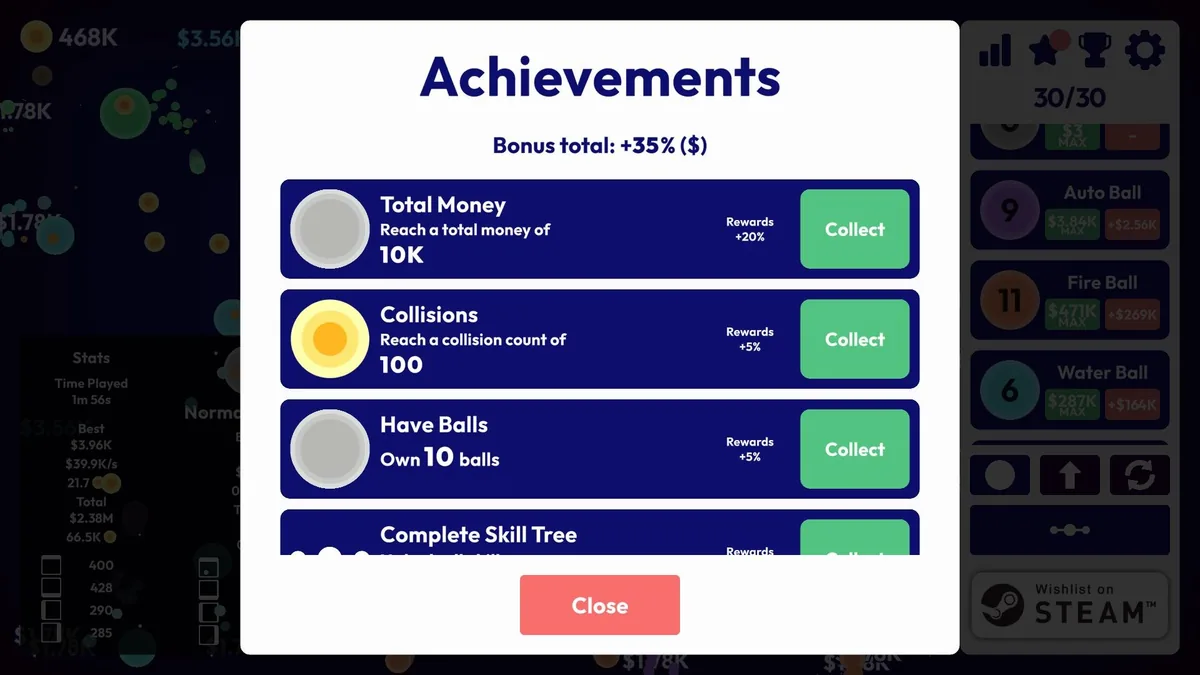 Caption: The achievements panel, confirmed in English, showing how individual achievement rewards stack into a single running income bonus.
GODEEPER: Looking for another incremental game with a deeper upgrade-tree structure to compare against? Our Orc Incremental beginner guide covers a different take on the genre with a card-drafting layer on top.
Ball types and the economy, what's confirmed
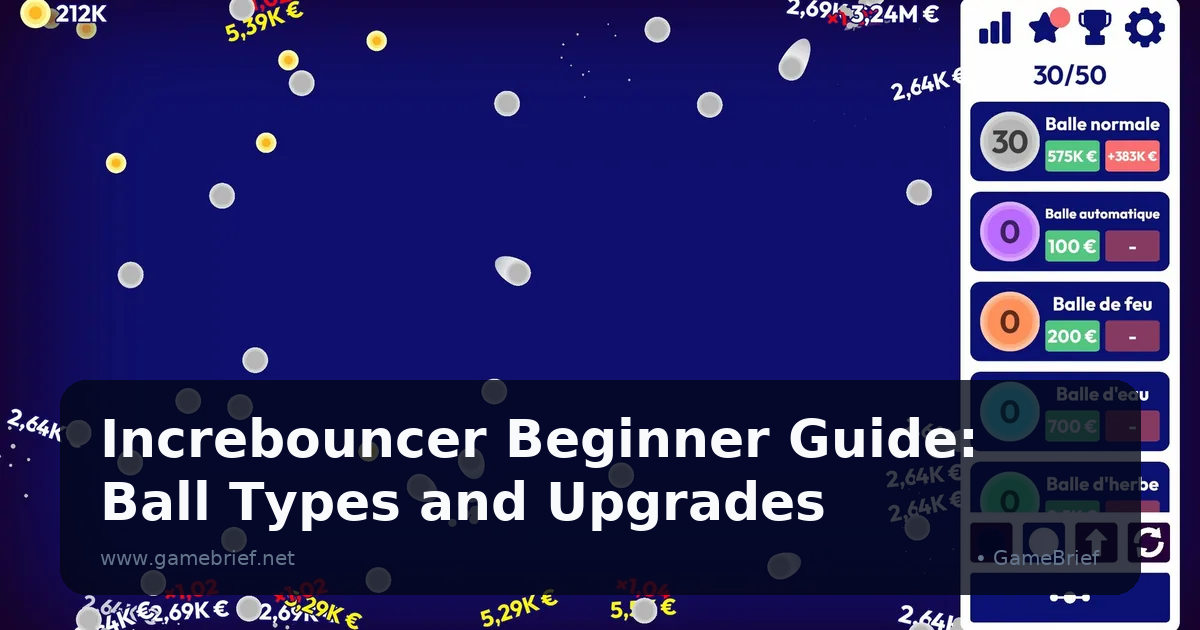
Screenshots confirm at least 5 distinct ball types, each with its own purchase cost and income contribution tracked in the shop panel: Normal Ball (the cheapest, baseline option), Auto Ball, Fire Ball, Water Ball, and Grass Ball. One screenshot (captured with the game's UI in French, cross-checked against a second, English-language screenshot to confirm the translations) shows each ball type's owned count, a maximum purchase cost, and an income contribution displayed separately, suggesting each type scales independently rather than sharing one flat upgrade curve. A late-game screenshot shows a ball count cap of 50 total (up from 30 in an earlier screenshot), suggesting the cap itself increases as you progress rather than staying fixed for the whole game.
Worth flagging directly: this guide translated the French UI terms into their plain English equivalents (Balle normale to Normal Ball, Balle automatique to Auto Ball, and so on) before separately confirming those exact English names against a genuinely English-language screenshot. That order matters. Translating a term and assuming it matches the developer's actual English wording is a real risk, official localized text sometimes differs from a literal translation in small but meaningful ways, so the confirmation step against real English UI text, not the translation itself, is what makes these names safe to publish here.
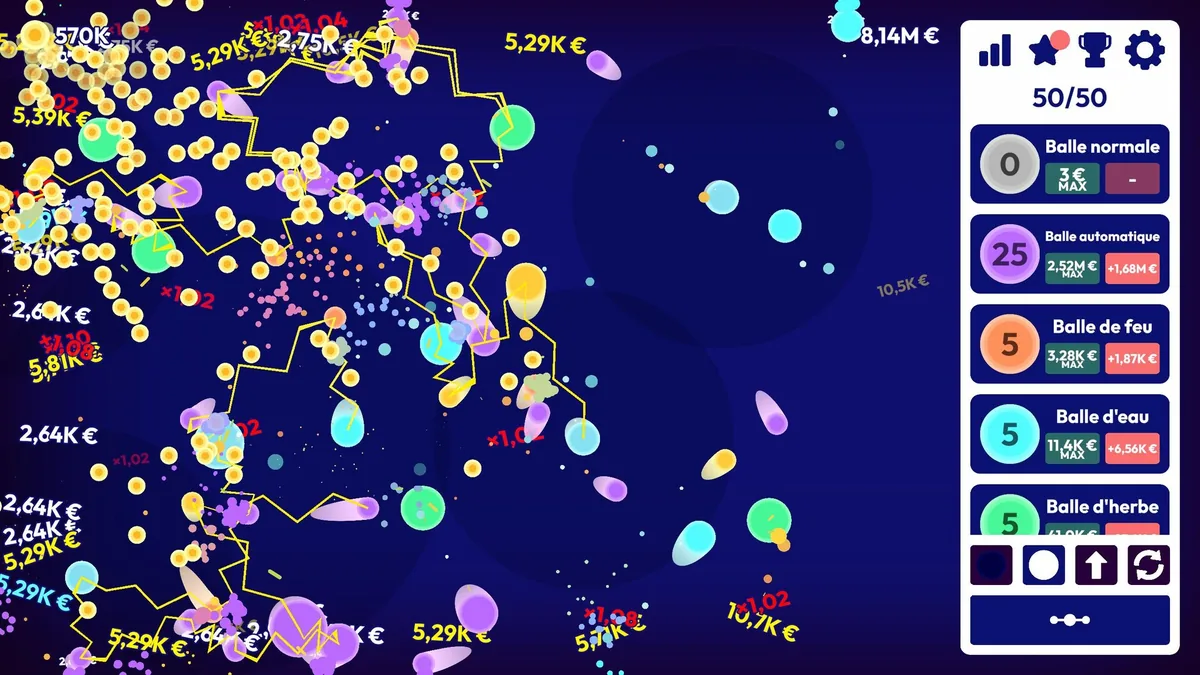 Caption: A later-game state with the ball cap raised to 50 and income numbers well into the millions, confirming the game's idle-scaling design.
Where Increbouncer fits among incremental games
The incremental genre spans a huge range of scope, from sprawling, months-long clickers with dozens of prestige layers to short, tightly-scoped experiences meant to be finished in a handful of sessions, a spectrum our Bugs. Billions of Bugs. beginner guide touches on from the tower-defense side of the same design space. Increbouncer's own framing as "short" and its confirmed structure (5-plus ball types, one skill tree, a finite achievement list, and a ball cap that raises rather than scales infinitely) puts it firmly in the second category. That's a real design choice worth knowing before you buy: if you're looking for a game that demands weeks of prestige-layer optimization, this isn't built for that. If you want a contained, physics-driven idle experience you can genuinely finish, the confirmed scope here suggests that's exactly what it's aiming for.
Is Increbouncer worth trying right now?
At $2.69 during its launch discount, Increbouncer is priced like a short, focused incremental rather than a sprawling idle game, which matches its own framing as "a short, incremental ball game." The confirmed systems, 5-plus ball types, a two-currency economy, a skill tree, stacking achievement bonuses, and global leaderboards, add up to more structure than the price point might suggest at a glance.
The honest limitation is the same one that applies to every other day-one pick covered on this site recently, the same restraint applied to Samgood Chronicles: DragonFall earlier this same week: no Steam reviews exist yet, and only the standard auto-posted new-release listing was found on Reddit, no organic player discussion. Treat the confirmed mechanics here as accurate and the overall pacing or balance of a full playthrough as still an open question until real feedback accumulates.
Related Reading
- Orc Incremental Beginner Guide: another fresh incremental launch from the same general stretch, with a card-drafting layer instead of a ball-physics economy.
- Samgood Chronicles DragonFall Beginner Guide: a very different genre pick from the same week, for contrast against Increbouncer's much shorter, lighter scope.
- Bugs. Billions of Bugs. Beginner Guide: another recent indie launch built around escalating on-screen chaos as its core hook.
- Kill Spewy Beginner Guide: a $1 cozy idle pick from the same stretch, with a rarity-tiered component system instead of Increbouncer's ball economy.
Frequently Asked Questions
What is Increbouncer? A short incremental game from developer Blasted Games, released September 11, 2026. You bounce balls off walls and each other to earn two currencies, Money and Collisions, then spend them on upgrades, new ball types, and a skill tree.
How many ball types are in Increbouncer? At least 5 confirmed directly from gameplay screenshots: Normal Ball, Auto Ball, Fire Ball, Water Ball, and Grass Ball. Each has its own purchase cost and its own income contribution shown in the shop panel.
How do you earn currency in Increbouncer? Two ways, tracked separately: bouncing a ball off a wall earns Money, and a ball colliding with another ball earns Collisions. Both currencies feed into the game's upgrade and achievement systems.
What do achievements do in Increbouncer? Each achievement grants a percentage bonus to your income that stacks with the others, confirmed directly from a screenshot showing a running Bonus Total. Confirmed achievement categories include Total Money, Collisions, Have Balls (owning a set number), and Complete Skill Tree.
Is Increbouncer good? There's no Steam review data yet, this guide is written within a few days of launch. Treat any quality claim as unconfirmed until real player feedback builds up.
References
- Increbouncer on Steam: official store page, price, and description cited throughout this guide.
- Increbouncer Steam Community discussions: the game's community hub, currently thin given how new the release is.
Was this guide helpful?
About the author

Senior Critic & Analyst
Former game data analyst turned critic with 11 years covering indie and mid-tier games. Based in Austin. Runs spreadsheets on games most people just play.
- 11 years games criticism
- Former game economy analyst
- Roguelike and strategy specialist
Keep reading

Disclaimer
This article is published for informational and entertainment purposes. It does not constitute professional financial, legal, or technical advice. Game performance, online services, patch schedules, and store listings change. Verify critical details (pricing, system requirements, regional availability) with publishers and storefronts before you buy. Affiliate links, where present, help support our editorial work and are labelled in our affiliate disclosure.
Comments
Loading comments…