
FeatureScoundrel
Scoundrel Card Game: 44 Cards Is the Whole Dungeon
Scoundrel card game on Steam: 44 shuffled cards, 2-5 minute runs, blades dull after kills. No meta-progression. $2.99 dungeon crawler by senator.ovh.
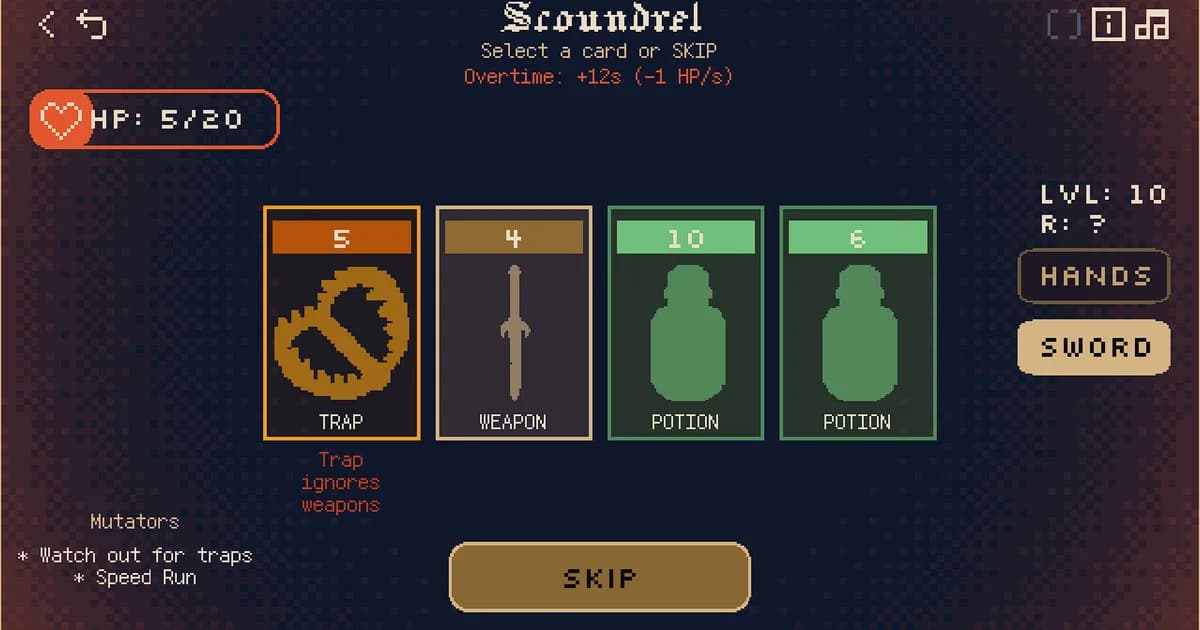
The Scoundrel card game puts the entire dungeon in a 44-card shuffled deck. That's it. No persistent world, no branching paths, no meta-progression unlocks waiting for you after a good run. Just 44 cards dealt into a different nightmare each time, and two to five minutes to find out how far you get.
It launched on Steam May 19, 2026 for $2.99, published by indie developer senator.ovh. The game was already available on iOS and Android: the Steam release brings keyboard, mouse, and full controller support to a format that had been touch-only.
TL;DR: Scoundrel is a single-player roguelike card game that fits an entire dungeon into one 44-card deck, with no meta-progression, played in 2-5 minute runs. It's $2.99 on Steam (also on mobile), built on standard playing-card suits where monsters, weapons, and potions are card values you manage in sequence. The depth is in when to fight bare-handed versus with a weapon and when to flee a room. Simple to learn, punishing to master.
The concept sounds simple. The execution is not.
Key takeaways
- 44 cards are the entire dungeon: shuffled fresh each run, no two alike
- Runs last 2-5 minutes with instant restart and zero meta-progression between attempts
- Two resources degrade as you play: blade durability (weapons dull after kills) and potions (first per room only)
- Skipping cards has consequences: the game punishes running as much as fighting badly
- $2.99 on Steam, also available on iOS and Android
- 20 Steam Achievements give long-term goals without adding permanent progression
What is the Scoundrel card game?
Scoundrel drops you into a dungeon that is exactly 44 cards. You reveal four at a time. You must confront three of them. The fourth is a choice: fight it, or skip it and take whatever consequence skipping brings.
The developer's launch post said it plainly: "Now go lose to the deck. The dungeon wants a story." That framing matters. Scoundrel isn't trying to feel fair. The 44-card structure is a pressure system. Every card you skip stays in the deck until it resurfaces, and every fight you take wears down your blade.
Scoundrel card game runs are short by design. Two minutes if things go well and you play efficiently. Five minutes if you're deliberate. Then you're dead or you've cleared the deck, and a new shuffle begins instantly.
The 44-card system: how the dungeon works
The mechanics behind Scoundrel's 44-card deck are elegant in a way that doesn't become obvious until you're mid-run and watching the count drop.
Four cards flip face-up each turn. They represent the encounters in that room: monsters to fight, items to collect, traps to navigate. You must engage three of them. The fourth can be skipped. That skip isn't free: skipping carries consequences built into the game's design, described in launch materials as part of the game's core philosophy that "excessive greed becomes more dangerous than combat threats."
What that means mechanically: the Scoundrel card game rewards measured aggression. You want to fight, because fighting cycles through the deck and gets you closer to clearing it. You don't want to fight everything blindly, because your blade degrades. You don't want to skip constantly, because consequences accumulate. The strategic layer is finding the tempo that manages all three pressures simultaneously.
Each run uses the same 44 cards, shuffled differently. The number is fixed. The sequence is never the same twice. That fixed total is what gives the Scoundrel card game its rhythm: you always know how deep you are.
Caption: The deck count tells you exactly how much dungeon is left. The tension of the final ten cards is the game's best design decision.
GODEEPER: Gambonanza runs a similar "every run is a fresh deck" roguelike structure but layers chess pieces over the card system: different outcome, same addictive loop. Gambonanza Review: Chess Balatro or Something Better? →
Weapon degradation and potion limits
Scoundrel has two resource systems that interact with every fight decision.
Your weapon degrades with use. Blades dull after kills. The more you fight, the weaker your weapon becomes. A player who fights every available card without managing blade health will reach the later cards with a noticeably weaker weapon than one who made selective choices earlier.
Potions have a harder limit: you can drink one per room, but only the first heals. Additional potions in the same room do nothing. Healing is turn-gated in a way that punishes stockpiling and panic drinking. You have to anticipate when you'll take damage and have a potion available for that room, not the last one.
Together, these two systems answer the question of why the Scoundrel card game is more interesting than a simple "fight or flee" dungeon. You're managing three things simultaneously: blade durability, potion availability, and skip consequences. A run that feels comfortable at the halfway point can fall apart in the final stretch if any of those three runs dry.
Caption: A dulled blade in the final third of the deck is often unrecoverable: blade management is the decision that separates mediocre runs from clear attempts.
GODEEPER: Die in the Dungeon applies the same "no-safety-net, start-from-scratch every run" philosophy through a dice-building format. Worth playing alongside Scoundrel if the genre clicks. Die in the Dungeon Review: Dice-Building With Brains →
Scoundrel card game: difficulty modifiers and replayability
The Scoundrel card game includes optional difficulty modifiers for players who find the base game manageable. The available modifiers include tougher enemies, traps, and time pressure, each tightening the constraints on runs that already last 2-5 minutes.
The base game already asks a lot. The enemy encounters in the later cards hit harder than the early ones, and a blade that's been fighting since card 10 reaches card 38 in worse shape. Modifiers aren't for new players; they're for players who've cleared the 44-card deck and want a reason to keep shuffling.
Twenty Steam Achievements give another layer of long-term goal-setting without introducing meta-progression. The Scoundrel card game stays true to its no-carry-over design while still giving players targets beyond "clear the deck again."
Is the Scoundrel card game worth $2.99?
At $2.99, the Scoundrel card game has almost no barrier to entry. The 2-5 minute run length means it fits in gaps between other tasks in a way that most roguelikes don't. No session commitment, no save state to think about, just shuffle and go.
Whether you keep playing the Scoundrel card game depends on whether the triple-resource puzzle (blade, potions, skip consequences) stays interesting to you across repeated runs. Some players will clear the deck on their first or second attempt and feel finished. Others will spend sessions chasing a better line through the 44 cards or stacking modifiers to find the limit.
The Scoundrel card game proved itself on mobile first. The Steam version adds control flexibility and achievements without changing what the game fundamentally is.
For the genre comparison: Gambonanza costs three times as much and runs much longer sessions with deeper systemic interaction. Die in the Dungeon goes deeper on build theory. Scoundrel card game doesn't try to compete on depth: it competes on clarity. For two dollars and ninety-nine cents, the clarity is well worth the cost.
If you're building a library of indie roguelites, the best indie games under $20 roundup is worth a look: Scoundrel fits the budget tier well.
Frequently asked questions
What is Scoundrel card game? A solo card roguelite where the entire dungeon is 44 shuffled cards. You reveal four at a time, fight three, and manage two degrading resources: blade durability and potion limits (first per room only). Runs last 2-5 minutes, no meta-progression.
How long are Scoundrel runs? Two to five minutes each. Instant restart on death. No loading screens, no save state, no meta-progression.
Does Scoundrel have meta-progression? No. Every run starts from the same baseline: just the 44-card deck in a different shuffle.
Is Scoundrel available on mobile? Yes. Available on iOS, Android, and Steam. The Steam version adds keyboard-only, mouse-only, and full controller support.
What are the difficulty modifiers? Tougher enemies, traps, and time pressure: all optional. They're for experienced players who want the loop tightened.
How much does Scoundrel cost? $2.99 on Steam.
Who made Scoundrel? senator.ovh, an indie developer. The launch announcement was personal: the developer thanked two people by name for feedback and motivation through development.
References
- Scoundrel on Steam
- senator.ovh: Scoundrel Official Site
- Scoundrel Launch Announcement (Steam Community, May 19, 2026)
Related Reading
- Die in the Dungeon Dice Tier List: another minimalist dungeon-crawl roguelike built on a tight randomized resource pool.
- Rune Dice Tier List: All 8 Classes Ranked: a physics dice roguelike for players who like single-session risk decisions.
- Black Jacket Complete Guide: a card-driven roguelite that turns a classic card game into run-based strategy.
About the author

News Reporter
Games journalist and news hound with 7 years covering industry moves, studio announcements, and patch notes. Chilean. Writes tight, edits tighter.
- 7 years games journalism
- Industry and esports specialist
- Early access coverage
Keep reading
Black Jacket Guide: Blackjack Roguelite Tips for 2026
General · 11 min

Skull Horde Review: Fast Dungeon Auto-Battler Worth Buying
General · 7 min

Killer Bean Early Access: 4 Modes and What Comes Next
General · 7 min
PegPigeon Beginner Guide: Boards, Relics, and Upgrades
Guides · 9 min
Combolands Roguelike Citybuilder Launches August 24
General · 7 min
Moonlighter 2 Tips: 9 Rules for Your First Hours Guide
Guides · 9 min
Game deals · affiliate links

Disclaimer
This article is published for informational and entertainment purposes. It does not constitute professional financial, legal, or technical advice. Game performance, online services, patch schedules, and store listings change. Verify critical details (pricing, system requirements, regional availability) with publishers and storefronts before you buy. Affiliate links, where present, help support our editorial work and are labelled in our affiliate disclosure.
Comments
Loading comments…