
GameBrief · General
Cursemark Secrets and Sigils Guide: All Unlocks (2026)
Reviewing
Cursemark
CLYDE games · Mad Mushroom
Cursemark secrets and sigils are the part of the game the tutorial never explains. You can play five hours and miss three permanent weapon unlocks because no one tells you that sigils only appear when you beat a boss, that they disappear if you walk past them, and that hidden passages in specific named areas contain rewards that won't show on your map.
TL;DR: Attunement Sigils drop from bosses and permanently unlock weapons and skills. If you miss one, it respawns next time you kill that boss. The three EA biomes each have a boss sigil. Secrets run deeper than early patch notes suggested: a 22-riddle clue notebook spans Ashford Lowlands, Cursewoods, and Mire Glades, with solutions ranging from lighting torches to breaking specific pots. Corruption must be cleared before altars unlock. Map features like Botyl Jars, Wells, Talisman Chests, and Runestones now show on the map. Luminary trades runes but won't return ones you already traded in.
What are Cursemark secrets and sigils? (quick answer)
Attunement Sigils are permanent unlocks. You get one from each boss. It expands your weapon and skill options for every future run. Secrets are hidden passages and elemental puzzles built into specific named stages. Neither system gets a proper tutorial. The game's own Steam description is blunt about it: "no map-markers, no hand-holding." What follows is what the patches and community have documented about both.
Cursemark current status: September 2026
The current Steam US snapshot lists Cursemark at $10.49, a 30% promotion from the $14.99 list price, with a Very Positive rating across 585 total reviews. The game released into Early Access on June 8, 2026. The official Steam announcements feed's July roadmap says the next biome is Boreal Ascent (renamed from Boreal Ridge) followed by Scarred Wastes, while the current guide below stays limited to the three biomes documented in the live EA build.
Sources: Cursemark on Steam and the official Cursemark announcements feed.
Step-by-Step: find your next Sigil
1. Clear the boss: Each current boss is the reliable source of an Attunement Sigil. Finish the encounter before leaving the stage.
2. Pick up the drop: Collect the Sigil before exiting. The June patch notes say an uncollected Sigil returns the next time you defeat that boss, so missing one delays the unlock but does not permanently erase it.
3. Check the permanent pool: Confirm the new weapon style or skill is available on the next run, then choose runes that support the new option instead of repeating the old loadout.
4. Route secrets separately: Clear Corruption before testing an altar, and use the clue notebook and map feature icons to decide whether a hidden room is worth the curse cost.
Attunement Sigils: what they unlock and where they come from
Every boss in Cursemark drops an Attunement Sigil on death. The sigil permanently adds a weapon style or skill to your available options, which means a boss kill that looks like just a checkpoint actually expands what all future runs can use.
One behavior worth memorizing: if you don't pick up the sigil before leaving the area, it'll respawn the next time you kill that boss. The June 9 patch states this explicitly: "If an Attunement Sigil dropped by a boss isn't picked up, it will spawn next time you beat them." You can't permanently miss one through accidental oversight, but you can delay getting it by ignoring a dropped item in the chaos after a fight.
The current Early Access build has three biomes, each with at least one boss. That's at minimum three boss-tied sigils in the current content. When Boreal Ascent (announced as "Boreal Ridge" at launch, renamed in CLYDE Games' July 2026 roadmap post) ships, that number goes up, and Scarred Wastes is confirmed as the biome planned after it.
Weapons unlocked through sigils cover the different melee and casting styles. The pre-launch announcement put it plainly: "the amount of different weapon styles you can use has greatly expanded" during development. Each style changes how your mage-knight plays at a physical level, not just stat differences. Getting sigils early is what lets you build meaningfully in later runs rather than replaying the same two weapon options.
GODEEPER: Once you have a sigil unlock in hand, the question becomes which runes work with it. The full rune breakdown covers all seven spell schools and which combinations hold up across runs. Cursemark Roguelite: Runes, Builds and Early Access Launch →
Named areas with documented secrets
The launch-week patch notes are the most reliable source for which areas have confirmed secrets, because they track bugs in the hidden triggers by name.
Twinkling Tree has a verified secret. The June 9 patch notes list "Fixed Twinkling Tree secret" explicitly, confirming it had a trigger condition that wasn't firing. The tree is in the first biome and players describe it as a route variant rather than a combat room.
Chill and Frost secret got fixed in the same patch: "Fixed Chill and Frost secret." This is elemental interaction logic tied to ice and cold effects, part of the environmental puzzle system the developer added during pre-launch demo updates. The dev called it out specifically: "elemental interactions and environmental puzzles" with "braziers you need to light, brambles" and similar triggers that react to your spells.
Glimmerpool shows up in the patch notes as a geometry and info-feature fix. It's one of the less-traveled locations in the first biome, and the level-info display fix suggests interactive features that weren't rendering before the patch.
Beyond those three, the area list from patch geometry fixes gives you the full map of named locations in the EA build: Cemetery, Curserot Chapel, Deadwood Grove, Greywater Bight, Bloody Fields, Stoneflow, Wildflower Meadow, Clearlake West, Spire of Ghen, The Fingers, Fungal Shrine, Duskridge, Lastlight Fields, Sedgepool, Slowbog, Cove of Awakening, Wildfire Basin, Temple Courtyard, Crow's Field, and others, including Witch's Hut, Sunfish Pond, and Runoff Basin. Each is a discrete stage on your map. The Fingers and Fungal Shrine both had geometry patches at launch, which tends to mean interactive elements that players were clipping through or getting stuck on.
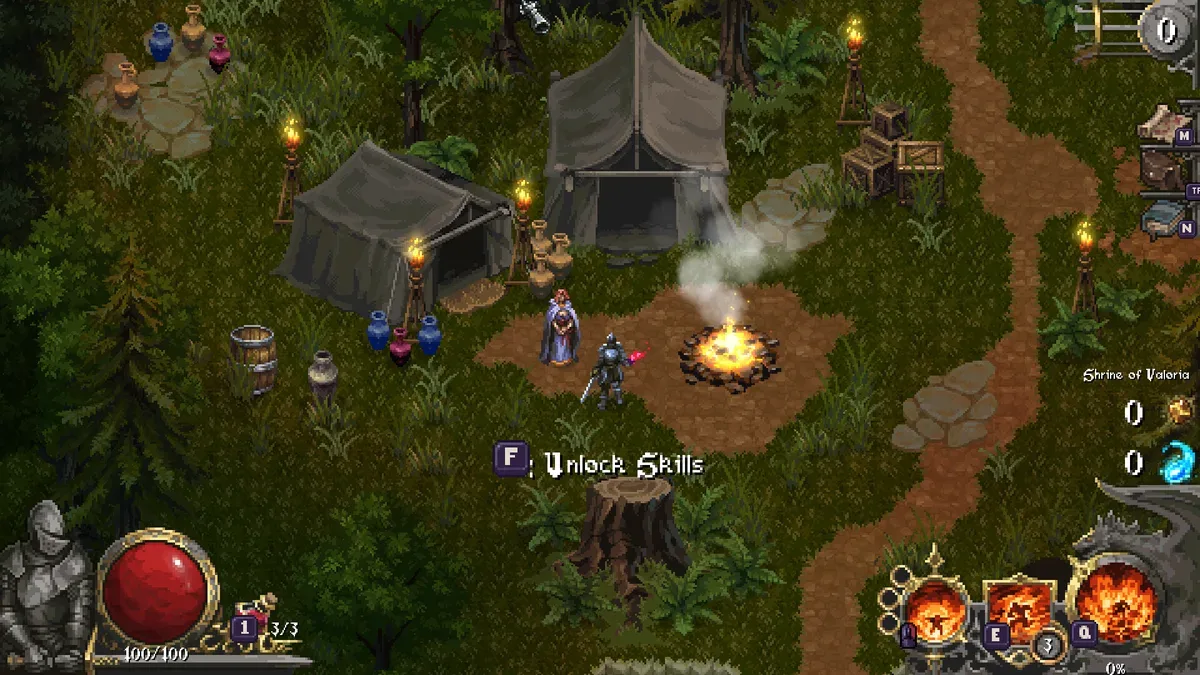 The Reliquary, one of Cursemark's named waypoint areas. The glowing archway is the kind of landmark players use to recognize a stage before checking whether it holds a documented secret.
The clue notebook: 22 riddles across three regions
The Twinkling Tree and Chill and Frost fixes above were June patch-note snapshots, just two entries in a much bigger system the community has since mapped out. Cursemark's clue notebook holds 22 riddles total, grouped by biome. Clues 1 through 10 are Ashford Lowlands riddles (the starting biome), clues 11 through 16 belong to Cursewoods (the second biome), and clues 17 through 22 are Mire Glades riddles (the swamp biome added for Early Access). The game never tells you the notebook exists until you stumble into your first clue by accident.
Several riddles are fully solved and documented by players. In Cursewoods, the riddle "If seven watch-fires be kindled with haste, the camp's relief shall then be graced" points to Forest Camp, where lighting all seven skull-torches triggers the reward. The Chill and Frost riddle from the June patch notes actually lives in Death Gorge: "By chill and frost make dark the torches two, beneath the place the fallen giant knew" means extinguishing two specific braziers there, not lighting them, which is easy to get backward on a first attempt.
In Mire Glades, the Witch's Hut riddle asks you to "extinguish all joy and preserve all misery" by breaking every pot marked with a smile while leaving frowning pots untouched, opening a path to a cauldron. Sunfish Pond's riddle solves by dropping one rune of each rarity (Common, Uncommon, Rare, Legendary) to unlock a weapon slot upgrade. Fungal Shrine's riddle wants the Corpse Finger talisman dropped at the fairy ring. Sedgepool's riddle is solved by stripping down: unequip every talisman and rune, drain your spell, ward, and ultimate charges, and drop below 50% health before interacting.
Not every riddle in the notebook has a confirmed public solution yet. If you're stuck on one that isn't covered here, the Steam Community discussion threads tracking all 22 are the most current source, since new solutions get added as players find them.
Elemental puzzles: what the game doesn't explain
Cursemark built environmental puzzles into its stages during development. Braziers you need to light. Brambles that react to spells. Cold elements that shift when ice hits them. The designer announced this as a specific feature addition, distinct from enemy combat.
The secrets tied to Chill and Frost slot into this: ice spells trigger environmental changes in cold-themed areas, fire spells can light braziers where the mechanic's active. These are the things players walk past because they look like decoration. The frozen pool you assume is just atmosphere. The unlit torch you don't try to light because the room feels like a straightforward fight.
The payoff isn't always dramatic. Sometimes it's a shortcut to the next stage. Sometimes it's a Botyl jar or a resource node. Sometimes it opens a passage to a Talisman Chest you'd have skipped. Nothing in the tutorial flags any of this, which is deliberate: the game's own Steam description calls the Unknown Lands "full of secret passages, hidden relics, and strange sights," and means it.
The practical approach: bring a fire spell into stages with unlit braziers and try them. Bring ice into cold-themed stages and interact with anything that looks frozen or inert. The dev confirmed the clue system works in a late-2025 update: "We've also fixed all the clues currently in the demo, so they all work and will pay off if you solve them."
Permanent progression beyond sigils
Sigils get the most attention because they're the clearest permanent unlock, but quite a bit more carries between runs.
Shrines and forges retain their upgrade level. A Blessing Shrine you upgraded in run 3 is still upgraded in run 10. Forges work the same way. This matters because early shrine investment compounds: a fully upgraded Blessing Shrine on run 2 is doing work on run 15 without you touching it again.
Rune slots unlock permanently from boss kills and new area discoveries. This is why early runs feel so limited: too few slots to build around anything coherent. Later runs feel different because the slot count finally has room. Each boss kill, even from a run you're clearly losing, advances this. The run isn't wasted.
Corruption clears reset per run, but the altar layout doesn't. Once you know which stages have altars and which enemies count toward the Corruption clear, you can route to them faster. The June 12 patch improved this a bit: Blessing Shrines now show what a potential upgrade does before you confirm. Before that patch, you were guessing.
GODEEPER: Understanding permanent progression is only useful if you know how to route the run that unlocks it. The beginner tips guide covers which rooms are worth the curse price and which to skip. Cursemark Tips: 10 Things to Know Before Your First Run →
Map features and how to find them
The June 12 patch made the map genuinely useful for secrets hunting. Botyl Jars and Wells now show as map features. Talisman Chests and Runestones display their remaining uses. You can see from the map whether a stage has a chest before entering, which is exactly the information you need to decide if clearing that room is worth the curse cost.
Forges show on the map from the run start. This means your first map read should include locating all forges before you commit to a route. A forge you missed in the middle of the map is a permanent upgrade you didn't get.
Talisman Chests have limited uses before they deplete. If a chest shows 0 uses on the map, skip the room. The curse cost of clearing it produces nothing. The game didn't surface any of this before the patch; now it does, and it changes how you approach each run from the opening map screen.
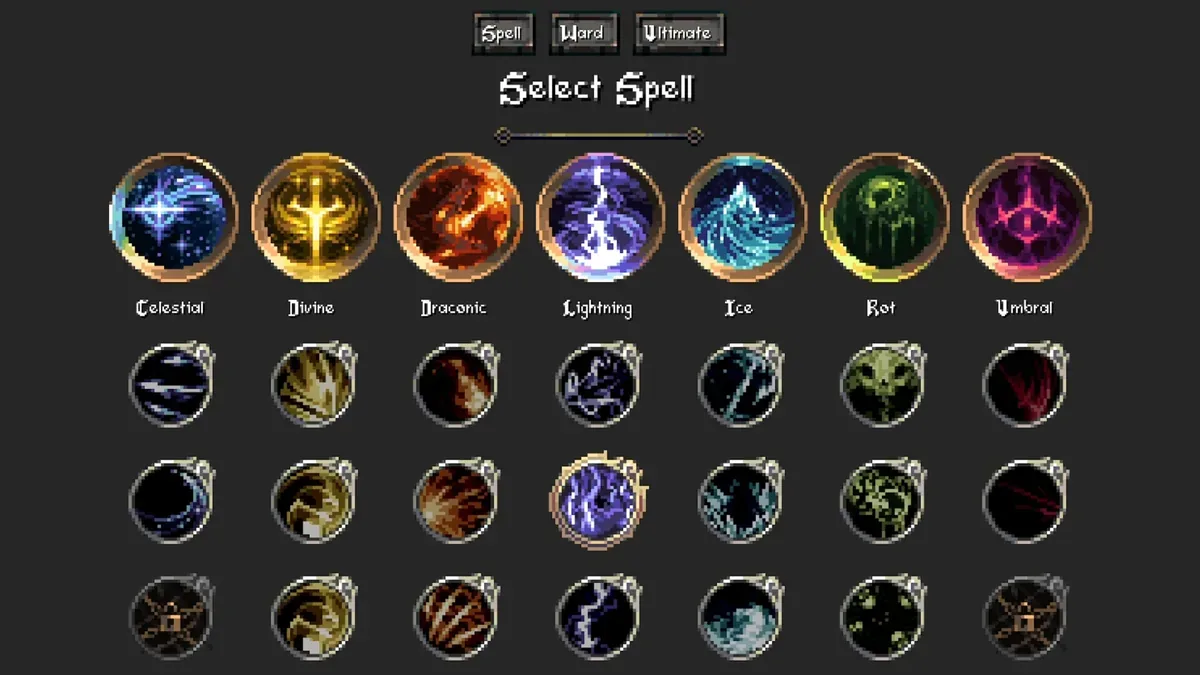 Cursemark's overworld map lays each biome out as illustrated parchment art, with pins marking stages and points of interest along the grid path. The June 12 patch added the feature icons (Botyl Jars, Wells, Talisman Chests, Runestones) referenced below.
The Luminary and what players miss about him
The Luminary is a rune trader. He shows up in certain stages and will exchange runes you offer for ones he holds. If a run has handed you a pile of mismatched runes that don't fit your school, he's the correction. Players who know about him treat him as a mid-run pivot; players who don't know about him walk past.
Two things worth knowing. First: he won't return runes you've already put in for a trade. The June 12 patch locked this explicitly: the Luminary "will no longer trade back runes you put in for that trade." Before the patch it was a known exploit. Once a rune goes in, it's gone. Think before you offer.
Second: the Luminary and Challenge Pedestals are the two interactive encounter types that appear in any stage, and players regularly walk past both. Challenge Pedestals spawn a wave of enemies for a reward. The Luminary trades. Both look like ambient objects if you're not already looking for them. Interact with anything that glows.
What's confirmed for future biomes
The EA launch announcement is specific: a fourth biome (named Boreal Ridge at launch, since renamed Boreal Ascent per CLYDE Games' July 2026 roadmap post, with Scarred Wastes confirmed as the biome after it) was in active development at launch, seven total biomes are planned for 1.0, and 1.0 is targeted before the end of 2026.
Each new biome means a new boss, at minimum one new Attunement Sigil, new named stages with their own secrets, and elemental interactions tied to the biome's environment. Boreal Ascent is ice and cold themed, so the Chill and Frost elemental puzzle system from the current build will likely have a direct expansion there.
The EA launch post also flagged that the game is "essentially feature complete" in terms of systems at Early Access. That's the developer saying the mechanics described here are the mechanics you'll use throughout. Sigils, Corruption, map features, elemental puzzles: these don't go away or get reworked. More content fills in around them. The secrets structure won't change; it'll just have more rooms to hide things in.
Related Reading
- Cursemark Tips: 10 Things to Know Before Your First Run: well choices, rune equipping, curse routing, and early-game decisions.
- Cursemark Roguelite: Runes, Builds and Early Access Launch: the seven spell schools and build foundations.
- Cursemark Review: A Roguelite Built Around Rune Depth (2026): whether the current EA build is worth buying.
- Rune Dice Complete Guide 2026: Classes, Relics, and Builds: a different rune-driven roguelite for comparison.
- Cursemark Best Builds Guide 2026: build priorities for the current EA pool.
- Cursemark Boss Guide: All Bosses: boss routes and Sigil checkpoints.
- Cursemark Complete Guide Hub: the full Cursemark coverage index.
- Cursemark Spell Schools Guide: how the seven spell schools shape rune choices.
- Cursemark Weapons Tier List: weapon-style comparisons after Sigil unlocks.
- All Hail the Orb Complete Guide 2026: another guide hub with permanent progression systems.
- Black Jacket Complete Guide 2026: a systems-heavy indie guide hub.
- Fatekeeper Complete Guide Hub: another combat-and-build coverage cluster.
- Tabletop Tavern Factions Guide: a different approach to permanent faction choices.
- Shapez 2 Complete Guide 2026: systems-first planning from another genre.
- Sunderfolk Complete Guide 2026: a current guide hub with class and progression references.
Frequently Asked Questions
What are Attunement Sigils in Cursemark? Attunement Sigils are items dropped by bosses that permanently unlock new weapons and skills for all future runs. If you miss the drop after a boss fight, the sigil respawns the next time you defeat that same boss, so no sigil is permanently missable.
How do I unlock more weapons? Each boss drops an Attunement Sigil on first kill. That sigil permanently unlocks a weapon style available in all future runs. Three biomes means at minimum three boss sigils in the current EA build.
What are the named areas in Cursemark Early Access? The EA build contains dozens of named locations: Cemetery, Curserot Chapel, Deadwood Grove, Greywater Bight, Bloody Fields, Stoneflow, Wildflower Meadow, Clearlake West, Spire of Ghen, The Fingers, Fungal Shrine, Duskridge, Lastlight Fields, Sedgepool, Slowbog, Cove of Awakening, Wildfire Basin, Temple Courtyard, and Crow's Field, among others.
How do secrets work in Cursemark? Secrets run through a clue notebook of 22 riddles split across three biomes: Ashford Lowlands (1-10), Cursewoods (11-16), and Mire Glades (17-22). Elemental puzzles respond to spell types: fire spells light braziers, ice spells trigger cold interactions. No map markers show these; the notebook only reveals a clue once you've stumbled into it.
What is the Luminary? The Luminary is a rune-trading NPC who appears in certain stages. He will exchange runes you offer for different ones. As of the June 12 patch, he will not return runes you have already traded in, so consider carefully before offering a rune.
How do I access altars in Cursemark? Altars unlock only after you clear Corruption from the area, which means defeating the required enemies in that stage. Once corruption is cleared, you can use the altar to upgrade runes and blessings. Blessing Shrines now show what the upgrade will do before you confirm.
How many biomes does Cursemark have? Three biomes are in the EA build. A fourth biome, called Boreal Ridge at launch and renamed Boreal Ascent in CLYDE Games' July 2026 roadmap, is in active development, with Scarred Wastes confirmed as the biome after it. Seven total biomes are planned for the 1.0 release, which is targeted before the end of 2026.
What permanent progression exists outside sigils? Shrines and forges retain upgrades between runs. Boss kills permanently unlock rune slots. New area discoveries can unlock shortcuts and starting options. Even failed runs advance the permanent layer.
References
- Cursemark on Steam: official store page, patch notes history, and developer announcements
- Cursemark Early Access Launch post by CLYDE Games: confirms biome count at launch, the Boreal Ridge announcement, and the 7-biome roadmap
- Cursemark Early Access Roadmap post by CLYDE Games: renames the fourth biome to Boreal Ascent and confirms Scarred Wastes as the biome planned after it
- Cursemark June 9 patch notes (Steam): documents Twinkling Tree and Chill and Frost secret fixes, Attunement Sigil respawn behavior
- Cursemark on Reddit r/roguelites: community discussion from launch week with early player impressions
- All Riddles marked on the World Map (Steam Community): player-compiled map of all 22 clue notebook riddles across Ashford Lowlands, Cursewoods, and Mire Glades
- Mire Glades Clues (Steam Community): confirmed riddle text and solutions for Witch's Hut, Sunfish Pond, Runoff Basin, Fungal Shrine, and Sedgepool
Was this guide helpful?
About the author

Games Critic
Games writer and reluctant optimist who has reviewed over 400 titles across 9 years. Irish, currently in Berlin. Has strong opinions about tutorial design.
- 400+ games reviewed across 9 years
- Platformer and horror specialist
- Narrative design focus
Keep reading

Disclaimer
This article is published for informational and entertainment purposes. It does not constitute professional financial, legal, or technical advice. Game performance, online services, patch schedules, and store listings change. Verify critical details (pricing, system requirements, regional availability) with publishers and storefronts before you buy. Affiliate links, where present, help support our editorial work and are labelled in our affiliate disclosure.
Comments
Loading comments…