
GameBrief · General
Cursemark Complete Guide: All 3 Bosses, Runes & Weapons
Cursemark complete guide: everything about the EA roguelite in one hub. All 3 bosses, 7 spell schools, 7 weapons, runes, sigils, and the review verdict.
Reviewing
Cursemark
CLYDE games · Mad Mushroom
This Cursemark complete guide pulls together every guide GameBrief has published on CLYDE games' rune-driven roguelite into one hub: the review verdict, all three Early Access bosses, all seven spell schools, the weapons tier list, the secrets and sigils system, and the beginner tips that actually matter in the first few runs. Cursemark entered Steam Early Access on June 8, 2026, and in the weeks since, the site has covered nearly every mechanic in the current build in enough depth that this page exists mostly to route you to the right one fast.
TL;DR: Cursemark is a $14.99 hack-and-slash roguelite from CLYDE games, Very Positive on Steam (87%, 605 reviews) nearly three months after its June 8, 2026 Early Access launch. The current build has 3 bosses, 3 biomes, 7 spell schools, 7 weapons, and nearly 100 runes and talismans. A 1.0 roadmap targets 7 total biomes before the end of 2026. This hub links all seven Cursemark guides on the site: review, bosses, spell schools, weapons, runes and builds, secrets and sigils, and beginner tips.
Key takeaways
- Developer: CLYDE games (previously Into the Necrovale). Publisher: Mad Mushroom
- Released Steam Early Access: June 8, 2026. Price: $14.99 standard (the 15% launch discount at $12.74 has ended)
- Very Positive on Steam: 87% positive across 605 reviews as of late August 2026
- 3 bosses in the current EA build: Iron Bastard, Crusade Captain Osric, and Lucian the Fallen Prelate, one per biome
- 7 spell schools: Celestial, Divine, Draconic, Lightning, Ice, Rot, and Umbral
- 7 confirmed weapons, unchanged since launch, with Divine Spear ranked S-tier
- A 4th biome (announced as Boreal Ridge at launch, renamed Boreal Ascent in CLYDE Games' July 2026 roadmap) was in active development as of the most recent build check, with Scarred Wastes confirmed as the biome after it; the 1.0 roadmap targets 7 biomes total
What is Cursemark?
Cursemark quick answer: it's a top-down fantasy hack-and-slash roguelite where you play a cursed mage-knight fighting through the Unknown Lands with melee weapons and rune-modified spells. CLYDE games (the studio behind Into the Necrovale) developed it, Mad Mushroom published it, and it entered Steam Early Access on June 8, 2026 at $14.99. The pitch, and the mechanic that separates it from most build-focused roguelites, is that runes don't just add stat bonuses. They rewrite what an attack, spell, ward, or ultimate actually does.
The genre comparison players reach for most often is soulslike-meets-roguelite: enemy attacks telegraph, the dodge windows are real but tight, and the combat rewards reading a pattern over trading blows. That's a different lineage than the pure twin-stick roguelites Cursemark gets shelved next to on Steam, and it's part of why the game's own beginner guide spends as much time on timing and routing as it does on build theory.
The more interesting question, for anyone who's already played a handful of rune-and-relic roguelites this year, is whether Cursemark's ability-rewriting runes are actually distinct from that pack or just a familiar idea with a nicer coat of paint. The early evidence leans toward distinct: a rune here changes what an ability does, not just how hard it hits, and that's a narrower, harder thing to design well than another stat-stick relic. Full controller support is confirmed, and the game is single-player only at Early Access. No co-op mode has been announced as part of the current build or the 1.0 roadmap.
Spell schools guide
Cursemark has 7 spell schools, and every one of the site's Cursemark articles that mentions them (the review, the launch news piece, and the dedicated schools guide) names the same seven: Celestial, Divine, Draconic, Lightning, Ice, Rot, and Umbral. Each school shapes three ability slots, an Offensive spell, a Ward, and an Ultimate, so choosing a school is closer to choosing a combat identity than picking a damage type.
Celestial is the beginner-recommended pick: balanced damage and clean, reliable projectiles with nothing situational to set up first. Draconic sits at the opposite end, high burst but close-range only, which punishes players who haven't learned enemy timing yet. Divine trades damage for sustain through healing wards and smite effects. Lightning is the pick for crowded rooms thanks to its chaining hits. Ice slows enemies and drops crowd-control pillars rather than racing for damage. Rot and Umbral both reward patience: damage-over-time and debuffs that compound over a full fight rather than a single trade.
The full Cursemark spell schools guide breaks down all seven in detail, including which weapon range pairs best with which school and why rerolling a rune usually fixes an underperforming school faster than abandoning it. Its own advice is worth repeating here: match a school to your weapon's range rather than just its damage number, since Draconic's close-range burst pairs naturally with melee weapons while Lightning and Celestial fit a poke-focused playstyle better. And don't judge Rot or Umbral by their first few hits. Both schools compound over the length of a fight rather than front-loading their value, so a Rot build that looks weak in the opening seconds is often still ahead by the end of the encounter.
Runes and builds
Runes are the system that makes Cursemark's seven spell schools feel like dozens of different games. A rune slotted into an attack, spell, ward, or ultimate changes how that ability behaves, not just its numbers. A rune on a sword swing can add chain lightning. A rune on a fireball can make it multiply on impact. A rune on a ward can turn a plain block into a heal-and-blind effect. Because runes stack across all four ability types, and because the current build holds nearly 100 runes and talismans, two runs with the same starting school rarely play the same way.
The Cursemark roguelite launch guide covers the rune system as CLYDE games described it at Early Access launch, with the developer's own examples of what a rune can rewrite. For a beginner-facing breakdown of which runes to prioritize and when to reroll, see the Cursemark tips guide, which is the more practical companion to this section: reroll only when a rune actively conflicts with your build, and upgrade one rune to level 5 before spreading essence across several half-upgraded ones.
- Cursemark Best Builds Guide: 4 Weapon and Rune Combos (2026): named weapon and rune recipes built from the July 3 status-effect patch, cross-checked against official Steam patch notes.
Weapons tier list
Cursemark has 7 confirmed weapons, and the roster hasn't changed since launch. Content updates since June have gone into runes and talismans instead. The current community-backed ranking, covered in full in the Cursemark weapons tier list, puts Divine Spear alone in S-tier: the best range in the game, high crit, and a poke attack that concentrates status-effect rune damage onto a single point instead of spreading it across a slash arc.
Thunderous Strike and Dragon Claws sit in A-tier behind it, a near-90% crit finishing hit and a fast burn-on-combo weapon respectively. Knight's Sword and Shadow Blade are the reliable B-tier picks, and Brumal Scythe's frost-trail mechanic lands it in C-tier: situational, but real against enemies that path through the trail. Wave of Decay is the consensus D-tier weapon, a single-hit poison weapon with no mechanic to make up for its low direct damage.
Weapons unlock permanently through Attunement Sigils (more on those in the secrets and sigils section below), so a run that ends early at a new boss is still useful progress if it drops a sigil for a weapon you hadn't tried yet.
Boss guide
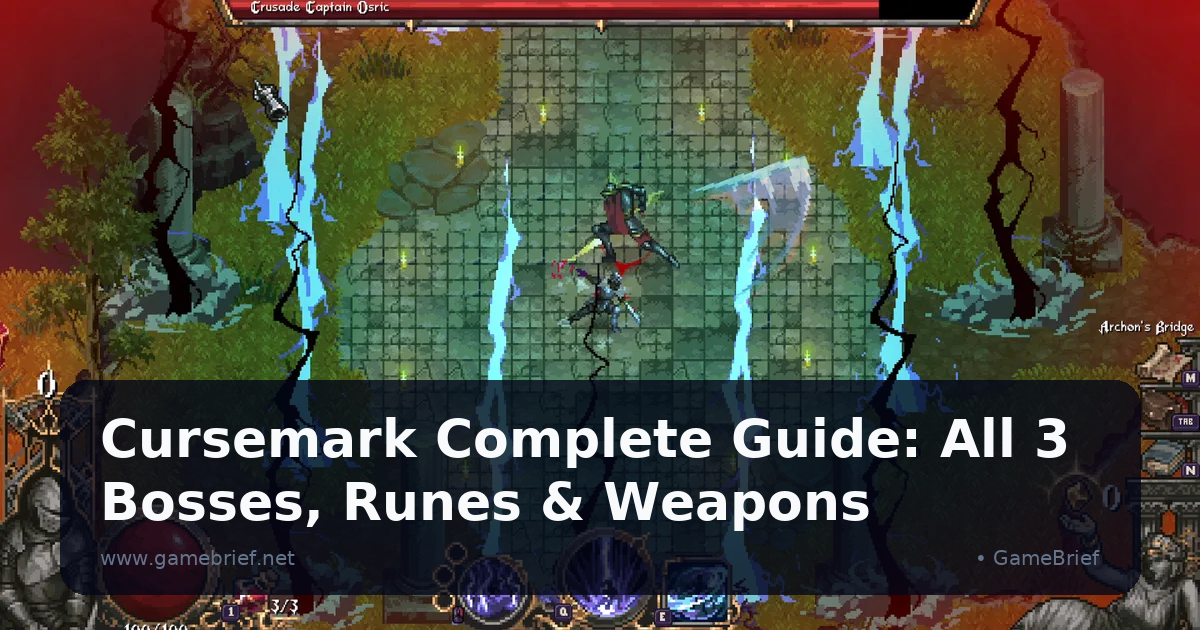
The current Early Access build has 3 bosses, one per biome, and beating each one both opens the next biome and drops a permanent Attunement Sigil. Iron Bastard (Biome 1) is weak to fire and enrages at 50% HP with an attack-speed spike that's actually easier to punish than his normal pace, since the shorter recovery frames make him interruptible by charged heavy hits. Crusade Captain Osric (Biome 2) is weak to Poison and Rot, resistant to Celestial, and fights around four arena pillars that don't respawn once destroyed, so save at least one for his 25% HP judgment slam that covers the whole floor. Lucian the Fallen Prelate (Biome 3) is the current endgame fight: weak to Celestial and Fire, and he summons mirror images that only the real boss's floor shadow gives away.
The full Cursemark boss guide covers attack patterns, dodge timing, and elemental weaknesses for all three fights in detail. Cursemark's 1.0 roadmap targets 7 total biomes, so four more boss encounters are planned beyond what's currently playable.
Each boss's sigil unlocks a specific weapon style: Iron Bastard's sigil unlocks the first, Osric's the second, Lucian's the third, and all three stack toward the same permanent roster covered in the weapons tier list above. One shared rule across all three fights is worth remembering before you walk in: red-glow attacks are unblockable in every boss encounter in the current build. Dodge through them rather than block, since the hitbox trails slightly behind the visual effect on all three bosses.
Secrets and sigils
Sigils and secrets are the parts of Cursemark the tutorial genuinely doesn't explain. Every boss drops an Attunement Sigil on first kill, and if you miss picking it up, it respawns the next time you beat that boss, so nothing is permanently missable, just delayed. The current EA build's three biome bosses mean at least three sigil-locked weapon or skill unlocks, with more coming as Boreal Ascent (announced as "Boreal Ridge" at launch, renamed in CLYDE Games' July 2026 roadmap post) and the rest of the 1.0 roadmap's seven total biomes, including the next-confirmed Scarred Wastes, ship.
Secrets take two forms: hidden passages between named stages, and elemental interaction puzzles (braziers that need a fire spell, frozen features that respond to ice) that the game never flags with a map marker. Named locations with confirmed secrets in patch notes include Twinkling Tree, Chill and Frost, and Glimmerpool. The Luminary, a rune-trading NPC, will swap runes you offer for ones he holds, but as of the June 12 patch he won't trade back a rune once it's gone in. Altars stay locked until you clear Corruption in that area, and the map now displays Botyl Jars, Wells, Talisman Chests, and Runestones so you can route toward them before committing to a stage.
The full Cursemark secrets and sigils guide has the complete list of named areas, sigil mechanics, and map features documented from launch-week patch notes. Named locations in the current build cover dozens of discrete stages, among them Cemetery, Curserot Chapel, Deadwood Grove, Greywater Bight, Fungal Shrine, and Spire of Ghen, each with its own layout and, in some cases, its own hidden trigger. Permanent progression isn't limited to sigils either. Shrines and forges you upgrade keep that upgrade level between runs, and rune slots unlock permanently from boss kills and new-area discoveries, which is why even a run that ends early at a fresh boss is still forward progress rather than a wasted attempt.
Beginner tips
The site's beginner guide exists because Cursemark's own tutorial explains less than most roguelites, and the mistakes it doesn't warn you about are specific enough to name. Equip every rune the moment you find it rather than holding it for something better. A ward with no rune is just a block, and the right rune on it can heal you and blind enemies. At Wells, take the 20% max-HP increase over the flat 20 HP restore early in a run, since the percentage compounds against future wells and outpaces the flat option well before the run ends.
Divine Spear is the recommended starting weapon for exactly the reason it tops the tier list above: its poke attack and range make status-effect runes hit harder and keep you out of melee range while you're still learning enemy timing. Voltara is the strongest early ultimate unlock because it covers both single targets and grouped packs, which matters before you know what a run's enemy composition will look like.
The curse mechanic is the other thing new players underestimate. Every room cleared tightens it, so clearing optional rooms with no loot, shrines, or sigils is pure cost with no payoff. The full Cursemark tips guide covers ten of these decisions in detail, including the essence-spending rule (upgrade one rune to level 5 rather than spreading it thin) that matters more than any single build choice in the first several runs.
Is Cursemark worth playing?
Yes, with the normal Early Access caveats. Cursemark holds a Very Positive rating on Steam, 87% positive across 605 reviews nearly three months into Early Access, which is a stable signal rather than a launch-week spike. The current build has 3-4 explorable areas by early player reports, 7 spell schools, 7 weapons, and a rune system that genuinely changes how each ability behaves rather than just scaling its numbers.
At the standard $14.99 (the 15% launch discount that put it at $12.74 has ended), the Cursemark review frames the value case as solid specifically for players who want build theory as the main draw, less so for anyone waiting for a finished game with a full content slate. CLYDE games' track record matters here too. The studio's previous game, Into the Necrovale, built a genuine community reputation rather than a famous one, and that history is a stronger signal for an Early Access bet than a debut studio's first build would be. A free demo is available on Steam if you want to test the combat feel and rune system before spending anything.
All Cursemark guides
Every article that makes up this Cursemark complete guide, in one list:
- Cursemark Review: A Roguelite Built Around Rune Depth (2026): the full Early Access verdict on the rune system, the 87% Steam rating, and CLYDE games' Into the Necrovale pedigree.
- Cursemark Boss Guide: All 3 Bosses in Early Access: Iron Bastard, Osric, and Lucian the Fallen Prelate, with weaknesses, attack patterns, and Attunement Sigil rewards.
- Cursemark Spell Schools Guide: All 7 Schools Explained: what Celestial, Divine, Draconic, Lightning, Ice, Rot, and Umbral actually do in combat, not just their names.
- Cursemark Weapons Tier List: All 7 Weapons Ranked 2026: Divine Spear's S-tier case, and why Wave of Decay ranks last.
- Cursemark Roguelite: Runes, Builds & Early Access Launch: the developer's own examples of what a rune can rewrite, from the Early Access launch coverage.
- Cursemark Secrets and Sigils Guide: All Unlocks (2026): hidden area names, elemental puzzles, the Luminary, and every permanent unlock system in the current build.
- Cursemark Tips: 10 Things to Know Before Your First Run: well choices, rune equip timing, curse routing, and the essence-spending rule that beats every other beginner decision.
- Cursemark Best Builds Guide: 4 Weapon and Rune Combos (2026): 4 named weapon, school, rune, and Ultimate combos built from the July 3 status-effect patch.
Frequently Asked Questions
What is Cursemark? Cursemark is a top-down fantasy hack-and-slash roguelite from CLYDE games, published by Mad Mushroom. You play a cursed mage-knight fighting through the Unknown Lands, and runes rewrite how your attacks, spells, wards, and ultimates behave. It entered Steam Early Access on June 8, 2026.
How many bosses are in Cursemark? Three in the current Early Access build: Iron Bastard, Crusade Captain Osric, and Lucian the Fallen Prelate, one per biome. Cursemark's 1.0 roadmap targets 7 total biomes, so four more bosses are planned beyond the current build.
How many spell schools are in Cursemark? Seven: Celestial, Divine, Draconic, Lightning, Ice, Rot, and Umbral. Each school shapes three ability slots, an Offensive spell, a Ward, and an Ultimate, so picking one is closer to picking a combat identity than a damage type.
Is Cursemark worth buying in Early Access? Yes, if you want a rune-driven build roguelite. It holds a Very Positive rating (87%, 605 reviews) nearly three months after launch, at a standard $14.99. A free Steam demo lets you test the combat and rune system before buying.
How many weapons are in Cursemark? Seven confirmed weapons, unchanged since the June 8, 2026 launch. Divine Spear ranks first for range and crit damage, with Thunderous Strike and Dragon Claws close behind. Wave of Decay ranks last.
What do Attunement Sigils do in Cursemark? Each boss drops one Attunement Sigil on first kill, permanently unlocking a weapon or skill for every future run. If you miss picking one up, it respawns the next time you defeat that same boss, so nothing is permanently missable.
Does Cursemark have co-op? No. Cursemark is single-player at Early Access launch, built around solo build experimentation with runes, spells, and weapons. No co-op mode has been announced as part of the current build or the 1.0 roadmap.
References
- Cursemark on Steam: official store page with current price, reviews, and patch notes
- Mad Mushroom (publisher): Cursemark's publisher
- Into the Necrovale on Steam: CLYDE games' previous title, useful context for the studio's track record
About the author

Critical game theorist with a background in film criticism. Writing for print and digital outlets since 2015. Specialises in genre analysis and design heritage.
- Background in film criticism
- 10 years games coverage
- Genre theory and design history specialist
Keep reading


Disclaimer
This article is published for informational and entertainment purposes. It does not constitute professional financial, legal, or technical advice. Game performance, online services, patch schedules, and store listings change. Verify critical details (pricing, system requirements, regional availability) with publishers and storefronts before you buy. Affiliate links, where present, help support our editorial work and are labelled in our affiliate disclosure.
Comments
Loading comments…