
GuideFarever
Farever Co-op Guide: 4 Classes, Group Builds, Dungeon Runs

About the game
Farever
Shiro Games · Shiro Games
Farever co-op is easiest to plan when the group talks about coverage before entering a dungeon. The official store page confirms online multiplayer, dungeons, crafting, and dynamic combat, but it does not publish a fixed “best” party. The role splits below are starting points to test in the current Early Access build, not balance law.
This guide covers party composition by player count, the crafting job split that most groups skip, how dungeon difficulty works with and without support, and the gear/build coordination that separates a struggling group from a group that clears content consistently.
TL;DR: Farever co-op has four commonly referenced class names and supports a group-oriented dungeon loop. Start by covering damage, sustain, and frontline durability, then adjust for the current patch and your party size. Discuss crafting coverage before a run, and do not treat an old floor-count ratio or fixed four-player meta as verified fact.
Farever co-op: quick answer
- A full group should cover damage, sustain, and frontline durability before specializing.
- A duo should test one damage-focused and one sustain-focused setup first, then adjust to the current dungeon.
- Crit and elemental split recommendations are community starting points, not official balance rules.
- Plan crafting around the group, not only the character who equips the result.
- Solo play is supported; class rankings can change with Early Access patches.
Current status: September 2026
Farever is still in Early Access. Major Update #1 added the Nightling invasion, Rifts, a new region, a level-cap increase to 25, and new weapons. The official Call to Glory Major Update #2 announcement targets September 30 and lists Heroic Mode for all dungeons, harder boss patterns and health, teammate revives, improved group rewards, and social features. Build advice should be rechecked after that update lands.
Overview: what makes farever co-op different
Farever's official description emphasizes dangerous dungeons, crafting gear, and dynamic combat. In practice, a group should watch its health, cooldowns, and available resources as it pushes deeper instead of assuming a fixed floor breakpoint.
If one class supplies healing or utility, treat that slot as a way to buy safer damage windows. The exact ability names and balance can move with patches, so validate the role in the current class tooltips.
Groups that skip sustain may clear easy encounters and then discover that later content exposes the missing coverage. That is a testable composition risk, not a confirmed universal rule.
GODEEPER: Understanding how each class functions individually before coordinating in group play makes the farever co-op experience significantly smoother. The Farever Class Guide breaks down all 4 classes, their gear bonuses, and how each fits different group compositions.
Step-by-Step: setting up your farever co-op group
Step 1: Decide your party count and assign primary combat roles first. For a full group, cover damage, sustain, and frontline durability before doubling a role. For three or two players, keep at least one character responsible for sustain and let the remaining players test damage or control options.
Step 2: Split duplicate builds only after testing the current patch. If two players choose the same damage path, compare the live tooltips and encounter results first. A crit and elemental split can be a useful experiment, but it is not an official requirement.
Step 3: Assign crafting coverage before the first dungeon run. The store page confirms crafting gear is part of Farever's loop. Decide who will gather materials and who will cover upgrades for the whole group; do not assume the combat role determines the crafter.
Step 4: Discuss how far to push before descending. Groups that don't communicate expectations get into trouble when one player wants to keep pushing and another wants to retreat. Agree on a rough target before descending. The Support player is often the best judge of when the group's resource budget is running low, since they're tracking the whole group's status, not just their own.
Step 5: Recheck the patch state before locking a build. Official v0.2.x notes have fixed party, dungeon, and ready-up issues, while Major Update #2 is adding Heroic Mode and revives. Read the current announcement and class tooltips before treating an older composition as current.
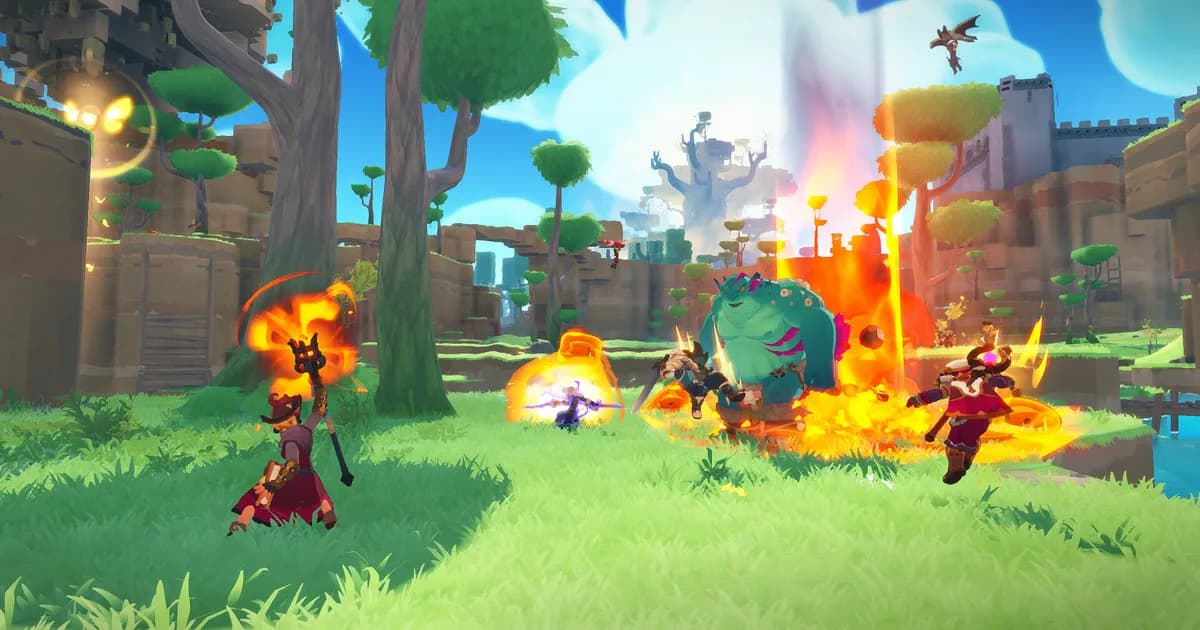
Group engagement mid-run: support positioning covers both damage players while the tank holds the elite enemy's attention.
Party size and role split: the farever co-op breakdown
Community class lists identify Warrior, Priest, Mage, and Rogue as the four familiar class names, but the official store page does not publish a tier list. A one-of-each starting party gives a group a way to test frontline, sustain, melee, and ranged coverage without claiming that it is the only viable composition.
At 3 players, start with two damage or control options plus one sustain option, then swap after seeing which failure mode ends the run. A tank-heavy or support-heavy version may be better for a specific patch or dungeon.
At 2 players, damage plus sustain is a sensible first test. If the dungeon is killing the damage player before output matters, try a sturdier frontline or utility option instead of assuming a DPS swap fixes it.
Solo: choose the class and weapon combination that covers your own survival and damage needs. The official page supports solo play, but it does not establish a universal solo ranking.
Crafting in farever co-op: the underused system
Most groups don't discuss crafting before their first run and end up with three players crafting damage gear and one player's Tank or Support going under-equipped for the first several sessions.
The crafting job system works because it's separate from combat class selection. A Damage player can be your primary crafter for Support gear. This is worth planning:
Before the first run, identify who will cover:
- Support gear crafting (materials that feed the support player's equipment progression)
- Tank gear crafting (block-focused equipment, different material requirements from damage gear)
- Damage gear crafting (crit and elemental specializations have different material needs)
Nobody should be crafting for only themselves. The group's progression is bottlenecked by the slowest-equipped role, which is almost always Support or Tank in groups that don't coordinate crafting.
GODEEPER: For the full breakdown of how crit and elemental Damage builds operate across different gear tiers and fight types, the Farever Builds Guide covers both archetypes in detail, including which equipment items define each build path.
Dungeon transition screen: this is the decision point. Push or retreat is easier to call here than mid-run when the group is over-committed.
Tips: farever co-op coordination
Communicate before pushing further, not after. "Are we going deeper?" is easier to answer at a natural break point than after you've already pushed on and hit a situation the group isn't resourced for.
The Support class player should call when to stop. They have the best visibility into group resource status. If Support says this run is at its limit, trust that read.
Don't adjust your build toward what the group already has. If your 4-player group already has one crit Damage player, don't run the same build as the second Damage player: run elemental. This applies to crafting specializations too: don't double up on what's already covered.
The current v0.2.x notes address party, dungeon, and ready-up bugs, but they do not promise a safe resume point for every disconnect. If a player needs to leave, retreat at a natural break rather than risking the whole group on an unverified reconnect behavior.
Siagarta's open zones have enough content to farm without dungeon diving. If the group isn't ready to push deeper, farming open zone encounters builds mastery and materials without the reset risk of a dungeon disconnect.
Frequently Asked Questions
How many players can play Farever co-op? Farever's official store page describes playing alone or with friends. Community co-op listings describe a four-player ceiling, but verify the current lobby before planning around it. A full group can cover more roles; solo players should choose the current class and weapon combination they can sustain.
What is the best Farever co-op party composition? There is no official endgame meta. Start a full group with damage, sustain, and frontline coverage; for two players, test damage plus sustain first; for three players, keep at least one sustain or control option. Revisit the split after the current Early Access update.
Does the Support class in Farever do damage? Judge a support-oriented class by the survival or utility it adds to the current group, not by a fixed damage ranking. The game is still receiving balance and dungeon updates.
How does dungeon depth work in Farever co-op? Dungeon content gets harder the further a group progresses into a run: enemy health and density both increase. Without a Support class, a group generally burns through its survival margin faster and needs to retreat sooner. A specific "floors 3-4 vs floors 5-6" figure was cited in an earlier version of this guide but wasn't independently verifiable, so it's been removed.
How do crafting jobs work in Farever co-op? The store page confirms that crafting gear is part of the game. Coordinate materials and upgrades for the whole party, and check the current crafting UI for the exact job split after patches.
References
- Farever on Steam: official Early Access page and current multiplayer description
- Farever official announcements: v0.2.x fixes, Major Update #1, and the September 30 Call to Glory update
- r/FareverGame: official community subreddit for group composition discussion (checked directly; no corroborating report found for a specific Support/floor-depth ratio)
- FareverDB class list: community data reference for the four named classes; not an official balance tier list
- Farever Class Guide: full class breakdown and co-op role fit
- Farever Builds Guide: crit vs elemental Damage builds and gear progression
- Farever complete guide hub: classes, builds, co-op party, and dungeon guides
Related Reading
For individual class performance before building a co-op group around it, the Farever Class Guide covers all four classes with gear bonuses and how each fits different group sizes. The Farever Builds Guide goes deeper on the Damage class split (crit versus elemental) which becomes especially relevant when two Damage players are coordinating their builds. And the Farever Tips Guide has the new-player information that saves groups from early mistakes around Siagarta's zone structure.
- Farever Early Access: Shiro Games' New Co-op RPG Launches: launch context and Shiro Games background.
- Farever Complete Guide Hub: the broader class, build, and dungeon index.
Was this guide helpful?
About the author

Critical game theorist with a background in film criticism. Writing for print and digital outlets since 2015. Specialises in genre analysis and design heritage.
- Background in film criticism
- 10 years games coverage
- Genre theory and design history specialist
Keep reading

Farever Guide 2026: Classes, Co-op, and Dungeon Builds
Guides · 15 min

Farever Review 2026: Good Bones, Rough Early Access
General · 9 min
Farever Builds Guide: Best Class and Team Comp 2026
General · 9 min

Farever Class Guide: All 4 Classes and How to Pick
General · 10 min

Farever Tips for Beginners: First Hours in Siagarta
General · 9 min

Farever Dungeon Guide: Depth, Classes, and Support (2026)
Guides · 10 min
Game deals · affiliate links

Disclaimer
This article is published for informational and entertainment purposes. It does not constitute professional financial, legal, or technical advice. Game performance, online services, patch schedules, and store listings change. Verify critical details (pricing, system requirements, regional availability) with publishers and storefronts before you buy. Affiliate links, where present, help support our editorial work and are labelled in our affiliate disclosure.
Comments
Loading comments…