
GameBrief · General
Farever Review 2026: Good Bones, Rough Early Access
Farever review: Shiro Games' co-op RPG recovered to Mostly Positive after v0.1.3. Here's what the underlying game does well and what's still rough.

Reviewing
Farever
Shiro Games · Shiro Games
Score
Reviewed build: Early Access v0.1.3
Pros
- Class-gated gear bonuses create build identity that outlasts raw item level comparisons
- Siagarta's vertical zone design: underwater caves, platforming temples: feels intentional
- Shiro Games responds fast: v0.1.3 hit within days addressing party bugs and data rollback
- Co-op synergy is genuine: support class extends dungeon depth for the full group
Cons
- Server instability at EA launch caused data rollbacks for some players
- Content volume is thin: most players report hitting the ceiling around 10-15 hours
- Party system bugs at launch damaged the co-op experience from day one
Verdict
Farever's foundation is better than its launch Mixed dip suggests. The right buy if Shiro Games' Wartales track record means anything to you: wait for v0.2 if content volume is the deciding factor.
The Farever review situation is specific: this is a game where the launch-day experience and the post-patch experience are genuinely different. Server overload, data rollbacks, party system failures hit the first week. v0.1.3 came out within days addressing them. The score dipped to Mixed during that window before recovering to Mostly Positive. The game those early reviews measured and the game available now have diverged.
TL;DR: Farever review in short: 7.0/10. Shiro Games' co-op action RPG has strong underlying mechanics (class-gated gear, dungeon depth synergies) and a rough EA launch (server instability, data rollbacks). Currently $19.99 on Steam, Mostly Positive after recovering from a first-week Mixed dip, v0.1.3 has addressed the worst of it. Worth playing if you have a co-op group; wait for v0.2 if you want more content.
This Farever review covers the current state: what the game actually is, what the launch problems were and how much of it has been fixed, and what the honest case for or against buying right now looks like.
Farever Review: Key Takeaways
- Farever launched May 6, 2026 at $19.99
- Co-op action RPG from Shiro Games, studio behind Wartales and Northgard, 1-4 players online
- 4 classes: Warrior (tank), Priest (support), Mage (ranged damage), Rogue (melee burst): class determines gear bonus access, not just equip eligibility
- Steam review score: dipped to Mixed after first-week server issues, recovered to Mostly Positive and currently sits at 74% positive from 5,104 English reviews
- Server instability and party bugs drove the early score down; v0.1.3 addressed the main issues
- Content volume is the persistent community complaint: most players report hitting the ceiling around 10-15 hours
What Farever Is
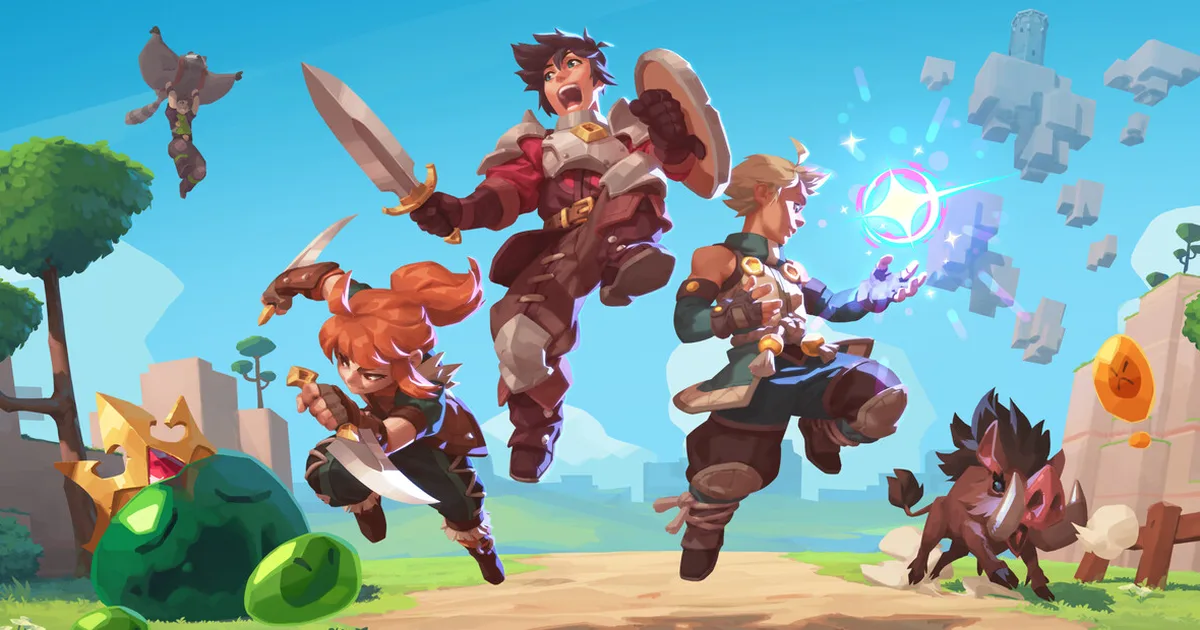
Farever is a co-op action RPG set in Siagarta, a fantasy open world designed around vertical exploration: temple ruins, underground cave systems, underwater platforming sections. You play as one of four character classes (see the Farever class guide), progress through gear and loot, and push deeper into dungeon-style instanced content alongside up to three other players.
Shiro Games is the studio. If that name means nothing, the context is: they made Northgard (2017 Norse RTS, still being updated) and Wartales (2021 EA tactical RPG that hit 1.0 in April 2023). Wartales also entered Early Access rough and delivered a finished, polished game. That track record is the main reason the current Farever review score is Mostly Positive despite the rough launch rather than a harder dismissal.
The game plays as a third-person action RPG. Combat is skill-based with cooldowns, not auto-attack-dependent. Class selection determines your role in a group: damage classes push burst, survivability classes absorb, support extends what the group can push into. There's a crafting job system separate from combat classes, so you aren't locked into crafting your own class's gear.
At $19.99 now, Farever is in a standard indie EA price range. The catch is that $19.99 buys you roughly 10-15 hours of content at the current build, which is the community's consistent complaint and the honest lens for this Farever review.
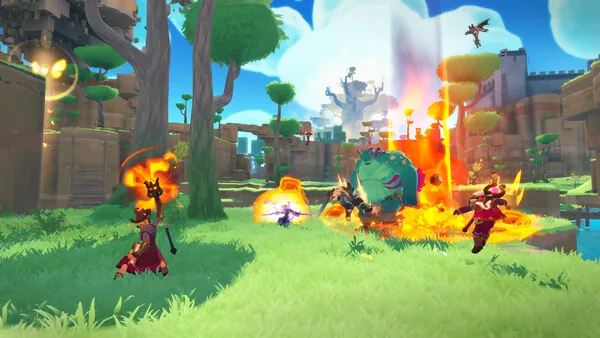 A group fight against one of Siagarta's larger enemies: positioning around the fire matters as much as damage output.
Gameplay: The Co-op Loop in Siagarta
The co-op loop works like this: you assemble a group, enter an open zone of Siagarta, and push through encounters toward instanced dungeon content. Difficulty ramps up the deeper you push into a run. A support class in the party generally extends how far you can push before needing to retreat and recover, though there's no confirmed fixed number attached to that gap.
That's a real difference, not a cosmetic one. Groups that skip the support class because it doesn't look impressive in solo encounter damage are leaving progression on the table. The Farever review community agrees on this pretty consistently: the support class is the most underrated pick in the current build. The Farever co-op guide maps the party roles out more directly if you are assembling a group.
Combat itself rewards positioning and cooldown management. Dodge windows matter. The damage class's burst windows are short enough that whiffing one rotation is a real cost. Survivability class rotations are more forgiving: block mechanics reduce punishment for mistimed inputs.
Siagarta's zone design deserves a flag in this Farever review. The world isn't procedurally generated. Zones have fixed layouts with optional paths, so a second run through a zone is actually navigable rather than disorienting. Underwater sections use a breath meter that adds pressure to exploration without making it punishing. The temple platforming sections feel like they belong in a different genre, which works better than it sounds.
GODEEPER: If you're choosing a class before buying, the full class breakdown covers role tradeoffs and gear synergies in detail. Farever Class Guide: All 4 Classes →
The Gear and Class System
This is where the Farever review gets interesting. The gear system doesn't just gate what you can equip by class: it gates which bonus properties unlock. A piece of armor that drops for everyone might give a damage class a crit multiplier that a survivability class can't access from the same item. The item is equippable by either class, but the passive pool differs.
This makes class selection a real commitment. Two players can equip the same weapon and get different outputs because their class determines which secondary properties fire. That's not obvious from the item tooltip.
Crafting jobs are layered on top of combat classes. You don't craft your own class's gear: you pick a crafting specialization that serves the group. A player running a damage class might be the group's primary crafter for support gear. In practice this means co-op groups end up talking about crafting before the first dungeon run, which is a different conversation than most action RPGs ever prompt.
The gear progression in the early Farever review window (first 5 hours) is clear and rewarding. The ceiling problem appears around hour 10, when the content volume runs out before the gear ceiling does. That gap is the EA reality, not a design flaw.
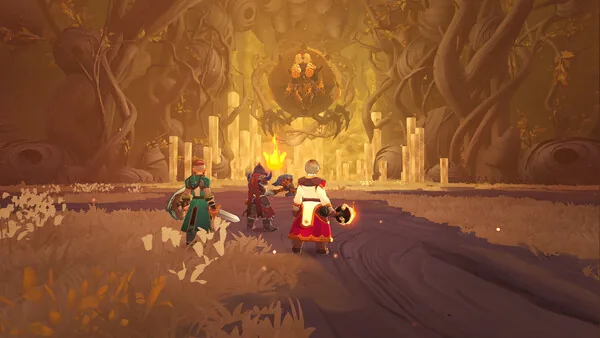 Siagarta's zones lean into set-piece landmarks like this shrine rather than generic open-world filler.
The EA launch: server problems and what got fixed
The Farever review score drop from Mostly Positive to Mixed has a specific cause. The game hit almost 15,000 concurrent players at launch. Shiro Games' server infrastructure wasn't built for that volume. What followed was server instability, party system failures, and (most damaging) a data rollback that caused some players to lose progress.
Shiro published a technical post explaining what happened: database overloads, memory pressure, the decision to roll back to preserve broader stability. They also shipped v0.1.3 covering: party invite fixes (players being teleported incorrectly, friend invites not functioning), server stability improvements, gamepad support expansion, and quality of life additions including inventory autosort.
The patch came within days. That speed matters in a Farever review context. A studio that ships meaningful fixes that fast is demonstrating they can maintain an EA title. Wartales saw similar early patches during its first month.
The party system issues are the most relevant to weigh. If the core pitch is co-op, party system bugs are core functionality bugs. Those hit the initial Farever review score hard, and accurately. Post-v0.1.3, the party experience is noticeably more stable: players are reporting groups holding together through instanced dungeon floors without the separation bugs that plagued launch week.
Server latency improvements are ongoing per the developer blog. Not fixed, but improved. Better than launch, not done yet.
Farever review tips: getting the most out of early access
Three things that change the early access experience, based on community feedback and my own time with the current build.
Don't skip the support class in co-op. The dungeon ceiling is higher with support in the group: not slightly higher, materially higher. If your group of three or four is all damage and survivability, you'll hit a difficulty wall faster than groups running support. Most players skip it because it doesn't look impressive in the first zone. Don't.
Read passive descriptions before equipping. The Farever gear system rewards players who understand which class passives apply to which items. Equipping the highest item level without reading the passive description is the main reason the first few hours feel harder than they should.
Set expectations on content volume. At review time the build had roughly 10-15 hours of distinct content before the loop repeated. Shiro Games shipped Major Update #1 ("The Nightling Invasion") on July 15, 2026, adding a new endgame Rifts system, additional dungeon bosses, and a higher level cap, the first real content expansion aimed at exactly this complaint. This review hasn't been replayed against that update, so treat the original 10-15 hour figure as the pre-update baseline, not the current ceiling.
GODEEPER: If you're ready to optimize your build for the current content ceiling, the builds guide covers class and gear combinations for each archetype. Farever Builds Guide: Best Class Picks →
Verdict
Rating: 7.0/10
There are two different questions here: is the underlying game good, and is the Early Access version worth $19.99 right now?
The underlying game is good. The gear system has real depth, class synergies actually matter rather than being decorative, and Siagarta has more care put into its zones than most EA open worlds I've played. Shiro Games can manage a multi-year EA: Wartales proved that.
The Early Access version has real problems. Content volume is thin. The launch was a mess operationally. Some players lost data. The launch Mixed dip was not review bombing. It reflected a co-op game that couldn't keep players in parties together during its first week.
Where that leaves you: buy now if you have a regular co-op group and trust Shiro's history. Play the 10-15 hours, then set it down until v0.2 adds the next zone. The how-long-to-beat guide breaks down that current content ceiling. That's a reasonable trade for $19.99. If you want a complete game, wait for 1.0.
The Farever review at launch would have landed around 5.5 or 6.0: server failures in a co-op game aren't a minor caveat. Post-v0.1.3, the game you actually play is closer to what they intended to ship. 7.0 is the right number for this Farever review now.
Farever is $19.99 on Steam with no discount running as of late July 2026 (an earlier launch-window sale has ended). Check Loaded (sponsored) for a potentially cheaper key before buying at full price.
Frequently Asked Questions
Is Farever worth buying in Early Access? At $19.99 in May 2026, Farever is worth it with a regular co-op group and trust in Shiro Games' EA track record. Solo players and players who want content volume should wait for v0.2; the Farever beginner tips are the better starting point if you do buy now. This Farever review reflects the current build: the foundation is solid, the content ceiling is just low.
What is the Farever Steam review score? Mostly Positive: Steam currently shows 74% positive from 5,104 English reviews, with 74% positive in the recent-review slice as well. It dipped to Mixed during the first week due to server instability and party bugs, then recovered after v0.1.3. The score reflects that rough launch, not a fundamental game problem.
How long is Farever Early Access? Shiro Games expects approximately one year of EA before 1.0. Based on the Wartales timeline, that puts 1.0 somewhere around mid-2027.
What are the Farever classes? Four classes: Warrior (tank), Priest (support), Mage (ranged damage), and Rogue (melee burst). Each class determines which gear passives you can unlock, a deeper mechanical distinction than just what you can equip.
What happened with Farever servers at launch? Server infrastructure was overwhelmed by almost 15,000 concurrent players, causing instability and a data rollback for some players. Shiro Games published a technical explanation and fixed the main issues in v0.1.3: party system fixes, stability improvements, rollback prevention. Latency improvements are still ongoing.
Is Farever solo-friendly? Yes, but the game is built around co-op synergies. Solo players should run a survivability-forward build. Dungeon depth is meaningfully higher with a support class in the group, which solo play can't replicate.
How does Farever compare to Wartales? Different genres (action RPG versus tactical RPG) but same studio. Wartales entered EA rough and delivered on its roadmap over two years. This Farever review is betting the studio's track record repeats, but it's a bet, not a certainty.
Related Reading
- Farever Tips for Beginners: First Hours in Siagarta: Farever tips for your first hours in EA: gear priorities, class synergies, co-op roles in Siagarta, and what....
References
- Farever on Steam: official store page, current review score, system requirements, and EA roadmap details from Shiro Games
- Shiro Games on Steam: developer profile with Wartales and Northgard track record for context
- Farever complete guide hub: classes, builds, co-op party, and dungeon guides
- Farever official Early Access launch trailer
The Farever builds guide covers class and team composition for the current early access meta: best class for solo, best co-op pairings, and gear priorities.
The Farever early access launch article covers the May 6 launch context: what Shiro Games shipped, what the initial community reaction was, and what the first-day Farever reviews looked like before the server issues became the story.
About the author

Senior Critic & Analyst
Former game data analyst turned critic with 11 years covering indie and mid-tier games. Based in Austin. Runs spreadsheets on games most people just play.
- 11 years games criticism
- Former game economy analyst
- Roguelike and strategy specialist
Keep reading


Disclaimer
This article is published for informational and entertainment purposes. It does not constitute professional financial, legal, or technical advice. Game performance, online services, patch schedules, and store listings change. Verify critical details (pricing, system requirements, regional availability) with publishers and storefronts before you buy. Affiliate links, where present, help support our editorial work and are labelled in our affiliate disclosure.
Comments
Loading comments…