
GameBrief · General
Lost Castle 2 Ethereal Nightmare Guide: All 5 Depths

Reviewing
Lost Castle 2
Hunter Studio
Lost Castle 2 Ethereal Nightmare is what waits on the other side of the credits. Most players roll them and assume the game is over. It's not. NPC Nia appears in camp, unlocks the Ethereal Nightmare device, and the actual progression loop begins.
TL;DR: Lost Castle 2 Ethereal Nightmare unlocks after defeating the final boss. Talk to Nia in camp to access the device. There are five Nightmare Depths cleared sequentially. Soulstones give permanent weapon upgrades but require Soul Inscriptions first. Soul Flowers and Champion Relics are distinct currencies for obtaining those inscriptions. Staff builds around the Arcane Master Inscription are a popular pick for Depths 4 and 5, and Musket got a real viability buff in patch 1.0.0.7.
Lost Castle 2 Ethereal Nightmare: what unlocks after the final boss (quick answer)
Ethereal Nightmare is Lost Castle 2's endgame mode and functions as a New Game Plus system. After you defeat the Demon Lord of Destruction, the game's final boss, for the first time, a cutscene plays, Nia appears as a permanent camp NPC, and she grants access to the Ethereal Nightmare device. From that moment the mode is always available.
The device lets you apply voluntary debuffs to your character before entering a run, such as reduced maximum HP or smaller elixir capacity. Each debuff increases your Nightmare Depth, and higher depths mean tougher enemies, more monsters per area, and harder boss patterns. The payoff is a separate reward track: Soulstones, Soul Flowers, and Champion Relics that have no equivalent in the base campaign.
Depths 1 through 5 are cleared sequentially. You cannot access Depth 3 without clearing Depth 2 first. Depths 4 and 5 were added at the v1.0 launch on June 11, 2026, along with Inscription Resonance III and 33 new loot items. If you finished the game during Early Access, returning now adds two new ceiling tiers.
Key takeaways
- Defeat the final boss once to unlock Ethereal Nightmare permanently through Nia in camp
- Five Nightmare Depths cleared in order: 1, 2, 3, 4, 5
- Soulstones require Soul Inscriptions unlocked first; spending them before that does nothing
- Soul Flowers and Champion Relics are separate currencies with separate functions
- A Staff build around the Arcane Master Inscription and its Floating Ether resonance is a popular pick for Depths 4 and 5
- Patch 1.0.0.7 buffed Musket heat gain and Glacier Launcher AOE radius, improving Musket viability in Nightmare runs
BETTER PRICE: Lost Castle 2 is $17.99 on Steam (no active discount). $8.39 on Loaded → (sponsored): same Steam key, a meaningfully better price.
How Nightmare Depths work: enemy scaling from 1 to 5
The core mechanic of Ethereal Nightmare is the debuff selection screen you see before each run. You choose debuffs voluntarily to push your Nightmare Depth higher. A single debuff might put you at Depth 1. Stacking two specific debuffs might reach Depth 2 or 3. The more debuffs you accept, the deeper the difficulty tier.
At each depth, enemies scale upward in HP and damage output. The monster density per area also increases, and boss encounters gain new attack patterns. Completing a run at a given depth and clearing its final boss unlocks the next depth permanently.
Rewards improve at each depth tier. Soulstone drops become more frequent. Champion Relics, which are rare in Depths 1 and 2, appear regularly by Depth 4. The reward curve is steep enough that grinding Depth 1 for Soulstones after unlocking Depth 3 is inefficient. Push as high as your current build can clear reliably.
One rule that catches players used to roguelite flexibility: you can't skip depths. Depth 2 requires a Depth 1 clear. Depth 4 requires a Depth 3 clear. Progress is strictly linear. Plan your Soulstone investment around this. You'll spend time in each tier before advancing.
 Caption: Hunter Studio's 1.0 launch trailer, which shows off the new enemies, gear, and modes (including Ethereal Nightmare) that arrived alongside the full release.
The Soulstone system: permanent upgrades that require Soul Inscriptions first
Soulstones are the primary permanent progression currency from Ethereal Nightmare. Spending them on a weapon increases that weapon's ATK, SPD, or other base stats. The upgrades persist across all future runs.
GODEEPER: Resonance III (the Third Layer) is the tier that makes Staff and other high-depth builds hit harder. If you're still learning how Soul Inscriptions work, the detailed breakdown is in the Lost Castle 2 Builds Guide: All 8 Weapon Types at 1.0 →
There is a hard prerequisite that the game communicates inconsistently: a weapon must have its Soul Inscription unlocked before Soulstones can be applied to it. If you spend Soulstones on a weapon without the Soul Inscription, nothing happens. You lose the resource.
The Soul Inscription for a given weapon is a one-time unlock. Once obtained, all future Soulstone spending on that weapon takes effect. The unlock comes from two sources: Soul Flowers and Champion Relics, which are different items.
The investment decision matters. Lost Castle 2 has nine weapon categories and over 200 weapons. Spreading Soulstone upgrades across multiple weapon types is slower than focusing on the one or two weapons your best Nightmare runs use. Community practice for Depths 3 and above is to pick a primary weapon type, unlock its Soul Inscription first, and stack Soulstones there before expanding to secondary weapons.
Soul Flowers and Champion Relics: two distinct currencies
Most guides treat Soul Flowers and Champion Relics as interchangeable. They're not. The two currencies do different things, and confusing them costs resources at exactly the wrong stage of progression.
Soul Flowers unlock a weapon's hidden potential. Practically, this means unlocking the Soul Inscription for that weapon, which is the prerequisite for any Soulstone spending. Soul Flowers are a deliberate, targeted spend: you pick which weapon gets the upgrade.
Champion Relics are pickup items you find during runs. Picking one up instantly grants a random weapon inscription. The inscription is random, not targeted. Champion Relics appear more frequently at Depths 3, 4, and 5, which is where this distinction starts to matter.
The timing mechanic that multiple guides mention but rarely explain: if a Champion Relic randomly grants you the inscription you'd have unlocked with a Soul Flower anyway, you save that Soul Flower for a different weapon. The phrase "save Soul Flowers by timing Champion Relic pickups" means this: don't pick up a Champion Relic immediately if you're planning to spend a Soul Flower soon. Wait to see what inscription the Relic would grant, and if it matches your target, use the Relic and preserve the Flower.
This only matters at Depth 3 and above, where Champion Relics appear frequently enough to affect your Soul Flower economy. At Depths 1 and 2, Champion Relics are rare enough that optimizing their timing is not worth the cognitive load.
Best builds for Nightmare Depth 4 and 5
Ethereal Nightmare 4 and 5 launched in the same 1.0 update as Resonance III, but Hunter Studio hasn't published a stated design link between the two: they're two separate additions from the same patch, not a difficulty tier explicitly "tuned around" one specific build. With that caveat, three build paths hold up well in practice.
Staff built around the Arcane Master Inscription
The Staff's Arcane Master Inscription unlocks the Floating Ether resonance skill, which the 1.0-era patches specifically strengthened, and it also triggers Satellite attacks when casting skills. Staff leans on sustained spell damage rather than melee positioning, which suits Depth 4 and 5's tougher enemy density.
The weakness is setup time: getting the Inscription unlocked and Soul Stones socketed into it takes longer than a straightforward melee build. Staff builds are high-ceiling, but they're more run-dependent than Two-Handed.
Two-Handed DEF scaling
A Two-Handed weapon built around the Furious Warrior or Ironbone Brute Inscription is the most forgiving Depth 4 build for players still unlocking their main weapon's Soul Inscription. The burst window is straightforward: stand in, hit hard, survive through DEF scaling. It underperforms against Depth 5's highest-damage enemies, but it clears Depths 3 and 4 reliably.
Musket after patch 1.0.0.7
Prior to 1.0.0.7, Musket builds underperformed in Depths 4 and 5 because enemy aggression patterns reduce the effectiveness of distance-based damage bonuses. The patch buffed the Dragon Blaster skill's Heat gain and expanded the Glacier Launcher skill's explosion radius by 20%, both confirmed in Hunter Studio's own patch notes. Musket is more viable now than at launch, though Staff remains a stronger pick for reliable Depth 5 clears.
GODEEPER: The Demon Lord of Destruction, the final boss that unlocks Ethereal Nightmare, is the 12th encounter in the game. Phase patterns and recommended build states for all 12 bosses are covered in the Lost Castle 2 Boss Guide: All 12 Bosses and How to Beat Them →
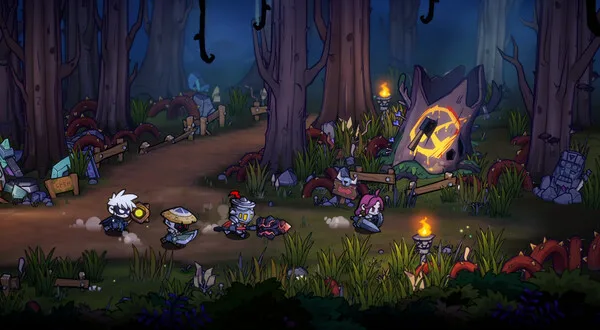 Caption: A forest dungeon floor showing the corrupted vine growths and rune-marked gates that mark the tougher areas players push through on deeper Nightmare Depths.
Tips for progressing through Nightmare Depths
Focus one weapon's Soul Inscription before spreading resources. The temptation to upgrade three weapons simultaneously spreads Soulstones too thin. Depth 2 and 3 clears are achievable without deep Soulstone investment. Depth 4 and 5 aren't. Pick your primary build weapon, unlock its Soul Inscription with a Soul Flower, then funnel every Soulstone there.
Don't force a specific resonance build. Players who enter a Depth 4 run committed to one weapon's Inscription and ignore strong items for other weapons lose more runs than players who build reactively. Let your build emerge from what you find each run rather than refusing items that don't fit a plan made before you saw your drops.
Track which debuffs actually punish your build. Not all debuffs that push Depth cost the same. Reduced elixir capacity is harsh in solo runs and less so in co-op. Lower max HP punishes Two-Handed players and barely affects Staff builds that avoid damage anyway. Learn which debuffs your current build can absorb, and stack those first when pushing a new depth tier.
If you wrote off the Musket during Early Access, check again. The 33 new loot items, 6 new weapons, and new armor from v1.0 added build paths that didn't exist before. The Musket buff in 1.0.0.7 specifically changed how Glacier Launcher-based builds function in Nightmare mode. Builds that felt like dead ends pre-launch may now have paths to Depth 4 viability.
Co-op changes the math on debuffs and build requirements. Ethereal Nightmare supports online co-op across all depths. In a team, one player can run crowd-control Inscriptions (Dual-Blades, status skills) while another runs burst (Staff, high-damage Two-Handed weapon). That synergy lets teams reach higher depths even when nobody's individual Resonance III progress is complete yet. If solo progression stalls at Depth 3, running co-op with a complementary build is usually faster than grinding the same solo attempt.
Related Reading
- Lost Castle 2 Builds Guide: All 8 Weapon Types at 1.0: Soul Inscription and Resonance III explained for each weapon category with named examples
- Lost Castle 2 Boss Guide: All 12 Bosses and How to Beat Them: covers the final boss that unlocks Ethereal Nightmare plus all preceding encounters
- Lost Castle 2 Weapons Tier List: 8 Categories Ranked: post-1.0 weapon rankings accounting for the new launch additions
- Lost Castle 2 Beginner Guide: Weapons, Build and First Run: foundational mechanics for players newer to the inscription system
- Lost Castle 2 Review: Is the 1.0 Launch Worth It?: full review of the v1.0 content package including the new Nightmare tiers
Frequently Asked Questions
How do I unlock Ethereal Nightmare in Lost Castle 2? Defeat the final boss once. After the ending cutscene, NPC Nia appears in camp and grants access to the Ethereal Nightmare device. The mode is permanently available from that point forward.
What are Nightmare Depths in Lost Castle 2? Nightmare Depths are the five difficulty tiers within Ethereal Nightmare mode, numbered 1 through 5. Each depth requires clearing the previous one before access. Deeper tiers increase enemy HP, damage, and monster count while offering better reward drops.
What do Soulstones do in Lost Castle 2? Soulstones provide permanent stat upgrades to specific weapons, including ATK and SPD bonuses. Before you can spend Soulstones on a weapon, you must first unlock that weapon's Soul Inscription. Without the Soul Inscription unlocked, Soulstones have no effect.
What is a Champion Relic in Lost Castle 2? Champion Relics are rare items dropped during Ethereal Nightmare runs. When picked up, each Champion Relic instantly grants a random weapon inscription. They appear more frequently at higher Nightmare Depths and can substitute for spending Soul Flowers to obtain inscriptions, depending on timing.
Which build works best for Nightmare Depth 4 and 5? A Staff built around the Arcane Master Inscription and its Floating Ether resonance is a popular pick for Depths 4 and 5. Two-Handed DEF scaling is a more forgiving fallback while you're still unlocking Soul Inscriptions and Soulstone upgrades.
Did the v1.0.0.7 patch change Ethereal Nightmare viability for any weapon? Yes. Patch 1.0.0.7 buffed the Musket's heat gain and expanded the Glacier Launcher's AOE radius. Before that patch, Musket builds struggled in deeper Nightmare Depths because enemy aggression patterns reduce the effectiveness of distance-based bonuses. The buff improved Musket viability in Nightmare mode, though Staff builds remain the ceiling option for most players.
References
- Lost Castle 2 on Steam: official store page with patch notes and update history
- Lost Castle 2 Official 1.0 Launch Trailer: 1.0 launch trailer, uploaded via the Indie Games Hub YouTube channel
- Lost Castle 2 Wiki: community wiki with Ethereal Nightmare mechanics documentation
- Lost Castle 2 v1.0 Announcement: official press release for v1.0 launch confirming new content additions
Was this guide helpful?
About the author

Senior Critic & Analyst
Former game data analyst turned critic with 11 years covering indie and mid-tier games. Based in Austin. Runs spreadsheets on games most people just play.
- 11 years games criticism
- Former game economy analyst
- Roguelike and strategy specialist
Keep reading

Disclaimer
This article is published for informational and entertainment purposes. It does not constitute professional financial, legal, or technical advice. Game performance, online services, patch schedules, and store listings change. Verify critical details (pricing, system requirements, regional availability) with publishers and storefronts before you buy. Affiliate links, where present, help support our editorial work and are labelled in our affiliate disclosure.
Comments
Loading comments…