
GameBrief · General
Valheim Ocean Biome Guide: Ships, Serpents and Chitin
Reviewing
Valheim
Iron Gate AB · Coffee Stain Publishing
This Valheim Ocean biome guide covers the part of 1.0 that still makes every long crossing feel risky: choosing a ship, reading the weather, hunting Serpents, and getting home with your cargo. The Ocean is not a boss tier, but it is the route between nearly every important island in the Valheim progression map.
TL;DR: Use a Karve for your first serious crossing, a Longship for routine long-distance travel, and a Drakkar when storage and hull health matter more than peak speed. Serpents spawn rarely in the middle of the Ocean at night or in rain, and they are weak to Frost. Leviathan barnacles give 3 to 4 Chitin each, but a disturbed Leviathan starts diving after 20 seconds. Kill Serpents near shore because meat floats while scales and trophies sink.
Valheim Ocean biome guide: what to do first (quick answer)
Treat the Ocean as a transport hazard, not a destination you clear once. Launch from a sheltered coast, carry a repair plan, choose a calm route toward marked land, and keep enough stamina and food to reach shore. Use the Ocean for travel, Serpent materials, and Leviathan Chitin, then leave before a bad fight becomes a recovery mission.
Key Takeaways
- A boat is essential. Swimming out from shore quickly drains stamina and can end in drowning.
- The Karve is the first dependable Ocean boat. The Raft is better for short, low-risk trips than open-water recovery.
- The Longship is the normal long-route pick. It has an 18-slot hold and the highest full-sail top-speed range of the standard boats.
- The Drakkar trades speed for capacity and durability. It carries 32 storage slots and has 3,000 HP.
- Serpents spawn in the middle of the Ocean. Night, rain, and thunderstorms are the conditions to watch.
- Frost damage is the Serpent answer. Do not expect Fire to solve this fight.
- Leviathan mining is a timed decision. Each barnacle gives 3 to 4 Chitin, but disturbance starts a roughly 45-second dive sequence.
- Recovery depends on where you fight. Meat floats, while scales and trophies sink, so shallow water is worth more than a few extra hits.
- The wider Valheim boss order still controls your gear path. Ocean travel supports progression instead of replacing it.
Overview: what the Ocean is in Valheim 1.0
The Ocean is a vast water biome that separates land regions and functions mainly as a vehicle for exploration. It has no boss summon and no armor tier of its own. Swimming is an emergency option near shore, not a travel method. Iron Gate's 1.0 FAQ also confirms that the release focused on Deep North and added nothing specifically focused on the Oceans, so the established sailing and recovery rules remain the ones to plan around. The Valheim 1.0 release coverage gives the wider launch context.
The two Ocean encounters with the biggest effect on progression are the Serpent and the Leviathan. A Serpent is the active threat: it attacks boats and provides food, scales, and a chance at a trophy. A Leviathan is passive and cannot chase you, but it is the source of Chitin used for several important abyssal tools. That split gives the biome a simple rhythm: sail, decide whether the weather is worth the risk, then return to land with anything valuable. Your Valheim Deep North achievements run may end north, but the Ocean is part of the route there.
The current Ocean is also more than a flat blue gap on the map. Weather changes wave size and frequency. The Valheim Wiki lists clear weather at an average wave height of 0.5 meters and a maximum of 1.5 meters. Rain averages 2 meters and reaches 3 meters, while thunderstorms average 3 meters and reach 5 meters. A storm is therefore both a navigation problem and a Serpent window.
GODEEPER: The Ocean makes more sense once you see how it fits between the game's land progression, bosses, food, and construction systems. Valheim Complete Guide: Bosses, Biomes and Base Building
Valheim Ocean biome guide: which boat should you use?
The best boat depends on whether you are scouting a nearby coast, moving a group and its cargo, or deliberately farming Ocean resources. The figures below are the full-sail speed ranges and storage values listed for the current boats. Wind, rowing, turning, and headwinds change what you actually feel during a trip.
| Boat | Full-sail speed | Storage | Best use |
|---|---|---|---|
| Raft | 2.2 to 3.1 m/s | 0 slots | Short coastal moves and emergency first crossings |
| Karve | 3.9 to 7.0 m/s | 4 slots | First dependable Ocean trips and solo recovery |
| Longship | 5.0 to 9.75 m/s | 18 slots | Long crossings, co-op crews, and regular cargo routes |
| Drakkar | 4.65 to 8.9 m/s | 32 slots | Large cargo runs where 3,000 HP and eight extra seats matter |
The Raft is not useless, but it is a poor answer to a long open-water recovery. It is slow, fragile, and gives you no storage. Use it to cross a river, reach a nearby island, or make a low-cost scouting attempt when losing the hull will not strand your character.
The Karve is the important early threshold. Four storage slots are enough for a modest haul, and its speed lets you disengage toward land more reliably than a Raft. Bring a bow, keep the rudder pointed toward your intended landfall when trouble starts, and do not turn a first Ocean trip into an overnight expedition.
The Longship is the default answer for a group. Its 18-slot hold makes a resource route practical, and its speed range is the highest of these four boats. The Drakkar is slower at its top end, but 32 slots and 3,000 HP make it attractive when your party is moving metal, trophies, or building supplies in bulk. The extra seats also make it the better social boat even when the map distance is not extreme.
One sailing rule matters more than the table: a boat moving directly into the wind with its sail unfurled only crawls at its lowest speed. Change course to catch a better angle, or use the rudder and rowing mode while you work toward a tack. Fighting the wind for ten minutes is a good way to arrive at the Serpent window with no stamina and no patience.
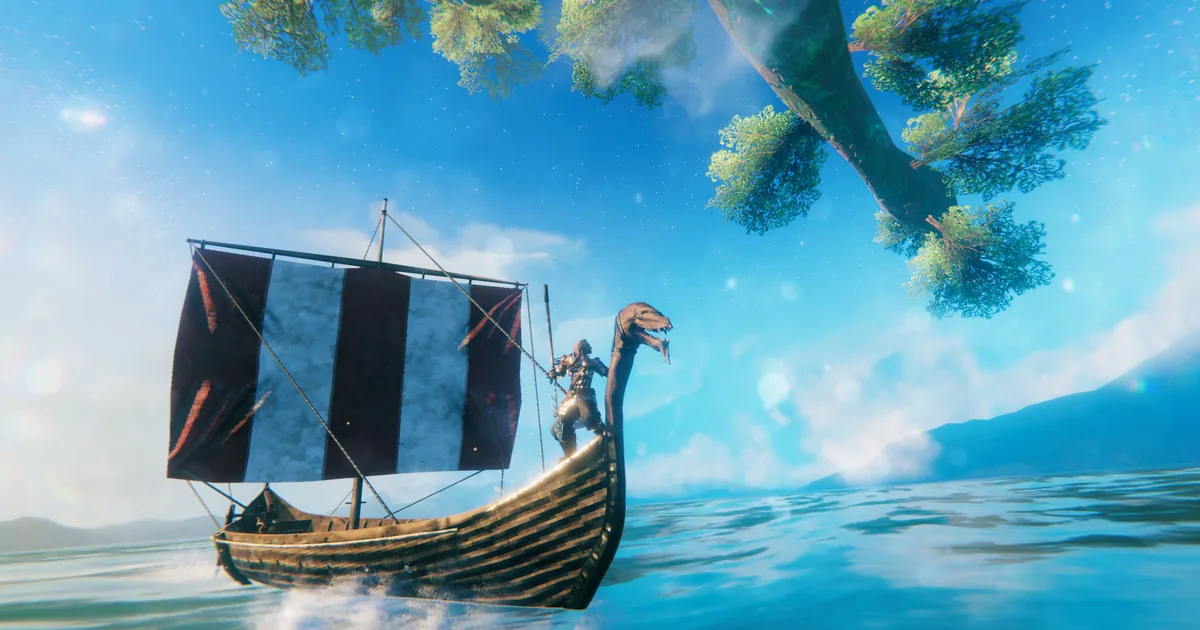
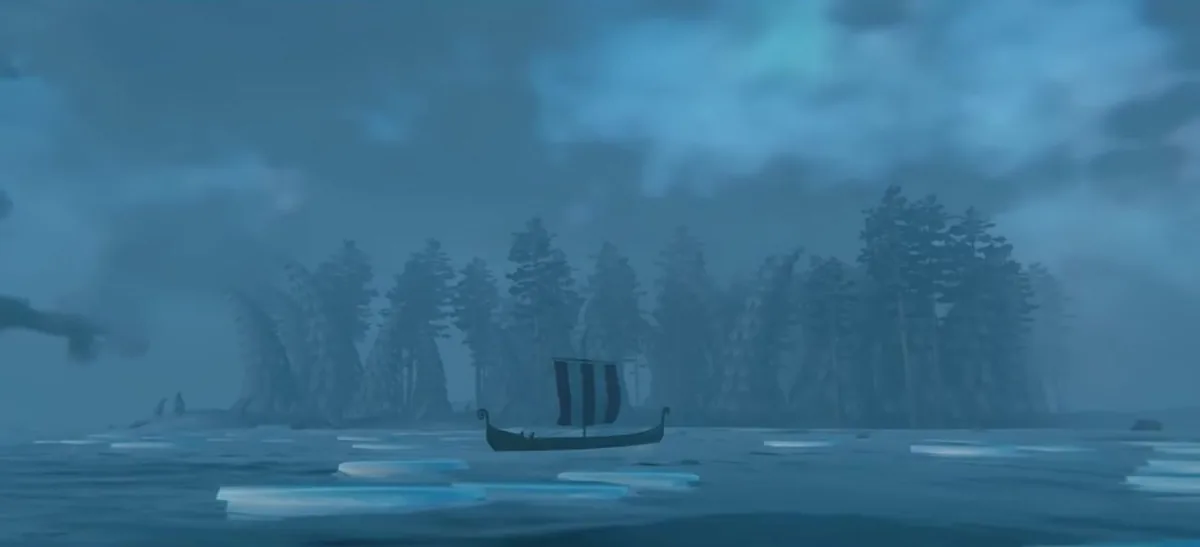 An official Iron Gate video frame showing the basic Ocean problem: keep a reliable landfall in mind while the boat does the dangerous work between islands.
Step-by-Step: safe Ocean crossing
The safest Ocean crossing is a prepared loop from one marked coast to another. Build a repair point at the launch side, check the weather, sail with a clear retreat direction, and treat every Serpent or Leviathan as a decision about loot recovery, not a demand to keep fighting.
1. Build a sheltered launch point: Put a workbench and storage near a protected shoreline, not on a narrow beach exposed to every wave. A small dock or raised landing also makes it easier to repair and board without swimming.
2. Repair before you load cargo: A damaged boat is a bad place to start a long route. Keep the repair point usable, and leave enough wood and food nearby to handle a return trip. If the route ends at a permanent outpost, prepare a second landing before you carry metal away from it.
3. Pick a weather window: Clear water is calmer and easier to read. Rain and thunderstorms make larger, more frequent waves and also create Serpent opportunities. Do not schedule a first crossing around the exact conditions that make the enemy most likely to appear.
4. Mark the route on your map: Place a marker at the departure cove, the destination, and any safe intermediate shore. A direct line is not always the best line. A route with two possible beaches is better than a shorter route that leaves you in deep water if the boat breaks. The Valheim Best Seeds guide is useful when you are planning a new world around shorter crossings.
5. Leave heavy cargo at home on the first scouting trip: Learn the wind, coast shape, and likely landfall before committing irreplaceable metal or trophies. Once the route is safe, use the Longship's storage to make the journey worthwhile. This matters even more before a dangerous landfall such as the Valheim Deep North biome.
6. Keep your sail angle honest: Full sail is for a favorable wind, not a button you leave on forever. If the wind shifts ahead of you, change course, row, or return to the last safe island. The lowest speed is still useful when it is buying a controlled retreat.
7. When a Serpent appears, turn toward shore: Do not stop in deep water to trade every shot. Keep the boat moving, use Frost damage from range, and make the fight shorter by bringing it toward a beach or shallow shelf. Your destination is part of the weapon choice.
8. Mine Leviathan barnacles in a short pass: Mark the creature, mine enough Chitin for the next craft, and leave before greed turns the dive timer into a panic. A single Leviathan is a resource opportunity, not a permanent platform.
9. Unload and repair immediately: Put scales, trophies, metal, and Chitin into land storage before you start another trip. If the haul includes iron, keep it on shore with the rest of your stockpile instead of leaving it in a boat. The Valheim Iron Farming Guide covers the resource loop that makes those cargo runs worthwhile. The Ocean punishes the assumption that the next crossing will be as calm as the last one.
How to find and beat a Valheim Sea Serpent
A Serpent is the only hostile creature that normally spawns in the Ocean. It appears rarely in the middle of the biome at night or during rain and thunderstorms. Use a bow with Frost damage, keep the boat pointed toward a recoverable shore, and never jump into deep water to finish a target whose drops you need.
The numbers explain why the fight feels worse when you improvise. The Serpent has 400 HP. Its Bite deals 70 Slash damage, can be used every 10 seconds when you are within 3 meters, and reaches 3 meters with an 80-degree horizontal arc. The creature is weak to Frost, resistant to Poison, and immune to Fire, Spirit, Stagger, Chop, and Pickaxe damage. Bring the damage type that the mechanic actually rewards instead of relying on a familiar fire setup. For an upgrade comparison, revisit the Valheim Mistlands Guide before spending rare materials on a new weapon tier.
When Serpents spawn
The reliable conditions are simple even though the encounter is rare:
- Night in the middle of Ocean: one rare Serpent can appear, but a night spawn despawns at dawn.
- Rain or thunderstorm in the middle of Ocean: a weather spawn can remain after the weather changes.
- Fresh Ocean zones: the spawn-zone rules check a valid zone every 1,000 seconds, with a 5% chance during night or rain and a 10% chance when both conditions overlap.
The last point changes how you hunt. Sitting in one patch of water and waiting for a Serpent is a poor use of time. A moving route that passes through fresh Ocean zones gives you more chances while also taking you toward a useful destination. Treat the exact percentages as the wiki's spawn-zone model, not as a promise that every loop produces a target.
Serpent drops and the recovery rule
A kill gives 6 to 7 Serpent meat, 8 to 10 Serpent scales, and a 33% chance at a Serpent trophy. The meat floats. The scales and trophy do not. That single difference should decide where you take the final shot.
If the Serpent is already near a beach, keep it there. If it is in deep water, use an Abyssal harpoon to drag it toward shallow ground once you have Chitin and can craft one. Do not spend the whole fight circling a sinking boat because you wanted one more attack. A living Serpent can be hunted again. A trophy at the bottom of an Ocean zone may be gone for good.
Leviathan and Chitin: mine fast, leave early
A Leviathan is a passive, immovable, indestructible Ocean creature. You cannot destroy the body or build on it. The useful targets are the Abyssal barnacles on its back, and each one yields 3 to 4 Chitin. The risk is a hidden timer: every barnacle hit has a 10% chance to disturb the Leviathan.
After it is first disturbed, the creature begins its permanent submergence process after 20 seconds. It takes roughly another 25 seconds from the start of that process to disappear below the waterline. The practical window is short enough that mining every visible barnacle is a gamble, especially if you arrived in a small boat or without a marked route home.
Leviathans are spawned with the world and do not respawn after they retreat. The wiki lists a 1% chance for each full Ocean zone and a minimum depth of 30 meters. That makes them valuable in two ways: Chitin is limited on a normal map, and the creature's position is worth recording before you mine it.
Use this order when you find one:
- Drop a map marker and look for the nearest safe coast.
- Repair the boat before climbing onto the Leviathan.
- Mine a controlled number of barnacles. Stop when the body starts shaking instead of swinging until the dive is already underway.
- Leave immediately when the disturbance becomes obvious or the dive begins.
- Store the Chitin on land before deciding whether another trip is worth it.
The first Chitin haul has a clear payoff. Chitin is used for the Abyssal harpoon, the Abyssal razor, and the Fins of Destiny. Craft the item that solves your next problem instead of treating the first Leviathan as a checklist you must empty in one visit.
What Ocean resources are worth bringing home?
The Ocean's best reward is not one item. It is the way Serpent meat, scales, and Chitin open different parts of the wider survival loop. Bring the resource back to a real base before you cook, craft, or start another crossing. That keeps the Valheim boss order moving without making every trip a gamble.
| Resource | Confirmed result | Why it matters |
|---|---|---|
| Cooked Serpent meat | 70 health, 23 stamina, 25-minute duration | Strong food from a successful hunt |
| Serpent Stew | 1 Mushroom, 1 Cooked Serpent meat, 2 Honey; 80 health, 26 stamina, 30-minute duration | A long-duration health food for dangerous routes |
| Serpent scales | 8 to 10 per kill | Required for the Serpent scale shield |
| Serpent trophy | 33% drop chance | A rare trophy and the part most likely to sink |
| Chitin | 3 to 4 per Abyssal barnacle | Abyssal harpoon, Abyssal razor, and Fins of Destiny |
The Serpent scale shield costs 10 Finewood, 4 Iron, and 8 Serpent scales. It is a tower shield with pierce resistance, so the scales are useful proof that you survived a storm. If your group already has the iron but keeps losing scale drops, change the kill location before you change the weapon.
Food is also why a safe recovery matters. Serpent Stew is a meaningful health upgrade, but its recipe depends on a complete kill and an Iron cooking station. Use the Valheim Food Buff Guide to plan the meal around the biome you are actually entering, not the food you happened to have when the Serpent spawned. If the route starts beside a new coastal outpost, the Valheim Base Building Guide has the practical setup for storage and portals.
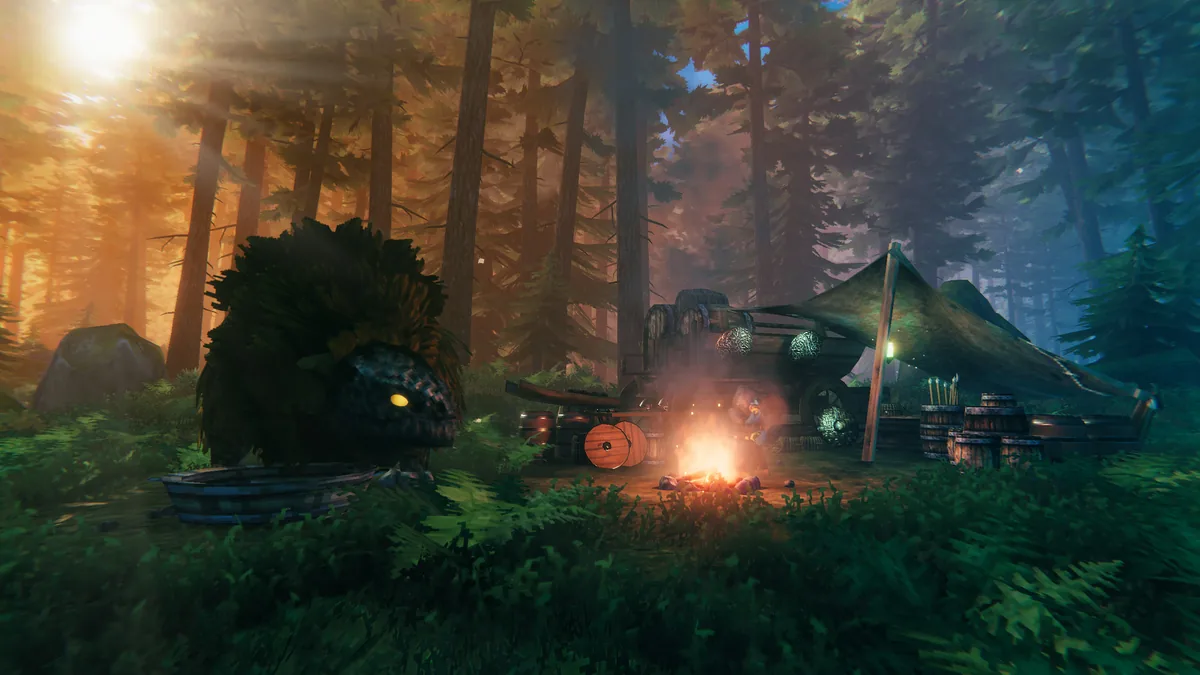 A boat is safest when it has a prepared landing nearby. Keep the next repair, meal, and storage point on land. The hull is a vehicle, not a permanent base.
Tips that prevent most Ocean recoveries
Most Ocean deaths come from stacking small risks: a Raft used too far from land, a storm treated as harmless, a full hold taken into an unmarked route, or a Serpent fought where its drops cannot be recovered. Build the trip around a safe return, and the Ocean becomes a travel system instead of a recurring corpse run.
Do not make the Raft your long-distance plan
The Raft's low speed, zero storage, and fragile hull make it a poor choice for open-water recovery. Use it for a short test or a river crossing. The Karve is the first boat that feels dependable for a solo route, and the Longship is the practical upgrade once you are moving cargo.
Keep a repair and portal plan on both sides
A portal does not remove the need to sail across the Ocean, but it can remove the need to sail back with every small item. Build a landing hub on the destination coast, repair the boat there, and use the portal after you have unloaded. The Valheim Base Building Guide covers the comfort, ward, and portal setup that makes these coastal outposts worth maintaining.
Take a Frost option even on a peaceful cargo run
You do not need to hunt every Serpent you see. You do need a way to end the encounter if it chooses you. A Frost-damage bow or another ranged Frost option gives the crew an answer without forcing a melee fight on a moving deck. The Valheim Weapons Tier List is useful when you are deciding whether the next upgrade is worth the materials, and it is worth checking before you spend a long crossing carrying the wrong damage type.
Separate cargo from ambition
On the first trip to a new island, take enough materials to survive and leave the rarest cargo at home. Once the route has a marked beach and a working repair point, return with the full hold. This is especially important for trophies and scales because their sinking behavior is less forgiving than meat.
Treat a storm as a route change
Clear weather's average 0.5-meter waves are not the same trip as a thunderstorm's 3-meter average. Turn toward the nearest known coast when visibility and wave height turn against you. You are not losing progress by docking. You are protecting the boat, the crew, and the cargo that made the crossing worthwhile. The same discipline helps when you later plan the Valheim Ashlands route, where the shoreline is less forgiving.
GODEEPER: Once your Ocean route is stable, the next improvement is choosing damage types by biome instead of upgrading every weapon equally. Valheim Weapons Tier List: Best Weapon Per Biome
Frequently Asked Questions
Is the Ocean a real biome in Valheim?
Yes. Ocean is a water biome built mainly for travel between landmasses. Swimming quickly drains stamina and can drown you, so a boat is the practical way to cross it. It has no boss or armor-tier gate of its own.
What creatures are in the Valheim Ocean biome?
The two creatures that matter most for Ocean travel are the hostile Serpent and the passive Leviathan. Serpents provide meat and scales, while Leviathan barnacles provide Chitin.
How do you find Serpents in Valheim?
Serpents spawn rarely in the middle of Ocean at night or during rain and thunderstorms. Night Serpents despawn at dawn, while weather-spawned Serpents persist. Moving through new Ocean zones is more productive than waiting in one spot.
What is the Serpent's weakness in Valheim?
Serpents are weak to Frost damage. They have 400 HP and a 70 Slash bite, so use a bow from your boat or lure one toward shallow land instead of trying to fight while swimming.
How do you get Chitin in Valheim?
Mine the Abyssal barnacles on a Leviathan. Each barnacle yields 3 to 4 Chitin, but every hit has a 10% chance to disturb the creature and start its eventual dive.
Do Leviathans respawn in Valheim?
No. Leviathans spawn during world generation and do not respawn after retreating below the Ocean. Mark every one you find and plan what you want to craft before you start mining.
What happens to your loot when a boat sinks in Valheim?
A death in the Ocean creates a floating headstone, and destroyed boat cargo appears in floating crates. Serpent meat floats, but scales, trophies, and many heavier items sink and can become unreachable.
What is the best boat for a long Ocean crossing?
The Longship is the safest general-purpose choice because it combines the fastest top speed among the standard boats with 18 storage slots. The Drakkar has 32 storage slots and 3,000 HP, but its top speed is lower.
Related Reading
- Valheim Deep North Biome Guide: Enemies and Gear 2026: prepare for the 1.0 land biome that Iron Gate prioritized over an Ocean update.
- Valheim Ashlands Guide: Fader Boss and Charred Enemies: plan the fire-resistant gear and boss progression after your Ocean routes are secure.
- Valheim Food Buff Guide: Best Foods for Every Biome: compare Serpent Stew with the food options that support each land biome.
- Valheim Base Building Guide: Comfort, Wards, Portals 2026: build coastal storage, repair points, and portal hubs that make sailing repeatable.
References
- Valheim on Steam: official store page for the current game and 1.0 release.
- Valheim 1.0 FAQ: Iron Gate's release answers, including the Ocean update question.
- Valheim on the official Iron Gate site: developer site.
- Valheim: The Voyage of Hervor Bloodtooth - Part 1: official Iron Gate sailing video used for the misty Ocean image.
- Valheim: 1.0 Out Now: official Iron Gate launch video for the current 1.0 context.
- Valheim Wiki: Ocean: Ocean access, waves, creatures, and lost-loot behavior.
- Valheim Wiki: Boats: boat speeds, storage, and sailing behavior.
- Valheim Wiki: Serpent: Serpent stats, spawn conditions, damage types, and drops.
- Valheim Wiki: Spawn zones: Ocean spawn timing and zone probabilities.
- Valheim Wiki: Leviathan: barnacle yield, disturbance timer, depth, and respawn behavior.
- Valheim Wiki: Serpent meat, Serpent stew, and Serpent scale shield: recipe and stat cross-checks.
- r/valheim: community signal checked for current Ocean recovery questions; player reports were treated as anecdotal.
Was this guide helpful?
About the author

Games Critic
Games writer and reluctant optimist who has reviewed over 400 titles across 9 years. Irish, currently in Berlin. Has strong opinions about tutorial design.
- 400+ games reviewed across 9 years
- Platformer and horror specialist
- Narrative design focus
Keep reading

Disclaimer
This article is published for informational and entertainment purposes. It does not constitute professional financial, legal, or technical advice. Game performance, online services, patch schedules, and store listings change. Verify critical details (pricing, system requirements, regional availability) with publishers and storefronts before you buy. Affiliate links, where present, help support our editorial work and are labelled in our affiliate disclosure.
Comments
Loading comments…