
GameBrief · General
Valheim Base Building Guide: Comfort, Wards, Portals 2026
Reviewing
Valheim
Iron Gate Studio
Valheim base building has more rules than the tutorial admits to. You can stack logs into a wall and call it a house, but the game is quietly tracking two separate systems the whole time: whether your structure can physically hold itself up, and whether the space you built is actually pleasant enough to sleep in. Miss either one and you'll find out the hard way, usually at 2 AM with a Greydwarf outside.
TL;DR: Two systems run every Valheim build: structural stability (blue/green is safe, yellow is risky, orange/red is about to collapse) and comfort (furniture that unlocks the Rested buff, faster stamina and health regen plus bonus XP, the longer you sit near enough of it). Standard portals still block ore and metal, though the post-Ashlands Portal Stone is a real exception. Deep North is adding steeper 67-degree roofs and a drawbridge ahead of the September 9, 2026 1.0 release.
How does base building work in Valheim? (quick answer)
Two systems run underneath every build: structural stability, which determines whether a piece stays up or collapses, and comfort, which determines whether resting near your build actually gives you a buff. Get both right and your base is both standing and worth living in. Ignore either and you'll either watch your roof cave in or wonder why Rested never procs despite a decorated hall.
Valheim base building: key takeaways
- Structural stability is color-coded. Hover the hammer over any piece: blue and green are solid, yellow is getting risky, orange and red are close to falling
- Wood placed directly over water loses roughly half its stability, so raise a foundation on pillars or land fill before building over rivers and coastline
- Comfort unlocks the Rested buff: furniture and decorations build a score, and resting near enough of it for 20 seconds triggers faster stamina/health regen and bonus XP
- Higher-tier furniture usually replaces lower-tier versions in the same category rather than stacking, so a Dragon Bed doesn't add on top of a Straw Bed's value, it supersedes it
- Standard portals still block ore and metal; the Portal Stone (post-Ashlands) is the one confirmed exception
- Deep North is adding new build pieces before 1.0: steeper 67-degree roof pieces and a drawbridge, both officially confirmed by Iron Gate
Structural stability: what the colors actually mean
Every piece you place gets a stability tint the moment your hammer hovers over it. Blue and green mean the piece is solidly supported and not going anywhere. Yellow means the support chain is thinning out but the piece will generally survive normal weather and impacts. Orange and red mean the structure is close to its limit, and red specifically means it's one nudge away from collapsing.
Material matters here more than most new players expect. Heavier materials like stone put more load on whatever they're resting on than lighter wood does, so a stone build with the same span and support pattern as a wood one will show worse color-coding sooner. This is why stone castles in Valheim tend to need thicker walls and shorter spans between supports than wood halls of a similar size.
The other trap: building directly over water. A wood piece placed straight over open water loses a significant chunk of its stability compared to the same piece on solid ground, roughly half by most accounts. If you're building a dock or a bridge, raise a stone or core wood foundation first rather than starting your wood structure right at the waterline.
GODEEPER: If your build keeps collapsing specifically in the Mistlands, the terrain there behaves differently than the biomes you've built in before. Valheim Mistlands Guide →
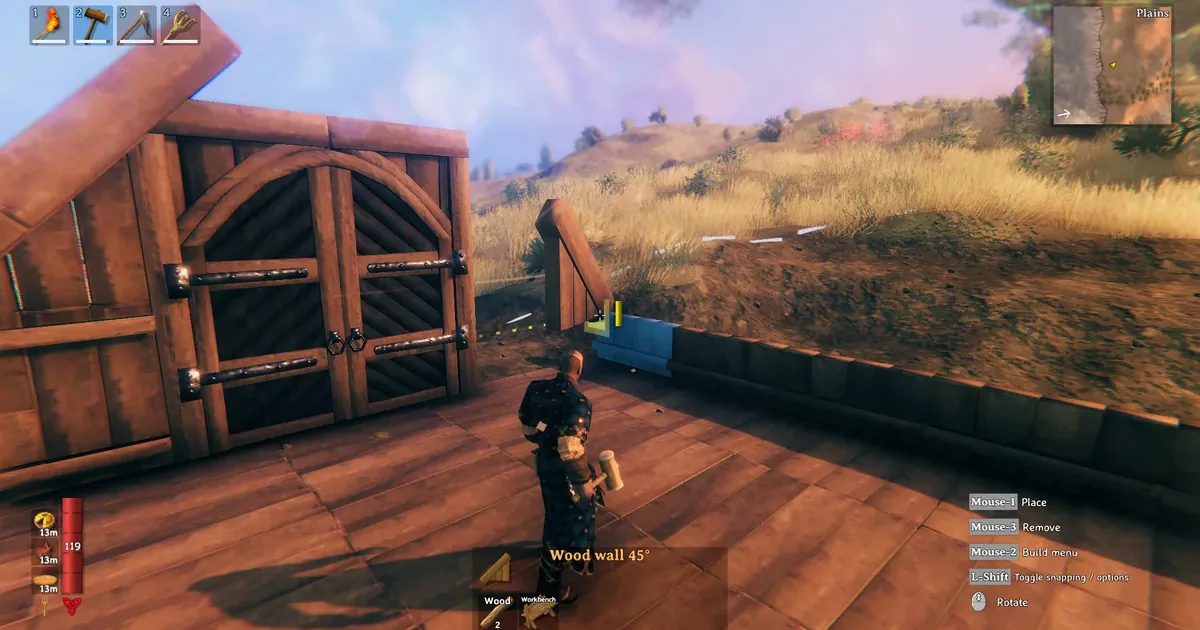 Hovering a piece before placing it shows the stability tint immediately, which is the fastest way to catch a bad support pattern before it becomes a collapsed roof.
Workbenches, crafting radius, and why pieces sometimes grey out
Placing most building pieces past the early tier requires being within range of a workbench or a more advanced crafting station. If you've ever had a piece grey out as unplaceable despite having the materials, that's the radius talking, not a bug. Iron Gate hasn't published an exact number for that radius, and figures players cite vary depending on the source and which station you're near, so don't treat any specific meter count you see elsewhere as gospel.
The practical fix is simpler than measuring distances: if something won't place, either move closer to your existing station or drop a second workbench nearer to the section you're expanding into. Multiple stations overlapping their radii is completely normal for larger bases, and it's cheap to do since a basic workbench costs very little.
Comfort: the system that decides if resting actually helps
Comfort is a separate score built from what furniture and decorations you've placed nearby. Sit or sleep near enough comfort for 20 seconds and you get the Rested buff: faster stamina regeneration, faster health regeneration, and a bonus to XP gain while it lasts. Each point of comfort you're near adds roughly a minute onto how long Rested sticks around after you stand back up.
Furniture generally works in categories rather than stacking infinitely. A campfire and a Hearth both count as your "fire" slot, but only the better one applies, since the Hearth supersedes the campfire rather than adding on top of it. The same pattern holds for beds, chairs, and tables: upgrading to a better version in the category raises your comfort, but having both the old and new version out doesn't double it.
Specific point values shift with balance patches more than most systems in the game, so treat any exact number as a snapshot rather than a permanent rule. What's stayed consistent across patches: rugs, banners, and basic tables tend to sit in the 1-2 point range, while thrones and the highest-tier bed are usually the standout single items, commonly cited around 2-3 points. Standalone extras like a hot tub or a Yule Tree add on top of the furniture categories rather than competing with them.
GODEEPER: Food and comfort work together more than the game explains directly, since a well-fed Rested character survives fights that would otherwise go badly. Valheim Food & Buff Guide: Best Foods 2026 →
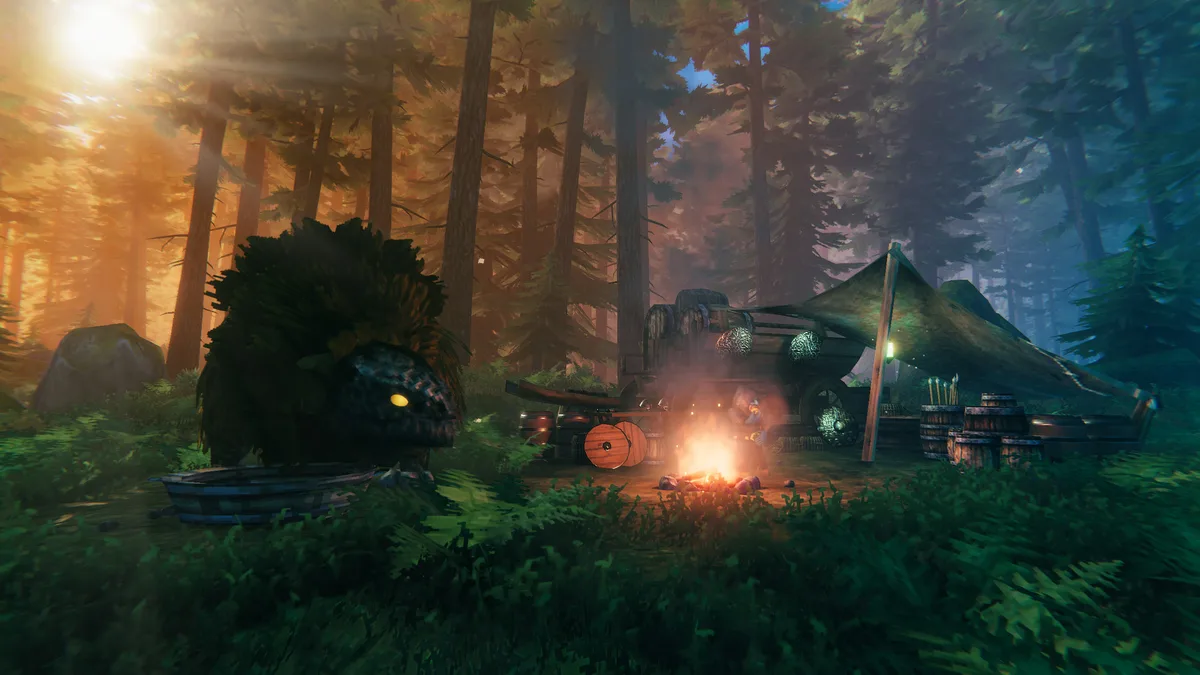 A minimal early camp like this one won't score much comfort, but it's enough to get through the first few nights before you commit to a permanent base location.
Portals: what can and can't travel through
The oldest building-adjacent rule in Valheim is that standard portals block ore and metal. You can walk raw Iron Scrap or Copper right up to a portal and it simply won't let you carry it through, which is why early hauling runs from the Swamp or Black Forest back to base are done on foot or by boat rather than by portal shortcut.
That rule changed, but only partially, with the Ashlands update. A new structure called the Portal Stone was added that explicitly allows teleporting ore, metal, and a handful of other normally-restricted items like dragon eggs. It's a separate, more involved structure than a standard portal, not an upgrade to the existing one, so building it is a deliberate choice rather than something that happens automatically as you progress. There's also a world-modifier toggle available at world creation that turns off the ore-teleport restriction entirely, for groups who'd rather skip the whole mechanic.
Naming portals correctly still matters for pairing: two portals with matching names link to each other, and a typo or mismatched name is the most common reason a "broken" portal is actually just unlinked.
GODEEPER: The Portal Stone is one of several practical Ashlands additions worth understanding before you push that far south. Valheim Ashlands Guide: Fader & What's New →
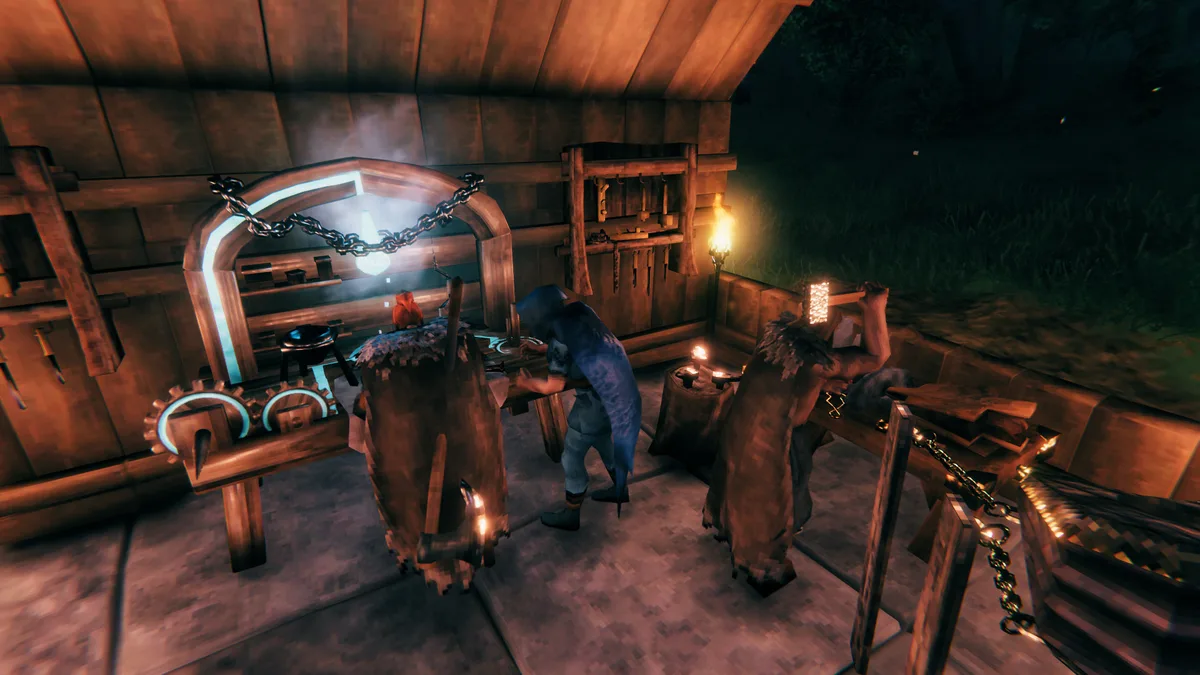 A dedicated crafting room like this one keeps multiple stations within a shared radius, which avoids the "can't place" problem more elegantly than one station trying to cover an entire base.
Tips for building bases that last
Build your first base away from open water edges. New players gravitate toward coastal spots for boat access, but that's exactly where the water-stability penalty bites hardest. A base set back even a short distance, with a dock extending out to the water, avoids the problem entirely.
Don't mix stone and wood load-bearing pieces in the same structure without extra support. Stone's heavier weight profile means a wood-supported stone wall will show yellow or orange far sooner than an all-wood equivalent. If you want a stone facade, plan the support pillars for stone specifically rather than reusing a wood layout.
Prioritize one comfort-category upgrade at a time, not all at once. Since categories supersede rather than stack, there's no comfort benefit to placing five straw beds instead of one Dragon Bed. Spend crafting time on getting one of each category to its best available tier before worrying about decorative extras.
Keep a second workbench near any addition you're building far from your original one. It's inexpensive and immediately fixes the "can't place" greyed-out piece problem without you needing to guess at an exact radius.
Name portal pairs something you'll actually remember, especially once you have four or five of them. "Home" and "Home2" gets confusing fast; naming by biome or purpose ("Swamp-Crypt", "Mountain-Base") holds up better over a long save.
Common mistakes
Assuming more furniture always means more comfort. Once a category is filled with its best version, adding a second or third copy of a lower-tier item in that same category does nothing. Comfort planning is about categories, not item count.
Building a roof flat because it looks simpler. Flat wood roofs collect rain damage differently than angled ones and can develop stability problems faster in exposed weather. A proper angled roof, even a basic one, holds up better long-term.
Ignoring the color tint entirely because "it hasn't fallen yet." Yellow is a warning, not a pass. A structure sitting at yellow for a while can still fail the moment you add one more piece or a nearby explosion shakes things loose.
Trying to portal ore back to base before checking if you even have a Portal Stone built. This is a fresh source of confusion since Ashlands, since players who haven't built the Portal Stone yet assume the old restriction was removed entirely. It wasn't; only the new structure bypasses it.
Frequently Asked Questions
How does the comfort system work in Valheim? Comfort is a score built from nearby furniture and decorations. Once you rest near enough of it for 20 seconds, you get the Rested buff: faster health and stamina regen plus bonus XP gain. Each comfort point adds roughly a minute to how long Rested lasts.
What furniture gives the most comfort in Valheim? Thrones and the Dragon Bed are among the highest single-item values, commonly cited around 2-3 points each, with rugs, banners, and tables typically worth 1-2. Exact per-item numbers get adjusted in balance patches, so treat any specific figure as approximate and check in-game tooltips for your current version.
How do you know if a Valheim structure is stable? Hover the hammer over a placed piece and it tints color-coded: blue and green mean solid, yellow means getting risky, and orange or red means the piece is close to collapsing. Heavier materials like stone fall apart faster than wood when support runs out, and any wood piece built directly over water loses a large chunk of its stability.
Can you send iron and ore through a Valheim portal? Not through a standard portal. That restriction is one of the oldest rules in the game. Since the Ashlands update, a separate structure called the Portal Stone was added that explicitly allows teleporting ore, metal, and a few other restricted items, and there's also a world-modifier option to turn the ore restriction off entirely at world creation.
What is the workbench radius in Valheim? A workbench (and higher crafting stations) only let you place certain building pieces within a limited radius around it. The exact distance isn't something Iron Gate publishes precisely, and player-measured figures vary by source, so the practical approach is simpler: if a piece greys out as unplaceable, you're outside range and need to move or add another station.
Is Valheim still getting new building pieces in 2026? Yes. Iron Gate confirmed steeper 67-degree roof pieces standing 4 meters tall, available in both thatch and darkwood styles, plus a long-requested drawbridge piece, both arriving with the Deep North content ahead of the planned September 9, 2026 1.0 release.
Related Reading
- Valheim Boss Order: All 7 Bosses Guide: the full progression path if your base is solid and it's time to push toward the next boss.
- Valheim Iron Farming Guide: Crypts, Keys & Portals (2026): Valheim iron farming happens in Sunken Crypts, unlocked by a key only The Elder drops.
- Valheim Best Seeds 2026: Codes for Fast, Rich Starts: Valheim best seeds worth trying now: HHcLC5acQt clusters bosses near spawn. But the 1.0 Deep
- Valheim 1.0 Release Date: Deep North, September 2026: what else is confirmed for the biome bringing the new roof pieces and drawbridge.
- Valheim Weapons Tier List: Best Weapon Per Biome (2026): Valheim weapons tier list: Frostner and Draugr Fang lead the Mountains, but Ashlands added 30+
References
- Valheim on Steam: official store page, current pricing, and Steam news feed for patch notes
- Word From the Devs: Through the Roof (Iron Gate developer blog): official confirmation of the 67-degree roof pieces and their height
Was this guide helpful?
About the author

Indie & JRPG Critic
Indie game evangelist and lifelong JRPG fan covering small studios since 2017. Mumbai-born, London-based. Writes the way she talks.
- 7 years indie games coverage
- JRPG and visual novel specialist
- Narrative design focus
Keep reading




Disclaimer
This article is published for informational and entertainment purposes. It does not constitute professional financial, legal, or technical advice. Game performance, online services, patch schedules, and store listings change. Verify critical details (pricing, system requirements, regional availability) with publishers and storefronts before you buy. Affiliate links, where present, help support our editorial work and are labelled in our affiliate disclosure.
Comments
Loading comments…