
GuideMewgenics
Mewgenics Guide: Breeding, Combat, and All 14 Classes
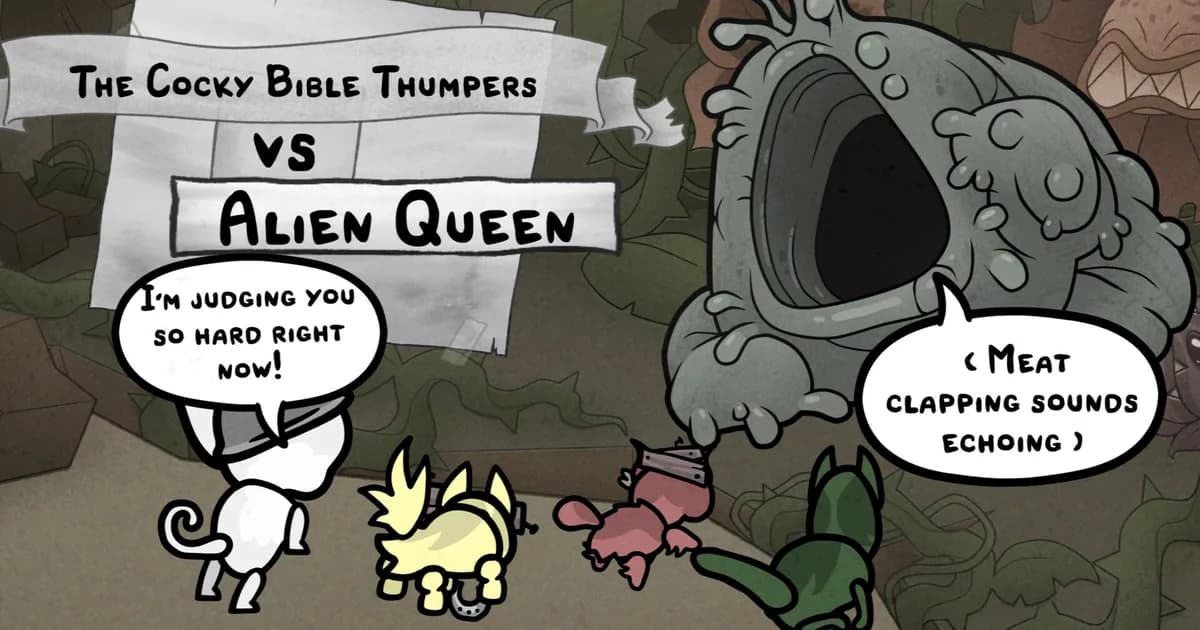
About the game
Mewgenics
This Mewgenics guide exists because the tutorial tells you almost nothing about why your cats keep dying in fights, or why two seemingly identical parents produce a kitten with garbage stats. It covers movement and the basic breeding prompt, then leaves you to figure out Libido, Comfort, and inbreeding coefficients on your own. What follows is the stat inheritance system that actually decides whether your cats are any good, plus the 14-class roster and how tactical combat rewards positioning over raw stats.
TL;DR: For each of seven core stats, a kitten inherits one parent's starting value, with Stimulation affecting the odds. Breeding also has separate active-ability, passive-ability, disorder, and appearance steps. Combat gives units a movement action and a basic attack by default; physical attacks into a unit's back deal 25% more damage. There are 14 classes total: 5 available immediately (Collarless, Fighter, Hunter, Mage, Tank) and 9 unlocked by clearing a zone and collecting its collar from Butch.
Mewgenics guide: breeding and combat basics (quick answer)
Breeding gives two adult cats in the same room a chance to pair at the end of the day. The pairing process uses compatibility and Comfort; Stimulation primarily affects what a successful kitten inherits. Combat is turn-based and grid-based: classes come from collars, not breeding, and a kitten's inherited stats and abilities are separate from its parents' collars.
Key takeaways
- For each of the seven core stats, a kitten inherits one parent's starting value. A stat acquired later in life is not the value used for this inheritance step.
- High Comfort increases the overnight breeding odds; low Comfort increases the odds of fighting. It is a modifier to the pairing process, not a guarantee of either outcome.
- Stimulation biases the stat and ability inheritance process. The breeding formula for the biased stat value is
(100 + |Stimulation|) / (200 + |Stimulation|). - Battle turns use Initiative order. By default, each unit has a movement action and a basic attack it can use once per turn; active abilities are separate actions with their own mana costs and rules.
- Backstabs are documented as a damage mechanic: a unit hit into its back takes 25% more damage, rounded down, and only physical damage can backstab. The guide does not treat an undocumented universal end-of-turn facing choice as a rule.
- There are 14 classes, 5 from the start and 9 gated behind zone clears plus a return trip to Butch.
- High inbreeding coefficients unlock unique disorders and birth defects. It's a real system, not a joke stat.
Overview
This guide covers the version of Mewgenics live on Steam as of this writing (appid 686060), which launched February 10, 2026 from Edmund McMillen and Tyler Glaiel, priced at $29.99. It's sitting at a Very Positive rating across more than 51,000 reviews. If you're past the tutorial and confused about why your third-generation cats are worse than your first, or why your four-cat squad keeps losing to trash mobs, this is written for you.
What this guide covers: the stat inheritance math behind breeding, the house stats that gate it, the core combat loop, and the full class list with unlock conditions. What it doesn't cover: a step-by-step story walkthrough or a tier list ranking every class (some of that depends on your specific stat rolls, which the game is designed to make different for every player).
Breeding and stat inheritance
Every cat rolls seven core stats between 3 and 7 at birth. These aren't cosmetic; they're the raw numbers everything else, including class performance, gets built on top of. The mistake new players make is assuming a good cat produces good kittens automatically. It's closer to a weighted lottery.
Two adult cats in the same room have a chance to breed at the end of the day. Compatibility is calculated from cat properties including the initiator's Charisma and the partner's Libido, then two rolls use compatibility and Comfort; at Comfort -10 or lower, those rolls automatically fail. Stimulation affects which parent's stat value is favored and also affects other inheritance steps. Put a high-Stimulation room together with compatible adults and you're nudging the odds rather than relying on a vague "good breeder" label.
For each of the seven core stats, kittens inherit one parent's starting value; the Stimulation formula biases which value is selected. That is only the stat-inheritance step, not the whole breeding result. The same process separately handles active abilities, passive abilities, disorders, and appearance, so "kittens inherit only base stats" is an incomplete description.
Mutations, Disorders, and inbreeding
Breeding resolves several separate outcomes. A kitten can inherit active and passive abilities, disorders, and appearance; appearance includes mutations and birth defects. Each parent's disorder has a separate 15% inheritance roll, and if fewer than two parental disorders were inherited, the game can add an inbreeding disorder with a chance of max(2%, 0.4 × inbreeding − 6%), capped at 34%. A high inbreeding coefficient is also the documented source of unique disorders and birth defects, so repeatedly breeding a tight family line has a real downside.
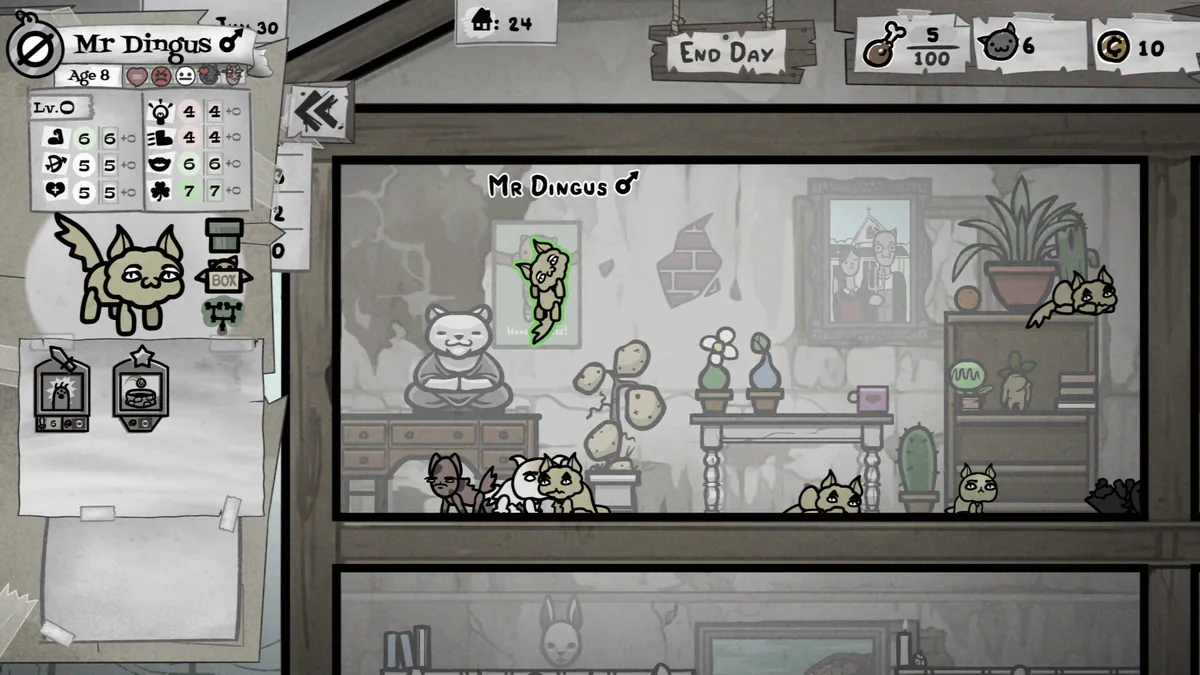 The household screen tracks each cat's inherited stats individually. This one, Mr Dingus, is showing six physical and mental stats, all still at base value before any training.
For the room-side breeding mechanics documented by the wiki, Comfort modifies the pairing rolls and Stimulation affects what a successful kitten inherits. Cat-side Charisma and Libido also feed compatibility. If pairing keeps failing, inspect those inputs instead of assuming a single "Mutation" or "breeder quality" stat controls the outcome.
Tactical combat basics
Fights are turn-based on a board made of 10x10 square tiles. An Adventure normally uses a four-cat party, though the game can add followers. Rounds give units turns in Initiative order; Speed is also the stat that affects movement range and combat tempo.
By default, each unit has a movement action and a basic attack usable once per turn. Basic attacks cost no Mana. Active abilities, also called spells, cost 0 or more Mana, can normally be used multiple times per turn unless their own rule says otherwise, and a cat can learn up to four active abilities. Max Mana and starting Mana usually scale with Charisma, while Intelligence controls end-of-turn Mana regeneration.
Backstab is the positioning rule new players skip past. The Damage Mechanics reference says a unit hit into its back takes 25% more damage, rounded down; only physical damage can backstab, and downed units cannot be backstabbed. Position for the back of the target, but do not rely on an invented universal "choose facing after every turn" rule.
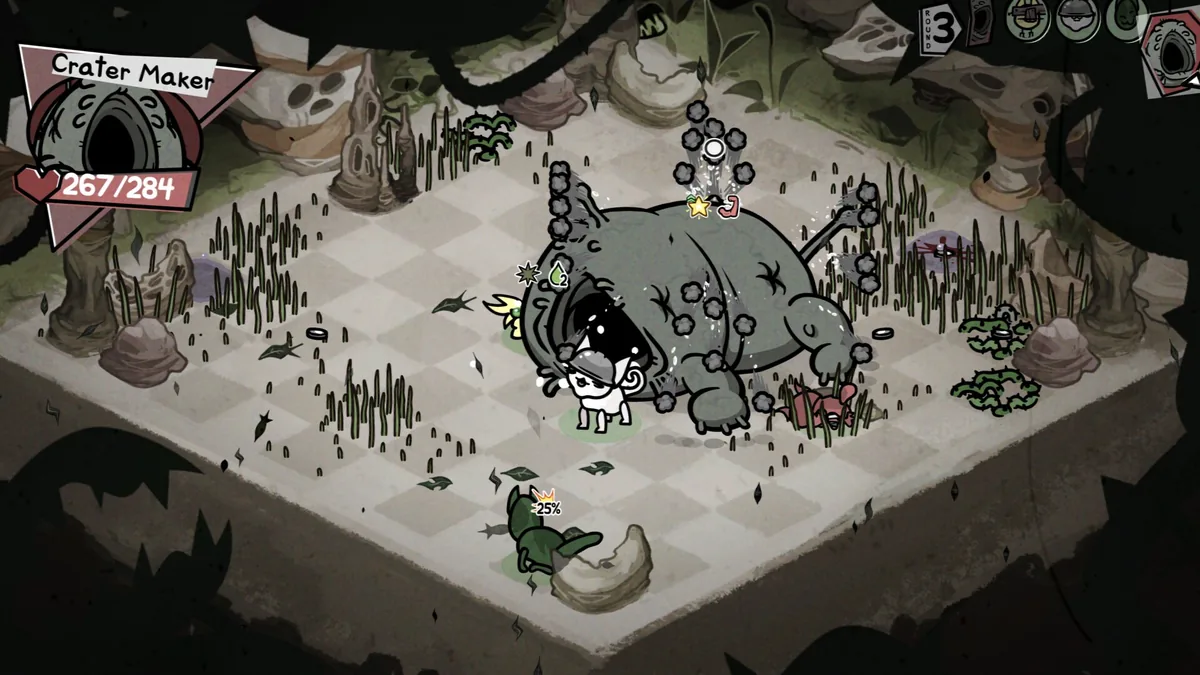 A round-3 encounter against the Crater Maker boss. The grid layout and round counter both matter more than raw damage output once fights go past the first couple of turns.
Tiles, objects, abilities, and status effects occupy separate parts of the battle model. The wiki documents that some status effects cannot stack and that downed units lose most of their status effects; it does not establish a universal count or a three-bucket resolution priority, so this guide avoids inventing one.
GODEEPER: If you're still figuring out which four cats to actually run together, our party composition breakdown for a similarly structured co-op tactics game covers the same tank/DPS/healer logic. Sunderfolk Beginner Guide: Best Classes and Party Tips →
All 14 classes explained
Classes come from collars, which you unlock by clearing zones and turning them in to Butch back at the house. They are not inherited traits, so a kitten's class potential is entirely separate from what its parents were wearing.
The 5 starting classes
- Collarless: no class modifiers at all. Every cat starts here before you assign a collar, and Collarless cats remain useful purely as breeding stock even if you never send them into combat.
- Fighter: melee physical damage. The straightforward pick if you want a cat that just hits things hard up close.
- Hunter: ranged physical damage. The class reference describes Hunters as shooting from afar, so they can contribute without standing adjacent to a target.
- Mage: ranged magical damage with access to elemental status effects, so it doubles as your early source of DoTs and control.
- Tank: absorbs damage and can knock enemies around, which doubles as crude crowd control when you need to break up an enemy formation.
The 9 unlockable classes
Each of these ties to clearing a specific zone for the first time, then talking to Butch, who hands you that zone's collar.
- Cleric (Alley collar): a recovery-focused class that the class reference describes as keeping the team alive after hits.
- Druid (Crater collar): summons animal friends and comes with a special Crow counterpart; the source does not require the stronger claim that the Crow is permanent in every context.
- Thief (Sewers collar): built for evasion, backstab damage, and coin collection, rewarding a hit-and-reposition playstyle.
- Necromancer (Boneyard collar): works with corpses and leeches life from enemies. Do not describe Soul Link as a life-leech spell: the status reference says linked characters share health loss when one loses health.
- Tinkerer (Bunker collar): crafts temporary weapons and gadgets mid-fight instead of relying on a fixed kit.
- Psychic (Moon collar): manipulates the battlefield and enemy positioning directly, more of a control specialist than a damage class.
- Monk (Lab collar): switches between melee and ranged stances and attacks twice per turn, which makes it flexible against mixed enemy compositions.
- Butcher (Core collar): cleaves chunks of meat and has a hook that pulls targets toward it.
- Jester (Rift collar): has no class limits in the class reference and grants +1 Level Up Reroll. The abilities reference documents four active and two passive Jester abilities, and says a Jester can start with a non-Collarless spell; it does not support calling six abilities "unique" or promising a fixed random-class kit.
Because kittens inherit stats and not classes, the practical approach is to breed for the core-stat spread and abilities that suit a role, then slot the resulting kitten into whichever unlocked collar fits. A Mage-leaning kitten needs a useful Intelligence/Charisma spread far more than it needs a Mage parent.
GODEEPER: Necromancer builds live and die by how well you snowball a single resource over a run. We broke down the same pattern in a different roguelite's necromancer kit. Rune Dice Necromancer Build: Snowball the Skeleton Army →
Step-by-Step: breed and assign a class
1. Put compatible adults in the same room: Breeding is evaluated at the end of the day, and the pairing process uses compatibility plus the room's Comfort.
2. Raise the inputs that actually matter: Check Charisma and Libido for compatibility, keep Comfort above the automatic-failure threshold, and use Stimulation when you want to bias inheritance.
3. Inspect the whole kitten result: Check all seven inherited core stats, then review active abilities, passives, disorders, mutations, and birth defects. The stat roll is only one part of breeding.
4. Assign an unlocked collar for the role: A kitten does not inherit its parents' class. Clear the relevant area, talk to Butch, and assign that collar when starting an Adventure.
Tips
Breed for stats, not for looks
It's tempting to pair cats because their colors or patterns look good together. Ignore that. Check the actual stat panel before committing a pair to a room, especially if you're trying to hit a specific class's stat requirements.
Fix Comfort before blaming Libido
If two cats you expect to breed keep failing to pair, check compatibility and Comfort first. Comfort modifies both breeding and fighting odds, while Libido is one input to the compatibility calculation; neither is a guarantee by itself.
Don't dump every ability into one AoE
Because active abilities can have different costs and usage rules, compare the spell's actual effect and Mana cost before stacking debuffs. Do not assume an undocumented global priority order for all status effects.
Save Jester for last
Jester requires the Rift unlock, so it is not part of the starting roster. Plan around the collar being unavailable until that area is cleared and Butch has awarded it.
Watch your inbreeding coefficient across generations
If you keep reusing the same two or three cat lines to lock in a good stat, track how tight that gene pool is getting. The unique disorders that show up past a high inbreeding threshold aren't worth a marginally better stat roll.
Common mistakes
- Assuming a boosted parent passes its boosted stats down. The stat-inheritance step uses the parent's starting core-stat values, while abilities and appearance have their own inheritance rules.
- Ignoring back direction during combat. Physical attacks into a unit's back trigger the documented 25% backstab bonus; do not replace that rule with an unsupported facing animation rule.
- Treating Collarless cats as useless. They're still valid breeding stock, and forcing a collar onto every single cat just to have "a class" isn't necessary.
- Treating every status interaction as a universal combo rule. Check the individual ability and status text; the general status reference does not provide the old fixed-priority claim used here.
- Skipping the return trip to Butch. Clearing a zone doesn't automatically grant its class. You still need to go back and collect the collar from him.
Frequently Asked Questions
How many classes are in Mewgenics? 14 total. Five are available from the start: Collarless, Fighter, Hunter, Mage, and Tank. The other nine unlock by clearing specific zones and talking to Butch, who hands out that zone's collar.
How does breeding work in Mewgenics? Two adult cats in the same room have a chance to breed at day's end. Compatibility and Comfort determine whether the pairing succeeds, while Stimulation biases each inherited core stat. The kitten can also receive abilities, disorders, and appearance traits through separate breeding steps.
Do kittens inherit their parents' class? No. Classes are assigned through unlocked collars. The breeding process can pass seven core-stat values, active/passive abilities, disorders, and appearance traits, but not the parents' collar assignment.
What is the best starting class in Mewgenics? Tank and Hunter carry the early game best since Fighter and Mage both need higher stat floors to be reliable. Collarless cats are still useful as breeding stock even if you never fight with them.
What causes Mutations and Disorders in Mewgenics? Disorders have separate parental inheritance rolls, and inbreeding can add another disorder when fewer than two parental disorders were inherited. Appearance includes mutations and birth defects. High inbreeding is associated with unique disorders and birth defects.
How do I unlock the Cleric class in Mewgenics? Clear the Alley zone for the first time, then talk to Butch back at the house. He hands you the Alley collar, which turns any cat wearing it into a Cleric.
Is Mewgenics worth playing if I don't care about breeding? The combat and class system stand on their own, but the breeding system is what most of the endgame optimization is built around. Skipping it means missing a large chunk of what the game is actually about.
Related Reading
- Mewgenics Tier List: All 14 Classes Ranked S-F: how the community ranks each of these 14 classes, sourced from a 552-vote poll plus real player disagreement.
- Sunderfolk Beginner Guide: Best Classes and Party Tips: another tactics game where party composition, not raw stats, decides most fights.
- Paralives Mechanics Guide: Needs, Moods, and Paras: a different take on simulation systems, useful if the stat-and-mood layer here is what interests you most.
- Rune Dice Necromancer Build: Snowball the Skeleton Army: for anyone leaning into Mewgenics' own Necromancer collar, the resource-snowball logic carries over almost directly.
- Palworld Breeding and Cake Farming Guide: another creature-breeding system where inherited traits and preparation matter.
- Rune Dice Class Unlock Guide: a roster and unlock reference from the same fabrication-audit sweep.
- Rune Dice Physics and Dice System Guide: a contrasting look at a run-based combat system built around physical interactions.
- Sunderfolk Class Tier List: a community-ranked class roster from another tactics game.
- Farever Class Guide: another class roster where the source-backed role descriptions matter.
- LegionBound Synergy Guide: a party-synergy guide with explicit class interactions.
- Dark Scrolls Hero Tier List: a comparable roguelite roster ranking.
- Rune Dice Complete Guide Hub: a full guide index for another class-driven roguelite.
- Sunderfolk Online Co-op Guide: party tactics and role coverage in a different grid-based game.
References
Was this guide helpful?
About the author

Senior Critic & Analyst
Former game data analyst turned critic with 11 years covering indie and mid-tier games. Based in Austin. Runs spreadsheets on games most people just play.
- 11 years games criticism
- Former game economy analyst
- Roguelike and strategy specialist
Keep reading
Mewgenics Tier List: All 14 Classes Ranked S-F (2026)
Guides · 13 min
Palworld Breeding Guide: All 5 Cake Types Ranked (2026)
General · 18 min
Graveyard Keeper 2 battles: all 23, waves and rewards
General · 14 min
Graveyard Keeper 2 Zombie Limit Guide: Cap Explained
General · 14 min
Graveyard Keeper 2 zombie power: factory power guide
General · 13 min
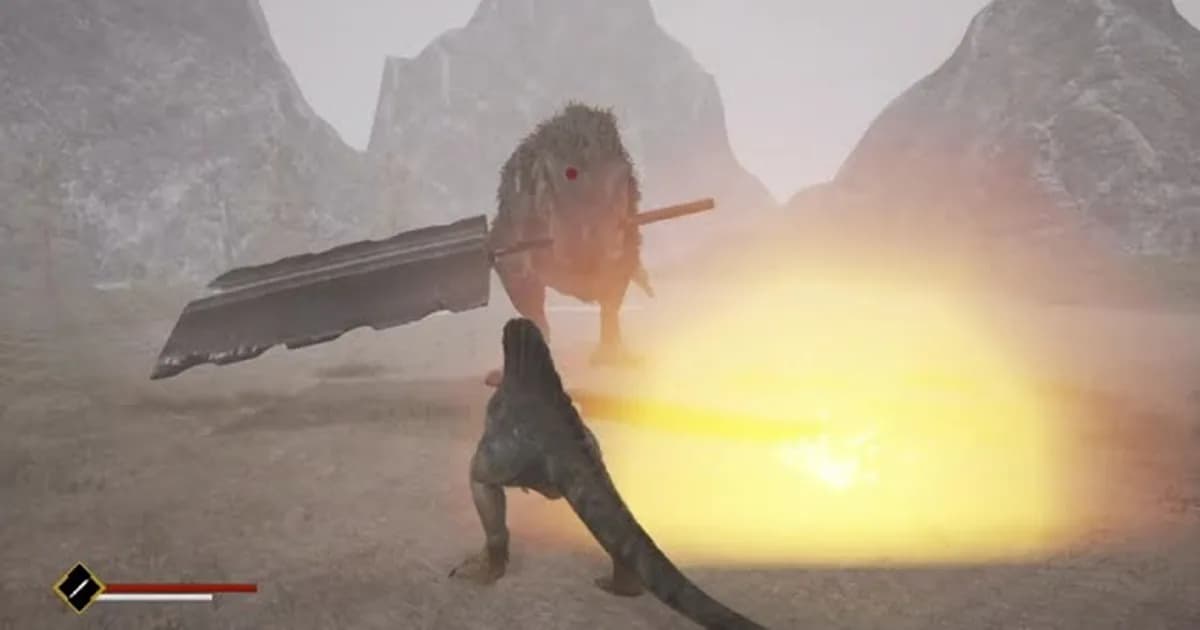
Dinoblade Boss Rush Guide: 1 Unlock and Clear Tips (2026)
General · 9 min
Game deals · affiliate links
Disclaimer
This article is published for informational and entertainment purposes. It does not constitute professional financial, legal, or technical advice. Game performance, online services, patch schedules, and store listings change. Verify critical details (pricing, system requirements, regional availability) with publishers and storefronts before you buy. Affiliate links, where present, help support our editorial work and are labelled in our affiliate disclosure.
Comments
Loading comments…