
GuideSubnautica 2
Subnautica 2 Oxygen Guide: Dive Planning and Survival

About the game
Subnautica 2
Unknown Worlds Entertainment · Unknown Worlds Entertainment
Subnautica 2 oxygen management sits at the center of every dive decision in the game. How far you go, when you turn back, where you anchor your base, which fabrication upgrade comes first: the oxygen system touches all of it. The gap between players who handle it well and players who keep dying at inconvenient depths isn't gear or biome knowledge. It's one clear rule about when to turn around, applied consistently.
TL;DR: Treat oxygen as a round trip, not a one-way budget: turn back when you've used half your air, not when it runs low. Below 100m, oxygen efficiency drops and your supply drains faster, so plan deep dives around that. Place bases and air sources to extend your range, upgrade tank capacity early, and carry an Air Bladder for emergency ascents. Most "I died at a bad depth" deaths are a turn-around-timing problem, not a gear problem.
Subnautica 2 oxygen? (quick answer)
Treat every dive as a round trip: identify the nearest air source, turn back at roughly half oxygen, and stage a base or Tadpole at the edge of your current range before pushing deeper. The first tank upgrade expands that range, but it does not replace a safe return route.
Current status: September 18, 2026
Subnautica 2 remains in Early Access and is still in active development. The official Steam listing showed a $29.99 price, 93% positive from 71,783 English reviews, and 88% positive from 2,150 recent reviews in the snapshot checked for this audit. The oxygen advice below is written for that live Early Access context, so expect balance and content changes as Unknown Worlds updates the game.
This guide covers how the oxygen system works in the current Early Access build, the specific decisions it shapes, and how co-op changes the calculation.
Key takeaways
- The turn-back rule: when your oxygen hits roughly half, you swim for air: not when it gets critical
- Tank upgrades are the highest-priority early fabrication unlock; no other upgrade extends your effective range more
- The Tadpole provides internal air; time inside the vehicle doesn't drain your personal oxygen
- Base placement at the boundary of your current exploration range creates a breathing anchor without forcing a full surface return
- Co-op oxygen is independent per player: coordinate ascents verbally, don't assume the team is tracking your meter
Step-by-Step: plan a safe oxygen dive
1. Register the nearest air source: Before leaving, identify whether your return point is the surface, a base, or the Tadpole. The route is safer when you know the anchor before the meter starts dropping.
2. Turn around at half oxygen: Start moving back when the meter is roughly half full. That leaves room for detours, cave exits, and slow navigation instead of forcing a panic ascent.
3. Stage the next anchor: Place a base or park the Tadpole near the boundary of the zone you can currently reach. A closer air source extends the next dive without pretending your starting tank can cover every depth.
4. Upgrade before pushing deeper: Prioritize the first tank upgrade before committing to the next depth layer. Recheck your return route after the upgrade rather than treating the extra capacity as permission to ignore the half-tank rule.
How the Subnautica 2 oxygen system works
Your oxygen meter sits in the HUD and depletes as you swim. Swimming faster doesn't drain it faster in a straightforward way: the depletion rate is relatively steady while you're in the water. What changes the practical duration is distance and routing: how far you've gone from your nearest air source determines how much oxygen you need to have in reserve before you start back.
The oxygen meter at 60% still looks comfortable, but this is exactly when the turn-back calculation starts. Waiting for the red zone at deeper ranges gets you killed.
The nearest air source is always one of three things: the surface, your base, or the Tadpole. Early in a run, before you have the Tadpole or a base placed, that means the surface. Later, it means whichever anchor you've placed closest to where you're exploring. The system doesn't change. What changes is how many air sources you have available and how close they are.
The single most useful oxygen habit to build: know your nearest air source before you need it. Before you dive somewhere new, mentally register what you're swimming back to. Surface? Base? Tadpole? When the meter drops, you already know which direction to point.
The turn-back threshold
Don't wait until your oxygen turns red before starting back. By the time the HUD flashes, you're already borrowing time.
The reliable rule: when your oxygen reaches approximately half remaining, you start moving toward your air source. Not panicking, not abandoning the current objective immediately: just orienting and beginning the return. This gives you a comfortable buffer for unexpected detours, slower navigation in tight cave systems, or the moment where you misjudge how far the surface actually is.
Players who wait until 25% remaining die in the current Early Access build with regularity. The visual of the meter makes half look like plenty, but that second half depletes under the specific pressure of a committed swim to safety: navigating around terrain, adjusting for currents, finding the exit from a cave system you maybe entered from the wrong angle.
The half-tank rule isn't conservative: it's calibrated. You'll feel like you're leaving before you had to. That's correct.
GODEEPER: The Tadpole fundamentally changes the oxygen calculation by adding a mobile air anchor anywhere in the ocean. Full breakdown of its range, depth rating, and how to use it as a breathing station rather than just transport. Subnautica 2 Vehicles Guide →
Tank upgrades: the highest-priority fabrication unlock
The first oxygen tank upgrade doubles (or close to doubles) your effective dive window. No other early fabrication unlock (not scanner modules, not hull reinforcement, not storage) changes what you can access as directly as more air.
The practical impact: with a base-tier oxygen capacity, you can reach the first-layer depth of the starting biome and return with margin. With the first tank upgrade, you can reach the first biome's depth limit, explore it meaningfully, and still return safely. That's the difference between surveying a zone and actually being in it.
Prioritize the materials for the first tank upgrade over almost everything else in the early fabrication queue. It's not flashy, doesn't change how combat feels or how fast you move. It just removes the ceiling on where you can go, and that matters more than any quality-of-life upgrade in the first few hours.
The second upgrade is meaningful but not as transformative. By the time you're positioned to need that range, you'll also have the Tadpole as a mid-dive air source, which changes the math again.
The Tadpole changes the oxygen calculation
Inside the Tadpole, you breathe. Your personal oxygen meter doesn't deplete. This is the key mechanical fact about the vehicle that changes exploration strategy more than its speed or depth rating.
The Tadpole isn't just transport: it's a mobile air anchor you can park at depth. The workflow: swim from your surface base to a deeper area, exit the Tadpole, explore on personal oxygen, return to the Tadpole when at half, breathe for a moment, then exit and continue. You're not going back to the surface between every dive segment. You're going back to wherever the Tadpole is parked.
This turns long-range exploration from a series of surface-to-depth-and-back round trips into something more like a dive-and-stage approach. Park the Tadpole at depth level one. Explore depth level two on oxygen. Return to depth one to breathe. The range extension is significant.
The one thing the Tadpole doesn't do: automatically pull you in when your oxygen is low. You still manage your own meter and make the call to return. The Tadpole being parked nearby doesn't help if you're not paying attention to where it is.
Base placement and the oxygen anchor strategy
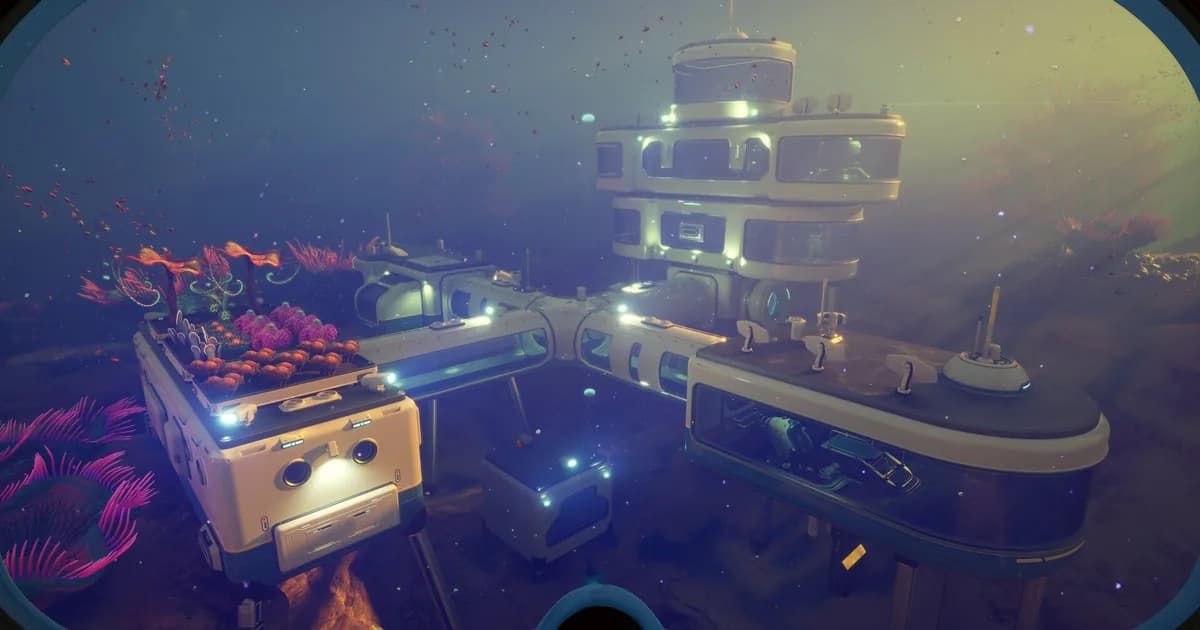
A base anchored at the biome transition point means you're never more than a short swim from air during exploration of the next layer down. Build shallow and you waste the anchor. Build too deep and you can't reach it safely yet.
Your base is a fixed air source at whatever depth you place it. That sounds obvious, but the placement decision compounds over the entire run.
A base placed too shallow (at the surface, or in the very top of the starting biome) doesn't extend your dive range meaningfully. You could have just surfaced. The base's air source is useful when it's closer to where you're exploring than the surface is.
The right placement for a first base: the bottom boundary of your current exploration zone. For most players early in a run, that's the depth at which the starting biome transitions into the next zone: right at the line where you've been comfortable but haven't yet gone past.
Build there. It puts a breathable anchor exactly at the frontier you're about to push past. When you're exploring one layer deeper, you're swimming back to your base rather than all the way back to the surface. Net dive time at depth roughly doubles. The exploration range increase is noticeable immediately.
GODEEPER: Full guide to base module selection, power requirements, and which structural combinations hold up at each depth tier. Subnautica 2 Base Building Guide →
Oxygen in co-op: the coordination problem
Up to four players can explore together in Subnautica 2. Each player manages their own oxygen independently. One player's low meter doesn't slow down anyone else unless the group coordinates around it.
This independence creates a communication need that solo play doesn't have. In solo, when you turn back for oxygen, you know you're turning back. In co-op, if you start ascending without saying anything, the remaining players don't know if you're surfacing, disconnecting, or dealing with something else.
Two habits that prevent most co-op oxygen friction:
Call out ascents. "Surfacing for air, back in two" is four words. It prevents three minutes of the group wondering where you went. Whoever's continuing knows you're coming back; whoever else is also near critical can decide to come with you.
Establish a shared air anchor. Agree before a deep dive where the group is swimming back to: the Tadpole, the base, the surface. If everyone's returning to different places, the group fragments. If everyone knows the anchor, low-oxygen decisions happen in the same direction.
In co-op, the oxygen system works identically to solo. The skill difference is social: keeping the group informed about your meter so everyone can make decisions together.
Depth zones and what changes
The starting biome is calibrated for early gear. Its depth ceiling matches what base oxygen capacity and standard gear can handle. Leviathans in the starting zone are boundary markers as much as threats: when you encounter one, you've reached the edge of that zone.
The transition into the next depth layer is the moment the oxygen calculation changes. Return distances increase. The Tadpole or a base at transition depth becomes necessary, not optional. The same half-tank rule applies, but half-tank now represents more absolute oxygen remaining because you're carrying the upgraded tank.
From the Subnautica 2 biomes guide: each biome has its own creature composition and environmental hazards, but the oxygen pressure changes are depth-driven rather than biome-specific. A 60-meter biome is a 60-meter biome in terms of return distance regardless of what's in it.
The pattern holds across the Early Access build: go deeper in stages, not all at once. Each stage, place an anchor. Each stage, the same turn-back rule. The game doesn't punish exploration; it punishes exploring past your infrastructure.
Common oxygen mistakes
Exploring without a return route registered. You enter a cave system without noting how to exit. When oxygen hits half, you spend the safety margin navigating back to the entrance. Solve this before every cave dive: locate the exit before committing to depth.
Leaving the Tadpole too far from the exploration zone. The Tadpole parked at the surface provides no oxygen benefit for a dive 80 meters down. Park it close to where you're working. The vehicle exists to solve the air problem, not to sit idle at your home base.
Co-op splitting without coordination. Half the group exploring south while the other half goes east, on different oxygen schedules, with no shared anchor. Someone surfaces at a base the others don't have access to. Agree on the anchor before splitting.
Not upgrading the tank before pushing depth. The second biome layer requires more range than base capacity comfortably provides. Players who push past the transition zone before upgrading the tank use their entire safety margin on the return swim and have no buffer for anything unexpected.
Building the first base too shallow. The base is at surface level. It saves fabrication range but contributes nothing to dive range. Every exploration trip still ends at the surface. Build at the frontier, not at home.
Frequently asked questions
How long does oxygen last in Subnautica 2? Long enough for a comfortable starting biome dive on base capacity, not long enough for the transition zone without an upgrade or anchor. The first tank upgrade is the turning point.
Does the Tadpole use oxygen? No. Internal air supply. Time inside the Tadpole doesn't touch your personal meter.
What happens when oxygen runs out? You die and respawn. It's not a permanent consequence, but the time cost of respawning and retracing your route in a deep zone is meaningful.
Does depth affect how fast oxygen depletes? Not the depletion rate directly: but depth increases the return distance, which means you need more oxygen in reserve before you turn back. Same meter, longer commitment.
How does co-op handle oxygen? Each player independently. Call out ascents so the group knows your status.
Where should my first base go? At the boundary of your current exploration zone: the depth at which the starting biome transitions into the next layer.
Is Subnautica 2 oxygen harder than the original? Broadly similar in solo. Co-op adds coordination complexity the original doesn't have.
Related Reading
- Subnautica 2 Immortal Creatures: Why You Can't Kill Fauna: Subnautica 2 immortal creatures explained: why Unknown Worlds made fauna invulnerable, what developers said, and how to survive....
- Subnautica 2 Beginner Guide: Systems, Survival, First Hours: Subnautica 2 beginner guide: oxygen, DNA modification, food, base timing, and the 5 mistakes new players make in....
- Subnautica 2 Shiver Leviathan: The Void's Pack Hunter: Subnautica 2 Shiver Leviathan guide: the female-plus-males pack guarding the Void, why your Tadpole dies instantly, and the....
- Subnautica 2 Great Jaw: The Trap You Loot, Not Fight: Subnautica 2 Great Jaw leviathan: the Venus-flytrap clam in Dolerite Spires, why you avoid its pink tendrils, and....
- Subnautica 2 Leviathan Guide: Avoid, Scan, Survive: Subnautica 2 leviathan encounters: patrol patterns, safe scanning range for both confirmed EA Leviathans, and.
- Best Early Access Games Worth Buying Right Now: May 2026: Early access games worth buying in May 2026: six picks including Windrose and Subnautica 2,.
- Subnautica 2 DNA Modification Guide: Scan to Upgrade: Subnautica 2 DNA modification turns creature scans into upgrades: each biome unlocks different mods, and....
- Subnautica 2 Resources: Biome Farming Guide for Early Access: Subnautica 2 resources: fractional harvests, biome rarity, and the scan-first fabrication pipeline most players get.
References
- Subnautica 2 on Steam: store page, EA updates, system requirements
- Unknown Worlds Entertainment: developer site
- Subnautica 2 tips guide for early access: first session priorities and starter biome breakdown
- Subnautica 2 biomes guide: all six zones, depth levels, what lives where
- Subnautica 2 base building guide: module selection, placement, and power
- Subnautica 2 vehicles guide: Tadpole stats, depth rating, upgrade path
- Subnautica 2 complete guide hub: survival, biomes, base building, DNA mods, and all cluster guides
Was this guide helpful?
About the author

Senior Critic & Analyst
Former game data analyst turned critic with 11 years covering indie and mid-tier games. Based in Austin. Runs spreadsheets on games most people just play.
- 11 years games criticism
- Former game economy analyst
- Roguelike and strategy specialist
Keep reading
Subnautica 2 DNA Modification Guide: Bioscanner and Biomods
Guides · 9 min
Subnautica 2 Resources: Biome Farming Guide for Early Access
Guides · 10 min
Subnautica 2 Biomes Guide: All 13 Current Zones (2026)
Guides · 14 min

Subnautica 2 Weapons: What You Use Instead of a Knife
General · 10 min
Subnautica 2 How Long to Beat: EA Story Length (2026)
Guides · 10 min
Subnautica 2 Creature DNA: Bioscanner and Biomods Guide
General · 10 min
Game deals · affiliate links

Disclaimer
This article is published for informational and entertainment purposes. It does not constitute professional financial, legal, or technical advice. Game performance, online services, patch schedules, and store listings change. Verify critical details (pricing, system requirements, regional availability) with publishers and storefronts before you buy. Affiliate links, where present, help support our editorial work and are labelled in our affiliate disclosure.
Comments
Loading comments…