
GuideLegionbound
LegionBound Tier List 2026: Ranking 30 of 42 Classes

About the game
LegionBound
Spicy Garlic Games
This LegionBound tier list ranks the original 30 classes S through C using an editorial rubric: documented synergy position, usefulness of the prerequisite chain, and how much setup a recommendation asks from a run. It is not an official ranking or a claim about a hidden stat formula. Patch 1.1 added 12 more heroes in July 2026, pushing the full roster to 42; they are kept outside this launch-roster list because the official announcement gives no tier data.
The most important thing to understand about this LegionBound tier list before reading further: tier position only tells half the story. A B-tier class that completes your Warrior group synergy may be a better pick than an S-tier class from the Barkeep group that has no one to activate with. These are editorial recommendations; individual runs deviate based on the heroes offered.
TL;DR: This LegionBound tier list ranks the original 30 launch classes S to C. Tier position is editorial: documented synergy position and setup matter more than an absolute class label. Patch 1.1 added 12 more heroes, bringing the roster to 42; the official patch confirms their abilities and passives but does not publish balance tiers. The Tax Collector loop is the smallest documented first-build option.
Key takeaways
- S-tier: Warrior, Sorcerer, Knight, Tax Collector, Rogue: chain anchors with early payoffs
- A-tier: Witch, Smith, Guardian, Duelist, Gunslinger, Ranger, Barbarian: strong satellites and mid-chain connectors
- B-tier: ten classes that require specific synergy setups or more waves to show full value
- C-tier: Peasant, Bard, Lumberjack, Wizard, Druid, Swashbuckler, Herbalist, Barkeep: late-activators and narrow specialists
- The Warrior group runs 14 classes deep, Barkeep group 11, Tax Collector group 4
- This LegionBound tier list reflects solo Battle Mode and Adventure Mode; team co-op shifts some rankings
- Patch 1.1 (July 2026) added 12 more heroes for a 42-class total: the official note confirms each brings abilities and passives, but it does not publish a balance tier, so this page does not guess at their ranking
How this LegionBound tier list ranks classes
Every placement on this LegionBound tier list comes down to three editorial questions. First, how much does the class contribute to completing a documented synergy loop: is it an anchor (Warrior, Rogue) or a later dependency (Swashbuckler, Barkeep)? Second, how much prerequisite setup does the recommendation ask for? Third, does the class fit the stated beginner or endurance use case? The source tables establish class names and prerequisite pairs; they do not establish a universal wave cutoff, Ascension stat ceiling, or Tax Collector gold rule.
This is an editorial tier list for the launch 30 classes. Where a recommendation is mode-specific, it is labeled as advice rather than presented as an official result.
Step-by-step: apply the launch-roster tier list
Step 1: Identify your starter and its documented loop. Start from the class offered to you, then use the synergy reference to see which launch group and prerequisite pair it belongs to.
Step 2: Prefer a compatible prerequisite over an isolated tier label. A lower-ranked class that completes the pair you already have can be the better pick for that run; the tier list is not a substitute for checking the actual dependency.
Step 3: Treat the rank as an editorial starting point. Recruitment offers, mode, and your available partners can change the best choice. Do not turn an S-to-C label into an official stat, wave, or Ascension guarantee.
S-tier on the LegionBound tier list: the chain anchors
Warrior is the foundation of the game's largest documented launch synergy group. The Warrior group runs 14 classes, and the class reference lists Sorcerer as the prerequisite for Warrior's Spellblade promotion. S-tier here is an editorial ranking based on that accessible position, not an official balance label.
Sorcerer belongs beside Warrior because the two form the first documented link in the Warrior loop. Sorcerer itself promotes to Warlock when Witch is present; pairing Sorcerer with Warrior promotes Warrior to Spellblade. The S-tier placement is this page's editorial judgment, not a published performance ranking.
Knight sits in the Warrior group's defensive portion. The class reference lists Smith as the prerequisite for Knight's Stalwart promotion. The surrounding Smith, Guardian, and Shield Mage links are useful context for the loop, but this page does not turn them into a guaranteed wave result.
Tax Collector reaches S on this LegionBound tier list because it anchors the smallest documented launch loop. Tax Collector, Barbarian, Brawler, and Mercenary each have a listed synergy class, and the four-class dependency is easier to reason about than the longer loops. The source table does not establish the gold-generation bonus claimed in older drafts.
Rogue is a Barkeep-group starter and promotes to Assassin when Duelist is present. Duelist and Gunslinger are later links in the documented Barkeep dependency chain, but the sources do not establish a highest-burst title for Assassin. Rogue is S-tier here because it offers a clear editorial entry point into that loop.
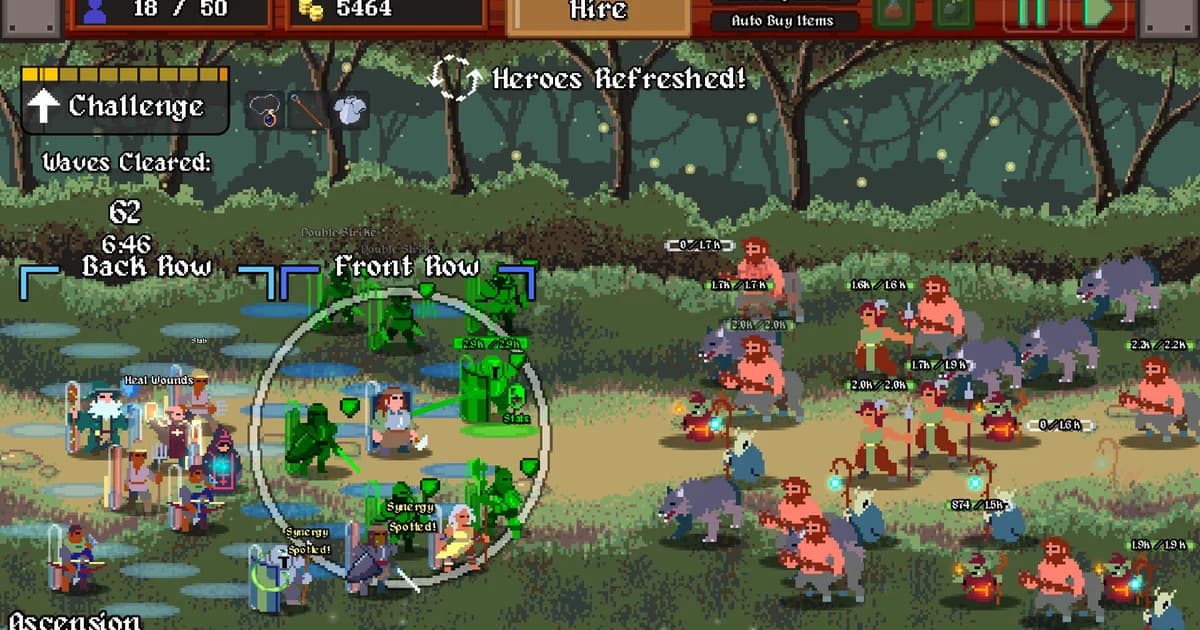
A Battle Mode fight. The image illustrates the combat context for the editorial rankings; it is not evidence of a universal wave or difficulty threshold.
GODEEPER: Per-class prerequisite pairs and circular loop diagrams for the documented launch groups. LegionBound Synergy Guide: Launch 30 Classes & Groups →
A-tier on the LegionBound tier list: reliable chain contributors
Witch is the third link in the Warrior loop: the class reference lists Cleric as the prerequisite for Witch's Hexer promotion. Sorcerer promotes to Warlock with Witch, so the three-class sequence is useful context, but Warlock is not Witch's subclass. A-tier reflects this page's setup-dependent ranking.
Smith promotes to Armorer when Guardian (or its promoted Bulwark form) is present, according to the class reference. Knight promotes to Stalwart with Smith; those are adjacent but distinct relationships. A-tier reflects Smith's position in the documented loop, not an unverified front-row effect.
Guardian promotes to Bulwark when Shield Mage (or Bastion) is present. Shield Mage promotes to Bastion with Battlemage (or Enchanter), so the two names should not be treated as a single Guardian-to-Bastion rule. A-tier reflects the chain position, not a verified highest-HP claim.
Duelist promotes to Fencer when Gunslinger (or Trickshot) is present. Rogue promotes to Assassin with Duelist, so Rogue is a prerequisite for Duelist's position in a broader chain but not Duelist's direct Fencer trigger. A-tier is an editorial placement.
Gunslinger promotes to Trickshot when Swashbuckler (or Trickster) is present. Duelist is the preceding Barkeep-loop class, but it is not the direct Trickshot prerequisite. The bleed and wave-scaling claims from the old draft are not retained without a source.
Ranger is a Barkeep-group starter, but the class reference lists Artificer (or Wright) as the prerequisite for its Snapshot promotion. Its flexibility is an editorial recommendation, not a claim that it activates without a specific partner.
Barbarian is a Tax Collector-group satellite. Tax Collector promotes to Strongarm with Barbarian, while Barbarian promotes to Berserker with Brawler (or Boxer). A-tier here reflects its position in the compact loop, not an immediate Strongarm effect on Barbarian.
B-tier on the LegionBound tier list: situational contributors
This is the longest section of the LegionBound tier list, which reflects how the synergy system works: most classes are useful in the right context and generic outside it.
Priest and Cleric occupy different Warrior-loop links: Priest promotes to Bishop with Knight (or Stalwart), while Cleric promotes to Mender with Paladin (or Templar). Their B-tier placements are editorial and do not claim a hidden healing formula or a mode-specific rank shift.
Paladin promotes to Templar when Priest (or Bishop) is present. The class reference supports that prerequisite relationship; the second-line tank and Ascension-role claims are not treated as mechanics here.
Shield Mage promotes to Bastion when Battlemage (or Enchanter) is present. Guardian is its preceding launch-loop link, but Guardian does not directly trigger Bastion. The rest is editorial pick order.
Artificer promotes to Wright when Samurai (or Ninja) is present. The source table does not describe an item-density activation rule, so B-tier is an editorial placement based on its position in the Barkeep loop.
Samurai promotes to Ninja when Rogue (or Assassin) is present. Its B-tier placement reflects the setup required by the Barkeep loop; the source does not publish the individual-stat comparison claimed in the old draft.
Battlemage promotes to Enchanter when Wizard (or Magus) is present. That documented dependency is the basis for the B-tier placement; the source does not define an overlap-zone or filler-slot mechanic.
Brawler promotes to Boxer with Mercenary (or Bounty Hunter), while Mercenary promotes to Bounty Hunter with Tax Collector (or Strongarm). Both are useful loop links in the editorial ranking; neither is assigned an unsupported stat profile.
Monk promotes to Drunken Fist when Barkeep (or Alchemist) is present. Its B-tier placement is based on the documented Barkeep dependency, not on an unverified damage-to-healing or bleed interaction.
C-tier on the LegionBound tier list: late-activators and specialists
This tier isn't "useless." It means "requires more run length or specific conditions than most runs provide."
Lumberjack and Druid are later links in the documented Warrior loop. Lumberjack promotes to Axeman with Warrior (or Spellblade); Druid promotes to Grovekeeper with Lumberjack (or Axeman). C-tier here means more setup in the launch loop, not a claim about a hidden power curve.
Wizard promotes to Magus when Druid (or Grovekeeper) is present. The old claim that it requires four preceding heroes is not supported by the dependency table, so C-tier is only this page's setup-based editorial judgment.
Barkeep promotes to Alchemist when Herbalist (or Apothecary) is present. Ranger is Herbalist's prerequisite, not Barkeep's direct trigger. The source does not establish an immediate Tax Collector gold bonus, so the comparison is omitted.
Herbalist promotes to Apothecary when Ranger (or Snapshot) is present. C-tier reflects the extra dependency in this editorial list; the source does not publish a universal attrition-wave threshold.
Swashbuckler promotes to Trickster when Bard (or Poet) is present, while Bard promotes to Poet with Monk (or Drunken Fist). Their C-tier placements reflect later Barkeep-loop setup, not an unsupported claim about damage or a standard-run cutoff.
Peasant is a special case on this LegionBound tier list. The class reference says Peasant promotes after three other synergy heroes have promoted. It is outside the three loops, so C-tier here reflects the conditional setup in the editorial rubric; the source does not promise a top-damage outcome or require two different loops.
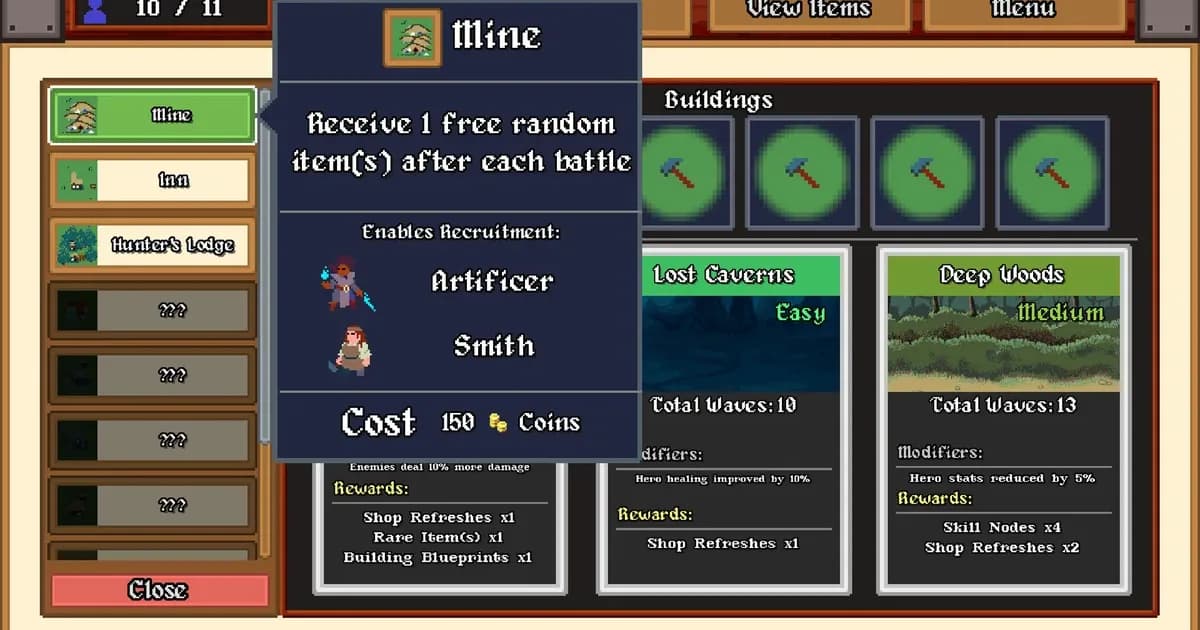
Adventure Mode buildings have special passive abilities and can make unique heroes available; the official store page does not support the older caption's exact Mine reward or class-unlock values.
LegionBound's 12 new heroes: why this page does not rank them
Patch 1.1 ("Volatile Elements," July 23, 2026) added 12 new heroes, taking LegionBound's roster from 30 classes to 42. That count checks out two ways: Spicy Garlic Games' patch notes say it directly ("Patch 1.1 introduces 12 completely new heroes to recruit, upgrade, and combine"), and the current Steam store page lists "42 different classes" among the game's features. The patch's own announcement art shows 12 distinct new hero portraits.
The official July 23 announcement confirms 12 new heroes, says each brings abilities and passives, and adds over 400 Ascension combinations. It does not publish official tier data or a named balance table. A community Steam class guide has since catalogued names and prerequisite pairs, but that is still not an official balance ranking; this page keeps the 12 additions outside its S-through-C editorial list instead of turning a source gap into invented tiers.
Ranking a class requires a stated rubric and evidence. Without official balance tiers, any S-through-C placement for the 12 additions would be editorial speculation, so this page labels its scope clearly. The LegionBound synergy guide documents the launch 30 loops and keeps the patch additions separate for the same reason.
Using this LegionBound tier list from wave 1
The LegionBound tier list matters most at the start of a run, when your starting class determines which documented synergy chain is available.
Three of the five documented starter classes belong to the Warrior group: Warrior, Wizard, and Cleric. Of the three, Warrior is this page's recommended anchor. Wizard promotes to Magus with Druid or Grovekeeper; Cleric promotes to Mender with Paladin or Templar. The tier placements are editorial, not official balance labels.
From the Barkeep group, both Ranger and Rogue are available as starters. Rogue promotes to Assassin with Duelist; Ranger promotes to Snapshot with Artificer or Wright. Which starter feels more forgiving is a recommendation, not a claim that either has an automatic activation.
Tax Collector is not listed as a starter in the class reference, so a run built around its loop must recruit into that dependency chain.
The practical use of this LegionBound tier list at the start of a run: commit to 2-3 class types by wave 3. Taking an off-cluster hero because it has better individual stats breaks synergy math. The LegionBound tips guide covers which first-wave options to skip regardless of their individual stats: the decision tree there is the tier list applied in real time.
For Adventure Mode, the camp routing and building choices that accompany class selection are in the LegionBound Adventure Mode guide. This tier list does not assign an unverified Tax Collector gold bonus or claim that a loop creates more shop windows.
GODEEPER: Chain construction tables, satellite hero priority by loop stage, and the cases where a B-tier class outperforms an A-tier class due to loop position. LegionBound Advanced Builds Guide →
Frequently asked questions
What is the best class in LegionBound? Warrior is this page's S-tier editorial pick. It anchors the 14-class Warrior group and pairs with Sorcerer for the Spellblade promotion in the documented launch dependency table. LegionBound does not publish an official tier list.
Is Tax Collector good? Yes, as an editorial beginner recommendation. It anchors the smallest documented launch loop: Tax Collector, Barbarian, Brawler, and Mercenary. The source table confirms the dependency names, but not a wave deadline or an immediate gold-generation rule.
What are the worst classes on the LegionBound tier list? Peasant and Bard are at the bottom of this editorial list because they ask for more conditional setup. Peasant's documented requirement is three other synergy heroes promoted; the sources do not promise a particular damage ceiling.
Synergy group or individual stats: which matters more? Synergy group, almost always. A B-tier class that completes your chain contributes more than an A-tier class from an unrelated group. The LegionBound tier list ranks assume primary loop building. Off-loop class picks rank situationally, not absolutely.
Best classes for Adventure Mode? This page recommends the Tax Collector loop for new players because it is the smallest documented launch dependency chain. Advanced runs can follow adjacent Warrior-group pairs such as Warrior-Sorcerer or Knight-Smith, but these are editorial suggestions rather than official mode-specific rankings.
Do all 42 classes appear in every run? This page intentionally ranks only the original 30 launch classes. Patch 1.1 added 12 heroes, bringing the roster to 42; the official announcement confirms abilities and passives but does not publish tier data, so this page does not guess at their ranks.
Related Reading
- LegionBound Ascension Chain: Timing, Risk, Recovery 2026: LegionBound Ascension choices, risk, and recovery advice, with exact outcomes treated as run-dependent.
- LegionBound Warrior Group: All 14 Classes & Synergies: LegionBound Warrior group: all 14 classes in the largest synergy loop, how the circular subclass chain works, and....
- LegionBound Barkeep Group: All 11 Classes & Synergies: LegionBound Barkeep group guide: all 11 classes in the mid-size synergy loop, the subclass chain, and the Rogue-Duelist-Gunslinger....
- LegionBound Tax Collector Group: All 4 Classes Loop: LegionBound Tax Collector group guide: the only synergy loop you can fully complete, all 4 classes and subclasses,....
- Lost Castle 2 Weapons Tier List: All 7 Categories Ranked: Lost Castle 2 weapons tier list: all 7 categories ranked for 1.0, with the standout weapon in each,....
- Legionbound Battle Mode Guide: Endurance Runs 2026: Legionbound Battle Mode explained: how endurance scaling works, when to use it over Adventure Mode,.
- LegionBound Ascension Guide: How to Merge Heroes (2026): LegionBound Ascension explained: how to preview combinations and reason about the 800+ possible Ascension heroes.
- Legionbound Launches on Steam: 50 Heroes, 30 Classes: Legionbound launches April 27 on Steam: an autobattler where you field 50 heroes from 30.
- LegionBound Endbringer Guide: When to Fight and How to Win: LegionBound Endbringer guide: Adventure Mode's scaling final boss, when to confront it, the best counter-builds,.
References
- LegionBound on Steam: store page listing "42 different classes," patch notes, community hub
- LegionBound Patch 1.1: Volatile Elements: official July 23, 2026 patch notes confirming 12 new heroes and the 30-to-42 class total, without naming the newcomers
- Spicy Garlic Games: developer page
- LegionBound synergy guide: launch 30 classes: per-class prerequisite pairs and loop diagrams for the launch roster, plus the 12-newcomer caveat
- LegionBound advanced builds guide: dual-chain construction and end-game class combos
- LegionBound tips guide: beginner-focused decisions and first-run guidance
- LegionBound Adventure Mode guide: camp routing, loop strategy, and Endbringer prep
- LegionBound complete guide hub: all classes, synergies, ascension, and battle/adventure mode guides
- Hero Class Guide: Steam community reference for class names and prerequisite pairs
- Hero Synergy Groups: Steam community reference for the 30 launch heroes and three dependency loops
- Developer answers on skill tree, targeting, and unlocks: row targeting, Adventure Mode skill-tree scope, and wave-25 Battle Mode unlock statement
Was this guide helpful?
About the author

Indie & JRPG Critic
Indie game evangelist and lifelong JRPG fan covering small studios since 2017. Mumbai-born, London-based. Writes the way she talks.
- 7 years indie games coverage
- JRPG and visual novel specialist
- Narrative design focus
Keep reading
LegionBound Adventure Mode Guide: 5 Steps to Clear
Guides · 16 min
LegionBound Tax Collector Group: All 4 Classes Loop
Guides · 9 min
LegionBound Endbringer Guide: When to Fight and How to Win
Guides · 9 min

LegionBound Guide 2026: All Modes, Classes and Builds
General · 16 min

LegionBound Advanced Builds: Late-Game Class Chains (2026)
Guides · 9 min
Legionbound Battle Mode Guide: Endurance Runs 2026
General · 8 min
Game deals · affiliate links

Disclaimer
This article is published for informational and entertainment purposes. It does not constitute professional financial, legal, or technical advice. Game performance, online services, patch schedules, and store listings change. Verify critical details (pricing, system requirements, regional availability) with publishers and storefronts before you buy. Affiliate links, where present, help support our editorial work and are labelled in our affiliate disclosure.
Comments
Loading comments…