
GameBrief · Guides
PegPigeon Beginner Guide: Boards, Relics, and Upgrades
Reviewing
PegPigeon
Erenyx
This PegPigeon beginner guide covers what's actually confirmed about Erenyx's September 11, 2026 release: a casual physics peg roguelite that borrows its card-drafting structure from deckbuilders while keeping the core loop as simple as aim and launch. The developer's own description frames it directly: limited launches per round, a shop between rounds, and long-term meta progression pulling you back for another run.
TL;DR: PegPigeon is a physics peg roguelite where you launch a limited number of balls per round to hit a score target, then draft one upgrade or relic between rounds. At least 4 themed boards are confirmed, relics are officially called Jokers, and meta upgrades (balls per round, shop rerolls, slot multipliers) persist between runs. Zero Steam reviews exist yet.
What is PegPigeon actually about? (quick answer)
You pick an unlocked stage from the hub, then launch balls through a pegboard using a limited number of shots per round. Balls cascade off pegs, trigger special peg effects, and land in scoring slots at the bottom, each with its own score multiplier. Clear the round's score target to advance, and after each round you're offered a random draft of upgrades or relics to shape the rest of the run. Fail a round or run out of launches, and the run ends, sending you back to the hub to spend earned gold on permanent meta upgrades, new pigeons, and skins.
Key takeaways
- Developer Erenyx, released September 11, 2026, $0.99, no launch discount
- Core loop confirmed directly from the store page's own "How to Play" section: aim, launch, chain peg hits, steer toward high-value slots
- Relics are officially called Jokers, drafted alongside regular upgrades in a random in-run shop with reroll options
- Meta upgrades confirmed: balls per round, salvo cap, end-run gold, shop rerolls, wall score, and slot multipliers
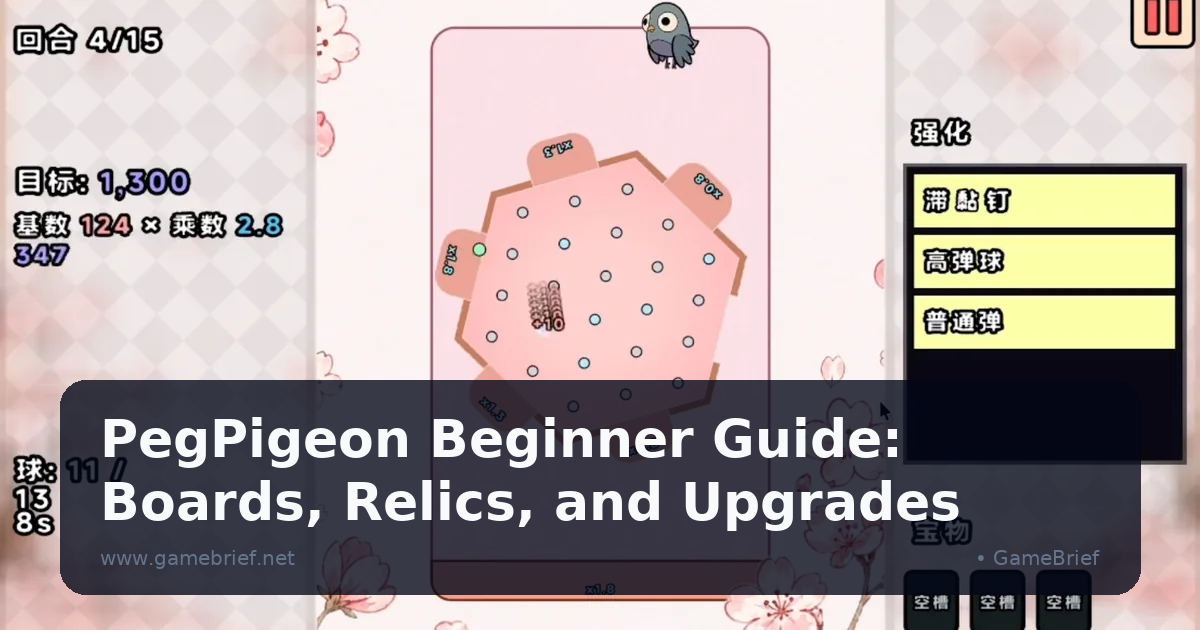
- At least 4 distinct themed boards confirmed from screenshots: cherry blossom, bakery, festival, and snowfield
- Zero Steam reviews and no organic Reddit discussion as of this guide, a same-week launch pick
Step-by-Step: your first run
1. Learn to read the slot multipliers before you aim: every board's bottom row shows a set of scoring slots, each labeled with its own multiplier (values like x0.8, x1.3, x1.8, and x3.3 were all confirmed across different screenshots). The center slots consistently carry the highest multipliers, so steering shots toward the middle of the board matters more than raw peg contact count.
2. Prioritize your first few relic drafts over upgrades: the official feature list distinguishes relics (Jokers) from regular upgrades, relics apply passive or trigger effects for the rest of the run, while upgrades tend to be single-use or stat boosts. A confirmed late-run screenshot shows a player with all 3 relic slots filled generating a single hit worth 77,777 points against a 777,777 target, that kind of scaling only comes from stacked passive effects, not from upgrades alone.
3. Use shop rerolls when the offered cards don't fit your run: the store description confirms rerolls are tied to meta progression, meaning your reroll count isn't fixed from the start, it's something you build up by spending gold on meta upgrades between runs. Early runs will have fewer rerolls available, so don't expect to reroll your way out of every bad draft yet. For a different take on run-to-run drafting under a hard resource limit, our Bugs. Billions of Bugs. beginner guide covers a similar early-resource-scarcity problem in a tower-defense shell instead of a physics one.
4. Watch your ball count each round, it's a hard limit: a confirmed HUD element tracks balls used against a total (observed values like 11/13 and 18/22 across different screenshots), alongside a countdown timer per shot. Running out of balls before hitting the round's score target ends your run, so don't waste early shots testing peg layouts once you understand the basic bounce pattern.
5. Spend gold on meta upgrades before cosmetics: the official feature list lists pigeon skins as a gold sink alongside meta upgrades, but skins are purely cosmetic. Early gold is better spent on the confirmed meta-progression list (more balls per round, a higher salvo cap, better end-run gold rates) since those compound across every future run, where a skin only affects one pigeon's appearance.
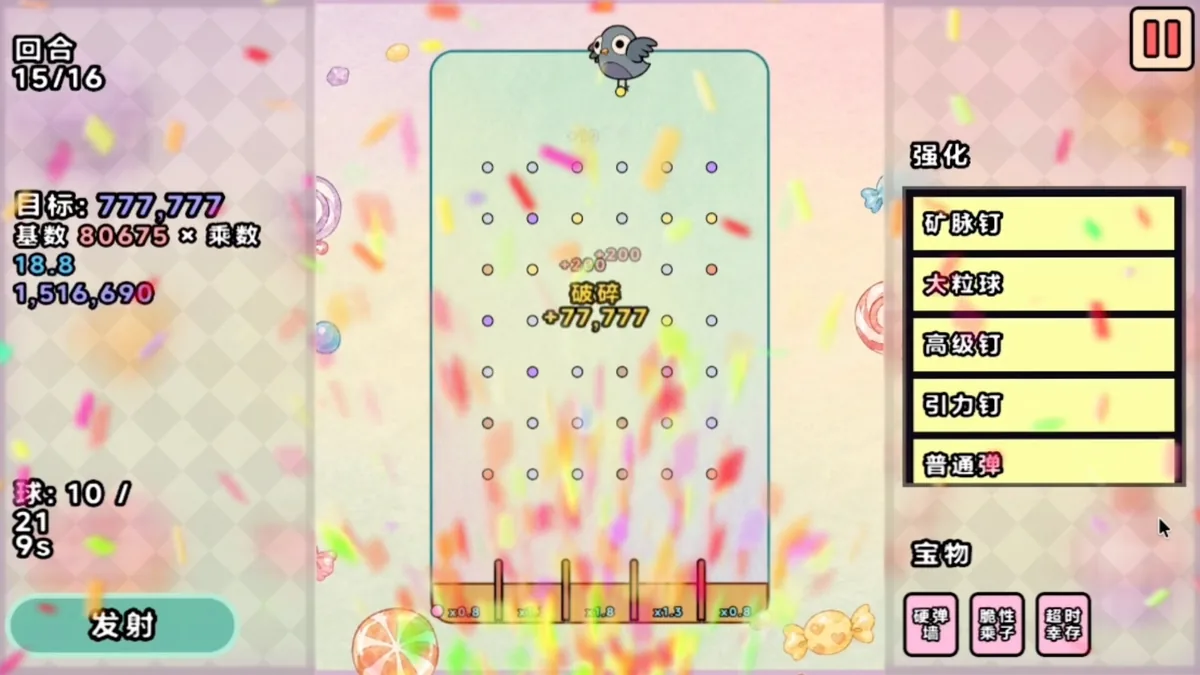 Caption: A late-run candy-themed board with all three relic slots filled, showing the kind of score spike stacked relics are designed to produce.
GODEEPER: Curious how another fresh roguelite from this same week handles its own draft-and-scale loop? Our Orc Incremental beginner guide covers a card-drafting incremental built around a very different core action.
The board variety, what's actually confirmed
Screenshots checked for this guide confirm at least 4 distinct themed boards beyond the base layout: a pastel cherry blossom board with a heptagon-shaped play area, a bakery-themed board with wheat and bread decorations, a festival board strung with lanterns and banners, and a snowfield board complete with a snowman in the corner. The official worldbuilding text adds a meadow and a barn to that list, describing the tone as "light, cartoon-fiction" with "no historical tie-ins", so treat the confirmed screenshot count as a minimum, not the full roster. Each board also carries its own peg layout rather than reusing a single template, the cherry blossom board's heptagon shape is structurally different from the bakery board's grid pattern, which is a real design choice worth knowing before you assume every stage plays identically.
One honest gap: every screenshot checked for this guide displays the game's Chinese-language UI, not the English version the Steam store page is written in. Rather than translate specific button and panel labels and present them as confirmed English terminology, this guide sticks to the systems the developer's own English description directly confirms (relics, Jokers, meta upgrades, the shop, achievements) and describes screenshots by what's visually happening rather than by translating on-screen text that hasn't been cross-checked against an English build. This is the same caution our Yushou Xianmen: Mortal Realm guide applied when its own in-game faction names didn't match the store description word for word.
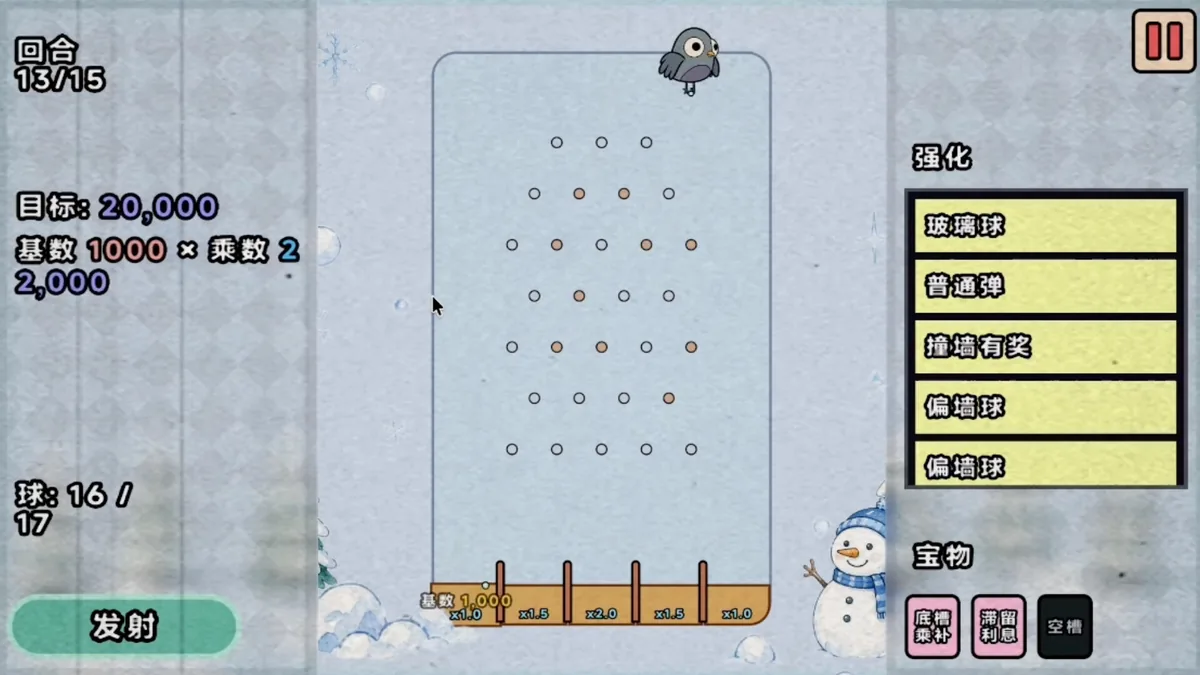 Caption: The snowfield board, one of at least 4 confirmed themed layouts, using a grid peg pattern instead of the cherry blossom board's heptagon shape.
How the meta progression actually compounds
The official feature list is specific enough here to build real expectations from: meta upgrades cover balls per round, salvo cap, end-run gold, shop rerolls, wall score, and slot multipliers, and all of them persist between runs rather than resetting. That's a meaningfully different structure from a pure single-run roguelike, a bad early run in PegPigeon still banks gold toward permanent upgrades, so the game is explicitly designed around gradual account-wide progression rather than treating every failed run as a total loss. Achievements add a second progression track on top of that, described as having "manual claim rewards" rather than firing automatically, and per-stage leaderboard snapshots give you a personal-best target to chase on boards you've already cleared. If you want a genre comparison for how a small physics-driven hook can carry a surprisingly deep meta layer, Increbouncer builds a comparable two-currency progression system around ball-bouncing physics instead of peg-drafting.
GODEEPER: Want a longer-form look at how meta-progression currencies interact in a different physics-adjacent incremental? Increbouncer's beginner guide breaks down a very similar dual-currency structure.
Is PegPigeon worth trying right now?
At $0.99 with no launch discount, PegPigeon is priced like an impulse buy, and the confirmed systems back that up: a real shop-and-relic draft loop, persistent meta upgrades across six or more tracked stats, at least 4 distinct themed boards, achievements, and personal leaderboard tracking. For a dollar, that's more structure than most casual mobile-style ports bring to Steam, and the "Jokers" relic terminology signals the developer is drawing deliberately from the deckbuilder roguelike space rather than just slapping a peg-bounce mechanic on a generic shop.
The honest limitation is the same one that applies to every other day-one pick covered on this site recently, the same restraint applied to Steeled and Miss Killer: Dream Rhythm Island earlier this batch: zero Steam reviews exist, and only the standard auto-posted new-release listing turned up on Reddit, no organic player discussion. The confirmed mechanics here are accurate to the store page and screenshots. Whether the run-to-run balance and board variety hold up over dozens of runs is still genuinely unknown until real player feedback accumulates.
Related Reading
- Increbouncer Beginner Guide: another physics-driven incremental from the same stretch of launches, with a two-currency system to compare against PegPigeon's gold economy.
- Bugs. Billions of Bugs. Beginner Guide: a tower-defense take on the same early-run resource-scarcity problem PegPigeon's ball limit creates.
- Orc Incremental Beginner Guide: a card-drafting incremental for readers who want more of PegPigeon's draft-and-scale structure in a different core loop.
- Temple 13 - Time Collapse Beginner Guide: a very different genre pick from the same week, for contrast against PegPigeon's light, casual scope.
Frequently Asked Questions
What is PegPigeon? A casual physics peg roguelite from developer Erenyx, released September 11, 2026. You launch balls through pegboards to hit a score target, draft upgrades and relics between rounds, and unlock stages, pigeons, and meta upgrades using gold.
What are relics in PegPigeon? The game's own description calls them Jokers, passive or trigger-based effects you draft in the in-run shop alongside regular upgrades. Slot count for relics can grow through meta progression, confirmed directly from the official feature list.
How many boards are in PegPigeon? At least 4 distinct themed boards are confirmed from screenshots alone: a cherry blossom board, a bakery board, a festival board, and a snowfield board. The official description also mentions a barn theme, suggesting more exist beyond what's screenshotted.
Is PegPigeon good? There's no Steam review data yet, this guide is written within days of launch. The confirmed systems (shop, relics, meta upgrades, achievements) suggest real structure, but treat any quality verdict as unconfirmed until real player feedback builds up.
Does PegPigeon have controller support? Yes. The official how-to-play text lists L2 to shoot, the d-pad to navigate, X to confirm, and O to cancel, alongside a keyboard Space bar shortcut for launching.
References
- PegPigeon on Steam: official store page, price, feature list, and how-to-play text cited throughout this guide.
- PegPigeon Steam Community discussions: the game's community hub, currently thin given how new the release is.
Was this guide helpful?
About the author

Senior Critic & Analyst
Former game data analyst turned critic with 11 years covering indie and mid-tier games. Based in Austin. Runs spreadsheets on games most people just play.
- 11 years games criticism
- Former game economy analyst
- Roguelike and strategy specialist
Keep reading

Disclaimer
This article is published for informational and entertainment purposes. It does not constitute professional financial, legal, or technical advice. Game performance, online services, patch schedules, and store listings change. Verify critical details (pricing, system requirements, regional availability) with publishers and storefronts before you buy. Affiliate links, where present, help support our editorial work and are labelled in our affiliate disclosure.
Comments
Loading comments…