
GameBrief · General
Dark Scrolls Best Builds: All 9 Heroes Ranked 2026
Reviewing
Dark Scrolls
doinksoft · Devolver Digital
Dark Scrolls best builds come down to one thing before the Shoppe even opens: which hero are you. In doinksoft's co-op roguelike, each of the nine characters has a fixed weapon type and a distinct special ability. The perks you stack during a run modify that base, they don't replace it. Pick the wrong perk for your hero and the run goes sideways at the second boss. Pick the right one and the screen fills with projectiles by the back half of the dungeon.
TL;DR: Grizz is the best starting hero: arcing axes, chainable ground pounds, and a sneeze burst that fires dozens of axes at once. Pigeon is the highest-ceiling skill pick. Biscuit is the strongest co-op support. Nezumi is the hardest hero and rewarding once learned. For Shoppe perks, stack one direction: Shuriken on Grizz or Pigeon, Thorns on melee heroes, allies on anyone who needs screen coverage. The star meter feeds burst attacks and threshold perks, so attacking constantly is always the correct play.
Dark Scrolls best builds: which hero runs which way? (quick answer)
All nine heroes in Dark Scrolls share one resource loop: attack to build stars, spend stars on burst attacks, buy perks at the Shoppe to amplify the hero's base weapon. The hero defines the weapon. The Shoppe defines what that weapon does to a screen full of enemies by run's end.
Five of the nine heroes are confirmed named. Grizz throws axes in an arc and ground pounds. Pigeon throws daggers and can angle them downward. Emerys fires bouncing magic orbs and deploys an orb shield. Biscuit barks with crowd-stun range and can enter a spinning pinball form. Nezumi fires saxophone notes in directional sequences that equip Shoppe abilities without spending coins, accessing 16+ combinations.
The other four round out the roster: Confit (the steak-throwing chef), Ironbeard, Saturn, and Quinn, a playable fairy. Same logic applies to all of them: match your Shoppe pick to your weapon type and don't spread across incompatible perks.
Grizz: the best all-around build
Grizz throws axes that arc through the air before returning. The trajectory rewards spacing: position yourself so the arc travels through an enemy cluster on both the outward and return path, and you hit each target twice per throw. That sounds minor but it doubles your star-building rate compared to a flat projectile that connects once.
The ground pound is what sets Grizz apart. You can cancel a ground pound off an enemy's hitbox and immediately re-enter another ground pound. Chain this across a group of close-together enemies and Grizz spends significant time airborne, above the scroll plane, hitting multiple targets in sequence. It's an intended mechanic that most players don't discover in the first two hours.
The sneeze burst, Grizz's star-meter special, fires dozens of axes in one burst. You don't aim it. It covers the screen in front of you. Save it for when a large group arrives from the right edge simultaneously: trigger it the moment they cluster and the burst clears them before you have to engage one by one.
Grizz Shoppe priority:
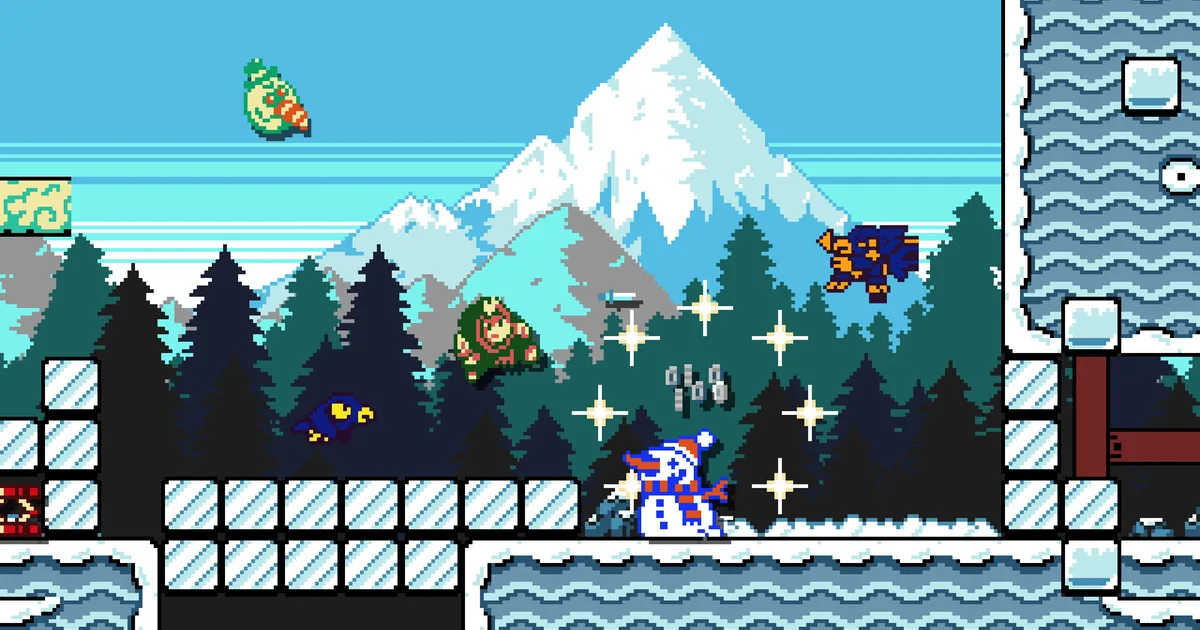
- Shuriken, first pick every time. Axes and shurikens both scale with jump-cancel spacing. The shuriken fires alongside your main attack, so every axe throw includes a bonus projectile without changing your movement pattern.
- Thorns as second pick if available. Grizz closes distance to chain ground pounds, which puts him in range of enemy contact damage. Thorns punishes enemies that make contact, turning close-range play from a risk into a damage source.
- Summoned ally as third pick. By the time you're buying a third perk, you want something that operates independently so you can ground-pound without breaking screen coverage.
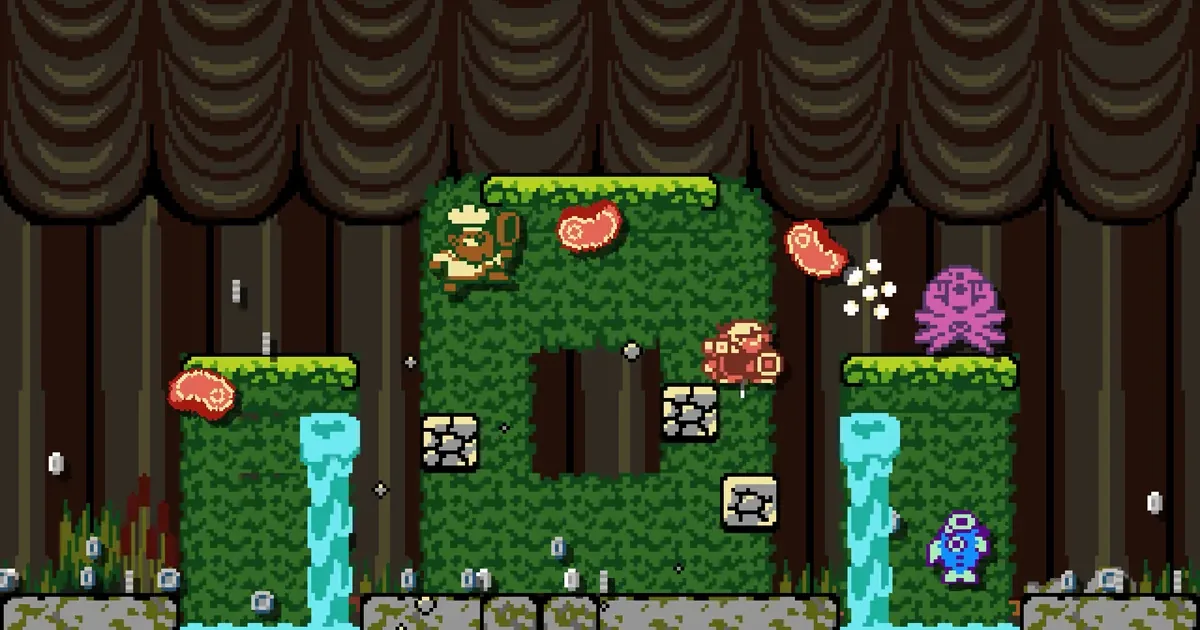 The chef hero's steak throw in a jungle stage. Each hero's weapon type determines which Shoppe perks produce synergy. Projectile modifiers like Shuriken work with thrown weapons; Thorns works with any hero who fights at close range.
Pigeon: the skill ceiling build
Pigeon throws daggers at close range with a rapid-fire pattern. She can also angle her dagger throw downward, effectively performing a melee downward strike instead of a ranged attack. This creates a ground-pound analog that Pigeon uses to attack enemies below a platform without jumping off it.
The skill requirement is positioning. Daggers are short range. Building stars with Pigeon means staying inside the effective dagger range, which is closer to the enemy group than most players instinctively stand. Players who learned Dark Scrolls on Grizz and then swap to Pigeon initially play her at axe range, where she generates almost no star progress and builds no meaningful Shoppe synergy.
The payoff once you adjust: Pigeon's attack speed is higher than Grizz's. Same Shuriken perk on Pigeon produces more total projectiles per second because the trigger fires more often. A Pigeon run with Shuriken active mid-run looks like a bullet-hell screen from behind the enemy rather than from in front of it.
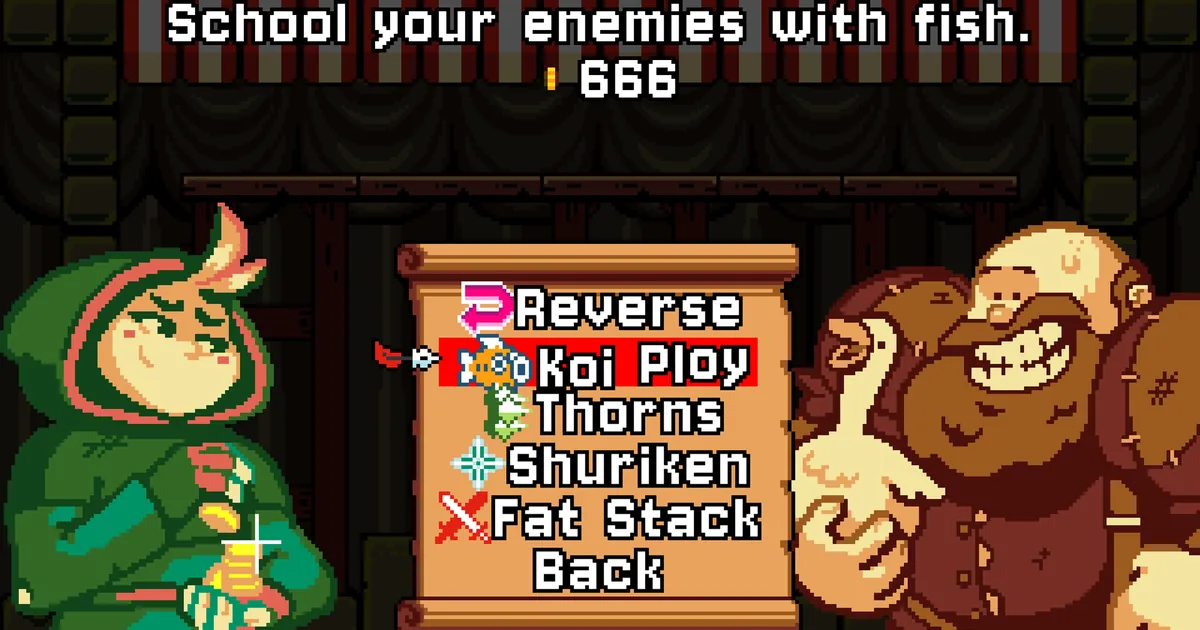
Pigeon Shoppe priority: Shuriken first (same reason as Grizz, higher output per second on Pigeon), then Koi Ploy. Koi Ploy adds a fish projectile modifier that fires alongside attacks. On Pigeon's rapid-fire cadence, the fish projectiles maintain near-constant forward coverage even when you dodge sideways, filling the screen gap that close-range repositioning creates.
GODEEPER: The star meter, burst attacks, and perk thresholds in Dark Scrolls share structural DNA with other autobattler roguelikes. Die in the Dungeon: Best Build Guide for All Relics →
Emerys: the safe-distance mage build
Emerys fires bouncing magic orbs that ricochet around the room. The orbs don't travel in a straight line. They deflect off walls and ceilings, which means positioning Emerys near a wall segment creates a situation where each orb delivers two or three hits per throw rather than one.
The orb shield is the secondary mechanic worth building around. It blocks incoming projectiles and zaps enemies who enter the radius. It runs on a duration timer, not a hit limit, so use it for large threats (boss attacks, multi-enemy volleys) rather than keeping it up permanently. Burning the cooldown on a single slow enemy means it's gone when something bigger arrives.
Emerys is the weakest of the three named damage dealers, and the reason is geometry. The orbs depend on walls. Rooms with flat surfaces give you clean ricochets and two or three hits per throw. Rooms with complex terrain or wide open spaces cut that down to one. Grizz and Pigeon hit what they aim at regardless of the room layout. Emerys doesn't get that consistency.
Emerys Shoppe priority: Fat Stack, which stacks a modifier that appears to amplify the orb count or bounce behavior. Second pick should be an ally summon so you maintain forward pressure during the orb's travel time. Thorns works here too since the orb shield puts enemies in contact range.
Biscuit: the best co-op hero
Biscuit is unlocked by freeing the dog in the cage during the first stage's boss fight. The bark attack delivers a sonic pulse with crowd-stun range: it doesn't require aim, fires in an arc around Biscuit, and interrupts enemy attack animations. The stun window is short but consistent.
The pinball form is the flashier mechanic. Biscuit can enter a spinning bounce state that clears groups of enemies on contact. Combined with the infinite jump that Biscuit also has, a skilled Biscuit player can bounce off enemy hitboxes the same way Grizz chains ground pounds, staying airborne and dealing contact damage through a group.
In co-op, Biscuit's stun is a setup tool for your partner. A bark on a clustered group buys two to three seconds where your partner can land uncontested hits, builds their star meter faster than normal play would allow, and sets up their burst attack earlier than it would otherwise charge. The stun timing also helps the living partner avoid scroll-edge pressure when the group is pushing back.
Biscuit Shoppe priority: Ally first. The ally fires independently while Biscuit enters pinball form, maintaining forward damage during the bounce sequence. Thorns second: the pinball form involves constant enemy contact, so every bounce punishes enemies with reflect damage. Shuriken is lower priority than on the projectile heroes since Biscuit's main attack already delivers wide coverage.
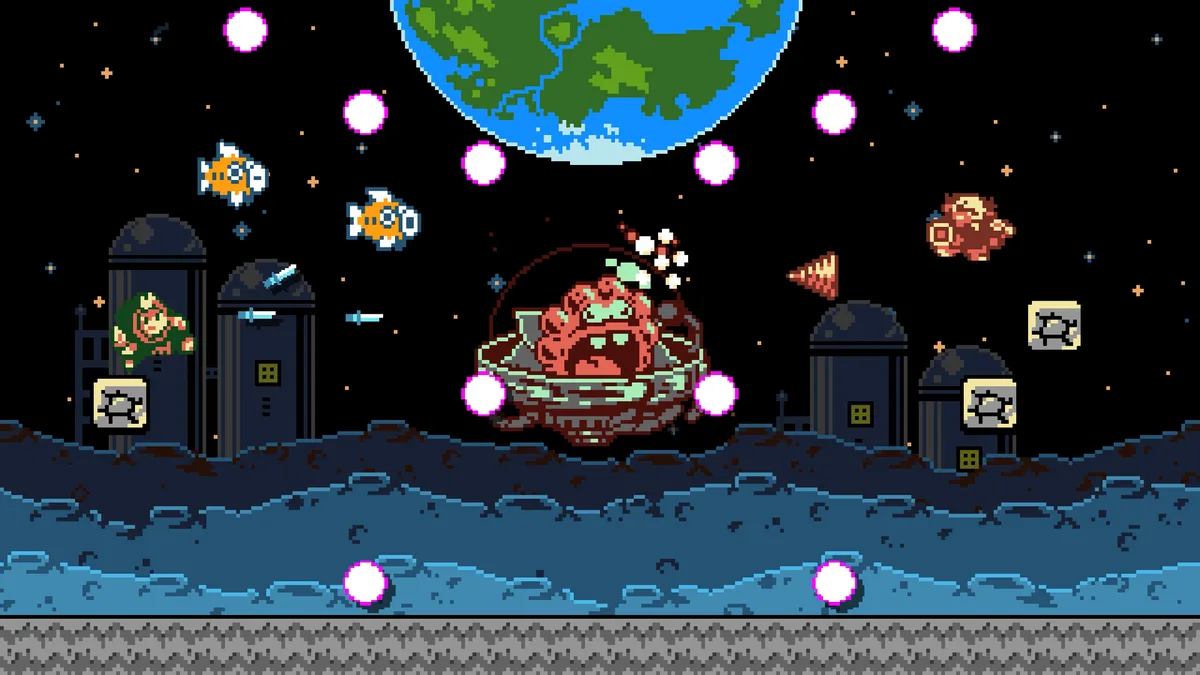 A late-game moon boss encounter. Boss fights are where Shoppe builds pay off: a Grizz with Shuriken active produces sustained multi-projectile pressure during boss patterns while the sneeze burst handles high-density projectile phases.
Nezumi: the advanced pick
Devolver Digital's own marketing tweet told players not to pick Nezumi. That's not accurate. It's a marketing bit designed to make Nezumi the most-picked character at launch. Nezumi is effective once the note system makes sense, but it requires more deliberate practice than any other hero.
Nezumi fires saxophone notes in different directions. Each directional sequence equips a different Shoppe ability without spending coins, and there are 16+ combinations. Other heroes pay for those effects at the Shoppe. Nezumi gets them free, mid-run, by executing the right note sequence. A player who knows three or four sequences reliably has a fuller perk set at the midpoint than most heroes who've been spending coins.
The homing attacks Nezumi generates have good range, which partially compensates for the attention the note sequences demand. You're managing two things simultaneously: fighting forward through the autoscroll and executing note inputs to equip abilities. Players who try Nezumi before learning the basic scroll rhythm die to the scroll edge while cycling through notes. The learning sequence should be: two or three runs with Grizz to learn scrolling, then Nezumi.
Nezumi in co-op: Your partner handles the forward fight while you cycle sequences and equip free abilities. That division works well. Two Nezumis in the same run don't though: you compete for the same note-equip timing windows and the output drops.
Shoppe perk synergy: the rules that apply to every hero
Three things hold across every hero:
Pick one direction, not two. A Grizz with Shuriken and Koi Ploy has two projectile modifiers that stack in the same direction: more projectiles alongside the main attack. A Grizz with Shuriken and Reverse has conflicting outputs because Reverse changes attack trajectory and Shuriken adds an attack following the original trajectory. They partially cancel each other's value.
Allies are a defensive pick. Summoned allies don't scale dramatically with the star meter or hero weapon type. They provide steady independent damage and screen coverage. Buy them when you're struggling with scroll pressure or in co-op to maintain coverage while your partner is in ghost form.
Later Shoppe visits offer better options. The Shoppe randomizes its list each visit. Banking coins from an early visit where nothing matches your build and waiting for the next one is a real strategy. The mistake new players make is spending everything at visit one because they have coins to spend, not because the options are compatible.
GODEEPER: Understanding how hero choice shapes your entire run mirrors the build decisions in other run-based roguelites. Farever Builds Guide: Best Class for Solo and Co-op Runs →
Co-op hero pairings that work
Grizz and Pigeon: The two strongest individual builds in the roster pair cleanly. Pigeon's fast star generation charges burst attacks quickly while Grizz handles elevated enemies with ground pounds. They don't share Shoppe perk categories, so both players can buy freely without competing for the same synergy.
Grizz and Biscuit: Biscuit's bark stun sets up Grizz's sneeze burst at full effect. Grizz normally fires the burst into a moving group. With Biscuit's stun active, the group is stationary for the burst. Significantly more hits, significantly more stars generated from the burst itself.
Emerys and Nezumi: The oddest pairing but defensively strong. Emerys's orb shield covers Nezumi while Nezumi cycles note sequences to equip abilities. Emerys doesn't need forward momentum to deliver damage (the orbs ricochet), so the partnership works at lower scroll-position risk than most combinations. Not recommended until both players know their hero well.
Avoid two melee heroes in early runs. Two Grizzs, or Grizz and Biscuit before either player knows the scroll edge, tends to collapse into both players fighting the same cluster on the left half of the screen. That's where the scroll catches you. Spread out.
Step-by-step: how to build a run from hero select to final boss
- Pick based on how you move, not how the hero looks. If you naturally stay close to enemies: Grizz or Biscuit. If you instinctively back up: Emerys. If you want something to invest in: Pigeon or Nezumi.
- Use the first stage to calibrate scroll speed. Every zone feels a bit different. Build stars hard in room one so your first burst is charged before the first real fight.
- At the Shoppe, check everything before spending. Nothing compatible? Bank the coins and check next visit. One clear match? Buy it and move on.
- After two visits you should know which direction the run is heading: burst-attack (star gen high, stack amplifying perks) or coverage (struggling with groups, buy an ally). Don't change direction at the third Shoppe.
- Hold the burst attack for the highest-density phase of the boss. Burning it on a phase where the boss is alone wastes it. The adds are where it pays off.
Related Reading
- Dark Scrolls Tips: 9 Things to Know Before First Run: The foundational tips covering autoscroll behavior, star system basics, and how the ghost mechanic works in co-op. Start here if you're new to the game.
- Dark Scrolls: Devolver Co-op Roguelike Launches June 22: The launch context: doinksoft's pedigree (Gato Roboto, Gunbrella), what the studio built, and why this is the June 2026 co-op roguelike to watch.
- Farever Builds Guide: Best Class for Solo and Co-op Runs: Farever's class system operates on similar logic to Dark Scrolls hero selection. If build theory in co-op roguelites interests you, this covers a comparable game.
- Dark Scrolls Unlock Heroes Guide: All 9 Characters: how to actually unlock the heroes these builds are built around.
- Die in the Dungeon: Best Build Guide: Die in the Dungeon's relic stacking is a different execution of the same principle: pick a direction and don't spread resources across incompatible synergies.
- Dark Scrolls Co-op Guide: Ghost System and Hero Pairings: Dark Scrolls co-op guide: when a player dies they haunt enemies as a ghost.
- Dark Scrolls Review: 9 Heroes, One Sharp Roguelite: Dark Scrolls review: doinksoft's co-op roguelite delivers 9 distinct heroes, a Shoppe system with real.
- Dark Scrolls Dungeon Guide: All Floors and Zones 2026: Dark Scrolls dungeon guide: how floors progress, enemy types by zone, Shoppe timing between stages,.
Frequently Asked Questions
What is the best hero in Dark Scrolls for beginners? Grizz. The arcing axe rewards spacing and timing, the ground pound chains across enemies to keep you airborne and attacking, and the sneeze burst fires a screen-clearing axe volley when your star meter fills. The damage output is high and the star-building loop is straightforward to maintain.
How does Nezumi work in Dark Scrolls? Nezumi fires saxophone notes in directional sequences. Each combination equips a different Shoppe ability mid-run without spending coins, giving access to over 16 effects. It rewards players who invest time learning the sequences and is harder than any other hero at first.
How do you unlock Biscuit in Dark Scrolls? By freeing the dog in a cage during the first stage's boss fight. Biscuit joins the roster permanently once freed and can be selected from the hero screen on future runs.
What perks work best with Grizz? Shuriken first: it fires alongside every axe throw without changing your movement pattern. Thorns second: Grizz's ground pound habit puts him in contact range of enemies, so Thorns converts that proximity into reflect damage.
Is Dark Scrolls good in co-op? Yes. Biscuit's bark stun sets up partner burst attacks, the ghost mechanic keeps dead players contributing, and some Shoppe perks stack across both players when you build in the same direction. Grizz and Pigeon is the cleanest pairing for players who are learning.
How does the star system affect builds? Stars are built by hitting enemies, up to five. Stars activate burst attacks and perks assigned to specific thresholds. A perk tied to four stars only works when you hold four stars, so consistent attacking to maintain count is mandatory, not optional.
Can you play Nezumi effectively in co-op? Yes, and it's stronger there. Your partner handles the forward fight while you cycle note sequences to equip free abilities. The 16+ combinations include effects your partner can't access without spending coins.
Who are the other heroes in Dark Scrolls? Rounding out the roster beyond Grizz, Pigeon, Emerys, Biscuit, and Nezumi: Confit (the steak-throwing chef pictured above), Ironbeard, Saturn, and Quinn, a playable fairy. Their builds follow the same Shoppe perk logic as the named five: match perks to weapon type rather than assuming one universal best pick.
References
Was this guide helpful?
About the author

Senior Critic & Analyst
Former game data analyst turned critic with 11 years covering indie and mid-tier games. Based in Austin. Runs spreadsheets on games most people just play.
- 11 years games criticism
- Former game economy analyst
- Roguelike and strategy specialist
Keep reading

Disclaimer
This article is published for informational and entertainment purposes. It does not constitute professional financial, legal, or technical advice. Game performance, online services, patch schedules, and store listings change. Verify critical details (pricing, system requirements, regional availability) with publishers and storefronts before you buy. Affiliate links, where present, help support our editorial work and are labelled in our affiliate disclosure.
Comments
Loading comments…