
GameBrief · General
Fatekeeper Archetypes Guide: 5 Build Paths Explained

Reviewing
Fatekeeper
Paraglacial · THQ Nordic
Fatekeeper archetypes aren't a class-selection screen. There's one playable character, the Druid, and a node-based skill tree built around three confirmed attribute lines: Strength, Precision, and Sorcery. Steam's own "About the Game" copy puts it plainly: "Whether you lean into raw strength, nimble precision, or devastating sorcery, the game supports a wide range of viable and unique builds." Paraglacial has never named or formally grouped specific builds beyond those three attributes.
The five archetype names used throughout this guide (Pyroclast, Frost Reaper, Wind Dancer, Blood Knight, Alchemist) are informal community shorthand. Some of them trace back to the fan wiki fatekeeper.wiki, which explicitly labels these as "build examples, not official classes." Paraglacial's own April 8, 2026 devlog ("Skill Tree!") sketches four unofficial example builds that loosely map onto four of the five: a freeze-then-punish build, an informal "pyromancer," a dagger build where dashing becomes a leaping attack plus a boomerang-style throw, and a consumable-and-alchemy-buff build. The fifth name, Blood Knight, has no independent corroboration anywhere; the devlog's fourth example is about consumables, not a sword-and-shield life-leech build. Treat all five names as community shorthand for build directions, not confirmed in-game systems, and read the specific mechanic names below with that caveat in mind.
This guide covers what's reasonably known about each direction: which confirmed skill tree nodes support it, what weapons pair with it, and where the confirmed information runs out. The best-build guide covers the general stat paths; this one goes deeper into each community-named direction so you know what's actually confirmed before you commit points.
TL;DR: Fatekeeper has three confirmed attribute paths (Strength, Precision, Sorcery), not five official classes. Five community-named build directions (Pyroclast, Frost Reaper, Wind Dancer, Blood Knight, Alchemist) describe recurring playstyles, but Paraglacial hasn't confirmed most of the specific perk names guides (including earlier versions of this one) have used for them. Confirmed skill tree nodes include Power, Fortitude, Insight, and Wrath. A Respec Potion, added in patch 0.1.3 and found in Haven, resets your whole tree if you change your mind.
Fatekeeper archetypes: what are the five build paths? (quick answer)
Fatekeeper doesn't have five build paths written into the game the way a lot of guides frame it. What's actually confirmed, straight from the Steam store page, is three attribute lines (Strength, Precision, Sorcery) feeding a branching skill tree. The five "archetypes" below are community shorthand for the build directions that keep showing up in discussions and in Paraglacial's own informal devlog examples: a fire-focused caster, a freeze-into-melee build, a wind-and-dagger mobility build, a life-leech melee build, and a consumables build.
None of the five are locked in by a class-selection screen, and Paraglacial hasn't formally named, ranked, or balanced them against each other. What follows treats each one honestly: what's confirmed, what's a reasonable community read, and what's simply unverified.
Key Takeaways
- Fatekeeper has one playable character (the Druid) and three confirmed attribute paths: Strength, Precision, Sorcery
- The five "archetypes" in this guide are informal community shorthand, some from a fan wiki, not an official class system Paraglacial has confirmed or ranked
- Confirmed skill tree nodes include Power (+5 Mana, +3% Elemental Damage, +3% Max Mana Node Efficiency), Fortitude (+10% Health), Insight (+10% Alchemy Skill), and Wrath (+10% Melee Weapon Damage)
- Paraglacial's April 8 devlog sketches four informal example builds; the specific perk names community guides use for them aren't confirmed by any official source
- A Respec Potion, added in patch 0.1.3 (July 30, 2026) and found in Haven, resets the entire skill tree, so committing early matters less than it used to
- Weapons break in Early Access; every direction should carry a backup weapon before boss rooms
Direction 1: Pyroclast (fire-focused Sorcery build)
The Pyroclast label describes a Sorcery-heavy fire build, and it's the closest of the five to something Paraglacial has actually acknowledged. The April 8 devlog describes an informal "pyromancer" example build leaning on fire spells and area-denial effects. Community reporting consistently backs Fire as a strong, reliable damage type against most enemy types in the current build.
Stat priority: Sorcery primary. The Power anchor node, confirmed via the skill tree (+5 Mana, +3% Elemental Damage, +3% Max Mana Node Efficiency), is a strong early pick for any Sorcery-leaning direction.
Confirmed nodes worth knowing:
- Power anchor (mandatory first investment for a Sorcery build)
- Excessive Flames (a confirmed fire-related node; Paraglacial hasn't published its exact numbers)
- Burning Axe (a confirmed fire-weapon node, useful once your melee backup matters)
- Greater Mana, once spell cost is actually blocking your combat loop, not before
A number of community guides (including earlier versions of this one) name a specific "fire chains between enemies" perk. That name isn't confirmed by Paraglacial or by any independently verifiable source. If a chaining effect exists in the current build, its exact name and numbers haven't been published, so treat any specific claim about it as unverified.
Weapons: One-handed sword or spear as a backup. Pyroclast casts primarily and only swings when mana runs dry. Spears give the most distance during recovery windows, which is where most caster deaths happen.
Where it struggles: Community reports consistently describe pure Sorcery builds having a rougher time against the Derelict Waterways boss fight (the one most players informally call "the Minotaur," a name Paraglacial's own patch notes don't actually use) than hybrid melee-caster builds do. If you're hitting a wall there, adding a few points of Strength or a blunt-weapon backup before the fight is a more reliable fix than grinding for more spell investment.
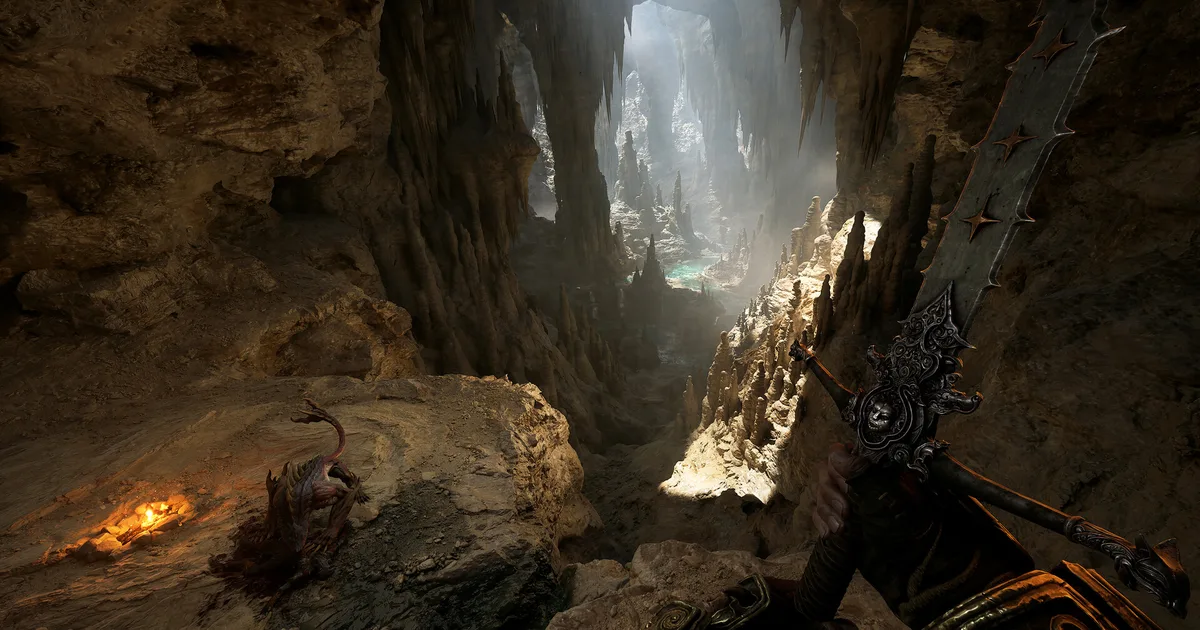
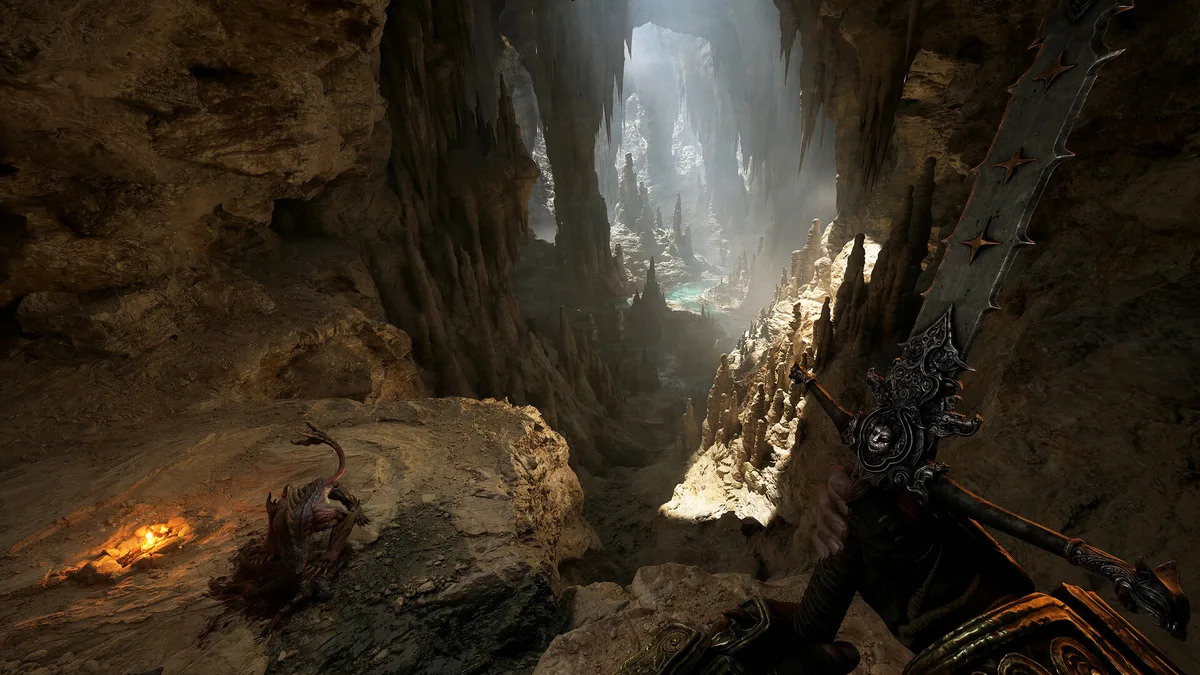 Fatekeeper's dungeons reward reading the room before committing. Lay down fire area-denial at a doorway like this one before enemies close in, not after they're already on top of you.
GODEEPER: For the confirmed three-attribute stat breakdown (Strength, Precision, Sorcery), see the full builds guide before committing your first points. Fatekeeper Best Build: Melee, Fire, and Caster Routes →
Direction 2: Frost Reaper (freeze plus heavy melee)
The Frost Reaper label describes the direction with the strongest anecdotal case for beginner-friendliness. The idea, confirmed loosely by Paraglacial's own devlog example, is to freeze an enemy in place with an ice-type spell, then finish with a heavy melee hit. The freeze window is reportedly long enough that players still learning enemy patterns can land the follow-up without rushing.
Stat priority: Split between Sorcery (for ice spell power) and Strength (for the melee follow-up). The two tracks reinforce each other in this direction.
Confirmed nodes worth knowing:
- Herald of Winter (a confirmed frost-related node)
- Fortitude anchor node (+10% Health) as an early safety pick while you're still learning freeze timing
- Wrath (+10% Melee Weapon Damage), for the follow-up hit
A specific "frozen enemies explode on a blunt-weapon kill" perk, sometimes named in community guides, is not independently confirmed. What is reasonably well supported is the general idea: crowd-control with ice, then punish with melee. Don't take the exact mechanic description as gospel until Paraglacial documents it.
Weapons: Maces, hammers, or clubs for the melee follow-up. If the freeze-plus-blunt-weapon interaction the community describes is real, edged weapons like greatswords likely don't trigger it the same way, so lean blunt until that's confirmed one way or the other.
Chain to know, with a caveat: Freeze first, then land a heavy blunt hit. At the Derelict Waterways boss, landing that freeze before the boss's charge attack requires reading the wind-up rather than reacting to the charge itself. That timing advice comes from community reporting, not an official source, so treat it as a starting point rather than a guarantee.
Where it excels: Open areas with multiple enemies, where crowd control from freezing effects has more value than in tight corridors.
Direction 3: Wind Dancer (mobility plus daggers)
The Wind Dancer label describes a mobility-and-dagger build, and it's the direction with the clearest devlog support. Paraglacial's April 8 devlog describes an unofficial dagger build where the dash becomes a leaping attack plus a boomerang-style throw. Wind-type spells reportedly control enemy positioning, and daggers handle the close-range follow-up.
Community guides describe a perk that replaces the standard dodge roll with a short-range teleport, which matters because Fatekeeper's base dodge has no invincibility frames by default. That specific perk name isn't confirmed by Paraglacial, but the underlying complaint (that the base dodge feels risky) and the general idea of a mobility upgrade are consistent with the devlog's own dagger-build example.
Stat priority: Precision primary, for critical hit chance and weapon handling speed, with enough Sorcery to make wind-type spells functional. A confirmed node, Storm Surge (+50% spell power with wind spells, +25% wind spell costs), is worth taking once your mana pool can sustain the extra cost, not before.
Confirmed nodes worth knowing:
- Lord of the Skies (a confirmed wind-related node)
- Storm Surge, once your mana pool supports the added cost
- Savant, a confirmed Telekinesis-tree node that cuts spell costs by 50%
- Ricochet, a confirmed node relevant to projectile-style attacks
Weapons: Daggers first. The confirmed Ornate Dagger, a named item from the current build, is worth checking for if you're leaning into this direction. Fists work as a backup for unarmed situations.
Where it struggles: The early game, before whatever mobility upgrade the community describes comes online. Community reports consistently describe Wind Dancer runs as rough in the first stretch of content. A couple of early Fortitude points as insurance is a reasonable hedge until you have more tools.
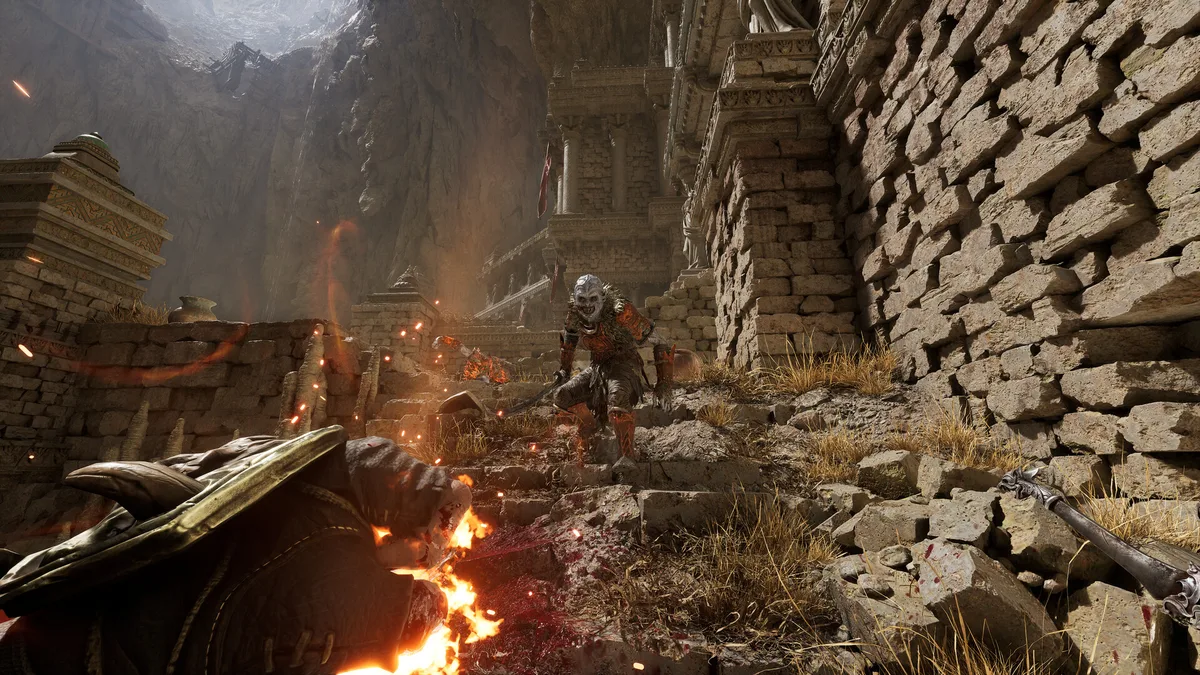 An enemy closing distance fast in the open ruins. This is exactly the kind of engagement where positioning tools matter more than raw damage: control the gap before it closes on you.
GODEEPER: Wondering how the current Early Access build holds up as a platform for any of these playstyles? The review covers mechanical depth and content depth separately. Fatekeeper Early Access Review 2026 →
Direction 4: Blood Knight (life-leech melee, least confirmed)
The Blood Knight label is the least confirmed of the five. It describes a life-leech melee build paired with sword and shield, but neither Paraglacial's Steam copy nor its April 8 devlog clearly describes a matching build. The devlog's fourth example build is about consumables and alchemy buffs, not a sword-and-shield sustain tank, which means the fan-wiki mapping of "Blood Knight" onto that fourth example doesn't hold up well under scrutiny.
What's reasonable to say: melee-focused, sustain-oriented builds exist as a viable direction given the confirmed Strength attribute path and general RPG genre conventions, and Wrath (+10% Melee Weapon Damage) supports any melee-heavy build regardless of what you call it. Specific claims about named life-leech perks, drain spells, or debuff effects tied to this label aren't independently corroborated, so this guide won't repeat them as fact.
Stat priority: Strength primary if you're building toward sustained melee damage, with Fortitude (+10% Health) as a natural complement for a tankier playstyle.
Weapons: Sword and shield for blocking uptime, or a mace as a secondary for armor-penetrating damage against heavily armored enemies.
Honest note: If you're specifically chasing a "Blood Knight" build because you saw it named elsewhere, know that the label itself is the shakiest of the five. A generic tanky-melee Strength build is a safer way to think about this direction than trusting any specific named ability tied to it.
Direction 5: Alchemist (consumables and oils)
The Alchemist label is the one with the clearest devlog backing besides Pyroclast. Paraglacial's April 8 devlog describes a consumable-and-alchemy-buff example build. It doesn't pair with a single attribute path the way the fire and mobility directions do; instead it centers on weapon oils and throwable consumables, with elemental damage coming from the coating rather than from spell investment.
That's both the appeal and the limitation. It's less mechanically demanding than the mobility direction and less committed than a pure Sorcery build, and it works with most weapon types. At high investment, though, focused directions likely pull ahead because every point they spend amplifies one core loop, while Alchemist's value is spread across a toolkit.
Stat priority: Insight (+10% Alchemy Skill), a confirmed node, if consumables are genuinely central to your playstyle. Otherwise split Strength and Fortitude and treat oils as a supplement.
Confirmed nodes worth knowing:
- Insight (+10% Alchemy Skill)
- Kutracite and Guards Vermillion, two confirmed nodes from the current tree (exact effects aren't published in detail, but both are real, named entries)
Where it excels: Varied enemy compositions, where switching oil types for different enemy resistances is a genuine adaptability advantage in a build that otherwise doesn't hit as hard as a focused direction.
Where it falls short: Consumable-dependent builds can run out of throwables in long fights, including the Derelict Waterways boss encounter. Stock up before entering a boss room rather than after you're already there.
Step-by-Step: committing to a direction before the Derelict Waterways boss
The Derelict Waterways boss fight (commonly called "the Minotaur" by players, though that's not Paraglacial's own term) is the current content gate for most builds. There's also a second, later boss fight confirmed via patch 0.1.1's separate "Second Bossfight" stat block, so don't treat the Derelict Waterways fight as the only or final challenge in the current build.
- Pick a direction before spending your first skill point. Changing course mid-tree costs points you'll want elsewhere.
- Take Fortitude (+10% Health) as opening insurance on most directions, or the Power anchor if you're going Sorcery-heavy.
- Put several points into your primary attribute path before spreading into secondary nodes.
- Confirm your chosen direction's core node or perk is secured before the Derelict Waterways room, and remember a second fight follows it.
- Carry a second weapon with full durability into any boss fight. Weapons break.
Tips for playing each direction
Pyroclast: Don't cast into melee range. Lay fire area-denial at doorways before enemies enter the room, not after they're already in your face.
Frost Reaper: Try to freeze on the enemy's wind-up animation rather than reacting to a charge after it's already started. Reaction time alone is often too slow.
Wind Dancer: Expect to take more hits than you'd like before your mobility tools come online. That's normal. A couple of early Fortitude points is reasonable insurance.
Blood Knight: Lean on the confirmed Strength and Fortitude paths rather than chasing specific named perks that aren't independently verified.
Alchemist: Stock consumables before the Derelict Waterways fight. A partial inventory going in is how this encounter turns into a war of attrition you lose.
Related Reading
- Fatekeeper Best Build: Melee, Fire, and Caster Routes: The three confirmed stat-attribute paths (Strength, Precision, Sorcery) with point-by-point recommendations before and after the Derelict Waterways fight.
- Fatekeeper Tips: 11 Things to Know Before You Start: Core beginner mechanics including weapon durability, alchemy basics, and parry timing that apply regardless of which direction you pick.
- Fatekeeper Review: First-Person RPG Worth It at $9.99?: An honest look at where the Early Access build stands, including how much the different playstyles actually vary in the current 2-hour content window.
- Is Fatekeeper Multiplayer? Solo-Only in Early Access: If you were hoping to run any of these directions with a friend, this covers Paraglacial's stated co-op plans.
- Fatekeeper How Long to Beat: 2 Hours Now, 15 Planned: Sets realistic expectations for how far each direction can actually be developed in the current build before content ends.
- Fatekeeper: What It Is, What You Get, and Is It Worth It: Fatekeeper is a first-person action RPG from Paraglacial, published by THQ Nordic. In Early Access since June 2.
Frequently Asked Questions
How many archetypes are in Fatekeeper?
Fatekeeper has no official class system. The three confirmed attribute paths on Steam's store page are Strength, Precision, and Sorcery. Five build archetypes (Pyroclast, Frost Reaper, Wind Dancer, Blood Knight, Alchemist) are informal community shorthand, partly from a fan wiki, not something Paraglacial has named or ranked.
What is the easiest Fatekeeper archetype for beginners?
The Frost Reaper direction, freezing enemies then following up with a blunt weapon, is widely reported as the most forgiving. The freeze window gives players still learning attack patterns real time to land a punish. It has less burst than a fire-focused build but more room for error.
What is the Pyroclast build in Fatekeeper?
Pyroclast is community shorthand for a Sorcery-heavy fire build. Paraglacial's own April 8 devlog describes an informal "pyromancer" example build. It leans on the Power anchor node (confirmed: +5 Mana, +3% Elemental Damage, +3% Max Mana Node Efficiency) and fire-focused nodes. It hits hard at range but has a rougher time in prolonged melee exchanges.
Can you respec in Fatekeeper?
Yes, as of patch 0.1.3 (July 30, 2026). A Respec Potion sits on the chart table in Haven, the hub town, and clears your entire skill tree in one use so you can rebuild from scratch. Separate Skill Point potions, hidden throughout the world, each grant one extra point. Neither system existed before that patch.
What is the Blood Knight archetype in Fatekeeper?
Blood Knight is community shorthand for a life-leech melee build paired with sword and shield. It has the least independent corroboration of the five archetype names; Paraglacial's own devlog examples don't clearly describe a matching build. Treat it as the least confirmed of the five labels.
What is Wind Dancer in Fatekeeper?
Wind Dancer is community shorthand for a mobility-and-dagger build. Paraglacial's April 8 devlog describes an unofficial dagger build where the dash becomes a leaping attack plus a boomerang-style throw, which lines up loosely with this label. Precision investment and a dodge-replacement perk are the core of the direction.
What weapon types work best with each Fatekeeper archetype?
Blunt weapons (maces, hammers, clubs) suit the Frost Reaper direction and the Alchemist's armor-break oils. Daggers suit Wind Dancer. Sword and shield suit Blood Knight for blocking uptime. Pyroclast works with any one-handed backup weapon since casting is the primary damage source. A confirmed item worth knowing: the Ornate Dagger, a real named weapon from the current build.
References
- Fatekeeper on Steam: official store page with review score, developer info, attribute description, and system requirements
- Fatekeeper official site: developer page for Fatekeeper updates and announcements
- Fatekeeper Steam Community Hub: player-shared build discussions and community guides
Was this guide helpful?
About the author

Senior Critic & Analyst
Former game data analyst turned critic with 11 years covering indie and mid-tier games. Based in Austin. Runs spreadsheets on games most people just play.
- 11 years games criticism
- Former game economy analyst
- Roguelike and strategy specialist
Keep reading


Disclaimer
This article is published for informational and entertainment purposes. It does not constitute professional financial, legal, or technical advice. Game performance, online services, patch schedules, and store listings change. Verify critical details (pricing, system requirements, regional availability) with publishers and storefronts before you buy. Affiliate links, where present, help support our editorial work and are labelled in our affiliate disclosure.
Comments
Loading comments…