
GameBrief · General
Greenhearth Necromancer Review: Undead Farming Done Right
Greenhearth Necromancer review: Silverstring Media's necromancy-farming sim. Living and undead plants, Lindsay Ishihiro's writing, and a 7.5 from us.

Reviewing
Greenhearth Necromancer
Silverstring Media Inc. · indie.io
Score
Reviewed build: 1.0
Pros
- The undead plant layer creates a genuinely second garden to tend, not just revived failures
- Deliberate rejection of countdown-ticker idle design actually works: the garden grows without you and rewards returning
- Lindsay Ishihiro's writing handles grief and community with real specificity
- Customizable lo-fi soundtrack and ambient sound layers add to the sense of personal space
Cons
- Necromancy spells don't always communicate their effect on plant traits clearly: requires trial and error
- Narrative pacing relies heavily on the event deck's randomness; some story beats arrive later than they should
Verdict
A small, carefully made cozy sim that treats necromancy and gardening as genuinely complementary: not a gimmick, but a second way to relate to your plants.
Greenhearth Necromancer review: Silverstring Media's game, released May 11, 2026 on PC and Mac via Steam.
The current Steam snapshot checked September 16, 2026 lists Greenhearth Necromancer at $10.99 with 96% positive reviews from 87 users. That store rating is separate from this review's 7.5/10 score.
There's a moment in Greenhearth Necromancer, maybe fifteen minutes in, after you've run through the tutorial and Echo's grandmother's garden is still mostly a mess of wilted pots and dry soil, when you cast your first resurrection spell on a dead succulent and it doesn't come back looking like a healthy succulent. It comes back pale, slightly luminescent, thorns a little longer and more angular than before. It's alive, technically, but in the way a ghost is alive. And then you realize you have to water it differently now.
That's this review's central finding in a single early-game moment. This isn't a farming game where necromancy is a coat of paint. It's a garden sim where the dead half of your garden has genuinely different rules from the living half, and figuring out those rules is most of what you'll be doing.
Greenhearth Necromancer Review: Key Takeaways
- Greenhearth Necromancer is a cozy, semi-idle garden sim from Silverstring Media, released May 11, 2026 on PC and Mac via Steam
- You play as Echo, a newly graduated necromancer inheriting a dead balcony garden, and build it into a hybrid ecosystem of living and undead plants
- Core mechanics: plant care (watering, fertilizing, pest control), necromantic spell-casting, potion brewing, and idle background growth
- Story is written by BAFTA-nominated writer Lindsay Ishihiro (I Was a Teenage Exocolonist) and delivered through an event deck system
- Greenhearth Necromancer review score: 7.5: a focused, atmospheric sim that earns its concept
Greenhearth Necromancer Review: Overview
Silverstring Media is a small queer-led studio out of Vancouver, BC, and Greenhearth Necromancer is their most mechanically ambitious game. This Greenhearth Necromancer review tested the full 1.0 release on PC. Published by indie.io, it's built around a simple premise: Echo, an enby witch who just finished their necromancy degree, inherits their late grandmother's apartment in a building called Greenhearth. The apartment comes with a balcony garden that's been neglected for years, and the neighbors in the co-op are curious but not hostile. Your job is to bring the garden back: using conventional gardening when it works, and necromancy when it doesn't.
The game calls itself a "semi-idle sim," which is an accurate description of how it feels to play. The garden exists in real time. Plants grow, wilt, and change whether you're actively tending them or not. Step away for an hour and something will have bloomed or died or transformed in your absence. The design deliberately pushes back against the countdown-ticker anxiety of most idle games: there's no timer telling you when to come back, no penalty for missing a watering window by twenty minutes. The garden has its own rhythm and you're learning to work with it rather than optimize it.
This is a meaningful design choice, and it changes the tone of everything else. Greenhearth Necromancer is not a game about efficiency. It's a game about paying attention.
Gameplay: The Farming and Necromancy Systems
The gardening system is straightforward in the best way: you water plants, apply fertilizer, prune overgrowth, deal with pests using either conventional methods or brewed potions, and harvest what the garden produces. Each plant has a care profile: some need frequent watering, others tolerate neglect. None of this is particularly demanding, and the game makes no attempt to stress you out about it.
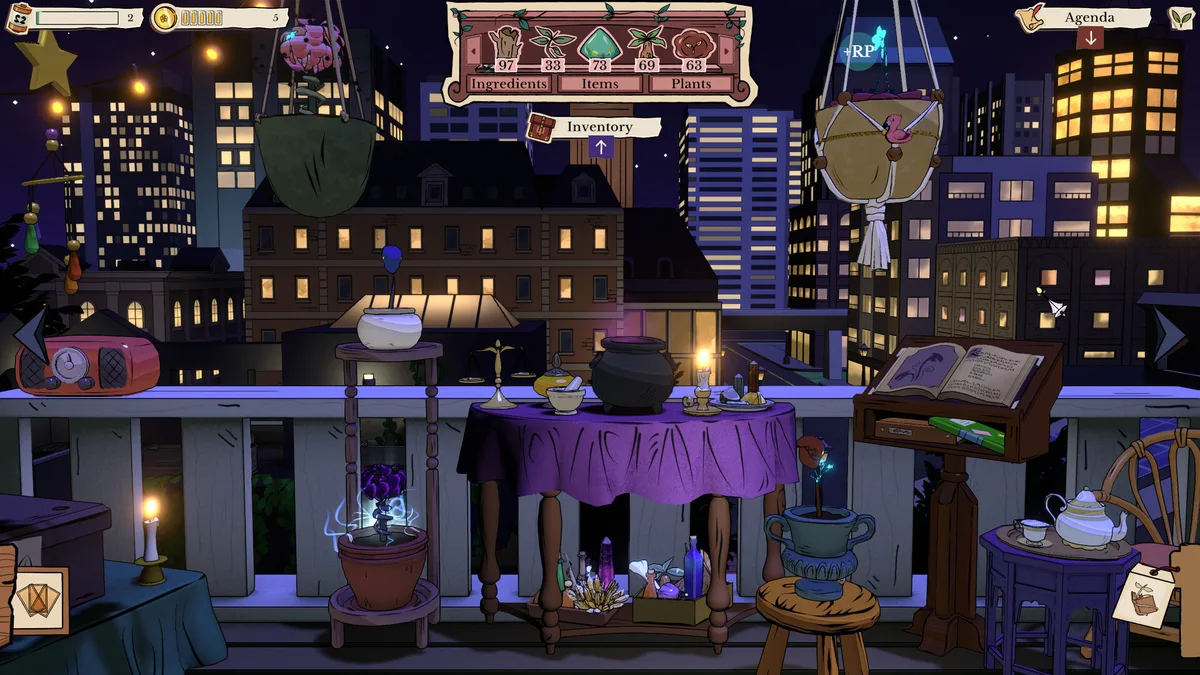
 Undead lavender (pale, slightly luminescent) growing alongside living herbs: two separate ecosystems sharing one pot.
What the gardening system does well is create a baseline of familiarity before necromancy enters the picture. You spend the first part of the game learning the living side of the garden, which makes the undead side feel like a genuine discovery rather than a tutorial checkbox.
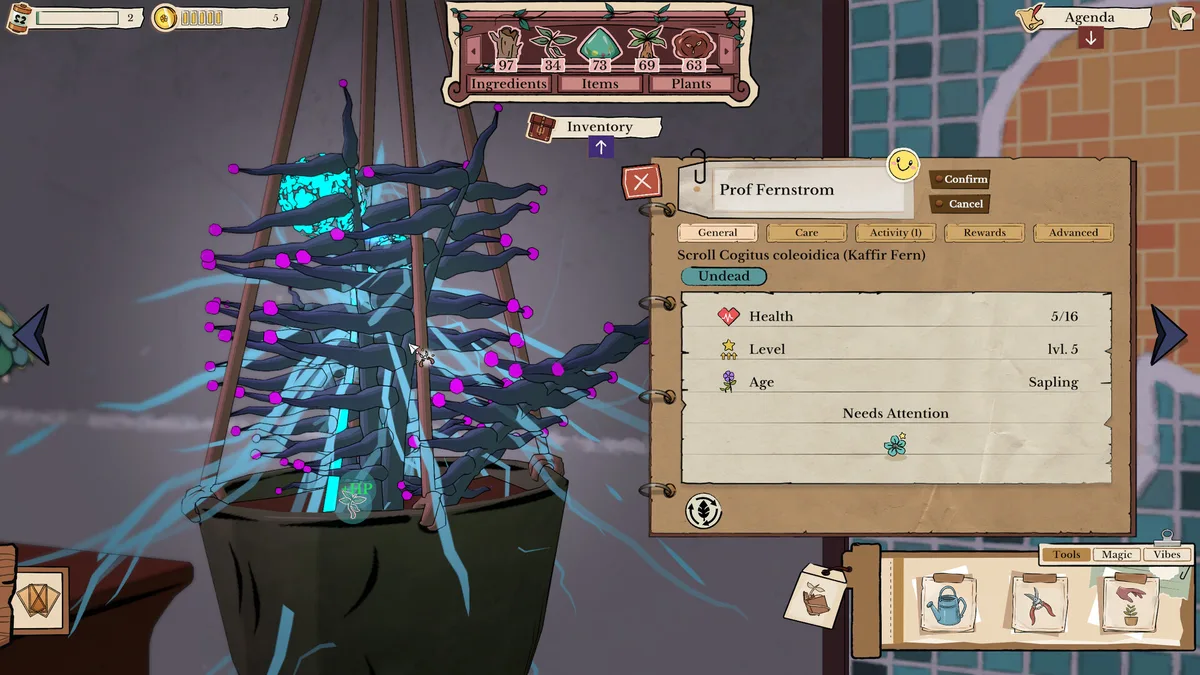
When a plant dies (or when you use a resurrection spell on something that's already dead) it doesn't simply recover. It becomes something different. Undead plants have altered appearances (the pale, luminescent quality I mentioned with the succulent shows up across species) and modified care requirements. Some undead plants don't need water but respond to necromantic energy infusions. Others actively repel certain pests that living plants would need potions to handle. A few have growth patterns that speed up dramatically overnight, which sounds useful until you realize you have to be there to harvest before they overwilt again.
The necromancy spell system is where this gets interesting. You cast spells to resurrect plants, but also to alter their undead traits, speed up growth, change the pest resistance profile, adjust how much necromantic energy they consume versus produce. The spell vocabulary isn't huge, especially early on, but each spell interacts with plant-specific variables in ways the game doesn't always explain clearly. You'll sometimes cast a growth-speed spell on an undead fern and not be sure whether it worked until two in-game days later. That ambiguity is probably intentional, the game wants you to observe and learn, but it can feel opaque when you're trying to understand why a plant died again.
Potion brewing fills the gap between spells: you craft pest-control potions, growth supplements, and undead stabilizers using materials composted or harvested from the garden. The crafting system is simple (two or three ingredients, no complex chains), and most of the potions you'll brew regularly become muscle memory within a few hours.
The idle layer works well. Leaving the game running while doing other things and returning to find that your undead moonflowers bloomed overnight while your living tomatoes developed a fungal issue is exactly the tone the game is going for. It creates a relationship with the garden that feels low-stakes but genuinely attentive.
For fans of narrative-driven cozy games, our Moomintroll: Winter's Warmth review covers another 2026 release that handles the same low-friction, emotionally grounded tone: useful comparison if you're calibrating expectations.
GODEEPER: Sintopia uses a dual-loop structure similar to Greenhearth's parallel plant ecosystems (a campaign layer and a resource loop that feed each other throughout the run. Sintopia Review) Dual-Loop Strategy Game →
Information Gain: What Makes This Hybrid Actually Work
Most coverage of Greenhearth Necromancer describes it as a "necromancy + farming game" and stops there. The actual mechanical insight is this: undead plants are not resurrected versions of living plants. They're a second category of resident in your garden with independent care logic.
A living tomato plant and its undead counterpart share a planting spot but have completely different needs: one wants water and sunlight timing, the other wants necromantic energy infusions and produces a pest-deterrent aura that helps its living neighbors. Managing both types simultaneously is where the game's real texture lives. You're not toggling between two modes; you're running two parallel ecosystems that happen to share a balcony.
This is the design move that separates Greenhearth Necromancer from "farming game with magic." The necromancy isn't a power you use on your garden: it's a second relationship you develop with a different kind of life. Some players will find the undead side less intuitive because the visual feedback is subtler (a slightly different leaf texture, a faint glow), but once the two layers click into a working rhythm together, the garden feels genuinely alive in a way that's hard to describe without playing it.
The event deck narrative system reinforces this. Lindsay Ishihiro's story arrives in fragments through triggered events, mixing scripted story moments with random neighbor encounters and memory sequences connected to Echo's grandmother. Grief and continuity run through the whole thing: the grandmother who died, the plants she left behind, the community that's waiting to see what Echo does with the space. It's quietly good writing that would feel earned even without the mechanical layer underneath it.
What Works
The undead plant ecosystem is this Greenhearth Necromancer review's standout finding. Once you have a mix of living and undead flora in the garden and they're interacting (an undead lavender deterring pests from living herbs, a living vine growing faster because an undead neighbor is producing excess necromantic energy) the balcony feels like a small world with its own logic.
 The necromancy spell UI: resurrection options show what the undead variant will require versus its living counterpart.
The idle design choice pays off. Greenhearth Necromancer is one of the few games in this genre that actually trusts you to come back on your own schedule. The garden rewards attention without demanding it, which makes returning to it feel like checking in on something rather than servicing a timer.
Ishihiro's writing is doing real work here. The way Echo processes their grandmother's death through the act of caring for what she left behind is specific enough to land without being overwrought. The neighbor characters have distinct voices and the event deck's randomization means different players will encounter story beats in different orders, which gives the narrative a slightly different shape each time.
For another cozy release worth comparing: our inKONBINI feature covers a different 2026 indie that applies the same low-stakes, atmosphere-first philosophy to a convenience store setting: different genre, same design values.
The ambient soundtrack system is a genuine feature, not a bullet point. Being able to build your own layered soundscape from the available audio components (rain, lo-fi beats, ambient noise) alongside the in-game music turns the game into a specific kind of calming environment. Some players will leave it running just for the atmosphere.
What Doesn't Work
Necromancy spell feedback is the weakest part of the game. When you cast an alteration spell on an undead plant to change its trait profile, the game doesn't always communicate what changed or whether the spell took effect. You're left checking back in a day or two to see whether the pest resistance increased or the growth rate actually shifted. This is probably a deliberate design choice (learn by observing, not by reading a tooltip) but it creates real moments of confusion, especially in the early hours when you're still mapping what each spell does to which plant types.
The event deck narrative pacing has a related problem. Because story events are shuffled into a random deck with gardening events, you can go several in-game days without meaningful story progress if the deck draws light. Key character moments involving Echo's relationship with their grandmother and the backstory of the co-op sometimes arrive later than they structurally should, which softens the narrative's emotional impact. The writing is good enough that you feel the loss when a story beat lands at the wrong moment.
Neither of these is a serious problem. The spell feedback issue is the kind of roughness you'd expect from a small studio's release, something that could be addressed with a patch adding clearer visual cues. The narrative pacing is more structural and harder to fix without reworking how the event deck weights important beats.
To summarize this Greenhearth Necromancer review: what doesn't work is two areas of polish, both fixable. What works is the core premise, fully realized.
Verdict
Greenhearth Necromancer earns its concept, and this greenhearth necromancer review lands at 7.5 because of it. The necromancy-farming hybrid isn't a marketing frame: it's a functional design where two parallel plant ecosystems create a genuinely different kind of garden to manage. Silverstring Media and writer Lindsay Ishihiro treat a small story about grief and community with care, and the semi-idle structure gives the game a calming presence that's hard to find in a genre that usually leans on anxiety.
At 7.5, it's a confident recommendation for players who want a cozy game with more mechanical texture than the average idle sim, and who don't mind some visual ambiguity while learning the undead side of the garden. If you bounced off farming sims because the economic loop felt hollow, or if you loved the emotional tone of I Was a Teenage Exocolonist and want something lower-pressure from the same writer, this is worth your time.
GODEEPER: For another 2026 indie built around a cozy loop with more mechanical depth than the genre average, Forage Wizard layers foraging economy onto wizard-school management. Forage Wizard Launch: What It Is →
Frequently Asked Questions
Is Greenhearth Necromancer worth buying? This Greenhearth Necromancer review recommends it if you enjoy cozy idle games that prioritize atmosphere and narrative over grind. The necromancy + gardening hybrid is distinct enough to feel fresh, and Lindsay Ishihiro's writing gives the story real emotional weight. It's a calm, low-pressure game with enough mechanical depth to keep you engaged for 8-12 hours.
Is Greenhearth Necromancer a farming sim like Stardew Valley? Not quite. It's a balcony garden sim: smaller in scope than Stardew, with no combat, no crop selling loop, and no town economy. The focus is on tending a single space over time, with necromancy adding a second layer to care mechanics. Think of it as more idle sim than full farming RPG.
What does necromancy actually do in the game? Necromancy lets you resurrect dead or withered plants into undead variants, then use spells to alter their traits, speed their growth, or use them to repel pests. Undead plants have different care requirements than living ones: they don't just become "alive again" but exist as a separate type of flora in your garden that you manage alongside normal plants.
How long does Greenhearth Necromancer take to complete? The demo covers the early narrative introduction and a handful of spells and rituals. Based on Silverstring's description of the event deck pacing, a full playthrough appears to run 8-12 hours depending on how much you let the idle systems run in the background. The game doesn't have a traditional endpoint: story events resolve over time.
Does Greenhearth Necromancer have Steam Achievements? Yes. Steam Achievements are confirmed as a supported feature at launch.
Who wrote the story for Greenhearth Necromancer? The narrative was written by Lindsay Ishihiro, the BAFTA-nominated writer behind I Was a Teenage Exocolonist. The story follows Echo, a newly graduated necromancer inheriting their grandmother's apartment and garden, and explores themes of community, grief, and early adulthood through an event deck system.
Is there a free demo for Greenhearth Necromancer? Yes. A demo is available on Steam that covers the tutorial, a selection of early spells and potions, and an introduction to the story. Silverstring Media described it as "almost all of the stuff in the eventual release but scaled down."
Related Reading
- Moomintroll: Winter's Warmth review: another emotionally grounded cozy release.
- Sintopia review: a different dual-loop strategy structure.
- inKONBINI feature: an atmosphere-first 2026 indie comparison.
- Forage Wizard launch: another cozy management game with a distinct resource loop.
- Sister Ray review: a narrative-focused indie review with a heavier emotional register.
- Above the Snow review: a solo-dev atmospheric comparison.
- Nook Fall: West Town launch: another small-scale narrative game with a strong sense of place.
- Kristala review: a darker comparison for players who want more mechanical pressure.
- Kristala complete guide: a broader guide hub for another atmospheric indie release.
- Tabletop Tavern review: a contrasting systems-first indie review.
References
- Greenhearth Necromancer on Steam
- Silverstring Media: Greenhearth Necromancer
- Raise a Garden from the Dead: Greenhearth Necromancer Demo Out Now (Gamespress)
- Greenhearth Necromancer Is Coming to Steam on 11 May 2026 (COGconnected)
- Greenhearth Necromancer on Loaded (sponsored): alternate key retailer; price varies by storefront and date
About the author

Indie & JRPG Critic
Indie game evangelist and lifelong JRPG fan covering small studios since 2017. Mumbai-born, London-based. Writes the way she talks.
- 7 years indie games coverage
- JRPG and visual novel specialist
- Narrative design focus
Keep reading





Disclaimer
This article is published for informational and entertainment purposes. It does not constitute professional financial, legal, or technical advice. Game performance, online services, patch schedules, and store listings change. Verify critical details (pricing, system requirements, regional availability) with publishers and storefronts before you buy. Affiliate links, where present, help support our editorial work and are labelled in our affiliate disclosure.
Comments
Loading comments…