
GameBrief · Guides
Outbound Best Base Locations: Where to Park Your Van

Reviewing
Outbound
Square Glade Games · Square Glade Games
Outbound best base locations are route decisions, not a fixed tier list of biomes. Your electric camper van is the base, workshop, and energy hub, so the right parking spot depends on which power source you have built and what the next gathering loop needs. A spot that is excellent for a wind setup can be poor for a resource run, and a beautiful coast may be inconvenient if the next objective is inland.
TL;DR: Start by matching the parking spot to the energy source you actually use. Open ground is a sensible test for wind, clear sky helps solar, and a water source can justify a water-focused setup, but the official game materials do not publish universal biome multipliers. Scout resources, check landmarks, watch the van's live energy readout, and move when the route changes.
Current status: September 2026 (quick answer)
The current Steam snapshot used for this audit listed Outbound at $24.99 in the United States. The page showed 73% positive from 1,788 English reviews and 77% positive from 58 recent reviews. Outbound is now a full release from Square Glade Games, and its official store description confirms the mobile electric camper van, energy gathered from sun, wind, and water, and online co-op.
The latest official announcement feed checked for this refresh included Patch 1.1.8. That patch fixed empty Download Terminals and the last Signal Tower in a biome, improved Dog Companion radial controls, and included multiplayer stability work. Those notes are useful evidence that landmarks and co-op behavior can change. They are not evidence for a permanent “plains are best” power formula.
Outbound best base locations: the decision rule
The best camp answers four questions in order:
- Which energy source can the current spot support?
- Which resources or objective are you trying to reach?
- How much walking will the group do between the van and that route?
- Can you relocate without wasting a large amount of unfinished work?
This is more reliable than memorizing a biome ranking. The official store confirms the three energy families, but it does not provide a public chart saying that one biome always multiplies wind by a specific amount or that another always blocks solar. In a freshness guide, those exact claims need a primary source. Until one exists, treat the categories below as scouting heuristics and verify your own output in the current build.
Match the spot to your energy setup
Wind: Test wind equipment in open terrain with a clear approach and enough room to expand. Avoid claiming that every plain produces the highest possible output. Read the generation value after parking, then compare it with a second spot before committing modules.
Solar: Prioritize open sky and a panel position that is easy to reach for maintenance or expansion. A clear-sky location is a sensible starting hypothesis, not proof of a fixed coast bonus. If your battery drains during the same routine, move the van or add another source before adding more production blindly.
Water: A water source is worth scouting when your build already uses water generation or when the route naturally follows a river or shoreline. Check that the placement is practical and that the spot still keeps your storage and gathering loop short. “Water is always the highest output” is not a verified rule for this guide.
Hybrid: The most forgiving mid-game camp often combines two sources that cover different conditions. The exact combination depends on unlocked modules and the local terrain. Use the energy forecast and battery behavior you can see in-game instead of copying a number from an old article.
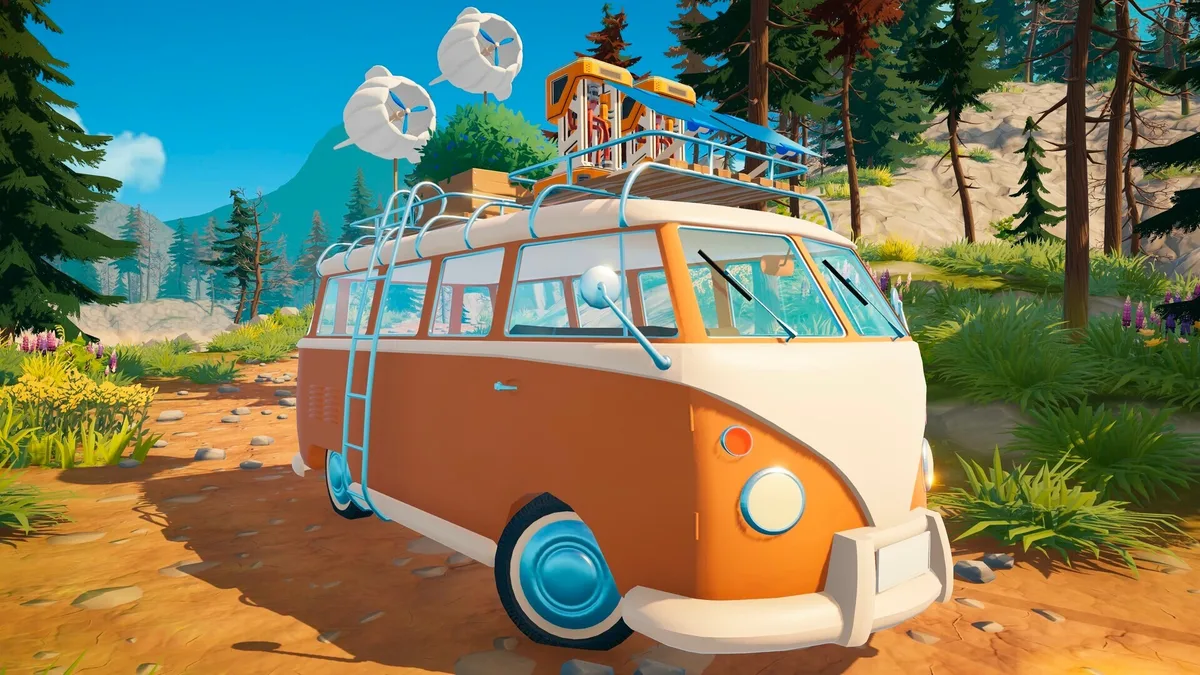 A useful camp balances an energy test with a practical gathering route. The screenshot is an example of a layout, not proof of a universal biome bonus.
What to scout around the van
The first circle around a new parking spot should answer the resource question. Look for the materials required by your next module, a safe place to return from, and a storage path that does not force every player through the same choke point. A camp beside a single attractive node is less useful if the rest of the route takes several trips.
For a solo session, favor compact loops. Park where you can gather, unload, craft, and leave without crossing the same distance repeatedly. For co-op, decide whether the party will stay together or split into two routes. A central camp is helpful only if it is near the group's actual objectives, not simply in the middle of the map.
The van's mobility is part of the system. Do not build as if the first parking spot must be permanent. Make the early camp good enough to support the next unlock, then relocate when the resource route or energy demand changes. The Outbound van build guide is useful when you need to balance modules against the weight and space cost of moving.
Signal towers and current landmark checks
Signal towers are worth visiting when the route takes you near one, especially before a long gathering session. Official Patch 1.1.8 notes mention fixes for empty Download Terminals and for the last Signal Tower in a biome. That confirms that these landmarks matter to exploration and that their behavior has received fixes.
It does not confirm the older claims that every biome has a tower, that every tower permanently locks a randomized blueprint, or that a tower always redirects your build. Check the current interaction in your own save. If the landmark gives you a choice, record that choice before you park. If it does not, do not build a guide around a historical behavior.
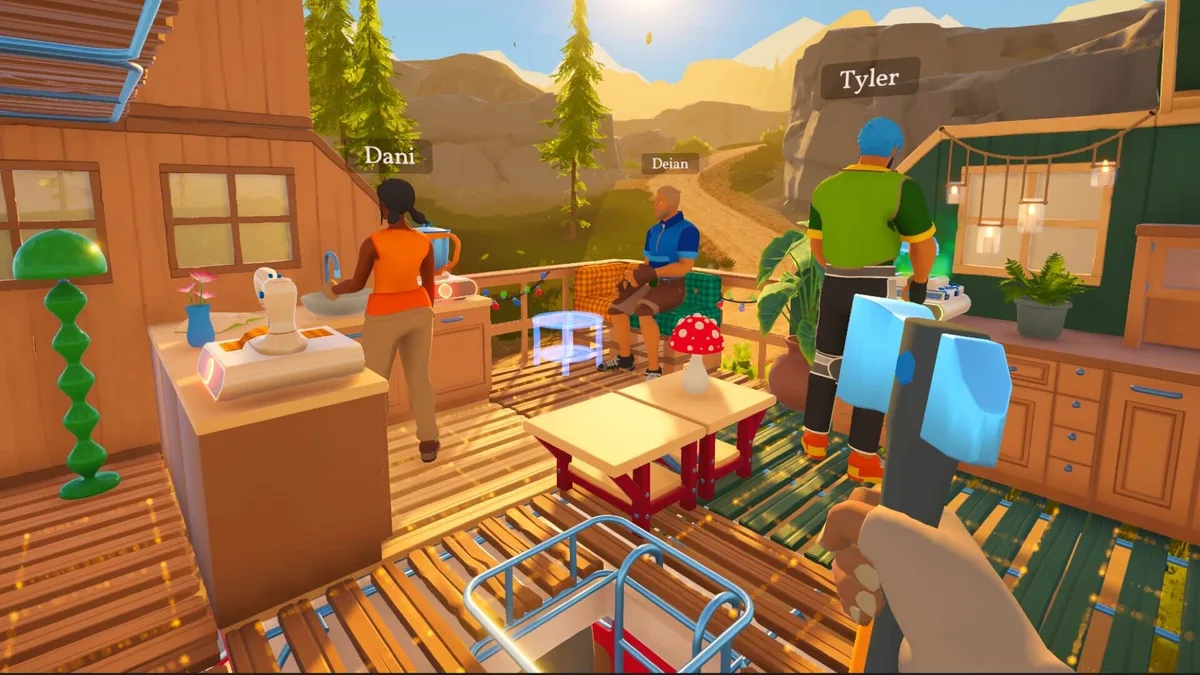 Check a landmark in the current save before treating an older blueprint or tower rule as universal.
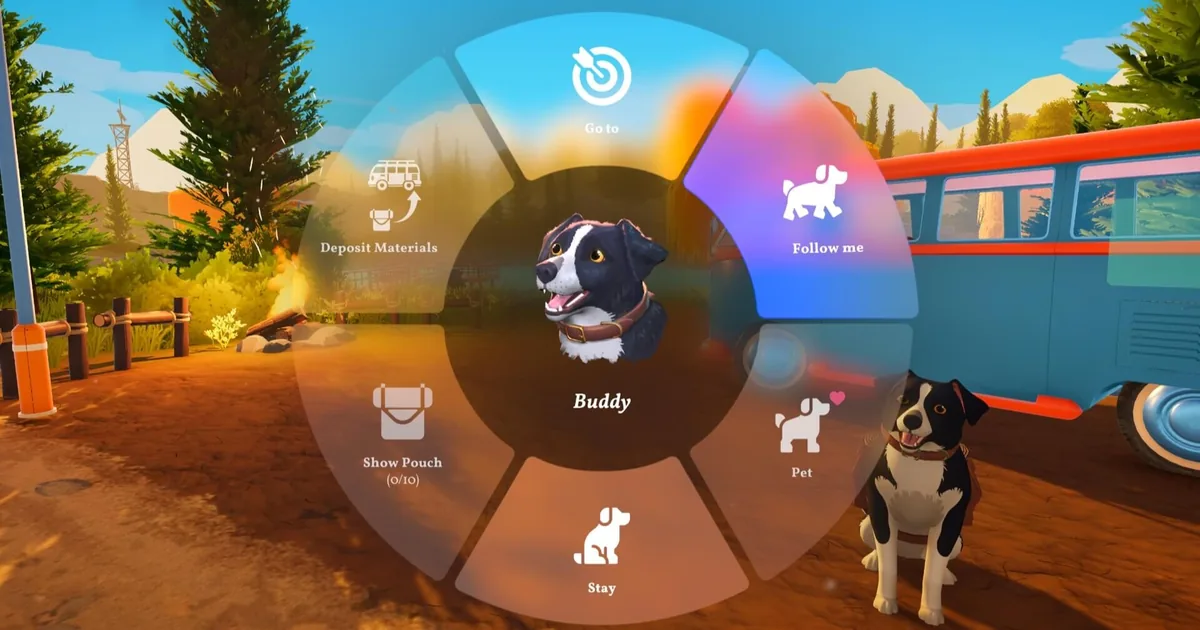
The same rule applies to the Dog Companion. The official patch feed specifically mentions improved Dog Companion radial controls, so a current co-op group should make sure everyone can use the control wheel before setting up a long route. The Outbound beginner tips guide covers the early sequence without treating a landmark as a guaranteed reward table.
Co-op parking and energy discipline
Online co-op changes the cost of a bad parking decision because four people can consume supplies and storage time at once. Agree on a power priority before someone expands a module. One player can watch battery status while another gathers, but that role should be a short assignment rather than a permanent “energy babysitter.”
Use a shared callout for the next relocation. Say whether the move is for a resource cluster, an objective, a landmark, or a better energy reading. That keeps players from scattering around a camp that no longer serves the group. The Outbound co-op guide has a fuller role split, while the energy management guide covers the power side of the decision.
Step-by-step: choose a new parking spot
1. Set the objective: Decide whether this camp supports energy, a resource run, a landmark, or the next story route.
2. Scout the perimeter: Walk far enough to inspect terrain, nearby materials, water access, and the return path before expanding the van.
3. Test one source: Deploy or inspect the energy module you plan to use and read the live output. Do not infer a bonus from the biome name.
4. Check the landmark route: Visit a nearby signal tower or Download Terminal when it is safe and note what the current save actually provides.
5. Run one loop: Gather, craft, sleep or recover if needed, and watch the battery during the same routine you expect to repeat.
6. Commit or move: Keep the spot if the route works. If energy or walking distance is poor, relocate the van before adding more modules.
Frequently asked questions
What are the best base locations in Outbound?
There is no verified universal winner. Choose open ground for a wind test, clear sky for solar, or a practical water source for water generation, then check the live result and the resource route.
Can the van be a permanent base?
It can be your long-term mobile base, but the useful mindset is a sequence of camps. Moving is part of Outbound's exploration loop, so avoid treating the first spot as irreversible.
Does a forest always reduce solar output?
The official materials checked for this audit do not publish a complete canopy penalty table. Test the panel output in the actual spot instead of quoting a fixed percentage.
Should I check a signal tower first?
Check it when it is on your route. Patch notes show that signal-tower behavior has received fixes, but they do not support a universal blueprint or permanence claim.
What is the best co-op layout?
Keep storage and crafting accessible, park near the group's next route, and assign gathering areas before splitting up. A central camp is useful only when it reduces the team's total travel.
Related Reading
- Outbound Van Build Guide: module and weight choices for a mobile camp.
- Outbound Energy Management Guide: compare the three energy families.
- Outbound Co-op Guide: roles and shared storage routines.
- Outbound Tips for Beginners: first-hour priorities.
- Outbound Beginner Tips: van setup and early exploration.
- Outbound Complete Guide Hub: the full article cluster.
References
- Outbound on Steam: current release status, co-op, energy sources, pricing, and review snapshot.
- Outbound official announcements: Patch 1.1.8 landmark, multiplayer, and Dog Companion notes.
- Square Glade Games: developer site and official project information.
Was this guide helpful?
About the author

Games Critic
Games writer and reluctant optimist who has reviewed over 400 titles across 9 years. Irish, currently in Berlin. Has strong opinions about tutorial design.
- 400+ games reviewed across 9 years
- Platformer and horror specialist
- Narrative design focus
Keep reading


Disclaimer
This article is published for informational and entertainment purposes. It does not constitute professional financial, legal, or technical advice. Game performance, online services, patch schedules, and store listings change. Verify critical details (pricing, system requirements, regional availability) with publishers and storefronts before you buy. Affiliate links, where present, help support our editorial work and are labelled in our affiliate disclosure.
Comments
Loading comments…