
Complete guideOutbound
Outbound Guide 2026: Van Builds, Co-op, and Biomes
Outbound guide hub: van builds, energy systems, co-op roles, and biome guides, updated for the live Fishing Update and the Wildlife Update roadmap.

About the game
Outbound
Square Glade Games · Square Glade Games
This outbound guide hub covers Square Glade Games' Outbound: a full 1.0 van-life co-op that landed May 11, 2026. The pitch: one electric camper van, up to four players, no combat, no enemies, and a set of decisions about weight and energy that make every build choice matter.
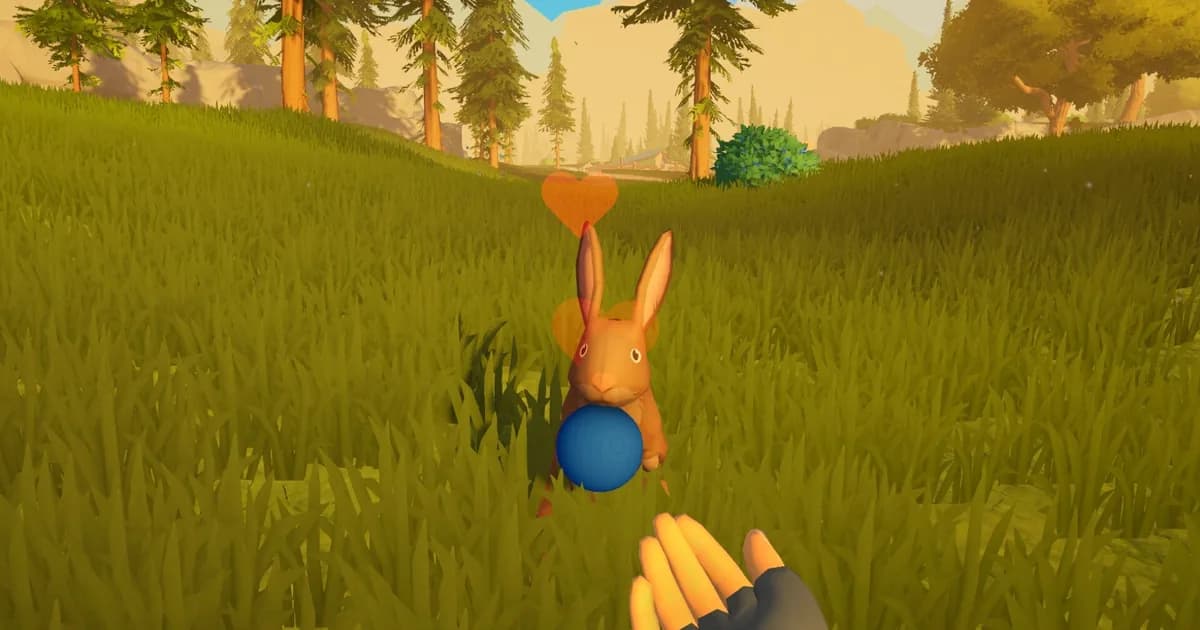
The live game is beyond launch state now. Patch 1.1's Fishing Update added three rods, 32 collectible fish, fish tanks, a journal, and new huts/cabins. Square Glade's September 9 announcement says the Wildlife Update is next, adding wild animals, birds, insects, a camera, and photo-journal entries; adventurers, campers, and townsfolk are planned for the update after that.
The game is a full 1.0 release. The Steam store snapshot checked September 16 shows roughly 73% positive across all reviews and 80% positive among recent reviews. The older 85% public-demo score from 50,000 testers and the 7.8/10 launch review score are useful historical context, not current store metrics. It works for what it is: the question this outbound guide answers is how to make it work well.
This outbound guide is organized by the decisions you'll actually face: what to build first, how to manage energy, how to split roles in co-op, and where to position the van. Use the section links to navigate to what you need, or start from the top if this is your first session.
TL;DR: Outbound launched May 11, 2026 at $24.99 as a full 1.0 release across PC, Xbox, PS5, and Switch. The live 1.1 Fishing Update adds 32 fish, rods, tanks, and a journal; Wildlife is announced as the next major update. One shared electric camper van, 1-4 players, no combat. Mix two energy sources before adding a second workstation. In co-op, assign 2 gatherers, 1 builder, and 1 scout. Launch review score: 7.8/10.
Key takeaways
What every outbound guide needs to establish before anything else:
- 1 to 4 players share one electric camper van; all decisions are collective
- Van weight governs everything: every module added slows the van and drains the battery faster
- Three energy sources: solar, wind, water: mixing two is standard practice
- Blueprint offers at signal towers are player-specific, which creates natural co-op specialization
- No combat, no enemies; tension comes from energy and resource management
- Full 1.0 release at $24.99; all major platforms including Switch
- Fishing Update 1.1 is live: 3 rods, 32 fish, 4 fish tanks, a journal, huts, and cabins
- Wildlife Update is announced as coming soon; adventurers, campers, and townsfolk are planned afterward
- Launch review score: 7.8/10
What is Outbound?
The short version before this outbound guide covers the mechanics: Outbound is built around a shared mobile home that creates friction. One van, one battery, one weight budget. Every decision (whether to add a workstation, take a mountain route, or linger in a biome for materials) affects everyone.
Square Glade designed the co-op around that shared constraint. Most co-op games let players diverge into independent roles that rarely intersect. In Outbound, four players share the same physical space, the same resource pool, and the same battery meter. Someone decides to add a heavy workstation. Everyone pays the handling cost.
The no-combat design is deliberate. Outbound's pressure comes from the energy system and the weight of your choices, not from enemies. That framing is what determines whether the game is for you: if you want combat, look elsewhere. If you want a game where the group has to agree on priorities and manage consequences together, Outbound does that well.
The Outbound launch feature covers what shipped in the May 11 build: the full van customization system, co-op infrastructure, and how Square Glade structured the exploration loop.
The Outbound launch feature has the pre-launch timeline, including why the game moved its PC/Xbox release from May 14 to May 11 (short answer: Subnautica 2 announced early access on the original date).
- Outbound Launch Feature: Day-One Build and What to Expect: why the launch moved from May 14 to May 11, what shipped in the day-one build, and Square Glade's post-launch roadmap.
- Outbound Review: Van Life Co-op That Actually Delivers: Outbound review: Square Glade's $24.99 van-life co-op makes shared base building, energy management, and biome exploration work for groups of up to four.
The van build: modules, weight, and stage priorities
This outbound guide section on van builds starts with the most important concept: the weight-mobility relationship. Every module added to the van serves a function. Every module also adds weight. Weight raises battery drain and slows handling on rough terrain. The van that can do everything moves like a tank in mountain biomes and runs dry before reaching the next signal tower.
The practical consequence: you're always under-building compared to what you want. The outbound guide recommendation is to think in stages rather than building to full spec immediately.
Stage 1: mobility first. Prioritize energy sources over workstations. A van that moves well and recharges consistently lets you reach more signal towers, which expands the blueprint pool. Workstations you can't carry don't help.
Stage 2: single workstation. The first workstation defines your early progression path. Pick one that matches your biome: in coastal terrain, processing marine materials makes sense; in forest, choose wood-based crafting. Don't add a second workstation until Stage 1 energy is stable.
Stage 3: storage and secondary systems. Storage is overlooked in early builds. Materials you can't carry are materials you leave behind. Adding storage before secondary workstations is usually more efficient per weight unit.
The blueprint randomization system at signal towers creates natural build divergence in co-op. Each player at a signal tower draws different blueprint offers. This means two groups running the same route will get different builds. It also means co-op groups need to communicate about which player takes which offer: don't let everyone grab the same category independently.
GODEEPER: Module order, weight budgets by stage, and how solo builds differ from 4-player configurations. Outbound Van Build Guide →
Energy management: solar, wind, and water
Energy is the resource you never stop managing. The van runs on a shared battery. The battery drains when you're moving, when workstations are active, and when multiple players use power-hungry modules simultaneously. It recharges from whichever energy source you've built.
Three sources are available. This outbound guide covers each:
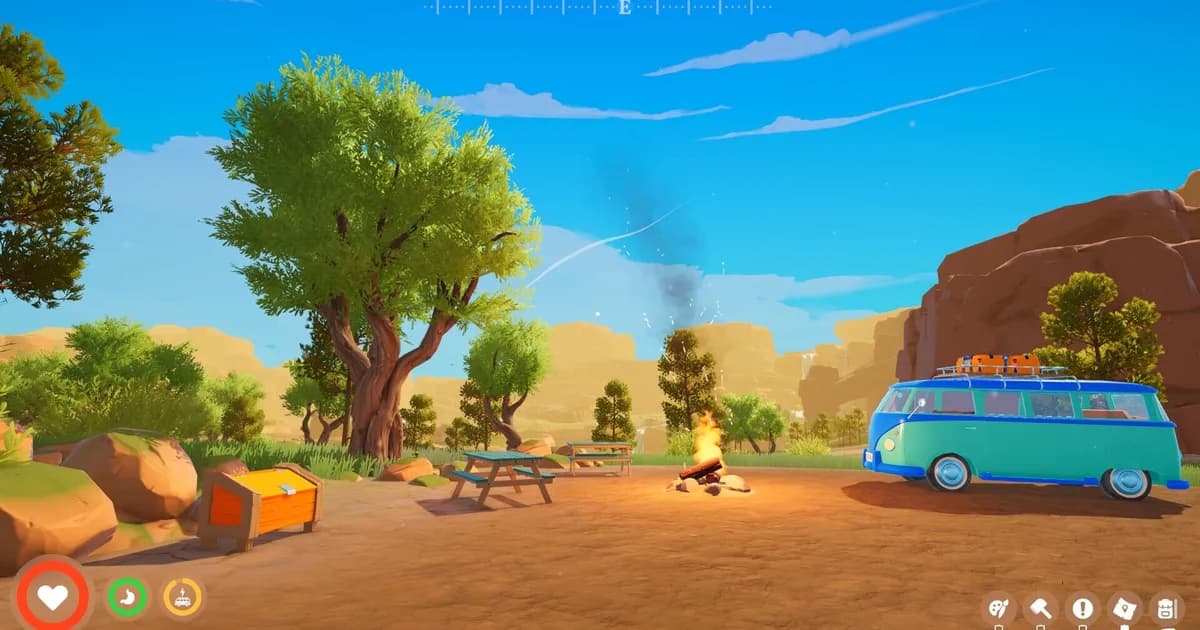
Solar panels deliver the highest sustained output in open terrain. The Starting Area and Coast are solar-friendly. Canyons' narrow corridors block sunlight and reduce solar output significantly. Night travel on solar-only drops your effective range considerably.
Wind turbines produce consistent output in stormy or overcast conditions when solar falls. Useful in Canyons and Mountains, where terrain and weather are less predictable. The output is lower than peak solar but more reliable when solar is suppressed.
Water wheels require proximity to a river or stream. They produce steady power regardless of weather or time of day, but they pin you to a specific location while active. The outbound guide use case: park near a river to recharge fully before a long Mountains crossing.
Running two source types is standard. Full solar works until it doesn't: you hit Canyons' shadowed corridors or a storm, and you're managing battery drain on an empty terrain slot. Two sources cover each other's failure conditions.
Battery conservation matters as much as generation. Workstations running simultaneously drain faster than sequential use. In co-op, having a dedicated energy monitor (someone who watches the battery level and calls warnings before it's critical) is worth losing one gathering slot.
Energy planning is where this outbound guide saves most first-time players the most time. The common failure: build a second workstation before getting a second energy source, then wonder why the battery dies on every mountain crossing. Lock in two energy sources before you add your second workstation: that sequencing prevents the majority of energy crises.
- Outbound Energy Guide: Solar, Wind, and Battery Setup: full pairing logic per biome, the sequencing rule that prevents most battery crises, and the co-op energy monitor role.
Co-op roles and party setup
Every outbound guide for co-op eventually addresses the same failure: players pile into a session, pick jobs informally, and end up with three gatherers and no one managing the van. The materials stack up. The workstations are idle. The battery drops at a signal tower. This outbound guide gives you the conversation to have before that happens.
The role split that prevents this has four positions: two gatherers, one builder, and one scout. This isn't a game mechanic: it's a coordination layer you impose before the session starts.
Gatherers (2 players) collect materials from the active biome. They track weight limits, call when bags are full, and communicate what they're finding so the builder can evaluate workstation priority. Two gatherers working the same zone process roughly twice as fast as one, which keeps the pipeline moving.
Builder (1 player) monitors the van: battery level, weight budget, workstation queues, and blueprint decisions at signal towers. This player has the final say on module additions. When the group hits a signal tower, the builder compares everyone's blueprint offers and decides what gets built first.
Scout (1 player) ranges ahead on the map: identifying biome transitions, flagging signal tower locations, and evaluating route options before the van commits to them. Mountain crossings that look short on the map can be long on battery. The scout calls these before, not during.
At 3 players, drop one gatherer and split gathering between the remaining two. At 2 players, builder and scout roles merge into one: whoever isn't gathering handles van management and route planning. Solo play is fully supported but requires switching between all roles yourself; the energy monitoring task is hardest to maintain solo.
A fully built-out van, roughly what a mid-to-late game loadout looks like once solar, storage, and a garden are all in place.
The Outbound co-op guide covers the full role breakdown with co-op party sizes, battery drain patterns under multi-player workstation use, and blueprint comparison strategy at signal towers. It's the next read after this outbound guide if you're playing with a group.
GODEEPER: Step-by-step role assignment, battery drain patterns, and blueprint coordination for 2- and 4-player groups. Outbound Co-op Guide →
Outbound guide: biomes and base locations
Where you park determines your energy budget, material access, and route difficulty. This outbound guide covers the major biomes and what each one offers:
Outbound has four biomes, and they're a progression path, not four equal choices: Starting Area, Canyons, Coast, and Mountains, roughly in that order.
Starting Area: where every run begins. Open terrain, strong solar output, flat ground that keeps battery drain low on transit, and around 20 basic materials. It's the easiest biome to learn the van's systems in, but the material variety is the lowest of the four.
Canyons: the industrial biome, narrow rock corridors and abandoned infrastructure. This is where you shift from raw survival into real crafting, with materials like common minerals, electronics, natural rubber, and honey. Signal tower density stays solid here.
Coast: the widest biome by resource count, around 27 materials, and home to inputs like glass, hardened metal, casings, and strong weave that feed mid-to-late Workshop and Fabricator recipes. Strong solar and wind access along the shoreline. This is also where you'll find the Paws and Whiskers Lodge, where you adopt a dog companion.
Mountains: the endgame biome and the only one with Tier 5 resources, including Rose Minerals, Adamant Metal, and Chrome Ore. Difficult terrain, high battery drain on transit, and unpredictable weather. Plan crossings from full charge with the van at minimum weight; never cross with a heavy load and less than 80% charge.
Parking near signal towers is more important than biome optimization in the first few hours. The blueprint pool unlocked by signal towers scales your capability faster than material farming. This outbound guide's opening advice: find the first signal tower in your starting biome before choosing a base location.
One thing most outbound guides miss: weather events don't happen on a fixed schedule: they scale with how far into the map you've traveled. Your first biome will be calmer than your third or fourth. Plan energy source diversity before you push into new territory, not after a storm reminds you that solar panels output nothing at night in a rainstorm.
The Outbound best base locations guide ranks locations within each biome, covering specific spots that combine energy source access with signal tower proximity and shelter from weather events.
Outbound guide: signal towers and the blueprint system
Signal towers are the primary progression mechanism in Outbound. Each tower unlocks a pool of blueprints available to the player who activates it. The key mechanic: blueprint offers are player-specific in co-op, not shared. Two players at the same tower see different options. This creates natural specialization without assigning roles: one player might see workstation blueprints while another sees energy source upgrades. Communication about what each player is seeing is what separates coordinated groups from ones that end up doubling up on identical modules.
The blueprint randomization has a weight system. Common module types (basic storage, standard solar panel) appear more frequently than specialized modules (secondary processing stations, advanced battery upgrades). Early signal towers in the Starting Area and Canyons skew toward the common tier. Mountains has later towers that offer higher-tier blueprints not available at starting-zone towers.
Optimal signal tower routing for new groups: don't commit to a base location until you've found the first tower in the Starting Area. The tower unlocks modules that determine what you can build, and knowing what's available before settling on a van configuration saves a rebuild later. This outbound guide's advice on sequencing: tower first, then base location, then module additions: in that order every session.
Outbound guide: the dog companion
Most first-time players don't find the dog companion until they reach the Coast, and some miss it entirely on a first run. The Paws and Whiskers Lodge sits in the Coast biome, and adopting a dog there is the entire companion system in Outbound: there's no branching set of companion types, just the one dog, chosen cosmetically from 4 options at the lodge.
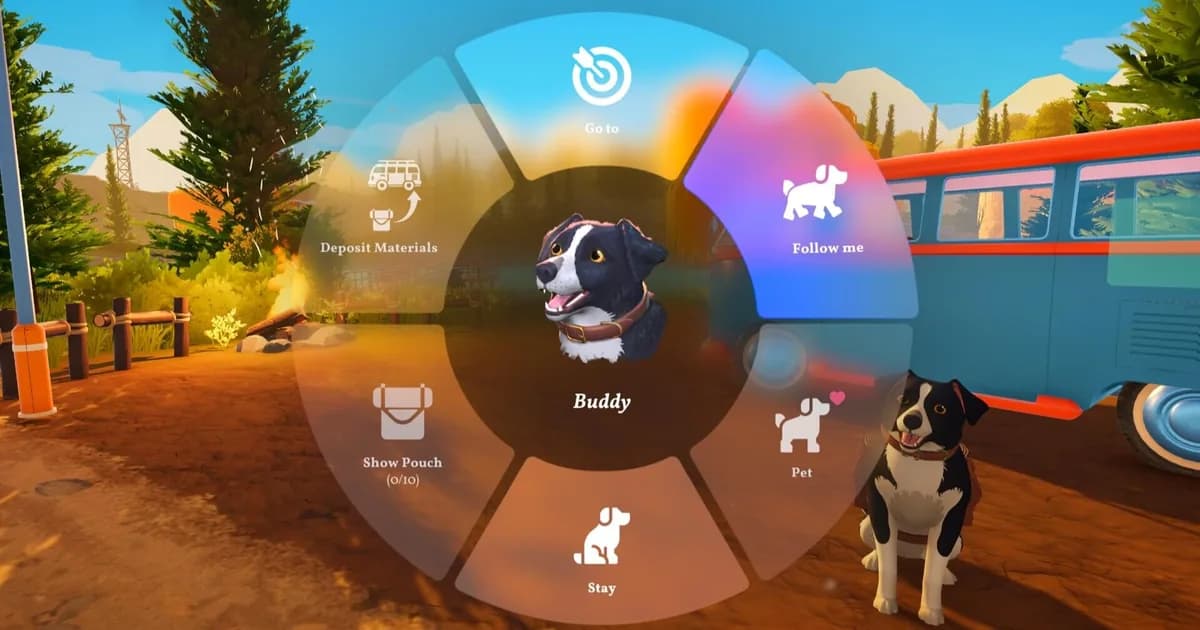
The dog follows your van and can be directed to fetch nearby items, which is genuinely useful in cluttered terrain where lots of small pickups would otherwise mean repeated manual trips. It operates in a radius around you rather than following without limit, so it's a range tool, not a full auto-collector.
Pouch Upgrade I and II, crafted at the Sewing Table, increase how much the dog can carry at once. Early adoption matters specifically because those upgrades take time to develop, so a dog picked up late in a run gets less value out of the same session length. The dog retreats when hurt but doesn't permanently die, so there's no run-ending risk to using it aggressively.
Works in both solo and co-op. In co-op, players tend to split dog-handling duties rather than one person managing it exclusively.
GODEEPER: Full detail on all 4 dog choices, exact pouch upgrade costs, and fetch-range specifics. Outbound Dog Companion Guide: Paws & Whiskers Lodge →
All Outbound guides
Every outbound guide on this site, organized by what you need:
Getting started:
- Outbound Launch Feature 2026: what shipped in the May 11 build, co-op infrastructure, and solo vs co-op differences.
- Outbound Tips: First Hours, Van Setup, and Energy Guide: van weight limits, energy source priority, and signal towers in your first session.
Van building:
- Outbound Van Build Guide: Module Order and Weight Budget: which modules to build first, weight budgets per stage, and how solo builds differ from 4-player configurations.
Co-op:
- Outbound Co-op Guide: Roles, Energy, and Van Builds: 4-player role split, shared battery management, and blueprint coordination at signal towers.
Exploration:
- Outbound Best Base Locations: Where to Park Your Van: biome rankings by energy output and material density, with signal tower proximity factored in.
Review:
- Outbound Review: Van Life Co-op That Actually Delivers: 7.8/10. The weight-mobility tradeoff and shared van design work; solo play is functional but co-op is the intended mode.
- Outbound Signal Tower Guide: Blueprints and Progression: Outbound signal tower guide: blueprint offers randomize per player in co-op. How to activate, what...
- Outbound Dog Companion Guide: Paws & Whiskers Lodge: Outbound dog companion guide: adopt it at the Paws and Whiskers Lodge, use fetch and...
- Outbound Beginner Tips: 10 Things to Do in Hour One: Outbound beginner tips cover van selection, the 20-item sprint cap, Homing Boots, and signal tower...
Frequently Asked Questions
What is Outbound and who made it? Outbound is an open-world co-op exploration game from Square Glade Games, published by Square Glade Games. It launched May 11, 2026 on PC and Xbox Series X|S, with PS5 and Switch versions following May 14. The game supports 1 to 4 players sharing one electric camper van as a mobile base. It has no combat: tension comes from energy management and the weight of every module you add.
How does the Outbound van build work? You customize a shared electric camper van by adding modules found at signal towers. Each module serves a function: workstations, storage, energy sources, crops: but every addition increases the van's weight, which raises battery drain and slows handling on rough terrain. The weight-mobility tradeoff is the core decision in every build. This outbound guide recommends energy and storage first, specialized workstations second.
What is the best Outbound co-op setup? For 4 players, assign 2 gatherers, 1 builder, and 1 scout. This splits the progression cycle evenly without creating bottlenecks. The builder manages weight budgets and blueprint offers at signal towers. The scout identifies safe routes and biome transitions ahead. Swap roles every few sessions to prevent burnout on any single task.
How does energy management work in Outbound? Outbound uses three energy sources: solar panels, wind turbines, and water wheels. Solar provides the most output in open terrain, wind handles stormy or overcast conditions, and water wheels work on riverbanks. Each source takes up module weight. Having two source types is the standard recommendation: full solar works in plains but fails in dense forest or at night.
Is Outbound worth buying? Outbound scored 7.8/10 in review. The van build system and energy management are well-designed, and the shared decision-making in co-op is genuinely satisfying. It's better with 2+ players: the weight-mobility decisions that define the game are more interesting when four people disagree about them. Solo play is supported but the shared van systems create friction for one player doing all roles.
What platforms is Outbound on? Outbound is available on PC (Steam and Epic Games Store), Xbox Series X|S, PlayStation 5, Nintendo Switch, and Nintendo Switch 2. PC and Xbox launched May 11, 2026; PS5 and Switch launched May 14. The game costs $24.99.
What is in Outbound's latest update? The Fishing Update (patch 1.1) is live with three fishing rods, 32 collectible fish, four fish tanks, a journal, and new huts/cabins. The Wildlife Update is announced as coming soon with wild animals, birds, insects, a camera, and photo-journal entries. The following update is planned to add adventurers, campers, and townsfolk.
References
- Outbound on Steam: official store page, patch notes, Square Glade Games
- Square Glade Games: studio behind Outbound; Kickstarter campaign and dev updates
- r/Outbound_Game: community discussion, build sharing, biome exploration reports
- Outbound Steam announcements: official Fishing Update 1.1 and Wildlife Update roadmap
- Outbound is $24.99 on Steam, its standard list price with no active discount as of this guide's last check. Loaded (sponsored) carries the same key and is worth a quick price comparison before buying, especially during a Steam sale window.
Related Reading
- All Outbound coverage: every Outbound guide, review, and news post published on GameBrief, in one index. For the build decisions in depth, module priority order, weight budget tracking, and how co-op groups should coordinate blueprint selections at signal towers, the Outbound Van Build Guide covers all of it. That's the next step after this outbound guide if you're optimizing your build. For co-op party setup from the first session, the Outbound Co-op Guide is the reference with specific role assignments by player count and battery management tips. If you're still deciding whether to buy, the Outbound Review covers the full 1.0 state, that's the companion read to this outbound guide for players who want the full picture before purchasing.
About the author

Senior Critic & Analyst
Former game data analyst turned critic with 11 years covering indie and mid-tier games. Based in Austin. Runs spreadsheets on games most people just play.
- 11 years games criticism
- Former game economy analyst
- Roguelike and strategy specialist
Keep reading

Outbound Van Build Guide: 8 Modules & Weight Budget
Guides · 12 min
Outbound Energy Guide: Solar, Wind, and Battery Setup
Guides · 12 min
Outbound Best Base Locations: Where to Park Your Van
Guides · 9 min
Outbound Review: Van Life Co-op That Actually Delivers
General · 8 min
Outbound Tips: First Hours, Van Setup, and Energy Guide
Guides · 7 min
Outbound Co-op Guide: 4-Player Roles & Van Builds 2026
Guides · 13 min
Game deals · affiliate links

Disclaimer
This article is published for informational and entertainment purposes. It does not constitute professional financial, legal, or technical advice. Game performance, online services, patch schedules, and store listings change. Verify critical details (pricing, system requirements, regional availability) with publishers and storefronts before you buy. Affiliate links, where present, help support our editorial work and are labelled in our affiliate disclosure.
Comments
Loading comments…