
ReviewReStory: Chill Electronics Repairs
ReStory review: mid-2000s Tokyo repair sim, 15+ hours tested
ReStory review: a 15+ hour Tokyo repair sim with branching customer stories, licensed Atari devices, and 95% positive Steam reviews after launch patches.
Reviewing
ReStory: Chill Electronics Repairs
Mandragora · tinyBuild
Score
Reviewed build: 1.0.015
Pros
- The disassemble, clean, resolder, and reassemble loop is specific and tactile, tracked with exact progress percentages instead of a vague 'repair' button
- A branching narrative where customer choices genuinely change dialogue outcomes and the ending, not just cosmetic flavor text
- Officially licensed Atari 2600-era devices sit alongside dozens of original, clearly-inspired 2000s gadgets, from a PMP handheld to an iPod-style Mapple Mypod
- Overwhelmingly Positive reception held up at scale: a SteamDB snapshot at audit time recorded 9,588 reviews with 95.4% positive, after the studio passed 500,000 copies sold
- The 1.0.013r and 1.0.015 hotfixes addressed story progression, memory, Mac, and save issues, while the studio replaced the disputed background assets
Cons
- The core loop is clean, repair, return regardless of device, and 15+ hours of that can flatten out for players who want more mechanical variety
- Some purchasable community-item backgrounds looked AI-generated at launch, a trust issue the developers addressed but that should not have shipped
- No Linux build, and Steam Deck compatibility still deserves a settings check even though current metadata reports full default-controller functionality
- Early patch notes list real bugs (achievements unlocking early, a firmware glitch, items stuck mid-clean) that day-one buyers ran into before the first hotfix
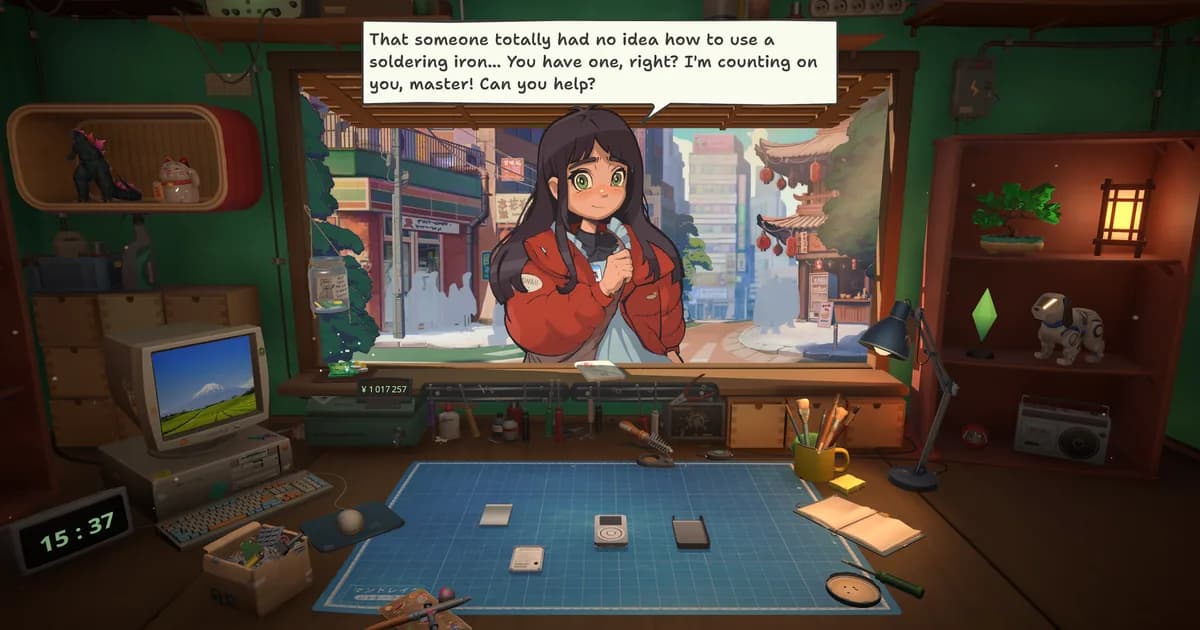
This ReStory review starts with a customer, not a mechanic. Through a CRT-shaped window between the shop and the street, she tells me whoever broke her console "totally had no idea how to use a soldering iron." That's the whole pitch in one exchange: half hardware puzzle, half small human moment, delivered through a shopfront that never lets you forget you're in mid-2000s Tokyo.
ReStory: Chill Electronics Repairs launched on Steam on August 6, 2026, from developer Mandragora and publisher tinyBuild. Since launch, the studio has shipped several fixes and announced a free content update planned for September 21. That makes the current patched build more relevant than the first-week snapshot.
TL;DR: ReStory is still an easy recommendation for a 15-plus-hour narrative repair sim. It costs $19.99, has an Overwhelmingly Positive reception, and the current patch line has addressed story progression, memory, Mac, and save problems. The repair loop remains repetitive by design, while the branching customer stories and customization carry the long tail.
Current status: September 2026
SteamDB recorded 9,588 total reviews and 95.4% positive at the time of this audit. Mandragora and tinyBuild have also announced more than 500,000 copies sold and a free content update planned for September 21. The version reviewed here is 1.0.015, after the 1.0.013r and 1.0.015 fixes.
The current Steam news feed shows work on memory leaks, Mac issues, story progression, save slots, and achievement or interface bugs. It also records the replacement of the disputed background assets. The controversy is still worth mentioning for buyers, but the present build should not be described as if the launch assets and launch bug list were untouched.
Key Takeaways
- Released August 6, 2026, from Mandragora, published by tinyBuild; $19.99, the 10% launch discount has since ended and it's back to full price
- Overwhelmingly Positive on Steam: SteamDB recorded 9,588 reviews and 95.4% positive at audit time; the studio has reported more than 500,000 copies sold
- 15+ hour main story with a branching narrative, multiple endings, and officially licensed Atari devices
- PC and Mac via Steam, with no Linux build listed; current SteamDB metadata reports all Steam Deck functionality accessible with the default controller configuration
- The current patch line includes 1.0.013r and 1.0.015 fixes for memory, Mac, saves, story progression, and earlier achievement or UI bugs
ReStory review: overview
Mandragora isn't a first-time studio. Its previous game, I Am Future, included a disassembling minigame that players latched onto harder than the developers expected, and ReStory grew directly out of that: a small side-system spun into a full release. That lineage matters because it explains why the repair mechanics feel worked-out rather than bolted on for a trend. tinyBuild, an indie-scale publisher that has backed plenty of small studios rather than AAA franchises, picked it up and pushed the wishlist campaign hard, crossing 200,000 wishlists a month after announcement and 750,000 by launch, with a spot on Steam Next Fest's 50 Most-Played Demos list along the way.
The premise: you inherit or open a small electronics repair shop in Akihabara-flavored mid-2000s Tokyo. Customers bring in broken consoles, phones, music players, and cameras. You take them apart, clean them, fix or replace the failing parts, and hand them back, while the customer tells you a little about their life in the process. It's a shop-management sim wearing a narrative game's clothes, and the ratio leans further toward narrative than the "chill" branding might suggest.
The commercial numbers back up the reception. The studio's current news feed reports more than 500,000 copies sold, a meaningful update from the first-week figure. That is a large result for a repair-sim spin-off, but the reason to play is still the workbench and its customer stories rather than a sales milestone.
Gameplay: what actually happens on the repair loop workbench
Here's where a lot of "cozy management sim" reviews get vague, so let's not. A customer hands over a device. You carry it to the workbench, where a to-do list breaks the job into discrete stages, each tracked by an exact percentage rather than a fuzzy progress bar. Cleaning a handheld's front panel might read "Remove dirt: 93%" while you're still brushing it down. Reflowing a motherboard shows a "Resolder: 0%" counter that climbs as you work the iron across labeled chip pads. Nothing here is abstracted into a single button press.
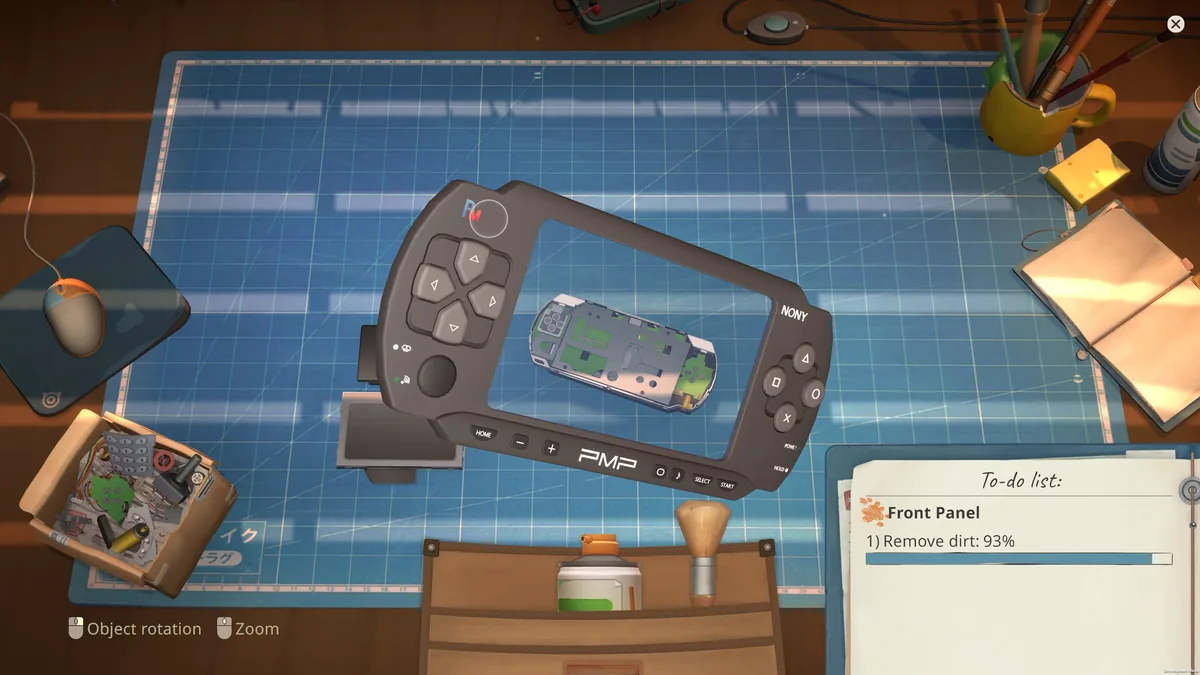 The cleaning stage tracks dirt removal by exact percentage on each disassembled panel, not a generic "repair" meter.
That same level of detail carries into parts sourcing. Rather than an in-shop shopping menu, ReStory gives you an in-game web browser (a parody labeled "Gozilla Firefox") for hunting down spare parts and whole devices on a Y2K-styled marketplace called Flea Market. Listings include seller star ratings, device condition tags like "Not turning on" or "Working," and prices in yen, right down to a broken Nony PlayMachine going for ¥5,500 next to a working Atari CX40 joystick at ¥2,800. It's a small system, but it's the kind of detail that separates a game that understands its premise from one that's just using the premise as set dressing.
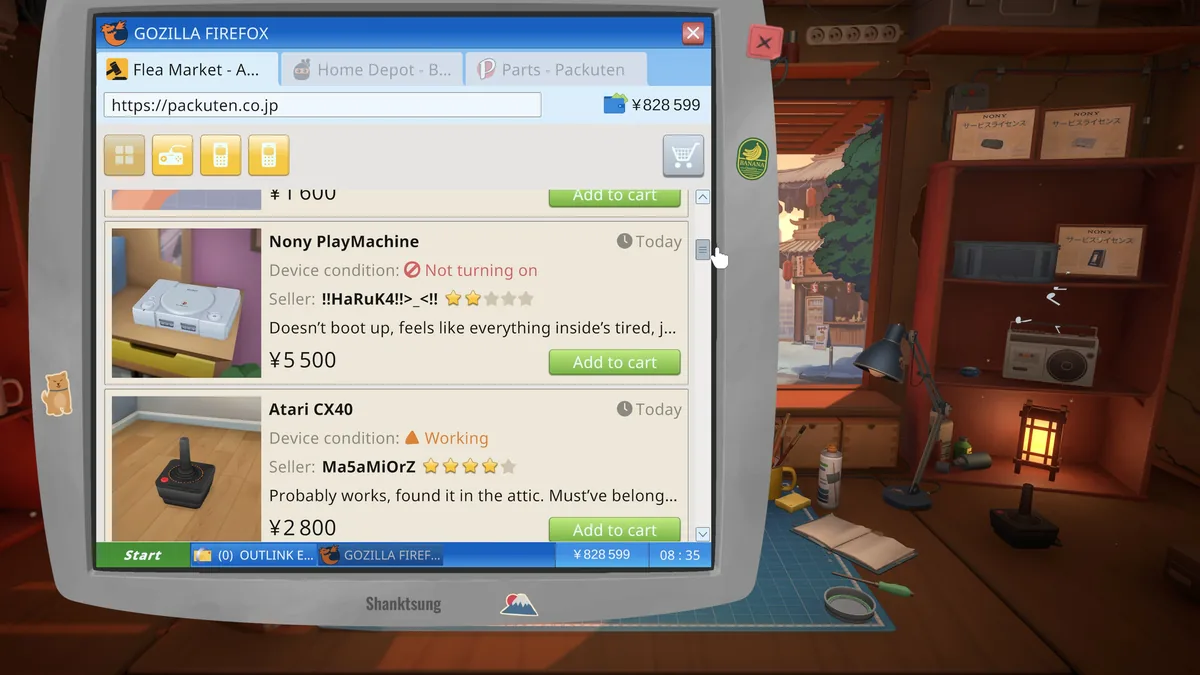 The in-game browser's Flea Market tab lists real condition and pricing details for every part and device you can buy secondhand.
Once a device is clean and functional, you can go further with an airbrush and sticker system, painting devices in custom colors from a nine-slot palette with adjustable brush size and opacity. It's optional, purely cosmetic, and completely unnecessary to finishing an order, which is exactly why it works: nobody's forcing you to engage with it, but it's there for players who want their Mapple Mypod repaint to look intentional rather than accidental.
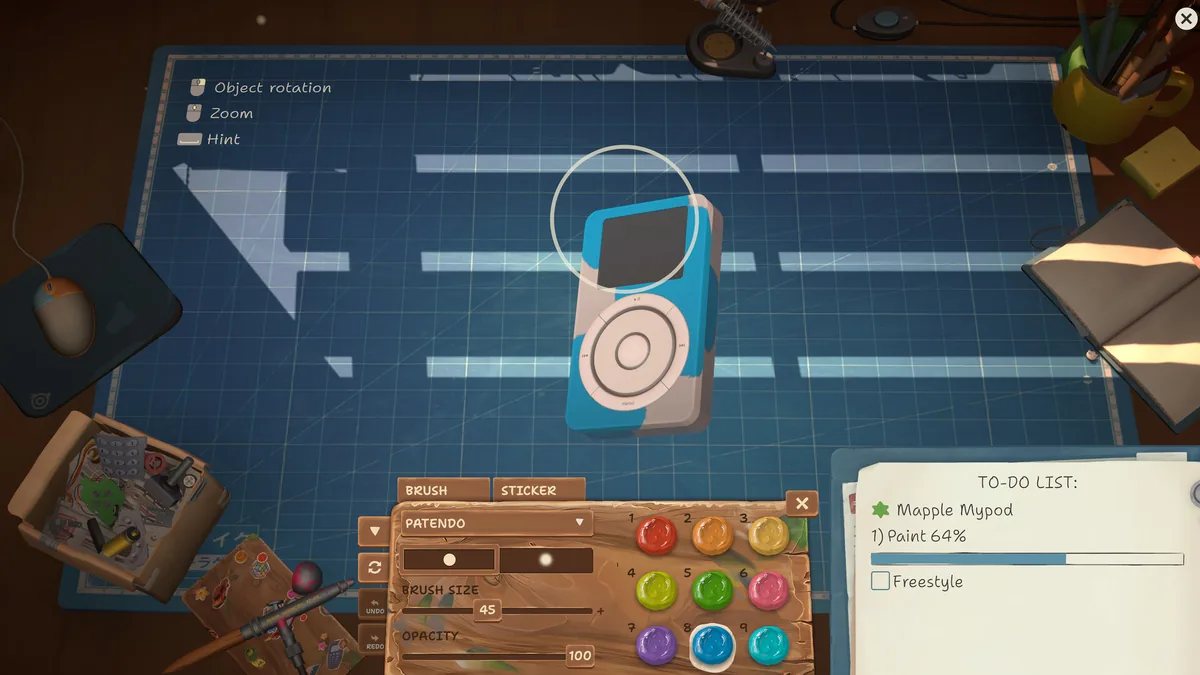 The Patendo-branded paint tool lets you recolor finished devices with adjustable brush size and opacity, entirely optional.
If you're weighing this against other cozy management sims on the site, Winter Burrow attaches similarly exact numbers to its warmth and cooking systems, and Beastro does the same for its cooking-combat deckbuilder. ReStory's version of that instinct is putting hard percentages on hardware repair instead of survival meters, which is a less common angle for the genre and one it commits to fully.
Where the loop does show its edges: every device essentially runs through the same four steps, take apart, clean, repair, reassemble, and after ten-plus hours the differences between fixing a Pokia handheld and fixing an Eggotchi come down to which specific parts are dirty or dead, not a genuinely new mechanic. The web browser and paint tool add texture, but they don't change the core rhythm. If you need mechanical escalation to stay engaged over a long session, that repetition will land sooner for you than for someone treating this as a background, low-pressure game.
The customers are doing more work than the pitch suggests
The official description promises that your decisions "impact both their lives and your shop," and the pre-launch devlogs back that framing up with specifics rather than leaving it as marketing copy. Two named regulars turned up in Mandragora's own character reveals before launch: Hashimoto Genzo, your landlord, a man who tends bonsai trees older than some of the devices you're fixing and still shows up in person to collect rent; and Baketsu, the mysterious upstairs neighbor and online Pac-Man champion who's quietly healing from something the game doesn't spell out early, and who gives you a spare controller the first time you open the shop.
The official Steam description gives one concrete branching example: whether you report a disturbing find inside a former gangster's phone, or help a lovestruck student work up the nerve to confess to his crush. Those are the kind of choices that make repair orders feel like more than an inbox to clear. It's a smaller-scale version of the branching-consequence structure narrative games have leaned on for years, but grounding it in a repair shop, where the player has literal physical access to a stranger's private device, gives the framing an edge most "customer service sim" games don't bother with.
The dialogue delivery matches the premise, too: every conversation happens through a shop counter styled like a CRT monitor, half interior workshop, half street-level window onto a lantern-lit Tokyo block. It's a clever way to keep both halves of the game, the workbench and the world outside it, visible at once without cutting to a separate scene.
A rocky first week: bugs, patches, and a real controversy
Launch wasn't friction-free, and it's worth being straight about that rather than smoothing it over. The early 1.0.009r and 1.0.010r notes listed achievement, firmware, inventory, interface, ultrawide, and cleaning issues. Later 1.0.013r and 1.0.015 notes addressed memory, Mac, save, and story-progression problems. If you bought day one, you likely saw a rougher build than the one reviewed here; current buyers should still read the live notes before assuming every edge case is gone.
The more serious issue wasn't a bug. Some purchasable community-item cosmetic backgrounds looked AI-generated, and players noticed immediately. The current official patch history says the backgrounds were replaced, while the studio separated the disputed cosmetics from the core game. That response is better than leaving the assets in place, but it remains a legitimate launch-quality complaint: players should not have had to identify the problem after release.
Neither issue touches the core repair-and-story loop, which is why the Overwhelmingly Positive score held through both. But if you're the kind of buyer who cares about a studio's response to a real problem as much as the problem itself, this is a case where the response was better than the initial mistake.
ReStory review verdict: 8.6
ReStory earns its reception. The repair minigame is detailed enough to reward attention instead of just clicking through it, the branching customer stories give the shop-management structure a reason to keep going beyond decorating for its own sake, and the officially licensed Atari hardware sitting next to dozens of clearly-researched original devices shows a level of care that's rare in a debut spin-off. A 95.4% positive score across 9,588 SteamDB-recorded reviews, alongside the studio's 500,000-copy update, looks like a sustained result rather than a launch spike.
The cons are real, but contained. The core loop doesn't escalate mechanically past hour ten or so, so buy this for the atmosphere and the story, not for building-complexity depth. The background controversy, even with the assets replaced, is worth knowing before you buy cosmetic add-ons. The early patch notes are also a fair reminder that day-one buys carry more risk than the current version suggests.
Buy it if you want a low-stakes narrative sim with a real hook and don't mind a repetitive core loop in exchange for atmosphere and story. Wait for a sale if mechanical depth matters more to you than setting and narrative, since the loop itself doesn't change much across the full 15+ hours. Skip it if Linux support is a hard requirement, and test the current handheld controls if Steam Deck is your main platform.
Rating: 8.6/10
Frequently Asked Questions
Is ReStory: Chill Electronics Repairs worth buying? Yes, if you want a low-stress narrative sim. A SteamDB snapshot at this audit recorded 95.4 percent positive from 9,588 reviews, and the studio has reported more than 500,000 copies sold. At $19.99 full price, it is a safe buy for cozy-game fans.
How long does it take to beat ReStory: Chill Electronics Repairs? The developers cite 15+ hours for the main story. Replayability comes from the branching narrative's multiple endings, device customization, and ongoing online repair orders, so total time depends on how much side content a player chases.
What platforms is ReStory available on? PC and Mac via Steam, with no Linux build listed. Current SteamDB compatibility metadata reports all functionality accessible with the default Steam Deck controller configuration, but the repair minigames still make a mouse a comfortable choice.
Does ReStory have controller support? Partial controller support is listed on Steam, including specific DualShock and DualSense recognition. The repair and painting minigames still lean on mouse precision, so keyboard and mouse is the more comfortable default.
Is ReStory Early Access or a full release? Full release. ReStory launched out of playtest and demo phases on August 6, 2026, developed by Mandragora and published by tinyBuild, after a public playtest that drew over 140,000 participants.
Are the Atari devices in ReStory real licensed products? Yes. tinyBuild has an official partnership with Atari, and the Atari 2600-era consoles in the shop are officially licensed. ReStory's other gadgets are original devices inspired by real 2000s hardware, not branded copies.
What was the AI-art controversy around ReStory? At launch, some purchasable community-item backgrounds looked AI-generated, and players called it out. The current patch history records the replacement of those backgrounds and separates the disputed cosmetics from the core repair game.
Related Reading
- Winter Burrow Review: Cozy Survival With Real Depth: Another cozy sim that backs its atmosphere with exact, checkable numbers instead of vague meters.
- Starsand Island Review: Charm, Bugs, and a Bot Scandal: A life sim covering similar low-stakes territory, including its own launch-week controversy worth comparing against ReStory's.
- Beastro Review: A Cozy Deckbuilder Worth Your Time: For readers who want ReStory's cozy, numbers-first feel in a card-based cooking format instead.
- Tales of Seikyu Review: A Farm Sim With Actual Depth: Another narrative-forward cozy sim built around relationships rather than combat.
- How to Fish Review: A Co-op Hit With a Solo Problem: a shorter co-op release where the current patch state changes the launch verdict.
- Winter Burrow Guide: Warmth and Cooking: another cozy loop built around precise resource actions.
- Tales of Seikyu Complete Guide Hub: a broader cozy-game reference for readers who want more systems after ReStory.
- Mina the Hollower Complete Guide Hub: a different kind of contained indie campaign with a stronger action focus.
- MOUSE: P.I. For Hire Review: a comparison point for a single-player indie with a strong visual identity.
- Pax Autocratica Review: an Early Access systems-heavy alternative when repair work feels too repetitive.
- Mortal Shell II Review: another current-build review where post-launch fixes change the recommendation.
- Windrose Comfort Guide: a guide for readers who prefer a systems-first survival loop.
References
About the author

Indie & JRPG Critic
Indie game evangelist and lifelong JRPG fan covering small studios since 2017. Mumbai-born, London-based. Writes the way she talks.
- 7 years indie games coverage
- JRPG and visual novel specialist
- Narrative design focus
Keep reading

Master of Pottery Beginner Guide: Throwing to Showroom
Guides · 10 min
Dressmaker Review: A Cozy Sewing Sim With Real Craft
General · 9 min
IRON NEST Review: The Heavy Turret Simulator Done Right
General · 10 min

Doloc Town Review: Farming the Wasteland, One Platform Up
General · 9 min

Masters of Albion Review: The God Game, Mixed 4 Months In
General · 12 min

Fields of Mistria Review: 12 Marriage Candidates, 1.0
General · 10 min
Game deals · affiliate links

Disclaimer
This article is published for informational and entertainment purposes. It does not constitute professional financial, legal, or technical advice. Game performance, online services, patch schedules, and store listings change. Verify critical details (pricing, system requirements, regional availability) with publishers and storefronts before you buy. Affiliate links, where present, help support our editorial work and are labelled in our affiliate disclosure.
Comments
Loading comments…