
GameBrief · General
Voidling Bound Complete Guide: Evolution, Builds, Splicing
Voidling Bound complete guide: single-player only, 9 species, Very Positive on Steam. This hub links evolution, splicing, builds and beginner tips.
Reviewing
Voidling Bound
Hatchery Games
This Voidling Bound complete guide is the hub for everything GameBrief has published on Hatchery Games' monster-taming shooter: evolution and the nine-species roster, the gene splice system, the community's top builds, multiplayer status, beginner priorities, and whether the game is worth playing at all. Every section below links out to the full guide on that topic, so pick whichever question brought you here and start there.
The more interesting question isn't whether Voidling Bound is a good monster tamer. It's whether "direct control of the creature" is a genre-defining idea or just a novel skin on the same collect-and-build loop Pokemon set thirty years ago. This hub, and the seven guides it links to, is the site's answer to that.
TL;DR: Voidling Bound launched June 9, 2026, and is single-player only, with 9 species, 5 attributes, and three linked creature systems: evolution (automatic, sets elemental alignment), breeding (combines parent genes at the Breeding Station), and splicing (unlocks after Subterranean Expedition, costs 5 Polychrome Mutagen, can lock out breeding). It holds Very Positive on Steam at 93% of 3,403 reviews. Nimiod's pylon build is the current S-tier pick.
Key takeaways
- Developer and publisher: Hatchery Games. Launched Steam and Epic Games Store June 9, 2026, priced at $24.99 with no active discount as of the last review update
- Single-player only. No co-op, no PvP, no Voidling trading between players, and no official multiplayer roadmap as of Hatchery Games' most recent public statements
- 9 base species at launch: Kwipeck, Gilick, Kerapin, Gwigoon, Anami, Ur-Sek, Nimiod, Morfang, Packuran
- 5 attributes with permanent point spending (no respec confirmed at launch): Strength, Vitality, Essence, Recuperation, Agility
- Three separate creature systems that the game barely explains: evolution (automatic, branching), breeding (Breeding Station, combines parent genes and natures), and splicing (Splicing Station, unlocks after Subterranean Expedition, irreversible)
- Steam rating: Very Positive, 93% of 3,403 reviews as of GameBrief's review update; GameBrief's own score is 8.0/10
- Main campaign runs 15-20 hours; a full completionist push with all 35 achievements lands around 40-50 hours
What is Voidling Bound? (quick answer)
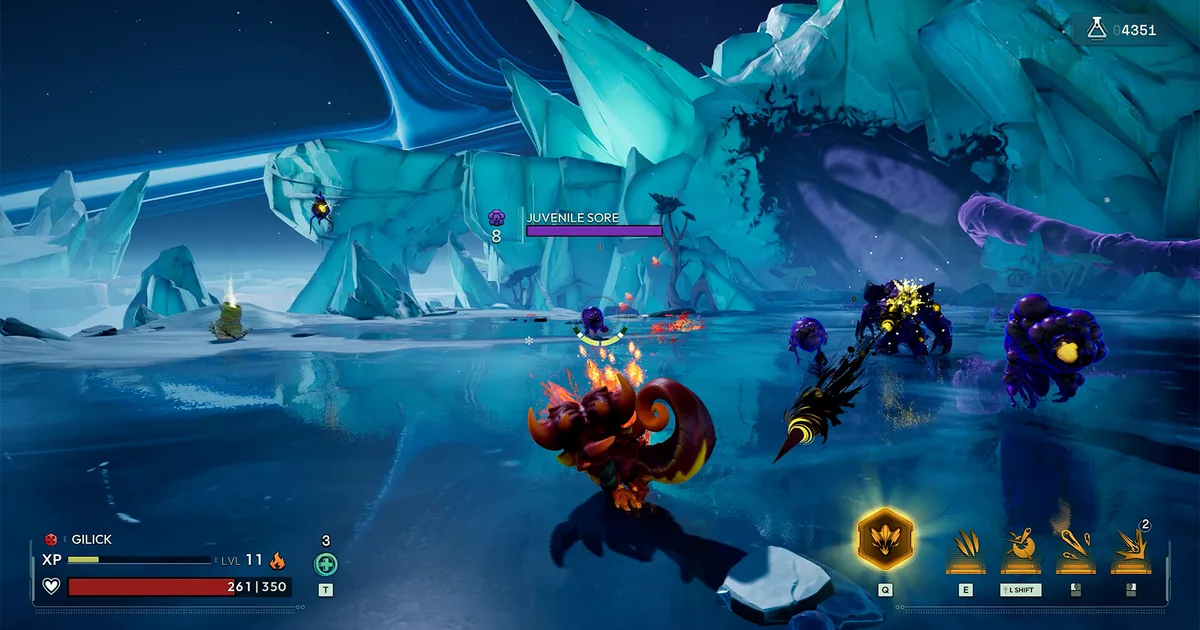
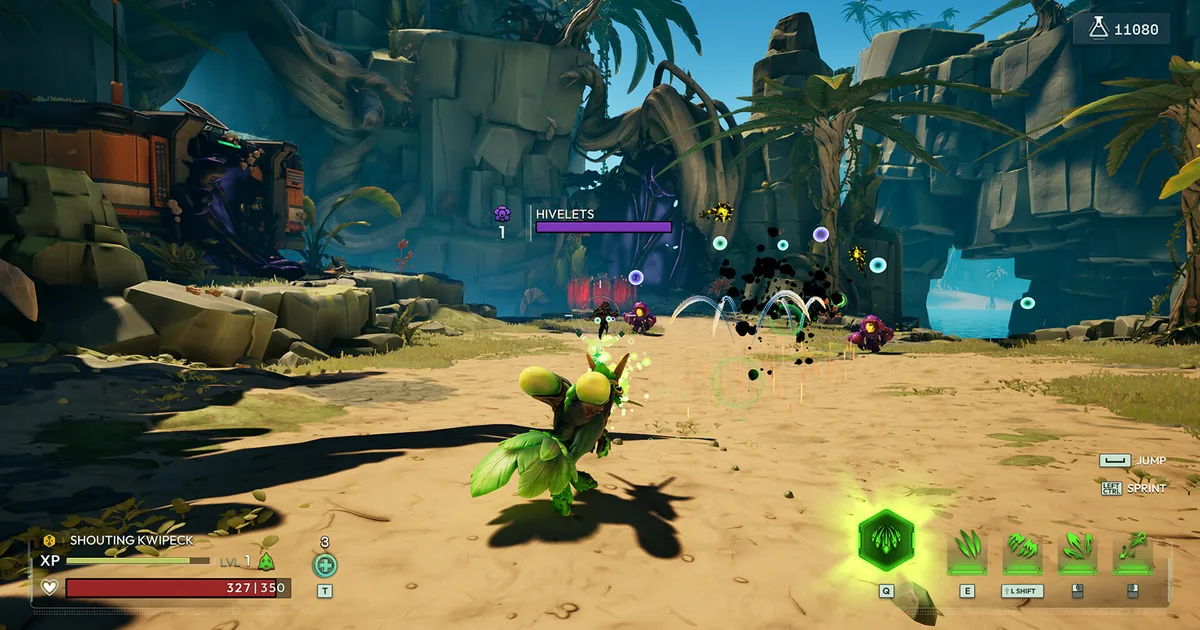
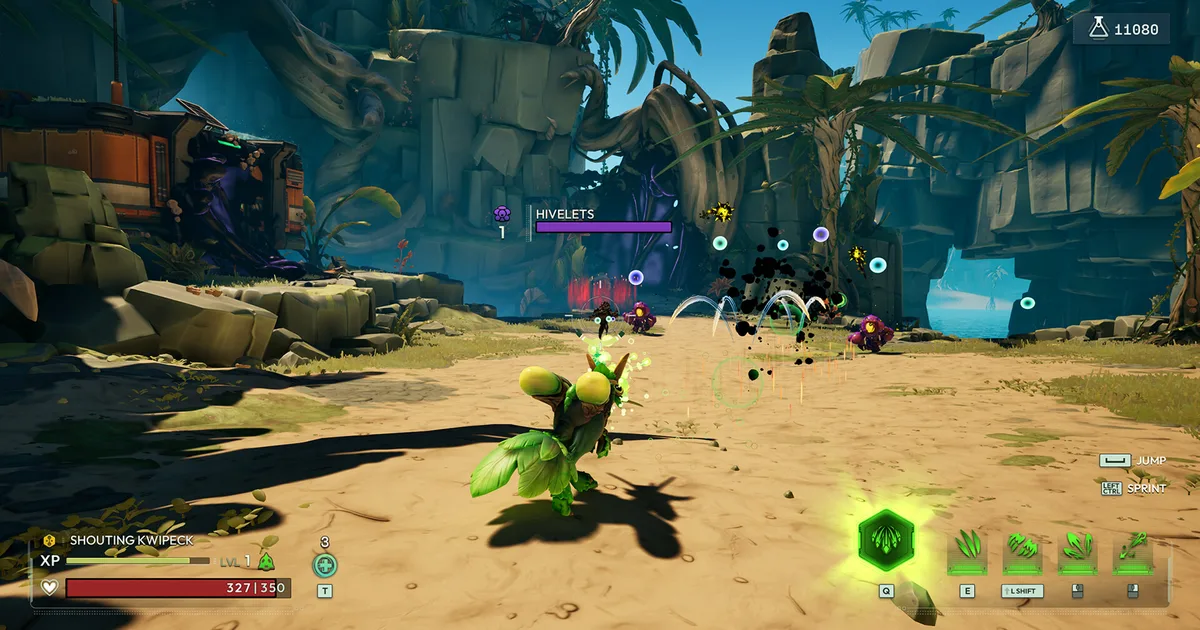
Voidling Bound is a sci-fi third-person action game where you play a Space Wrangler who takes direct control of creatures called Voidlings, rather than commanding them from a distance the way most monster-taming games do. You shoot, slash, slam, dash, parry, and unleash ultimates as the creature itself, while evolving it along branching elemental paths and reclaiming planets overrun by a spreading corruption. Hatchery Games launched it on Steam and Epic Games Store on June 9, 2026.
The pitch reads like several genres stacked on top of each other: monster taming, third-person shooter, roguelite endgame, breeding sim. Most creature collectors keep a wall between the player and the monster. You give orders; it fights. Voidling Bound tears that wall down, and the effect ripples through every other system in the game. Your creature isn't a stat block you send into a fight anymore. It's your character for that fight, which means the taming and evolution layers exist to shape who that character is, not just how strong it is.
- Voidling Bound: Monster Taming Meets Third-Person Shooter: the original launch coverage on what Hatchery Games changed about the genre's basic formula and what to watch as the game matures.
Monster guide and evolution
Every Voidling starts as one of nine base species, each with its own stat profile and ability gene pool: Kwipeck, Gilick, Kerapin, Gwigoon, Anami, Ur-Sek, Nimiod, Morfang, and Packuran. You acquire new ones by rescuing and hatching eggs found in infested biome locations, and each species leans toward a different combat identity, from Gwigoon's high Strength ceiling to Anami's unusually broad, multi-elemental gene pool.
Evolution is the first of the game's three creature-development layers, and it's automatic in the sense that you don't activate a separate menu system for it: as you play and level a Voidling, you choose a direction at each branch point. Those choices set its elemental alignment (fire, cryo, electro, organic, cyber, and others depending on the species), change its appearance, and determine which abilities it unlocks. There's no confirmed respec at launch, so a branch choice is close to permanent. Nimiod is the clearest example of how much this matters: its Cyber branch runs on chain-lightning abilities, while its Organic branch trades that burst for sustained spore-based node damage. Both hit hard once committed to, but they play nothing alike.
Layered on top of evolution is attribute assignment. Every level-up hands out points across five stats: Strength (melee and ranged attack output, crit damage up to 4.3x at max), Vitality (health from 200 to 1,600 HP, plus stamina), Essence (elemental damage up to 99% bonus and status effect multiplier up to 3.8x), Recuperation (cooldown reduction up to 49%, healing multiplier up to 2.4x), and Agility (fire rate, movement speed, and crit chance up to 81%). These points are also permanent, which means your first few allocation decisions on any given Voidling lock in a combat identity you'll be living with for a long time.
Breeding is the third layer and the one most beginners skip past too fast. The Breeding Station combines two parent Voidlings into an offspring that inherits a mix of both parents' natures and attribute values. Rare natures from well-farmed eggs compound when both parents carry them, which is why the guide below recommends clearing a few infested egg sites across biomes before your first serious breed session rather than pairing whatever you happen to have.
- Voidling Bound Monster Guide: Evolution & Tips 2026: the full roster breakdown, how the two evolution tracks work, and the Corrupted DNA Catalyzers that push stats past their normal caps in the Abyss.
Gene splice guide
Splicing is the deepest and least forgiving of the three creature systems, and it's the one the game explains the least. Once unlocked, the Splicing Station lets you pull ability genes from other species and transfer them onto a Voidling you've already evolved, letting a Nimiod pick up a Gilick's passive cryo tick or a Kerapin's ambient electro field on top of its native kit.
The system doesn't open right away. It unlocks after you complete the Subterranean Expedition mission, a mid-game story beat, and each splice costs 5 Polychrome Mutagen, itself crafted by fusing 5 elemental Mutagens in the Polychrome Converter, so a single splice runs through 25 elemental Mutagens total. A splice can edit up to 14 genes across morphology, modules, abilities, and up to 3 perks, though a focused splice targeting 2 to 4 ability genes is usually the smarter first attempt over trying to fill every slot at once.
The mistake that costs players the most time is splicing too early. Spliced Voidlings cannot breed by default; the restriction only lifts if you buy the Spliced Breeding upgrade at the Breeding Station, which is a real resource cost of its own. Splice your best or only good breeding parent before confirming your build direction in the Abyss, and you've turned a future breeding asset into a combat-only dead end. The community-documented top donor genes are Snowfall (a passive cryo tick from Gilick), Static Buildup (a passive electro charge from the Electrified Anami variant), Hellfire (a Burn damage multiplier from the Hellfire Packuran variant), and Mark of the Storm (an ambient electro field from the Monsoon Kerapin variant).
- Voidling Bound Gene Splice Guide: When and What to Splice: the full donor-gene breakdown, the Polychrome Mutagen resource chain, and a step-by-step first-splice walkthrough.
Best builds
Three builds have emerged as the community's top-tier options in the weeks since launch, and each locks in a different attribute priority.
Nimiod pylon-network is the current S-tier pick. Its deployed nodes attack automatically and restore stamina when you stand near them, which feeds its infinite-jump mobility rather than draining it. The build wants Essence pushed to 8-10 points before splitting into Recuperation and Vitality, runs Cyber element for Static procs that chain through enemy groups, and aims at the Electromagnetic or Overcharged evolution branch for the biggest node damage ceiling.
Plasma Packuran control sits at A-tier as the safest roster anchor. Plasma hits all four enemy factions (GenBots, Crystallines, Ancients, and Lesion-spawns) at Effective (1.25x) with no weaknesses, trading peak damage for consistency across mixed-faction missions. It's the build most players keep as an open-world backup even after committing to Nimiod for the Abyss.
Morfang close-range aggression is also A-tier and the least technically demanding of the three, since it doesn't require managing nodes, stamina loops, or faction matchups mid-fight. Strength first, then Agility, then Vitality for survivability, with the Pyro evolution branch adding burn damage-over-time and a Fear effect that buys a re-engage window.
| Build | Tier | Element | Primary attribute |
|---|---|---|---|
| Nimiod pylon-network | S | Cyber | Essence |
| Plasma Packuran control | A | Plasma | Essence |
| Morfang close-range aggression | A | Pyro | Strength |
The practical roster most players settle into is one Abyss main carry (usually Nimiod) plus two elemental backups to cover whichever faction the carry is weak against, since no single element covers all four factions equally well.
- Voidling Bound Builds: Top Gene Combos and Splices 2026: full attribute breakpoints for each build, splicing recommendations, and how Corrupted DNA Catalyzers factor into an Abyss roster.
Multiplayer
Voidling Bound is single-player only. The Steam store page lists it under the "Single-player" category with no online or local multiplayer tags: no co-op mode, no PvP arena, no creature trading, and no shared world. Hatchery Games has not made any official announcement about adding multiplayer, and their post-launch communication has focused on content additions like new Voidlings and levels instead.
The reason isn't just a missing feature. The core loop runs on a single player's decisions across gene inheritance, attribute allocation, and Abyss run composition, and each of those feeds the next: the Voidling you breed reflects the genes you've collected, and the build you take into the Abyss reflects the attribute points you've assigned to it. Splitting that across two players either removes the agency that makes the loop interesting (shared decisions) or produces two separate single-player games running side by side (independent builds), neither of which is really co-op. If you specifically want a multiplayer creature-collection game right now, Palworld (up to 32 players) and Monster Hunter Wilds (four-player co-op) are the closest alternatives, though neither shares Voidling Bound's direct-control combat or splice system.
- Is Voidling Bound Multiplayer? Co-Op Status in 2026: the full breakdown of why the solo design isn't just an oversight, and what to check if Hatchery Games ever announces co-op plans.
Beginner tips
The five starting species each teach a different lesson, but for a first run the learning curve matters more than the combat role. Kwipeck is the most forgiving pick: nothing in its kit requires precise timing or positioning, which makes it the best species for learning how ability slots and dodge timing work before you commit to anything harder. Gilick, Kerapin, Gwigoon, and Anami all ask more of you sooner, in exchange for a higher ceiling once you know the game.
Your first attribute point should go into Vitality, not because it's the best offensive stat but because the extra health and stamina keep you alive long enough to actually learn combat. Attribute points don't reset at launch, so treat every point as a real commitment, not a placeholder.
Run two or three story missions before you touch the deeper systems. The game's combat rhythm, dodge timing, parry windows, switching between shoot, slash, and slam, is something you learn by doing, and browsing menus doesn't substitute for it. Once you've hatched a few eggs, release the low-rarity ones for roughly 150 Research Points each rather than holding onto filler creatures; those points fund hub upgrades you'll want. And don't splice your first strong Voidling. Build a dedicated breeding pair first, confirm your build direction works, and only then commit Polychrome Mutagen to a combat-only copy.
- Voidling Bound Beginner Guide: Tips for First Runs: species picks, the first-hour progression order, attribute priorities, and six mistakes that reliably cost new players time.
Is Voidling Bound worth playing?
Yes, with real caveats. GameBrief's review scores it 8.0/10, and the Steam community backs that up with a Very Positive label across 3,403 reviews, 93% positive. That's not a fluke score. Parrying a boss attack with a creature you spent hours breeding and evolving carries a kind of weight that delegated monster combat never manages, and the splicing system pays off the patience it demands with builds that genuinely surprise you once the gene pool opens up.
The friction is real too, and it clusters in three places. Early biomes feel thin before splicing becomes viable, since the first several hours are mostly baseline creatures clearing straightforward missions, not exactly a strong first impression for a game whose best ideas live an hour deeper. Wrangler difficulty, the hardest setting, spikes sharply at a point in the mid-game where your gene pool is still developing, with tighter parry windows and less telegraphing than a first playthrough prepares you for. And the lack of co-op means a breeding and splicing system practically built for comparing builds with a friend has no social outlet beyond screenshots on the subreddit. None of that undoes the core hook, but it does mean the game asks for patience up front before it pays out. If you want something over time, not an immediate hit, that trade is worth making.
- Voidling Bound Review: Monster Taming Meets the Abyss: the full review, including where the difficulty curve breaks down and what the 35-achievement list rewards.
All Voidling Bound guides
Every Voidling Bound article published on GameBrief, in one place:
- Voidling Bound: Monster Taming Meets Third-Person Shooter: the launch overview covering what separates this game from other monster-taming titles.
- Voidling Bound Monster Guide: Evolution & Tips 2026: all 9 species, how evolution and splicing work, and the Genes system explained.
- Voidling Bound Gene Splice Guide: When and What to Splice: the splicing decision tree, donor genes, and the Polychrome Mutagen resource chain.
- Voidling Bound Builds: Top Gene Combos and Splices 2026: the three community-verified top builds and their attribute allocations.
- Is Voidling Bound Multiplayer? Co-Op Status in 2026: why the game is single-player only and what that means for the design.
- Voidling Bound Beginner Guide: Tips for First Runs: what to prioritize in your first several hours and the six mistakes to avoid.
- Voidling Bound Review: Monster Taming Meets the Abyss: the full verdict, including what the Very Positive score doesn't tell you.
Frequently Asked Questions
What is Voidling Bound? Voidling Bound is a sci-fi third-person action game from Hatchery Games where you directly control creatures called Voidlings instead of commanding them from the sidelines. You evolve, breed, and splice them while reclaiming corrupted planets. It launched on Steam and Epic Games Store June 9, 2026.
Is Voidling Bound multiplayer or co-op? No. Voidling Bound is single-player only at launch, confirmed on its Steam store page. There is no co-op, PvP, or trading between players. Hatchery Games has announced content additions like new Voidlings and levels, but none of them include multiplayer.
How many Voidling species are there? Nine at launch: Kwipeck, Gilick, Kerapin, Gwigoon, Anami, Ur-Sek, Nimiod, Morfang, and Packuran. Each has its own stat profile, ability gene pool, and branching evolution paths. New ones come from hatching eggs found in infested biome locations.
When should I start gene splicing in Voidling Bound? Not on your first good Voidling. Splicing unlocks after the Subterranean Expedition mission and is mostly irreversible, and spliced creatures cannot breed by default. Build a breeding pair and confirm your build direction in the Abyss first, then splice a second copy for combat.
What is the best Voidling Bound build right now? Nimiod's pylon-network build is the community's S-tier pick, with Plasma Packuran control and Morfang close-range aggression both rated A-tier. Nimiod's automatic node damage and teleport blink give it the highest Abyss ceiling of the three.
Is Voidling Bound worth playing? Yes for players who like long-term creature builds. It holds a Very Positive rating on Steam (93% of 3,403 reviews) and an 8.0/10 score from GameBrief's review, praised for direct creature control and splicing depth, though early biomes are thin and there's no co-op.
How long does it take to beat Voidling Bound? The main campaign across the corrupted planets runs 15 to 20 hours for most players. Unlocking all 35 achievements and pushing deep into the Abyss adds another 20 to 30 hours, putting a full completionist run around 40 to 50 hours total.
References
About the author

Critical game theorist with a background in film criticism. Writing for print and digital outlets since 2015. Specialises in genre analysis and design heritage.
- Background in film criticism
- 10 years games coverage
- Genre theory and design history specialist
Keep reading

Disclaimer
This article is published for informational and entertainment purposes. It does not constitute professional financial, legal, or technical advice. Game performance, online services, patch schedules, and store listings change. Verify critical details (pricing, system requirements, regional availability) with publishers and storefronts before you buy. Affiliate links, where present, help support our editorial work and are labelled in our affiliate disclosure.
Comments
Loading comments…