Loading…
GameBrief · Guides
Far Far West Winged Skull Boss: The First Fight Guide
8 min readBy Priya Nair

Reviewing
Far Far West
Evil Raptor · Fireshine Games
This Far Far West Winged Skull boss guide is about the first fight in the game, and the single lesson it exists to teach. The Winged Skull is the tutorial boss: a bullet-hell encounter where the dense overlapping patterns matter less than one habit. Move constantly. Players who stand still to aim die; players who run and fire in the gaps win. This guide breaks down the patterns, the build that fights on the boss's terms, and the map-first rule the Winged Skull teaches you the hard way.
TL;DR: The Winged Skull is Far Far West's first boss and its easiest by design. It fires dense bullet-hell patterns, skulls, spectral bolts, and spread shots that overlap across the arena. Movement is the mechanic: standing still to optimize shots kills you faster than any attack. Run first, fire in the gaps. Bring Electric Chain Spark, because its chain arc hits while you are moving and needs no precise aim. Critically, clear the full map before triggering the fight, because killing any boss spawns an infinite enemy wave that ends your looting window for good.
Far Far West Winged Skull boss: the lesson disguised as a fight
The Winged Skull appears early, in the Far West starting region, and it is the first boss most players meet. It is also the easiest of the five bosses, and that is on purpose. Its entire job is to teach you how Far Far West boss fights feel before the fights get genuinely hard.
The lesson is simple to state and hard to obey under pressure: movement is the mechanic. The Winged Skull does not have a clever gimmick or a hidden phase. It throws a wall of projectiles at you and waits to see whether you keep moving or freeze up trying to aim. If you internalize the movement rule here, every harder boss after it, the Ghost Train, the Undead Spellcaster, the Necromancer, builds on a foundation you already have.
Key takeaways
- The Winged Skull is the first boss and the easiest, by design a tutorial.
- It appears in the Far West starting region, marked with a skull icon.
- It fires overlapping bullet-hell patterns: skulls, spectral bolts, spread shots.
- Movement is the mechanic. Standing still to aim kills you faster than any attack.
- Best spell: Electric Chain Spark, which hits while moving and needs no aim.
- Clear the entire map first. Killing a boss spawns an infinite wave that ends looting.
The patterns: read the overlap, not the individual shot
The Winged Skull's danger is not any single attack, it is the overlap. It layers several pattern types at once: spreads of skulls, lines of spectral bolts, and wide spread shots that fan across the arena. On their own, each is readable. Together, they fill the space and leave you hunting for the gaps.
That is the key to reading the fight: do not track individual projectiles, track the gaps. Bullet-hell design always leaves safe lanes through a pattern, and the Winged Skull is no exception. Your eyes should be on where you can move, not on the specific bolt about to reach you. New players make the mistake of reacting to the nearest projectile and getting clipped by the one behind it. Reading the negative space, the path through the wall, is the skill the fight is training.
The pace is forgiving compared to later bosses, which is exactly why it is the right place to practice this. You have time to find the gap if you are looking for it. Later fights compress that window; the Winged Skull gives you room to build the habit.
 The Winged Skull's threat is the overlap, not any single shot. Watch the gaps between patterns, not the nearest projectile, and keep moving toward the safe lane.
Movement is the mechanic
Here is the rule the whole fight is built around: run first, shoot second. Players who hold position to line up clean shots die faster than players who keep moving and fire whenever a gap opens. The Winged Skull punishes positioning harder than any individual projectile does.
This is counterintuitive if you come from shooters where standing still gives you accuracy. In Far Far West, accuracy you buy with stillness is a trap, because the cost is a hit you cannot afford. Reframe the priorities: movement is your primary action, shooting is the thing you do in the spaces movement leaves you. Spend almost the entire fight in motion, circling the arena, and let your damage come out in the gaps rather than from a planted position.
If the Winged Skull keeps killing you, this is almost certainly why. The fix is not better aim or a better build, it is the decision to stop standing still. Once movement becomes the default and shooting becomes opportunistic, the fight stops feeling like a wall.
GODEEPER: The Winged Skull is the gentlest of five. The same movement-and-windows grammar runs through all of them, ramped up. Far Far West Boss Guide: All Five Bosses →
The build: Electric Chain Spark
Because you spend the fight moving, you want damage that does not require you to stop or aim. Electric's Chain Spark is the strongest spell for the Winged Skull. Its chain arc jumps to targets without precise aim, so it lands reliably while you are running through patterns.
That is the whole logic: Chain Spark fights the boss on the boss's terms. You are mobile, so you bring a spell that rewards mobility. Fire it on cooldown as you circle, and your damage accumulates without you ever needing to plant your feet. Compare that to a spell that needs a careful line-up, which forces the exact stillness the Winged Skull punishes, and you can see why Chain Spark is the pick.
Around Chain Spark, prioritize anything that keeps you moving or sustains you through chip damage. You do not need a complex loadout for this boss. You need one reliable source of move-while-you-fight damage and the discipline to keep circling. Save the intricate build planning for the Ghost Train, where it actually matters.
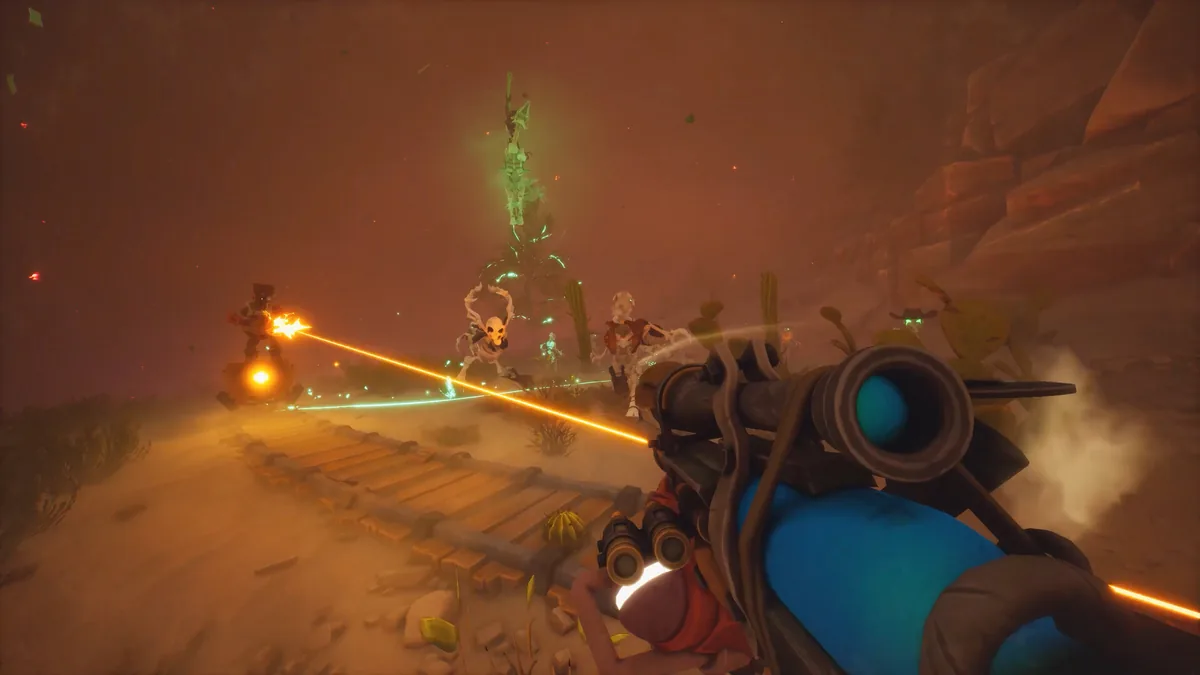 Electric Chain Spark is the Winged Skull build: the chain arc finds targets without precise aim, so your damage keeps landing while you stay in constant motion.
The map-first rule the Winged Skull teaches
There is one rule that costs new players their loot, and the Winged Skull is where they learn it: clear the entire map before you trigger the boss.
In Far Far West, killing a boss spawns an infinite enemy wave that permanently ends your looting window. The run does not pause to let you mop up afterward. Anything you have not collected by the time the boss dies is gone. So the correct sequence is: explore the full region, grab every pickup and chest, and only then walk into the skull icon to start the fight.
Because the Winged Skull's location is marked before you enter, you have full control over when to trigger it. Use that. Treat the skull icon as the last thing you touch in a region, not the first. This habit matters more on later, loot-rich maps, but the Winged Skull is the cheap place to learn it, before forgetting it costs you a good run.
What the Winged Skull sets up for the rest of the game
It helps to see the Winged Skull as a syllabus rather than an obstacle. Each thing it asks of you is a skill the later bosses demand in harder forms, and clearing it cleanly means you arrive at those fights already fluent.
The movement-first habit is the obvious one. The Ghost Train's phase-one mortar barrage is the same dodge-or-die test with a tighter stamina budget, and the Necromancer punishes static play with tracking attacks that only a moving target can break. If you beat the Winged Skull by learning to circle and fire in gaps, you have already built the muscle those fights rely on.
The map-first rule is the other transferable lesson, and it matters more as maps get richer. Later regions hide far more loot than the Far West starting area, so forgetting to clear before triggering a boss costs a lot more than it does here. The Winged Skull is the cheap classroom for an expensive habit.
Finally, the build logic generalizes. The reason Chain Spark works here, damage that lands without forcing you to stop, is the same reason mobile spells outperform stationary ones across the roster. Bring spells that fight on the move and you will find every boss easier, not just the first one. Treat the Winged Skull as the place you learn the grammar, then read the harder fights with it.
Frequently Asked Questions
How do you beat the Winged Skull? Move constantly and fire in the gaps. Bring Electric Chain Spark so damage lands while you run, and clear the map before triggering the fight.
Where is it? In the Far West starting region, the first boss, marked with a skull icon.
Best build? Electric Chain Spark, because its chain arc hits moving targets without precise aim.
Why does it keep killing me? You are standing still to shoot. Make movement primary and shooting opportunistic.
Do I clear the map first? Yes. Killing a boss spawns an infinite wave that ends looting, so collect everything before you trigger it.
Is it hard? No, it is the easiest of the five by design. If it feels hard, it is teaching you the movement rule the rest of the game needs.
Related Reading
The Far Far West Boss Guide covers all five bosses and how the Winged Skull's movement lesson scales into the harder fights.
The Far Far West Complete Guide is the hub for every Far Far West system, from spells and builds to bosses and endgame.
The Far Far West Builds Guide breaks down the spell archetypes, including the Electric line the Winged Skull rewards.
- Far Far West Voodoo Spells: All 5 & the Healing Rule: Far Far West Voodoo spells: all 5 healing spells from Drain to Doll, the rule that healing only.
- Far Far West Ghost Train Boss Guide: Two-Phase Fight: Far Far West Ghost Train boss guide: dodge the spectral mortars, clear the bandits, and burst the engine.
- Far Far West Cryptic Vulture Boss: Break Shield, Hit Head: Far Far West Cryptic Vulture boss: destroy the Wing Shield skulls, burst the head weak spot, stay mobile.
- Far Far West Elec Spells: All 5 & the Portal Trick: Far Far West Elec spells: all 5 from Strikes to Thunderstrike, why Portal duplicates any spell thrown through.
References
- Far Far West on Steam: official store page, updates, and patch notes
- Fireshine Games: the publisher's Far Far West page
Was this guide helpful?
About the author

Indie & JRPG Critic
Indie game evangelist and lifelong JRPG fan covering small studios since 2017. Mumbai-born, London-based. Writes the way she talks.
- 7 years indie games coverage
- JRPG and visual novel specialist
- Narrative design focus



Disclaimer
This article is published for informational and entertainment purposes. It does not constitute professional financial, legal, or technical advice. Game performance, online services, patch schedules, and store listings change. Verify critical details (pricing, system requirements, regional availability) with publishers and storefronts before you buy. Affiliate links, where present, help support our editorial work and are labelled in our affiliate disclosure.