
ARC Raiders · Guides
ARC Raiders Vendor Leveling: What Actually Unlocks Gear
ARC Raiders vendor leveling doesn't exist: traders have no levels. Here's what unlocks better gear instead, from Workshop stations to blueprints and quests.
Sponsored

About the game
ARC Raiders
Embark Studios
ARC Raiders vendor leveling isn't a thing. The traders in Speranza don't have relationship levels, selling to the "right" one earns you nothing but coins, and no trader unlocks a recipe. What actually gets you better gear is your Workshop, the blueprints you find and the quests the traders hand out. If you came here for a route, ours is short: craft Ferros from round one, put your materials into the Gunsmith and Gear Bench, and do quests as they come.
Updated 2026-10-14: rewritten from the ARC Raiders Wiki's trader, Workshop, Blueprints and Quests pages and Embark's Frozen Trail 2.0 notes. The old guide was built on a system that doesn't exist: trader "relationship XP" from selling, "Tian Wen level 2" unlocking the Ferro recipe (the Ferro is craftable at the Workbench from your first round), "Apollo level 2" unlocking Motion Sensors and Smoke Grenades, Shani's level raising Hatch Key stock, run counts per vendor level, and Orange zones. It also priced things in "credits"; traders take coins (Celeste takes seeds).
 Image: Trader_Tian_Wen_horizontal.png, ARC Raiders Wiki (arcraiders.wiki), uploaded by Dread. Game art is the property of Embark Studios.
What the traders actually do
Traders sell gear, buy your loot and give out quests, and that's all they do. The wiki's own description is that "they'll offer you quests to collect valuable supplies on the surface", and none of the trader pages lists a level, a reputation track or stock that unlocks over time. Here's who sells what after Frozen Trail 2.0:
| Trader | Takes | Sells |
|---|---|---|
| Celeste | Seeds | Basic and Topside materials |
| Shani | Coins | Binoculars, cameras, light sticks and other social items, Raider Hatch Keys |
| Tian Wen | Coins | Ammo, starter and mid-tier weapons, weapon mods |
| Lance | Coins | Augments, shields, bandages, shield rechargers, defibrillators |
| Apollo | Coins | Grenades, mines, ziplines and other gadgets |
| Nomadic Envoys (Cassio) | ARC materials, weapons | Stash expansions, Expedition Vault slots, a weekly rotation |
Two 2.0 changes matter for your shopping. Tian Wen no longer sells the Anvil or the Hullcracker; both moved to the weekly Nomadic Envoys rotation. And launcher ammo and energy clips now have a daily purchase limit, so stock up the day before a boss run, not the hour before.
 Image: trader icons from the ARC Raiders Wiki (Icon_Trader_Celeste, Shani, Tian_Wen, Lance, Apollo), uploaded by Dread, arranged by GameBrief. Game art is the property of Embark Studios.
What unlocks gear instead
Workshop stations
This is the system the old guide mistook for vendor levels. Your Workshop has a station for each kind of gear, and each upgrade "unlocks more items which can be crafted". Most items above the basics also need you to learn their blueprint first. The Workbench is the exception: after one round played it crafts the Ferro, Kettle, Stitcher, Hairpin, a Looting Mk. 1 augment, a Light Shield and every ammo type, no blueprint needed.
| Station | Level 1 costs | Level 2 costs | What level 2 adds |
|---|---|---|---|
| Gunsmith | 20 Metal Parts, 30 Rubber Parts | 3 Rusted Tools, 5 Mechanical Components, 8 Wasp Drivers | Osprey, Rascal, Torrente, Venator, Arpeggio, tier II mods |
| Gear Bench | 25 Plastic Parts, 30 Fabric | 3 Power Cables, 5 Electrical Components, 5 Hornet Drivers | Mk. 2 augments, Heavy Shield |
| Medical Lab | 50 Fabric, 6 ARC Alloy | 2 Cracked Bioscanners, 5 Durable Cloth, 8 Tick Pods | Defibrillator, Sterilized Bandage, Surge Shield Recharger |
| Utility Station | 50 Plastic Parts, 6 ARC Alloy | 2 Damaged Heat Sinks, 5 Electrical Components, 6 Snitch Scanners | Smoke Grenade, Lure Grenade, Raider Hatch Key, Zipline |
Gunsmith level 3 is where the epic and legendary guns live (Bettina, Tempest, Renegade, Jupiter, Aphelion and more), and it costs 3 Rusted Gear, 5 Advanced Mechanical Components and 4 Sentinel Firing Cores. Level 4 needs the Outpost and opens Weapon Amplification; our Outpost guide covers that part.
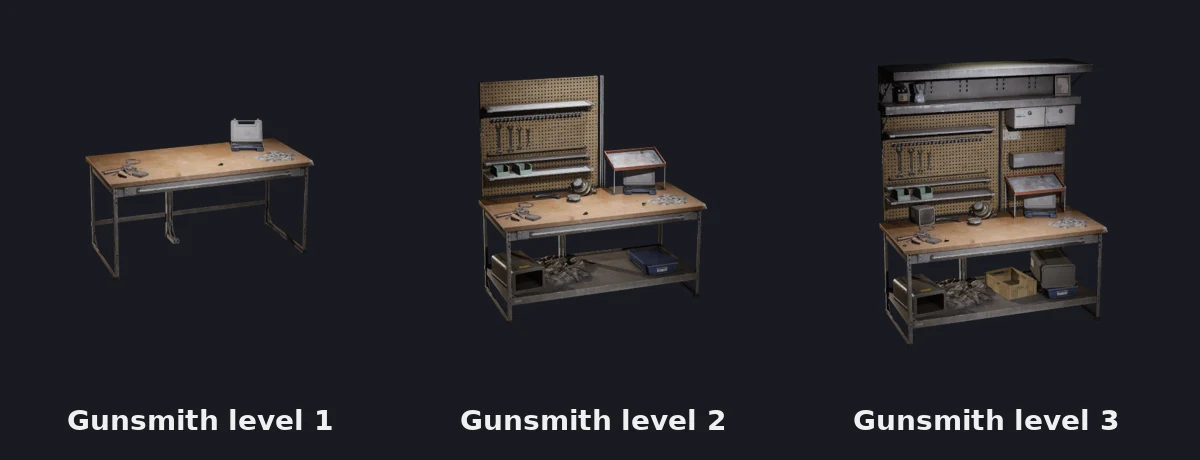 Image: Gunsmith_1, Gunsmith_2 and Gunsmith_3 renders from the ARC Raiders Wiki, uploaded by Dread, arranged by GameBrief. Game art is the property of Embark Studios.
GODEEPER: Every station's material list in one place, plus what to farm for each. ARC Raiders Crafting Guide →
Blueprints
A station level only lets you craft what you've learned. Blueprints drop topside, and the wiki's rules of thumb are worth memorizing: weapon and gun-part blueprints come from raider containers, augments from security containers, medical items from medical containers, and blueprints for rare and epic items are more common during the double-loot major map conditions. ARC Surveyors can drop them too. Some blueprints only come from quests, and every blueprint in the scavenging pool can also be won as a Trials reward. Frozen Trail 2.0 added a third route: the Outpost unlocks a Research Station, and players report it can research a long list of blueprints, though not every one. On r/ArcRaiders, u/dragonx254 put it plainly: "There's a large selection, but it does not cover every blueprint possible."
Quests
This is the one place traders do move your progress. The main quest line is a chain of 115 quests handed out by the traders, and the rewards include gear and blueprints: Tian Wen's "Industrial Espionage" pays out the Burletta blueprint, and Celeste's "Greasing Her Palms" gives you the Lure Grenade blueprint. Since Frozen Trail 2.0, completing quests and quest objectives also grants XP, so there's no reason to leave them sitting in your log.
The fastest route, in order
- Craft Ferros from your first round. The Workbench makes them with no unlock, and the Ferro hits as hard as anything you'll find early. Don't spend your coins on starter weapons you can build.
- Gunsmith to level 2 next. It's the cheapest big jump in firepower: five new guns and tier II mods. The Wasp Drivers come from Wasps, so shoot them when you see them.
- Gear Bench to level 2. Mk. 2 augments are a clear step up from Mk. 1, and the Heavy Shield keeps you alive through the fights the Gunsmith gets you into.
- Take every trader quest that fits the map you're on. They pay items, blueprints and, since 2.0, XP. That's the closest thing to "leveling a vendor" the game has.
- Push to raider level 25 for the Nomadic Envoys. Cassio's stash expansions take a lot of ARC materials (200,000 in item value for the first), but the weekly offers are where the Anvil lives now. This week's list (October 13 to 19, 2026) has Anvil II and Hullcracker II on it.
GODEEPER: How far the stash goes and what each expansion costs. ARC Raiders Stash Size Guide →
Our take
We'd stop thinking about traders as something you level. Sell to whoever buys what you've got, buy only what you can't craft, and put your real effort into the Gunsmith and Gear Bench. If you're short on coins rather than materials, our currency guide has the selling side; if you're short on materials, the maps guide shows where to farm them. And when you're ready for Gunsmith 3 guns, the weapons tier list tells you which blueprints are worth chasing.
How we checked this
We rewrote this guide in October 2026 against the ARC Raiders Wiki's Traders, Workshop, Blueprints, Quests and Nomadic Envoys pages, each trader's own page, and Embark's Frozen Trail 2.0 update notes. No play claims here: everything about costs and unlocks comes from those pages. The full source list is in our notes for this article.
Related Reading
- ARC Raiders Beginner Guide: the first hours, from Free Loadout to your first sale.
- ARC Raiders Augments Guide: which Mk. 2 and Mk. 3 augments the Gear Bench is worth upgrading for.
- ARC Raiders Weekly Reset Guide: Trials, Feats and the Envoys' weekly offers on top of the quest chain.
- ARC Raiders Extractions Guide: getting the materials home.
- ARC Raiders Endgame Guide: Trials and what comes after.
- ARC Raiders Frozen Trail: Everything in the 2.0 Update: the update that changed Shani, Tian Wen and quest XP.
References
Was this guide helpful?
Keep reading
Sponsored

Disclaimer
This article is published for informational and entertainment purposes. It does not constitute professional financial, legal, or technical advice. Game performance, online services, patch schedules, and store listings change. Verify critical details (pricing, system requirements, regional availability) with publishers and storefronts before you buy. Affiliate links, where present, help support our editorial work and are labelled in our affiliate disclosure.
About the author

Systems & Economy Desk
GameBrief's byline for roguelikes, strategy and simulation. Reads patch notes, wiki tables and Steam stats and puts the numbers on the page.
- Roguelikes, strategy and simulation
- Builds, progression and economy
- Sources listed per article