
GameBrief · General
Fogpiercer Game Pass Review: Worth Playing 13 Days Later
Fogpiercer Game Pass review: worth downloading 13 days post-launch. Five patches fixed motion sickness and softened difficulty since the July 17 release.
Reviewing
Fogpiercer
Mad Cookies Studio · Hooded Horse
Score
Reviewed build: 1.0 (Update #5, July 27 2026)
Pros
- Five substantial patches in the first 10 days, directly citing review feedback in the changelogs
- 100+ cards across 10 carriages and 4 drivers, each pushing toward a different playstyle (ice/stun, time/space, summon, repair)
- Zero purchase risk through Game Pass since it costs nothing beyond the subscription already being paid
- A positioning-based train combat system no other 2026 deckbuilder release is running
Cons
- Full-release score (83.6% Very Positive, 438 reviews) sits meaningfully below the pre-launch demo's 91% at 223 reviews
- Motion sickness was severe enough at launch that the developer shipped a dedicated accessibility mode within 24 hours, meaning the base camera design wasn't solved before ship
- Player reports of sub-30fps on Xbox Ally, relevant to the same Game Pass audience increasingly running PC titles on handhelds
- Difficulty needed a dedicated patch to soften after launch, meaning early reviews caught a harder, less-tuned build
The Fogpiercer Game Pass slot looked like an easy win on paper: day-one access, no purchase risk. Then the Steam review score dropped nearly 8 points in the two weeks between demo and full release, 91% positive across 223 demo reviews, 83.6% Very Positive across 438 since the July 17 launch. That gap, and the five patches Mad Cookies Studio shipped to close it, are the actual story for anyone deciding whether the download is worth it now.
Key Takeaways
- Released July 17, 2026, on Steam (Windows/Mac/Linux) and day-one on PC Game Pass, not Xbox console
- Base price $19.99, currently on a 25% launch discount to $14.99
- 438 Steam reviews at 83.6% positive ("Very Positive"), down from the demo's 91% at 223 reviews
- Five post-launch patches in 10 days: July 18, 20, 22, 25, and 27
- Full launch content: 10 carriages, 4 drivers, 3 locomotives, 3 bosses, 6 minibosses, 2 biomes, 100+ cards
- Motion sickness accessibility mode and a difficulty rebalance both shipped in direct response to launch-week feedback
Overview: Fogpiercer on Game Pass
Mad Cookies Studio's first release under Hooded Horse (the publisher behind Manor Lords and Heroes of Might and Magic: Olden Era) is a sci-fi roguelike deckbuilder where the deck is attached to a physical train. Each carriage you attach carries its own module slots, and combat plays out with your train's cars occupying fixed positions relative to the enemies attacking it, so where a carriage sits matters as much as what cards it holds.
That's the mechanical hook that separates Fogpiercer from a card-only deckbuilder: a carriage in the front line takes different hits than one three cars back, and several of the game's stronger builds (the "Kick Back" module rewarding damage taken, or "Late Supper" rewarding a stationary turn) are explicitly built around exploiting train position rather than just deck composition.
At $19.99 ($14.99 on the current 25% launch discount), Fogpiercer sits in the same price bracket as most single-developer roguelike deckbuilders this year. The Game Pass slot changes the calculation for anyone already subscribed: the price question disappears, and the decision becomes purely about whether the current build is worth the install, which is where the post-launch patch history actually matters more than the sticker price.
Gameplay
A run assembles a train from a starting locomotive (Foggy, Steamie, or Bullet, each with a different survival-versus-utility tradeoff) and adds carriages as you progress through two current biomes. Ten carriage types exist at launch, each unlocking its own card pool once you've used it enough in combat, a system Update #2 and #3 both tuned because several carriages (Bullet, Leeter, Crane) had unlock conditions tied to specific tactical playstyles that punished players who didn't naturally play that way.
Four drivers govern the run's overall identity: Monica (ice and stun-focused), Pan (repositions enemies through time and space manipulation), Ghost (summons a spectral secondary train), and Whiskey (repair and protection). Enemy encounters scale through two biomes with 32 confirmed enemy types, three named bosses (Lojzo, Marauder, Tinkerer) and six minibosses, each with a distinct mechanical gimmick, Sapper attacks the deck directly with bloat cards, Mamatroshak spawns smaller copies of itself when damaged, and Servitor originally had a retarget ability aggressive enough that Update #4 removed it outright after players reported it created unwinnable positions.
Decision density is high early: a typical fight asks which carriages absorb which attacks, whether to reposition mid-fight, and which of the 100+ cards to slot into which module. The environmental hazard system (originally criticized for repeating the same hazard type too often) was reworked in Update #5 with a "pity" mechanic that increases the odds of a new hazard type appearing the longer you've gone without one, the same fix pattern applied to rare and epic card draws.
The difficulty curve was a genuine launch problem, not just a subjective complaint. Update #3's patch notes describe lowering "enemy numbers across all regions for the most difficult segments" and increasing the odds of easier boss-fight modifiers, changes the developer explicitly ties to player feedback rather than internal testing. That's a meaningfully different game than the one the first wave of post-launch reviews encountered.
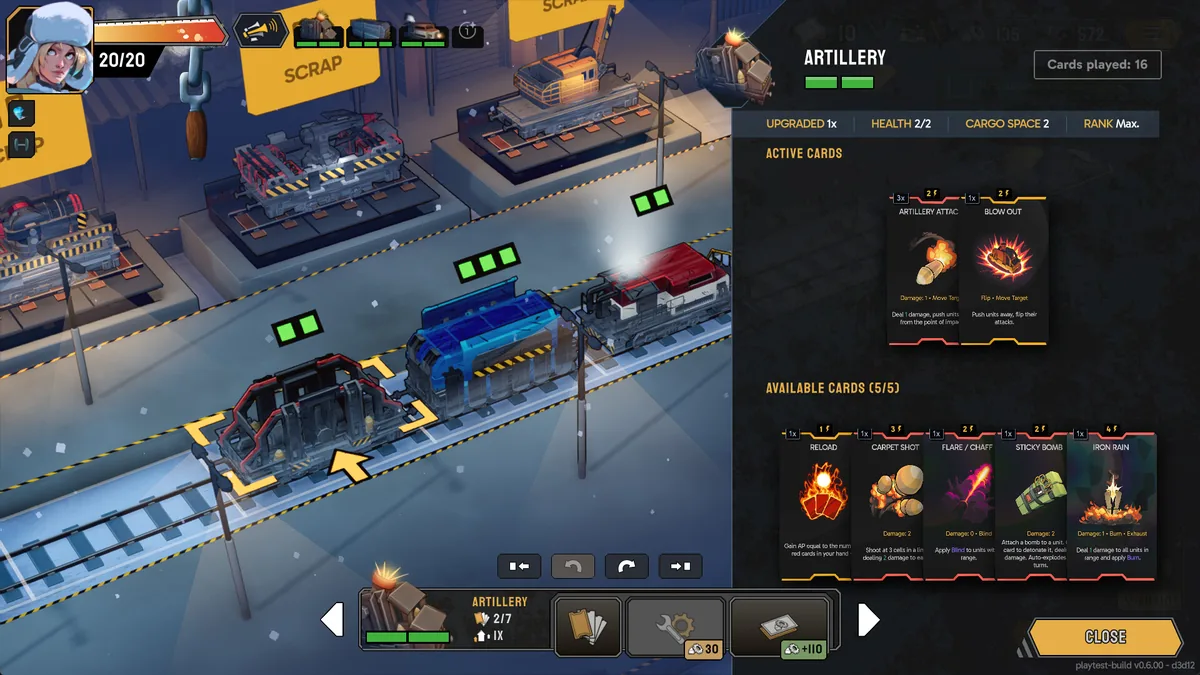 Each carriage has its own active and available card pool. The Artillery car's Iron Rain and Sticky Bomb here are examples of the module depth Update #4 expanded.
Rubric Assessment
Design Coherence
The train-as-deck concept is coherent and distinct: position matters mechanically, not just thematically, and the module system (over a dozen new options added in Update #4 alone) rewards planning around carriage placement instead of treating it as a skin on a standard deckbuilder. Where coherence slips is onboarding. The game shipped without enough guidance on why unlock conditions were tied to specific playstyles, and that's precisely what Updates #2 and #3 had to go back and fix.
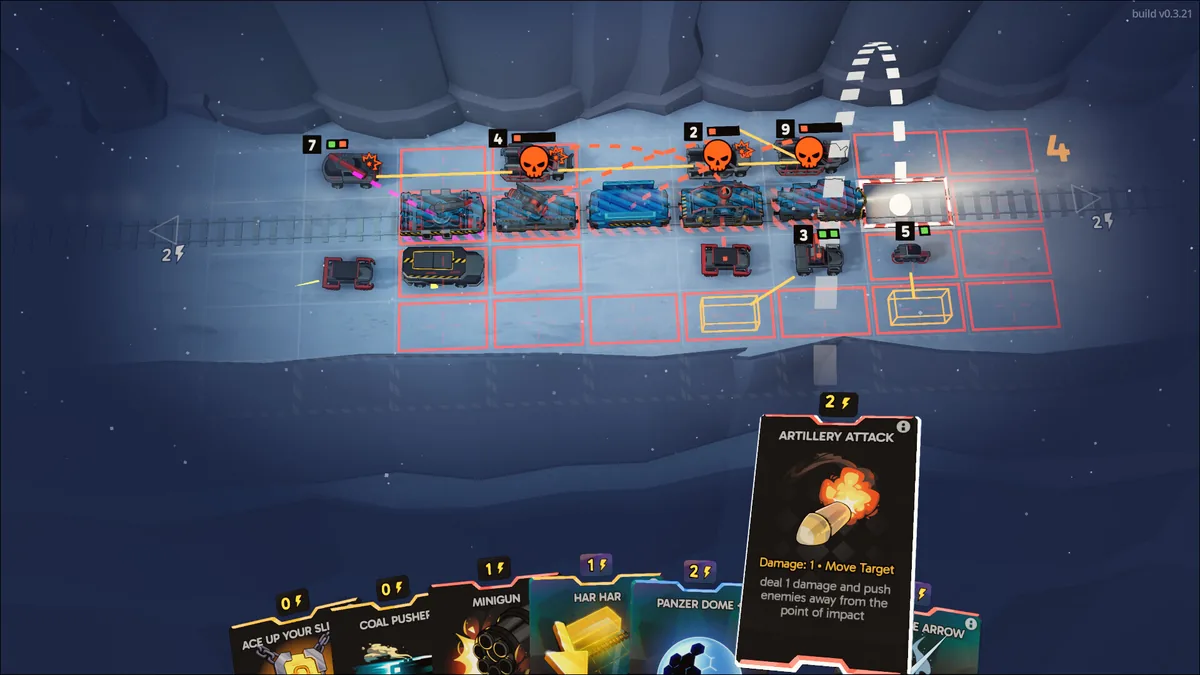 Position determines what a carriage can hit and what can hit it back, the layer that separates this from a standard card-only deckbuilder.
Value per Dollar
At $14.99 on the current discount, ten carriages, four drivers, and 100+ cards across two biomes is a reasonable amount of build variety for the price, in line with genre peers. Through Game Pass, the value question is moot, the content is included regardless of how the price-to-hours ratio shakes out for a standalone purchase.
Onboarding
This is the weakest dimension at review time. Carriage unlock conditions were tuned twice in the first four days specifically because new players hit invisible playstyle requirements the game didn't explain. The difficulty softening in Update #3 addressed a related problem: early fights were tuned hard enough that players bounced before reaching the systems that make the game distinct.
Technical Quality
Update #1 arriving one day after launch specifically to add a Motion Sickness mode is a strong signal the base camera and movement design had a real accessibility gap at ship, not a minor one, the developer's own words describe the initial reduced-speed approach as insufficient ("We were wrong!"). Separately, community reports on Reddit flagged possible sub-30fps performance on Xbox Ally, a detail relevant specifically to the Game Pass audience since that's a PC-based handheld running the same build.
Replayability
Ten carriages and four drivers support meaningfully different runs, and the "pity" system added in Update #5 for rare cards and hazard variety directly targets the repetition complaints that surface in longer-session roguelites. Whether that holds past dozens of runs is the open question a five-patch, ten-day history can't answer yet.
The official launch trailer shows the train-positioning combat in motion, worth watching before deciding if the spatial layer appeals over a standard deckbuilder.
Verdict: Is the Fogpiercer Game Pass Slot Worth It?
Fogpiercer is worth the download specifically because it's on Game Pass: the price question that would otherwise weigh against a rocky launch (score drop, motion sickness, a difficulty curve the developer itself has now softened twice) simply doesn't apply when the subscription is already paid for. Judged as a $14.99 standalone purchase instead, the calculus is closer: the systems underneath are genuinely distinct, but a buyer paying full price is buying into a build that needed five patches in ten days to reach its current state, and the Xbox Ally performance reports haven't been addressed yet.
Recommended for: Game Pass subscribers who like roguelike deckbuilders and want a positioning layer standard card-only entries don't have. Less certain for: a full-price purchase without the subscription cushion, until performance on handhelds gets an official response.
Rating: 7.7/10
Frequently Asked Questions
Is Fogpiercer worth playing on Game Pass? Yes. Five patches in the first 10 days addressed the roughest launch issues, and since it costs nothing beyond an existing subscription, the usual purchase-risk question doesn't apply.
Why did Fogpiercer's review score drop after launch? The pre-launch demo sat at 91% positive across 223 reviews. The full release settled at 83.6% Very Positive across 438 reviews, a real gap the developer has been actively patching since day one.
Does Fogpiercer have motion sickness issues? It did at launch. Update #1, shipped one day after release, added a dedicated Motion Sickness accessibility mode after the developer said reduced camera speed alone wasn't enough on its own.
Does Fogpiercer run well on Xbox Ally or other handhelds? Reports on Reddit flagged possible sub-30fps performance on Xbox Ally shortly after launch. No official statement on handheld optimization has followed as of this writing.
How many post-launch patches has Fogpiercer had? Five in the first 10 days after the July 17 launch, covering accessibility, difficulty tuning, 16 new modules, a UI redesign, and card-rarity probability fixes.
Is Fogpiercer on Xbox console Game Pass? No. It's day-one on PC Game Pass specifically, not the Xbox console version. Console players cannot access it through Game Pass.
How does Fogpiercer compare to other 2026 roguelike deckbuilders? Its train-positioning system, carriages arranged in a line, each with its own module slots, is distinct from card-only deckbuilders like Slay the Spire 2. The tradeoff is added spatial complexity most genre peers don't ask for.
For more on what Fogpiercer's launch week actually contained, the Fogpiercer release date coverage has the day-one specifics. Readers weighing it against the rest of this year's genre crop can check the best indie roguelites roundup.
References
- Fogpiercer on Steam: official store page, current price, and full patch note history
- Fogpiercer official launch trailer (YouTube)
- Hooded Horse: the publisher behind Fogpiercer, Manor Lords, and Heroes of Might and Magic: Olden Era
About the author

Senior Critic & Analyst
Former game data analyst turned critic with 11 years covering indie and mid-tier games. Based in Austin. Runs spreadsheets on games most people just play.
- 11 years games criticism
- Former game economy analyst
- Roguelike and strategy specialist
Keep reading

Disclaimer
This article is published for informational and entertainment purposes. It does not constitute professional financial, legal, or technical advice. Game performance, online services, patch schedules, and store listings change. Verify critical details (pricing, system requirements, regional availability) with publishers and storefronts before you buy. Affiliate links, where present, help support our editorial work and are labelled in our affiliate disclosure.
Comments
Loading comments…