
GameBrief · General
Graveyard Keeper 2 Review: A Bigger, Stranger Keeper
Graveyard Keeper 2 review: the sequel adds a restored town, zombie combat, and conveyor-belt automation, but the old grind still follows you.
Reviewing
Graveyard Keeper 2
Lazy Bear Games · tinyBuild
Score
Reviewed build: Launch build, September 23, 2026
Pros
- Town restoration gives the graveyard loop a wider purpose and a visible sense of progress
- Conveyor-belt factories and zombie battles are meaningful sequel additions, not just new scenery
- The Steam launch build is Deck Verified and supports full controller input
- A strong early response, including 91% positive Steam reviews, gives the launch a healthy base
Cons
- The old resource grind remains the backbone, so players who disliked the first game's pacing may not be converted
- Official launch material explains the systems well at a high level but not every production recipe or army unlock
- A launch hotfix was needed for pre-order content already missing from existing saves
Verdict
Graveyard Keeper 2 earns its sequel label by adding a restored town, conveyor-belt production, and an undead army that can defend it. The familiar grind is still here, but the new systems give the work a better destination.
Graveyard Keeper 2 review starts with the question the sequel has to answer: does a bigger cemetery sim justify another round of digging, crafting, and queue management? At launch, the answer is yes, with one important caveat. Lazy Bear Games has not thrown away the slow-burn work of the original. It has given that work a town to rebuild, factories to connect, and an undead army to point at the next crisis.
This is a launch-state review of the September 23 Steam build, using the current store listing, official launch notes, combat developer update, and the game's live systems rather than pretending that a single early save has already revealed every late-game edge case. The result is a sequel with a clearer strategic shape, even if the familiar grind still asks for patience.
Key Takeaways
- Graveyard Keeper 2 launched on September 22, 2026 for $24.99 on Steam, with Adventure, RPG, and Simulation tags.
- The live Steam listing shows 91% positive from 634 user reviews and currently marks the game as Deck Verified.
- Town restoration is the sequel's new central layer: the graveyard supplies work, while the Town gives that work a public purpose.
- Conveyor-belt factories and zombie-based production are genuine new systems confirmed by the official Steam development posts.
- Town battles add barricades, towers, zombie fighter squads, banners, and wave-based pressure to the management loop.
- The original resource grind remains, and official launch material does not yet document every recipe, army unlock, or squad limit.
Graveyard Keeper 2 Overview: What Changed From the Original
The original Graveyard Keeper was built around a wonderfully grim contradiction. You could turn a body into a resource, improve a cemetery one skull at a time, and keep a medieval economy moving while everyone else treated you as a suspicious caretaker. Graveyard Keeper 2 keeps that premise, but it widens the camera. The goal is no longer only a better graveyard. It is a restored Town that can produce, trade, and survive.
That distinction matters because the sequel's new systems are connected to the setting instead of being separate minigames. The official Steam description asks you to restore the Town, manage the graveyard, automate production, and lead an undead army into battle. Lazy Bear's own game page uses the same structure: rebuild businesses, construct machinery, expand the cemetery, then build fortifications and train zombie troops.
The presentation also changes the feel of the series. Official development material describes the first game as stylized 2D pixel art and the sequel as a 3D production. The move does not erase the macabre humor, but it makes the Town feel more like a place that can be walked through and repaired than a collection of clever screens around a cemetery.
At $24.99, the sequel is priced above the original's usual sale floor but below a full-priced blockbuster. That makes the scope question straightforward. You are paying for a new management layer and a more active defense loop, not for a completely different genre. Players comparing that price with another long Early Access journey can use our Paralives price and value review, while fans of Fields of Mistria, its season and festival guide, or Tales of Seikyu should understand that this is the dirtier, more systems-heavy branch of the cozy-sim family.
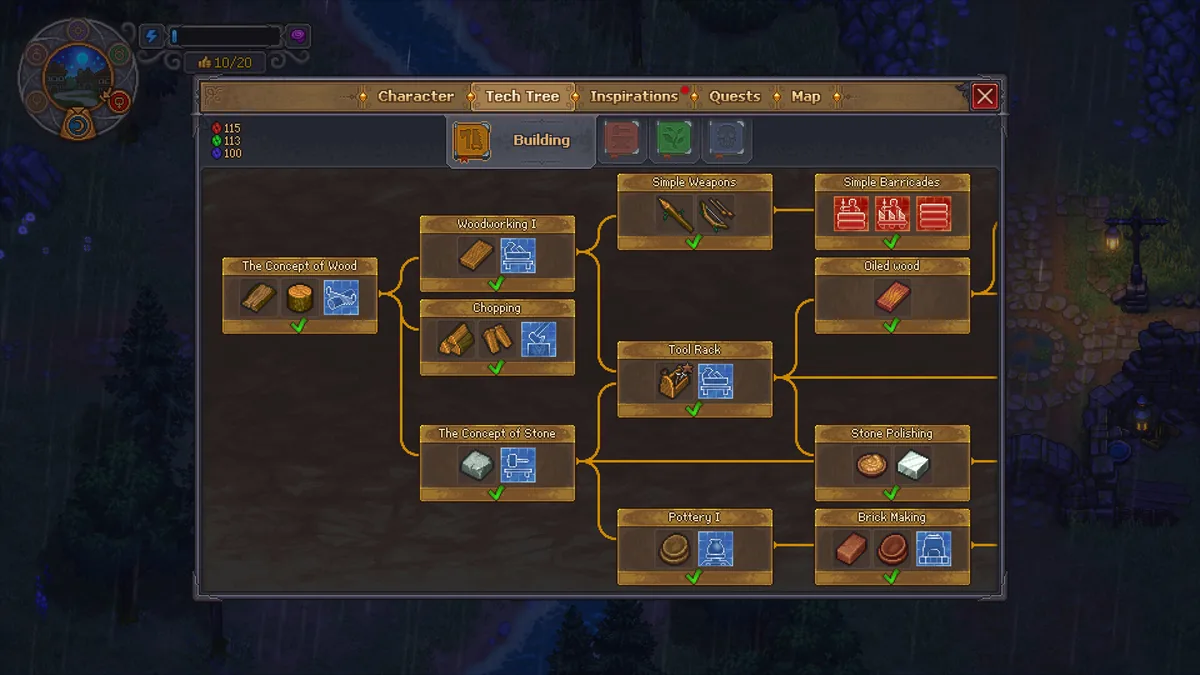 The technology tree makes the new Town layer feel like a continuation of the original's long research climb.
Gameplay: Why Town Restoration Gives the Grind a Destination
Graveyard Keeper 2's core loop is still built from small jobs. Gather materials, unlock a better station, process inputs, improve the graveyard, and repeat. That rhythm is familiar enough that returning players will know exactly what kind of commitment they are making. The difference is what happens after the next upgrade. Town restoration turns individual production choices into visible infrastructure.
The official launch announcement frames the Town as something you rebuild, fortify, and defend. The store page adds businesses and machinery to that promise. In practice, that means the game has a useful second question beyond whether a resource is profitable: does this production chain help the Town become more functional? That makes the best base-building games comparison more useful than a simple farming-sim label. The sequel is asking for layout, throughput, and defense decisions as well as cemetery maintenance.
Its layered work order sits closer to the Winter Burrow crafting recipes guide than to a pure town decorator. Materials have to move through stations before the settlement looks finished, and the satisfaction comes from watching a chain become dependable.
This is also where the old game's friction remains visible. Graveyard Keeper has always made progress feel earned through layered requirements and repeated trips. The sequel does not suddenly turn that into a quick crafting game. More machinery means more dependencies to understand, and a repaired Town gives you more reasons to keep feeding those dependencies. If you loved the first game's slow reveal, that is a strength. If you wanted a cleaner onboarding path, the expanded scope may feel like more paperwork before it feels like power.
The current store page's early response is encouraging. Steam lists 91% positive from 634 user reviews, and the launch feed reported a peak of 50,000 players. Those are not proof that every production chain is balanced, but they do show that the sequel's larger premise has landed with a substantial audience. A post-launch hotfix also fixed pre-order bonus content that failed to appear in existing saves, a reminder that the first days are still part of the review picture.
Automation Is the Sequel's Biggest New Identity
The automation system is not a marketing adjective pasted onto the old workbench. Official Steam development material calls conveyor-belt factories a completely new mechanic, while the store page describes machinery, automated production, and zombie-based labor. Those sources establish the system's shape even though they do not publish a complete recipe database.
The important design change is that production can become a layout problem. Instead of treating every station as an isolated stop, you can think about where inputs arrive, where processing happens, and how finished goods leave the chain. That is a familiar pleasure for anyone who enjoys Shapez 2's advanced routing or the increasingly elaborate factories in All Hail the Orb. Graveyard Keeper 2 gives that logic a much stranger wrapper: the workers are zombies, the products support a cemetery and a town, and the final output may be part of a defense plan.
There is a limit to what can honestly be said at launch. The official pages confirm the existence of conveyor-belt factories and scalable production, but they do not list every station prerequisite, exact worker condition, or optimal chain. That is why this review treats automation as a design strength rather than inventing a perfect early factory. The companion automation and zombie army guide sticks to confirmed systems and marks the places where players still need to read the live in-game tooltips.
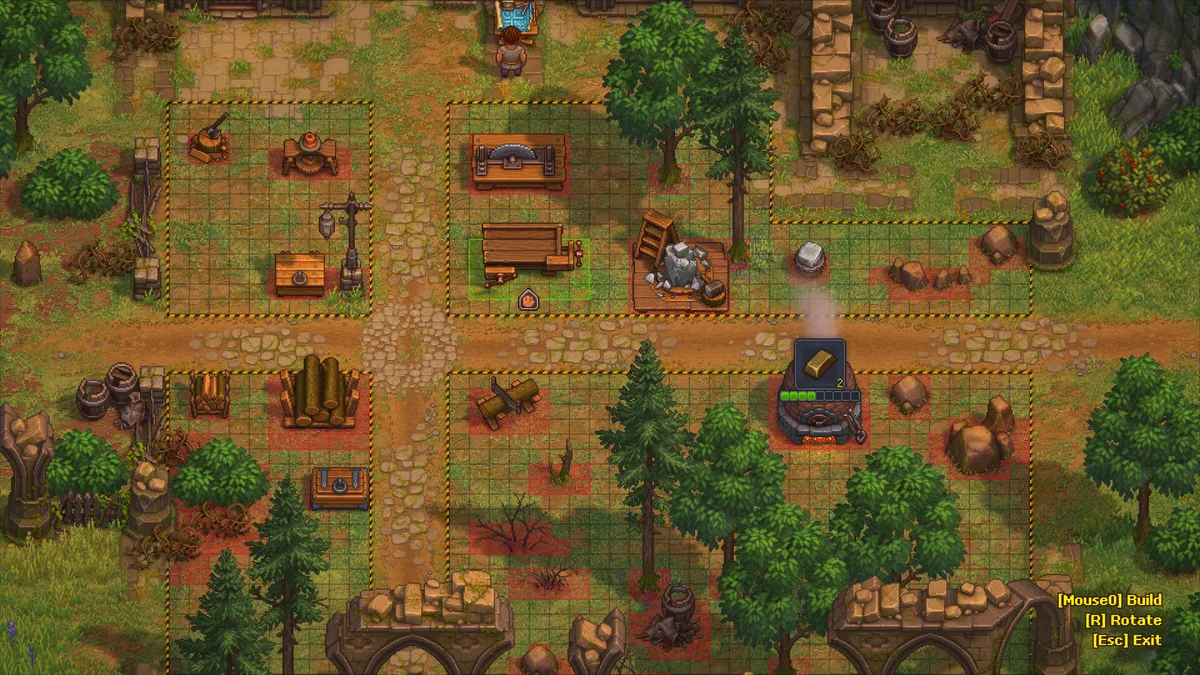 Building mode shows the practical side of the new loop: placement and space become part of production, not just decoration.
The Undead Army Turns Management Into Defense
The undead army is the other major addition, and official combat notes provide more detail than the store summary. Town battles take place in street arenas with distinct objectives. The Town Square can send waves from several directions, while central streets can push pressure across multiple fronts and ask you to capture control points. The devlog also says city battles occur on a particular day of the week, while the sewers remain available on all six days.
The defensive vocabulary is pleasingly practical. You can build barricades and towers, position squads of zombie fighters, or raise a banner and lead the force yourself. The official examples include all-archer squads, spiked barricades, and combat potions. Mouse and keyboard combat is designed to be controllable with one hand, which fits the series' larger fantasy of juggling a production operation while a crisis arrives at the gate.
That makes combat feel like an extension of the factory rather than a separate action game. A production chain can support armor, weapons, fortifications, or consumables. A battle can then expose whether the Town you restored is actually organized enough to survive. The official combat post even says the game contains a little over 4,000 zombies across its course, but that number should not be mistaken for a published recruit roster or a fixed army limit.
The practical weakness is documentation. The official sources confirm the battle structure, squad examples, defensive tools, and schedule rules. They do not yet give an authoritative table of recruit conditions, squad caps, stat breakpoints, or controller button mappings. That is not a reason to dismiss the system. It is a reason to avoid the usual launch-day guide fiction that turns one demo observation into a universal rule.
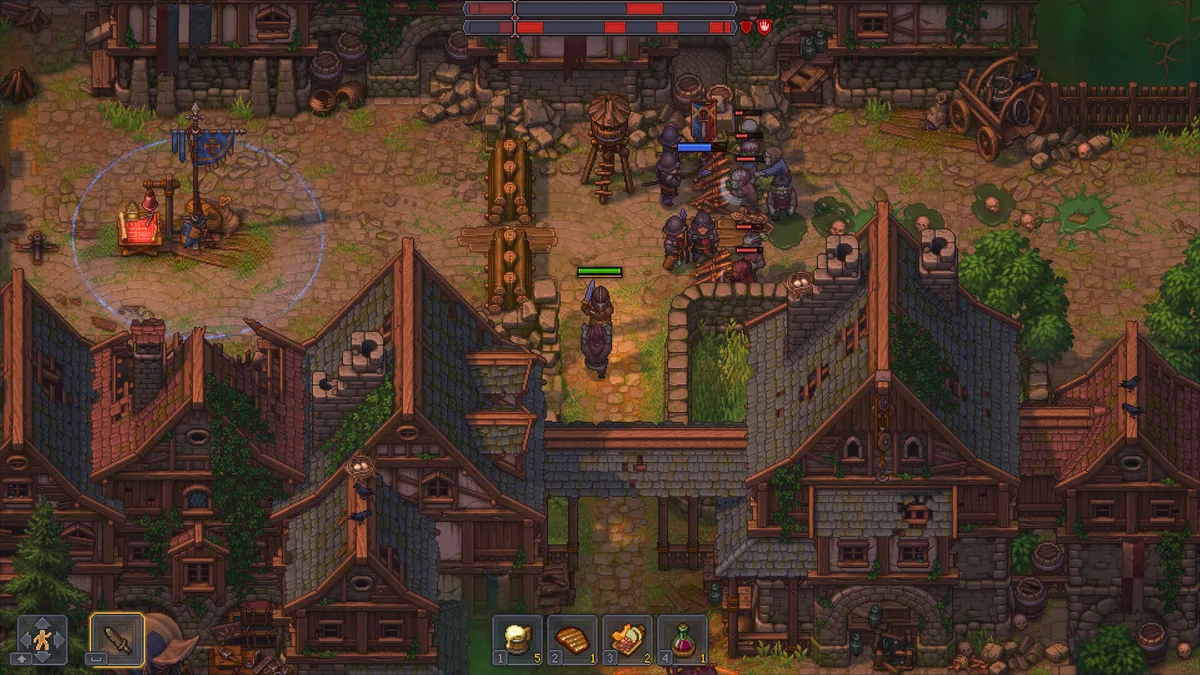 Town battles make the restored settlement answer for all the production work that came before it.
Launch Reception and Technical State
The first-day response is unusually strong for a systems-heavy sequel. The live Steam page currently shows a Very Positive label with 91% positive from 634 reviews. The launch news feed also carried a 50,000-player peak report. Review counts will move quickly in the first week, so those numbers describe this launch snapshot rather than a permanent score.
Steam currently marks the PC version as Deck Verified, and the store categories include full controller support. That is a meaningful quality-of-life signal for a game built around repeated resource runs and menu checks. It is also one area where the sequel looks more ready for a broad audience than the original did at release.
The caveat is the pre-order-content hotfix. The official note says it fixed an issue where the bonus content did not appear in existing save files. A quick response is good, but a save-linked launch issue belongs in any honest review of the opening build. Players beginning a long management game have good reason to update before they judge the economy or start a serious Town project.
Verdict: Is Graveyard Keeper 2 Worth It?
Graveyard Keeper 2 is worth buying for players who wanted the original's dark management loop to grow into a proper settlement game. The restored Town gives every production upgrade a larger context. Conveyor-belt factories make the work spatial and systemic. Zombie battles give the output a consequence beyond another unlocked recipe.
It is a less convincing recommendation for anyone who bounced off the first game because of its slow gates and repeated material runs. The sequel does not abandon that pacing. It layers more decisions on top of it, which can feel like satisfying depth or a taller stack of chores depending on your tolerance for long progression.
The launch build also deserves a little breathing room while the community maps the exact production chains and army thresholds. The best indie automation and logistics games list shows how much competition there is for clean factory design, while Brave New Wonders is a useful reminder that town-scale management can succeed through different kinds of friction. Graveyard Keeper 2's advantage is that few of those games make a cemetery, a zombie workforce, and a weekly street battle belong to the same loop.
The sequel earns an 8.2/10 at launch. It is broader, stranger, and more purposeful than the original, with enough new machinery and combat to justify its existence. Like Beastro's cozy cooking guide, it understands that a repeated work action needs a strong fantasy around it. The Valheim base-building guide makes a similar case for protected work space, while the Creature Kitchen review shows how much personality can come from a focused production loop. Give Graveyard Keeper 2 time to explain itself, keep the first production lines modest, and expect the first patch cycle to be part of the experience. If you want practical priorities before committing to a large factory or army, start with the companion automation and zombie army guide when it lands.
Frequently Asked Questions
What is new in Graveyard Keeper 2? The sequel adds town restoration, conveyor-belt factory automation, and an undead army that can defend the Town in structured battles. It also moves the presentation from the original game's 2D pixel art into 3D.
How much does Graveyard Keeper 2 cost? The current US Steam price is $24.99 with no launch discount shown in the live store listing. Prices can vary by region and change after publication.
Is Graveyard Keeper 2 Steam Deck Verified? Yes. Steam's current hardware compatibility result marks Graveyard Keeper 2 as Deck Verified, including legible interface text and a performant default configuration.
Does Graveyard Keeper 2 have zombie army battles? Yes. Official combat notes describe Town street battles, defensive structures, zombie fighter squads, banners, and multiple wave or control-point objectives.
How does automation work in Graveyard Keeper 2? Official launch material confirms machinery, conveyor-belt factories, and zombie-based production. It does not publish every recipe or unlock threshold, so exact chains should be checked in the live game rather than guessed from previews.
Is Graveyard Keeper 2 a sequel or a remake? It is a sequel. Lazy Bear Games keeps the graveyard management premise while adding Town restoration, factory automation, zombie combat, and a fully 3D presentation.
Was Graveyard Keeper 2 patched after launch? Yes. An official hotfix addressed pre-order bonus content that did not appear in existing save files, and the Steam news feed lists other launch announcements and combat details.
References
- Graveyard Keeper 2 on Steam - current price, review score, genres, features, and Deck compatibility
- Graveyard Keeper 2 official Steam announcements - launch posts, hotfixes, combat notes, and development updates
- Let's talk Combat - official Town battle objectives, structures, squads, and control details
- Graveyard Keeper 2 is OUT NOW - official launch announcement and Town restoration framing
- Lazy Bear Games: Graveyard Keeper 2 - developer overview of automation, fortifications, and zombie troops
- Graveyard Keeper 2 is OUT NOW on PC, PlayStation, Xbox and Nintendo Switch - official tinyBuildGAMES launch video
About the author

Indie & JRPG Critic
Indie game evangelist and lifelong JRPG fan covering small studios since 2017. Mumbai-born, London-based. Writes the way she talks.
- 7 years indie games coverage
- JRPG and visual novel specialist
- Narrative design focus
Keep reading

Disclaimer
This article is published for informational and entertainment purposes. It does not constitute professional financial, legal, or technical advice. Game performance, online services, patch schedules, and store listings change. Verify critical details (pricing, system requirements, regional availability) with publishers and storefronts before you buy. Affiliate links, where present, help support our editorial work and are labelled in our affiliate disclosure.
Comments
Loading comments…