
GuideGraveyard Keeper 2
Graveyard Keeper 2 zombie power: factory power guide
About the game
Graveyard Keeper 2
Lazy Bear Games · tinyBuild
Graveyard Keeper 2 zombie power confusion usually starts when a conveyor line stops after one small extension. The problem may not be the belt connection. Players are currently using the word power for three separate systems: Zombie Power from the Bioreactor, Factory power from staffed Zombie Carousels, and the zombie limit that controls workforce capacity.
This Graveyard Keeper 2 zombie power guide separates those systems, then turns current Factory power references into a pre-build calculator. The values are community-read data from Wikily and AllThingsHow, not developer figures. The future-plans post promises more zombie gear later, without a date, so treat every total as patch-sensitive.
TL;DR: Zombie Power is a crafting ingredient made by the Bioreactor from Wheat. Factory power is conveyor capacity produced by zombies assigned to Zombie Carousels. Each belt, Underground Conveyor, Conveyor Splitter, and Supply Station currently uses 1 Factory power, while each Carousel worker supplies 7, or 10 with the Belt Master Keeper perk. The zombie limit is a separate workforce cap.
Graveyard Keeper 2 zombie power: quick answer
The short answer is that Zombie Power and Factory power are not interchangeable. The Bioreactor turns Wheat into Zombie Power for the crafting chain. A staffed Zombie Carousel supplies Factory power for conveyor components. The zombie limit determines how many zombies you can support, but it does not make belts move.
An unofficial recipe extract lists Zombie Power as an input for Supply: Appliances I, Zombie Mechanism, Supply: Engineering Mechanism, and the Magic Mirror quest. GK2DB calls it an ingredient but lists no consumers. That use list is fan data, not an official recipe announcement. For belts, use the Carousel budget below. For the wider loop, start with the Graveyard Keeper 2 automation guide or the complete guide hub.
Key Takeaways
- Bioreactor output is Zombie Power, a crafting resource. It is not a belt battery.
- A zombie assigned to a Zombie Carousel supplies Factory power. An empty Carousel contributes no working capacity.
- Current community references give each powered conveyor component a demand of 1.
- Current community references give each ordinary Carousel worker 7 supply, with 10 reported after Belt Master.
- A line with 7 powered pieces fits one ordinary worker, while 14 needs two and 21 needs three.
- Belt Master is a Keeper Talent Tree perk in the current GK2DB data, not a Zombie Talent.
- When demand exceeds supply, one current factory guide reports that the whole network shuts down.
- The zombie limit is a separate capacity system. Do not solve a worker-cap problem by building another belt, or solve a belt-budget problem by farming more Bioreactor output.
Overview: the three systems behind the confusion
Zombie Power: Bioreactor output for crafting
The Bioreactor belongs to the factory crafting chain. A current unofficial recipe extract records 5 Wheat producing 1 Zombie Power. It lists four current consumers: 1 for Supply: Appliances I, 1 for Zombie Mechanism, 2 for Supply: Engineering Mechanism, and 3 for the Magic Mirror quest.
That use list needs a source label. The page is an independent fan site, while the GK2DB item page says only “Ingredient for” without naming a consumer. The safest conclusion is that the fan datasets have different coverage. Keep the live Assembly bench II recipes and quest panel as the final authority after a patch.
The stable negative is that Zombie Power does not run belts, Underground Conveyors, Conveyor Splitters, or Supply Stations. AllThingsHow describes it as a separate crafting resource, so Wheat for the Bioreactor cannot increase your conveyor budget.
Factory power: Carousel output for conveyor demand
Factory power is a capacity budget. A zombie has to be assigned to a Zombie Carousel before that position produces the power your conveyor pieces draw from. That worker is not automatically the operator for a production station, so a line can have capacity and still fail at the bench.
Wikily lists “+7 Factory power (10 with Belt Master)” for the Carousel and 1 for each conveyor piece. AllThingsHow reports that the whole network shuts down when demand is higher than supply. These are community references, not an official power table.
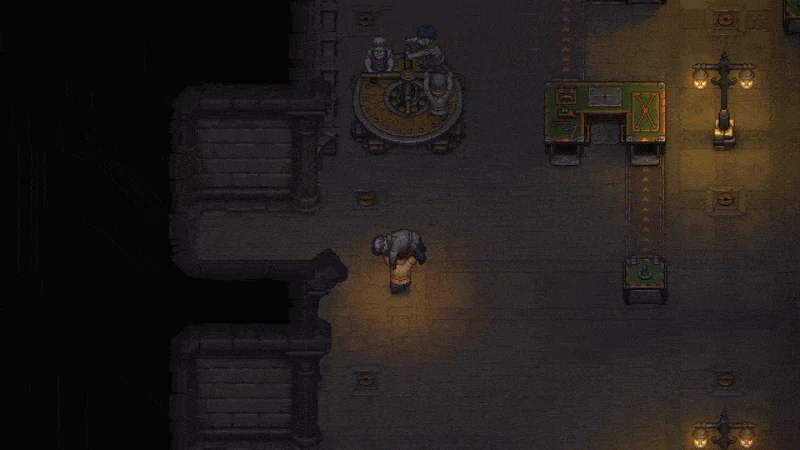
This Steam development image shows an underground workshop with a Carousel, machines, and a routed conveyor line. It illustrates the factory context, not an official power tooltip.
Zombie limit: workforce capacity, not belt capacity
The zombie limit answers how many zombies your current systems can support. It affects production, gathering, logistics, and combat, but it does not add Factory power to a Carousel or pay the demand cost of a new belt.
That distinction matters around the PR machine. The Graveyard Keeper 2 PR machine guide covers temporary zombie capacity, not conveyor power. Update 1.008 fixed the zombie Panic debuff failing to trigger over the zombie cap. The Graveyard Keeper 2 zombie army battle guide covers the separate combat assignment problem.
GODEEPER: The Graveyard Keeper 2 factory layout guide covers short lanes, buffers, belt direction, and room for station access. This guide goes deeper on the separate Factory power budget so you can check capacity before changing that layout.
Factory power rules: count every powered piece
The practical formula is:
Factory power demand = Conveyor Belts + Underground Conveyors + Conveyor Splitters + Supply Stations.
Count each placed component once. A hidden Underground Conveyor and a Supply Station at the delivery end still consume power.
| Factory component | Current community-read demand | Source boundary |
|---|---|---|
| Conveyor Belt | 1 Factory power | Wikily and AllThingsHow community references |
| Underground Conveyor | 1 Factory power | Wikily and AllThingsHow community references |
| Conveyor Splitter | 1 Factory power | Wikily and AllThingsHow community references |
| Supply Station | 1 Factory power | Wikily and AllThingsHow community references |
Count staffed Carousel positions, not empty buildings. An ordinary worker contributes 7 in the current reading, or 10 with Belt Master. The perk changes supply, not demand.
The 7, 14, 21 Factory power calculator
These examples assume every powered piece is counted and every Carousel position is staffed. The totals are current-build community-read values and may change. “Belt Master workers” means workers benefiting from the Keeper Talent Tree perk.
| Powered pieces in the line | Ordinary Carousel workers needed | Belt Master workers needed | If every piece is a Conveyor Belt |
|---|---|---|---|
| 7 | 1, supplying 7 | 1, supplying 10 | 7 Bronze Gear + 7 Fabric |
| 14 | 2, supplying 14 | 2, supplying 20 | 14 Bronze Gear + 14 Fabric |
| 21 | 3, supplying 21 | 3, supplying 30 | 21 Bronze Gear + 21 Fabric |
The first three columns are capacity. The last applies only when every piece is a normal Conveyor Belt. A 7-piece mixed line still demands 7 Factory power, but its materials differ.
Carousel and belt-line material costs
GK2DB's buildings index lists a Zombie Carousel at 6 Bronze Gear, 6 Iron Detail, and 4 Wooden beam. Wikily lists the same cost. The Carousel still needs an assigned zombie to contribute capacity.
GK2DB and Wikily list 1 Bronze Gear and 1 Fabric for a normal Conveyor Belt. An all-belt line therefore costs one of each per piece: 7 pieces cost 7 of each, 14 cost 14 of each, and 21 cost 21 of each. Mixed lines use their own component costs.
| Component | Build materials in the current references | Factory power use or supply |
|---|---|---|
| Conveyor Belt | 1 Bronze Gear + 1 Fabric | Uses 1 |
| Underground Conveyor | 4 Bronze Gear + 2 Fabric | Uses 1 |
| Conveyor Splitter | 3 Bronze Gear + 1 Fabric | Uses 1 |
| Supply Station | 4 Bronze Gear + 6 Iron Detail + 2 Wooden beam | Uses 1 |
| Zombie Carousel | 6 Bronze Gear + 6 Iron Detail + 4 Wooden beam | Supplies 7, or 10 with Belt Master |
Do not read the Carousel's 6 Bronze Gear as 6 Factory power. One is a build cost, the other is supply per assigned worker.
Step-by-Step: diagnose a line that stops after expansion
1. Inventory the route
Walk from input to output and count every Conveyor Belt, Underground Conveyor, Conveyor Splitter, and Supply Station. Include the new piece. A line that worked at 14 can stop when a fifteenth powered component exceeds two ordinary workers' 14 supply, according to AllThingsHow.
2. Check Carousel assignments
Confirm that every Carousel position has a zombie assigned. Building the Carousel is not enough. Moving a worker to production, combat, or gathering can lower supply without changing the belt layout.
3. Recalculate with Belt Master if you have it
GK2DB places Belt Master in the Keeper Talent Tree as a perk costing 1 talent point. Its current data changes Carousel quality from 7 to 10. It is not listed in the separate Zombie Talent Tree.
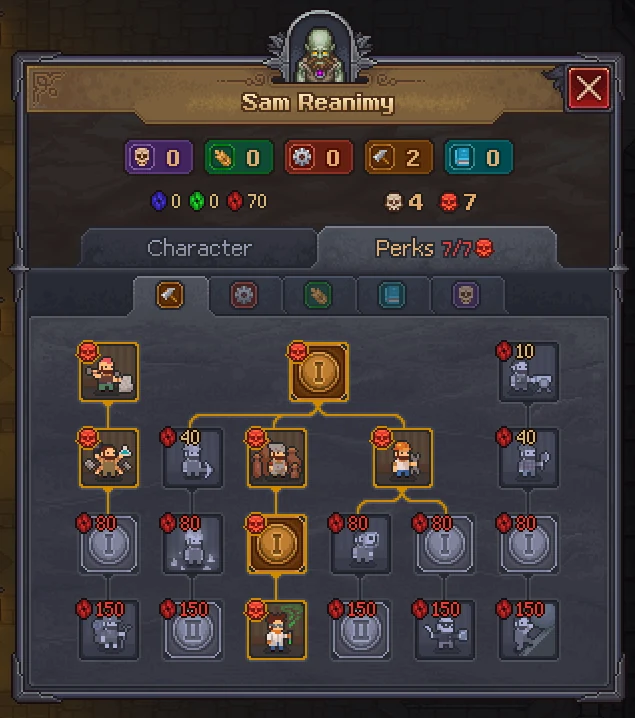
This Steam development image shows the game's zombie perk interface. The current GK2DB data places Belt Master in the Keeper Talent Tree, so use the live Keeper tree to confirm its position in your build.
4. Separate a power failure from an operator failure
If Factory power is available but a bench does not craft, check its zombie, input, output storage, and worker requirement. Factory power only covers conveyor components.
5. If the whole network stops, reduce demand or add staffed capacity
One current factory guide reports a whole-network shutdown when demand exceeds supply. Add a staffed Carousel position, use Belt Master, or shorten the route. Removing an unnecessary component can solve the problem without another worker.
Version 1.008 still has no move command. The official 2 October plans post promises movable workstations, without a date. Current references report full material refunds for dismantled belts and Carousels, but check the live dismantle panel before a rebuild.
Tips for a stable Factory power budget
Keep a small reserve instead of matching the limit exactly
An exact 7-to-7 match leaves no room for a new splitter. Plan the next component and mark which Carousel position supplies it.
Treat a Bioreactor as a recipe station
The Bioreactor's 5 Wheat to 1 Zombie Power recipe is a crafting decision. It may support the Assembly bench chain or Magic Mirror hand-in listed by the unofficial extract, but more Wheat will not fix a dead belt.
Use Belt Master as a capacity upgrade, not a belt discount
Belt Master gives a reported 10 Factory power per affected worker instead of 7. It does not change component costs or remove the need to assign a zombie.
Recheck after official patches
The official 2 October “Plans for the future” post says zombie gear output for conveyor belts will increase, with and without the perk. It gives no future values or date, so current 7 and 10 figures are only a community-read snapshot.
The official 1.008 changelog includes conveyor-related infinite-load fixes. If a patch changes a tooltip, trust the current tooltip and check the Graveyard Keeper 2 patch notes guide. The Graveyard Keeper 2 beginner guide places the factory decision in the wider progression order.
GODEEPER: If the power math exposes that your real bottleneck is too few available workers, read the Graveyard Keeper 2 PR machine guide. It covers zombie-capacity planning. This article's Carousel budget still applies after you have enough zombies. The Graveyard Keeper 2 Town approval guide explains the wider workforce and restoration loop.
Frequently Asked Questions
What is Zombie Power in Graveyard Keeper 2? Zombie Power is a Bioreactor crafting resource made from Wheat. One unofficial extract lists current Assembly bench II and Magic Mirror uses, while GK2DB's item page only says “Ingredient for.” It is not the Factory power that runs conveyor pieces.
Can Zombie Power run conveyor belts? No. Factory power comes from zombies assigned to Zombie Carousels and is consumed by belts, Underground Conveyors, Splitters, and Supply Stations.
How much Factory power does each conveyor piece use? Current community references list each Conveyor Belt, Underground Conveyor, Conveyor Splitter, and Supply Station as using 1 Factory power. The values are not developer-published.
How much power does a Zombie Carousel worker provide? Current community references report 7 Factory power per assigned zombie, or 10 with the Belt Master Keeper perk. These are current-build community values.
Is Belt Master a Zombie Talent? No. GK2DB places it in the Keeper Talent Tree as a perk costing 1 talent point. Its current data changes Carousel output from 7 to 10.
What happens when Factory power demand is too high? One factory guide reports that the network shuts down when demand exceeds staffed Carousel supply. Count every powered component, then add a staffed Carousel position or shorten the line.
Is the zombie limit the same as Factory power? No. The zombie limit supports workforce planning. Factory power is conveyor capacity supplied by staffed Carousels, and the PR machine belongs to the separate temporary capacity system.
Related Reading
- Graveyard Keeper 2 factory layout guide: Plan route shape, buffers, and placement.
- Graveyard Keeper 2 automation guide: Follow the broader factory and zombie-worker loop.
- Graveyard Keeper 2 PR machine guide: Separate zombie capacity from conveyor capacity.
- Graveyard Keeper 2 zombie army battle guide: Plan combat assignments when workers also fight.
- Graveyard Keeper 2 patch notes guide: Check official updates before trusting a tooltip.
- Graveyard Keeper 2 Complete Guide: Return to the hub for the full guide cluster.
References
- Graveyard Keeper 2 on Steam confirms the game's machinery, automation, Town, and zombie-worker premise.
- Lazy Bear Games: Graveyard Keeper 2 describes machinery, automation, Town restoration, and zombie troops from the developer's site.
- Official Steam post: Plans for the future says the number of gears zombies provide for conveyor belts will be increased, without publishing a date or replacement values.
- Official Steam Update 1.008 records the current conveyor-related loading and zombie-cap fixes.
- Official Steam post: Where Zombies Feel at Home describes zombies operating semi-automatic machines in underground factories.
- AllThingsHow factory automation guide reports that each listed conveyor component uses 1 Factory power, each Carousel worker supplies 7, and the network shuts down when demand exceeds supply. It is a community guide, not a developer specification.
- Wikily: Conveyor Belt, Zombie Carousel, Supply Station, Underground Conveyor, and Conveyor Splitter list the current community-read costs and Factory power values.
- GK2DB buildings lists current unofficial building costs, including the Bioreactor, normal Conveyor Belt, and Zombie Carousel.
- GK2DB perks and the Keeper Talent Tree identify Belt Master as a Keeper Talent Tree perk and list its current Carousel quality change.
- GK2DB Zombie Power item data labels Zombie Power as a crafted ingredient but does not list named consumers on the page I read.
- Graveyard Keeper 2 Field Guide: Zombie Power is an independent fan data extract that lists the Bioreactor input and current recipe or quest consumers. Use the live recipe and quest panels if that dataset differs from your build.
Was this guide helpful?
About the author

Indie & JRPG Critic
Indie game evangelist and lifelong JRPG fan covering small studios since 2017. Mumbai-born, London-based. Writes the way she talks.
- 7 years indie games coverage
- JRPG and visual novel specialist
- Narrative design focus
Keep reading

Graveyard Keeper 2 vs Graveyard Keeper: Key Differences
Features · 12 min

Graveyard Keeper 2 Complete Guide: Town, Factory, Battles
General · 18 min
Graveyard Keeper 2 Guide: First Hours in Order (2026)
General · 14 min

Graveyard Keeper 2 Patch Notes: Update 1.008 and More
General · 14 min

Graveyard Keeper 2 Calendar and Workshop Hours Guide 2026
General · 14 min

Graveyard Keeper 2 Release Date, Price, and Platforms
General · 11 min
Game deals · affiliate links

Disclaimer
This article is published for informational and entertainment purposes. It does not constitute professional financial, legal, or technical advice. Game performance, online services, patch schedules, and store listings change. Verify critical details (pricing, system requirements, regional availability) with publishers and storefronts before you buy. Affiliate links, where present, help support our editorial work and are labelled in our affiliate disclosure.
Comments
Loading comments…