
GameBrief · General
Graveyard Keeper 2 Town Approval Guide: What It Means
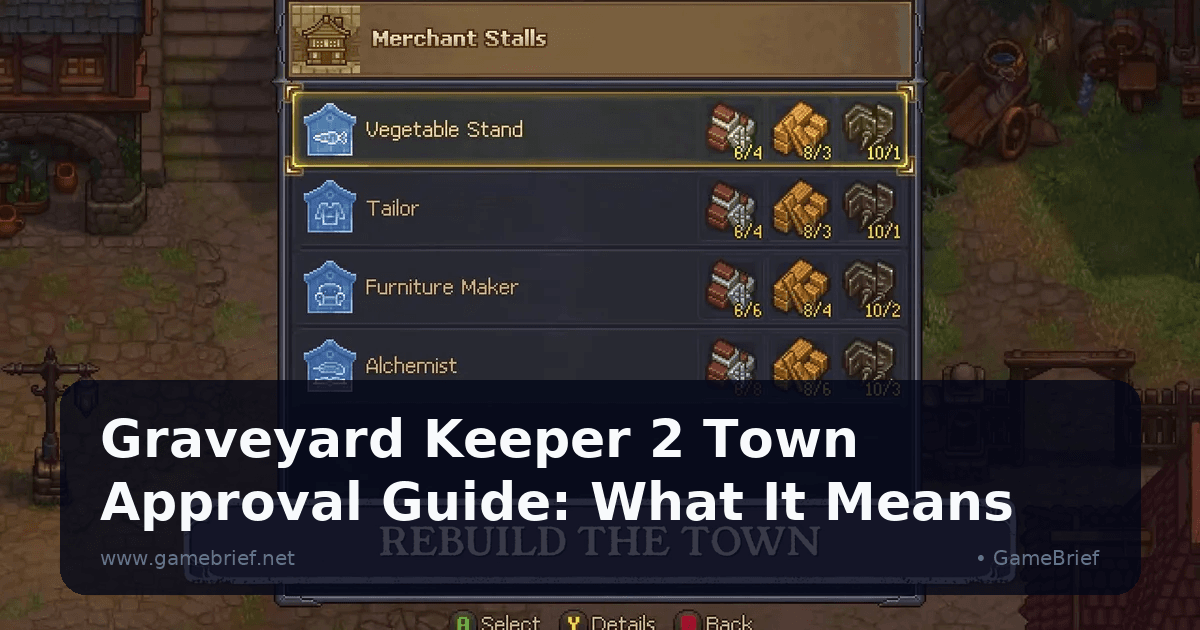
Reviewing
Graveyard Keeper 2
Lazy Bear Games · tinyBuild
Graveyard Keeper 2 town approval is not one bar you fill by repairing every house. The full-release game separates settlement progress into village reputation, Town Gratitude, happiness, and town quality. The Town Warehouse, supply crates, building materials, and Builder then sit on top of those systems. This guide maps the terms to the jobs they actually perform.
TL;DR: Treat reputation as a progression gate, not a currency. Treat Town Gratitude as a happiness item, and town quality as the ceiling for that happiness. Repairing houses can produce Green Scrolls, but trader-shop construction and upgrades are the important village-reputation route. The Town Warehouse handles crafted supply crates on a Pride-day cycle, while the Builder is a shop you construct in your own Town.
Graveyard Keeper 2 town approval: quick answer
“Town approval” is useful search language, but I could not verify it as a named resource in the current game. The closest verified systems are different: reputation measures standing with characters or the village, Town Gratitude is an item that can become happiness, happiness supports sermons, and town quality limits that happiness. Warehouse orders are a separate delivery loop.
That distinction prevents the most expensive early mistake: spending time on the wrong kind of progress. A house repair can look like approval because the Town visibly improves, but it does not replace a reputation quest or a trader-shop upgrade. A supply crate can pay for restoration, but it does not automatically raise village reputation. Check the system first, then choose the task.
Key takeaways for Town restoration
- Village reputation is a shared standing value, while most characters have their own reputation.
- Reputation is checked for thresholds and progression. It is not spent when you unlock a gated option.
- House repairs produce Green Scrolls. Giving those to Linda through her New people option raises town quality later.
- Town Gratitude is used to create happiness. Happiness is consumed by sermons and is limited by town quality.
- The Town Warehouse is the delivery point for crafted supply crates, not a general chest for loose materials.
- Building materials can mean a warehouse order category. It is not automatically the same thing as a raw stone, wood, or construction kit.
- The Builder is a shop you build on a town plot, then upgrade through its trader.
- The game calls Gunter the Astrologer. “Astronomer” is a search variant worth recognizing, not a separate Town system.
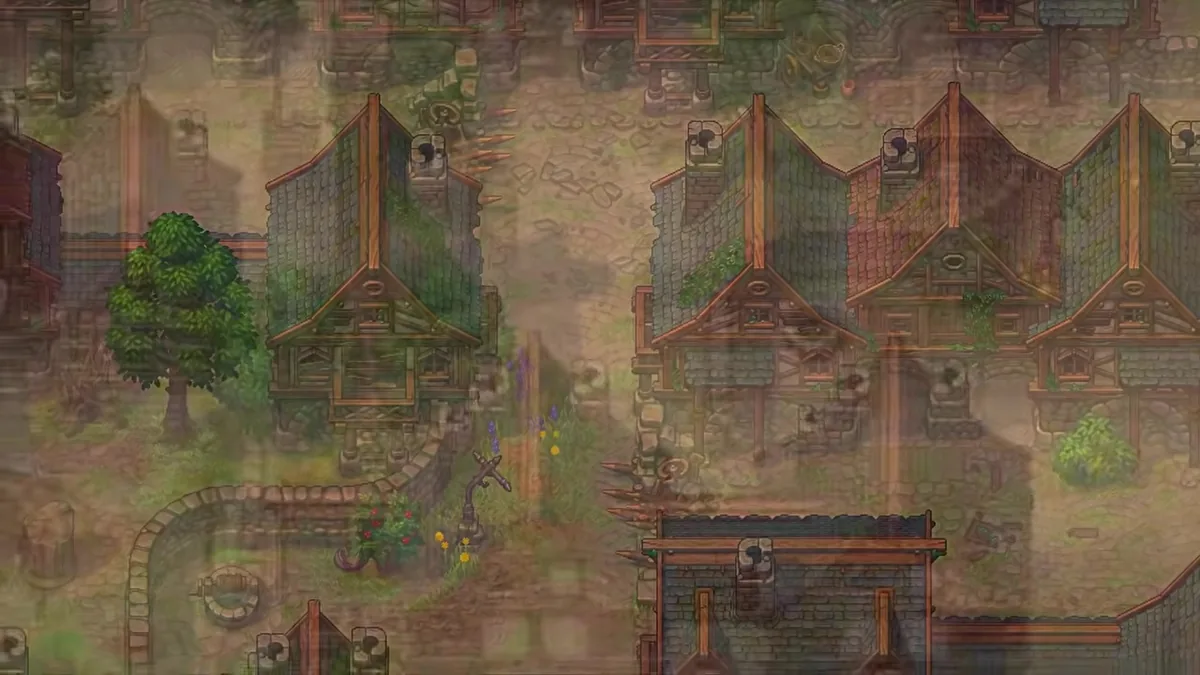 The restoration menu groups trader shops with construction requirements. That is why the same material can matter to both a shop upgrade and a warehouse order.
Reputation, Town Gratitude, happiness, and town quality
The word reputation hides two different scales. A character such as Gunter can have personal reputation, while the village has a shared reputation value. A quest can therefore improve one character's standing without acting like a universal Town approval meter. Read the portrait or quest requirement that is actually named before assuming the reward applies everywhere.
Village reputation is a threshold system. Current game data records it increasing through relevant quests and through building or upgrading trader shops. When another system asks for a reputation value, the game checks the number. It does not remove points from the pool. That makes reputation different from any resource you spend on a recipe, sermon, or warehouse order.
Town Gratitude is separate again. It is an item associated with Town restoration and town services. When used, it provides happiness. Happiness matters for sermons: sermon attendance is constrained by the lower value between happiness and church quality, and the parishioners consume happiness when the sermon starts. If you are saving Gratitude for a reason, save it as an item rather than imagining that its count is your reputation score.
Town quality is the ceiling that controls how much happiness the settlement can support. The current data pages connect Green Scrolls from repaired houses to Linda's New people option, which raises town quality. Repairs therefore matter, but through a different chain than village reputation. The practical loop is:
- Repair houses to receive Green Scrolls.
- Give the scrolls to Linda when her relevant option is available.
- Raise town quality.
- Use Town Gratitude or other happiness sources without hitting the lower ceiling as quickly.
This is why a player can repair a row of houses and still fail a reputation check. The visual restoration, scroll supply, quality cap, happiness stock, and reputation gate are related, but they are not one stat.
Step-by-Step: restore the Town without mixing up the systems
1. Read the exact requirement: When a quest, shop, or NPC asks for reputation, note whether it names a character or the village. When a sermon or town option asks for happiness, do not spend time farming reputation instead.
2. Run the reputation quests: Complete the early quests that explicitly award village reputation or a character's reputation. A quest reward is stronger evidence than a visual change to a house.
3. Repair houses for Green Scrolls: Restore houses when you have the materials and need the scroll route. Record the result as Green Scroll progress and future town quality, not as an immediate village-reputation increase.
4. Build or upgrade trader shops: Trader shops are a direct village-reputation route in the current data. Their tiers also change what the trader can offer and how many town orders are available, so a shop upgrade can serve both progression and supply planning.
5. Treat Town Gratitude as a happiness item: Use Gratitude when a sermon or another happiness decision justifies it. Keep the item category separate from reputation in your storage notes.
6. Open the warehouse loop when the port is ready: After the port-side progression gives you access to the Town Warehouse, check the order board on Pride day. Take only an order whose crate you can finish before the next tally.
7. Build the Builder when its shop is useful: Place the Builder on an available town plot, build its first tier, and return to the trader for upgrades. The Builder's stock is a convenience and a material source, not a universal approval meter.
How the Town Warehouse and town supplies work
The Town Warehouse is the port building that handles town orders. The board is associated with a weekly Pride-day cycle. Current port data places the Town Warehouse and its order board in the port area, with a cellar route connected to the wider production network. A warehouse guide documents the practical sequence: accept the request on Pride day, craft the requested supply crate, place it on the covered delivery stack or use the cellar route, and wait for the next Pride-day tally.
Do not bring loose iron, cloth, wood, or stone to the warehouse and expect the order to complete. A request such as Supply: Iron or Supply: Building materials I names a packaged crate category. The requested crate is the deliverable. The inputs are only useful after you turn them into the requested item at the appropriate station.
The order board is not a normal storage interface. It is a contract loop with a clock. Take an order when you can make the full package, and keep a note of the next Pride day. Delivering at the last moment can be risky because the game's tally window matters. The current official 1.007 changelog also lists a fix for iron supply delivery quests getting stuck, so update before treating an old delivery failure as a missing recipe.
The Shapez 2 tips guide uses a similar beginner habit: identify the next complete output before you commit the whole input buffer.
The phrase “town supplies” usually points to this crate system. It can also be used casually for all the goods that feed Town restoration. The safe reading is the exact item label on the board: a named Supply crate is a warehouse deliverable; a raw input or a Building Kit is a different object.
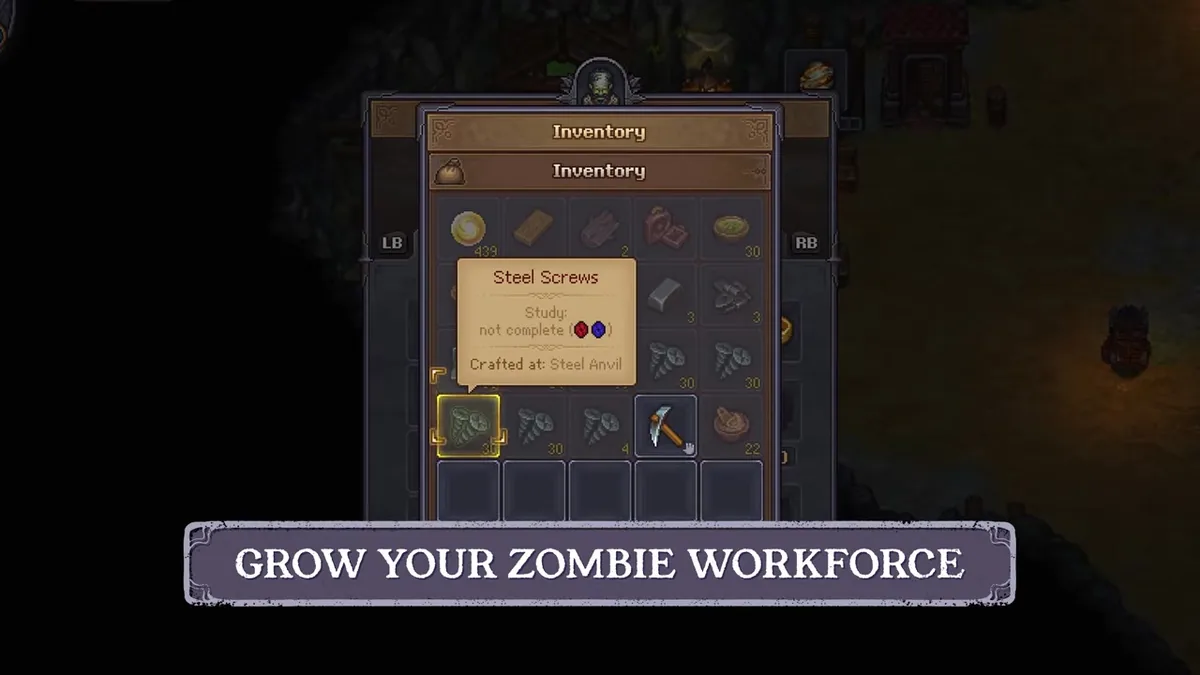 A material tooltip shows why the item name matters. Check the crafted object and its station before assuming it is a warehouse-ready supply crate.
Building materials versus Building Kits
“Building materials” is another phrase that can hide two layers. Warehouse orders can ask for a packaged Supply: Building materials category, with numbered tiers in the order text. Town construction can instead ask for individual resources or construction-kit items such as a Building Kit. Both are part of the same economy, but they are not interchangeable delivery objects.
Use this short check whenever a construction job or order appears:
- If the board starts with
Supply:, it is asking for a crafted supply crate. - If a build menu lists a kit, resource, or station output, it is asking for that construction input.
- If the Builder lists an item for sale, it may reduce a bottleneck, but it does not complete a warehouse order unless you still craft the required crate.
The distinction matters most when the Town offers two tempting jobs at once. A crate order may consume an input that a shop upgrade also needs. Compare the deadline and the permanent benefit before turning every piece of cloth or metal into a weekly delivery. The Graveyard Keeper 2 automation guide covers the later factory question; this page is about identifying the object before you automate it.
If you prefer a visual example of a multi-station chain, the Winter Burrow crafting recipes guide uses the same helpful habit: identify the finished object before you spend the input.
What the Builder actually is
The Builder is a player-built town shop. It does not point to one permanent NPC stall on the map that you walk up to at the start. You place the shop on an available plot, build its first tier, then speak with the trader to unlock later tiers. Higher tiers expand the shop's stock and make the building more useful as your restoration economy grows.
That makes the Builder a material-planning tool. Use it when a listed item solves an immediate construction bottleneck, when you want another shop tier, or when you are balancing a warehouse order against a repair. Do not build it because the search phrase “Builder” sounds like a hidden reputation level. The shop is a Town building, and its upgrades can contribute to village reputation because trader-shop construction is part of that progression path.
If you are comparing the Town with other settlement builders, our best base-building and colony sim games guide gives broader genre context. The useful takeaway here is narrower: build the Builder for a material or stock problem you can name.
The Shapez 2 automation guide is a useful comparison if you are used to thinking in inputs and outputs. Graveyard Keeper 2 has the same temptation to treat every icon as a throughput problem, but the early Town loop still has quest gates, weekly timing, and personal reputation checks in the way.
Why the “astronomer” search leads to the Astrologer
Gunter's verified role is Astrologer, and his location is the Astrologer's Tower in the port area. Searchers may type “astronomer” because it is a natural synonym, but it is not a second NPC or a separate approval system. Gunter also has his own reputation, so a Gunter requirement should not be read as village reputation unless the quest says so.
This is a small naming detail with a real payoff. If a guide tells you to raise “astronomer reputation,” search the current NPC and quest text for Gunter or Astrologer. Then check whether the reward is character reputation, a tech threshold, a quest item, or a Town-quality step. The Graveyard Keeper 2 review gives the broad sequel context, while this glossary keeps the individual systems separate.
Town restoration tips and common mistakes
Do not use house repairs as a reputation farm. Repairs are still valuable for Green Scrolls and the visual Town, but current data does not treat them as the village-reputation source. Build or upgrade trader shops when the objective is specifically village standing.
Do not spend reputation in your mental budget. A threshold check can unlock a node or option without consuming the number. Save your actual materials and money for the building or order that follows.
Do not deliver raw inputs. A supply board request is asking for the packaged crate. Read the full item label and inspect the recipe before moving resources to the port.
Do not accept every warehouse order. The weekly Pride-day clock turns an ambitious order into a storage problem if you lack one station, one material, or one trip through the Town.
Do not confuse happiness with town quality. Happiness is the stock that sermons use. Town quality is the ceiling. Town Gratitude helps with the former, while Green Scrolls and Linda's New people option help with the latter.
Do not build the Builder without a reason. It is a useful tiered shop, but the right moment depends on the construction materials and orders already in your queue. Plan the shop around a bottleneck instead of a vague approval goal.
That reserve-first habit also appears in the Tainted Grail survival tips guide: survival economies become easier to read when one emergency does not consume every shared input.
Frequently Asked Questions
Is Town Approval an actual resource in Graveyard Keeper 2? I could not verify Town Approval as an official resource name. Players generally mean a combination of village reputation, Town Gratitude, happiness, or town quality, which are separate systems.
How do you raise reputation in Graveyard Keeper 2? Complete quests that award it and build or upgrade trader shops. Village reputation is checked at thresholds and is not spent when a gate opens. Character reputation remains separate unless the game explicitly names the character.
What is Town Gratitude used for? Town Gratitude is an item that provides happiness when used. Happiness supports sermons, while town quality sets a ceiling on the available happiness. It is not a replacement for village reputation.
When should you use the Town Warehouse? Use the board on Pride day, accept a request you can finish, craft the requested supply crate, and deliver it before the next Pride-day tally. The warehouse is for packaged orders, not loose raw materials.
What are town supplies in Graveyard Keeper 2?
They are usually the packaged crates requested by Town Warehouse orders. Check whether the board says Supply: and whether it specifies a tier. A raw resource or Building Kit is a separate object until it is processed into the requested crate.
Where do you build the Builder? Build the Builder on an available Town plot. After the first tier is complete, talk with the trader to access upgrades and a larger shop stock. It is a player-built shop, not a reputation meter.
Is Gunter called the Astronomer or the Astrologer? The current role is Astrologer, with Gunter at the Astrologer's Tower. Astronomer is a search variant that can lead you to the same character, but it is not the verified role label.
Related Reading
- Graveyard Keeper 2 review: The broad sequel review covering Town restoration, factories, and the undead army.
- Graveyard Keeper 2 automation guide: A deeper look at factory lanes, zombie production, and Town defense.
- Shapez 2 automation guide: Belt-routing context for players coming from logistics builders.
- All Hail the Orb automation guide: Another production-chain guide focused on readable throughput decisions.
- Romestead survival tips guide: A contrasting early-game guide for resource pacing and settlement survival.
- Shapez 2 tips guide: Beginner-friendly production planning before a factory grows complicated.
- Best indie automation and logistics games: More examples of readable input and output chains.
- Tainted Grail survival tips guide: Another guide built around protecting scarce early resources.
References
- Graveyard Keeper 2 on Steam: Official feature list for Town restoration, automation, and the undead army.
- Graveyard Keeper 2 official page from Lazy Bear Games: Developer overview of the Town, cemetery, automation, and fortifications.
- Official Steam announcements: Release material and the 1.007 changelog, including the supply-delivery fix.
- Reputation mechanics data: Current data reference for personal and village reputation, thresholds, and sources.
- Town and shop data: Current data reference for repairs, Green Scrolls, shops, orders, and Town quality.
- Port and warehouse data: Current data reference for the Town Warehouse, order board, cellar, and Pride-day cycle.
- Builder shop guide: Current data reference for the player-built Builder and its tiers.
- Official launch trailer: tinyBuild's release video used for the article's gameplay frames.
Was this guide helpful?
About the author

Indie & JRPG Critic
Indie game evangelist and lifelong JRPG fan covering small studios since 2017. Mumbai-born, London-based. Writes the way she talks.
- 7 years indie games coverage
- JRPG and visual novel specialist
- Narrative design focus
Keep reading

Graveyard Keeper 2 Achievements Guide: All 38 Listed
General · 14 min

Graveyard Keeper 2 PR Machine Guide: Unlock and Use It
General · 17 min
Graveyard Keeper 2 Zombie Army Battle Guide Explained
General · 22 min

Graveyard Keeper 2 Release Date, Price, and Platforms
General · 11 min

Graveyard Keeper 2 Calendar and Workshop Hours Guide 2026
General · 13 min
Graveyard Keeper 2 Factory Layout Guide: Build Better
General · 20 min

Disclaimer
This article is published for informational and entertainment purposes. It does not constitute professional financial, legal, or technical advice. Game performance, online services, patch schedules, and store listings change. Verify critical details (pricing, system requirements, regional availability) with publishers and storefronts before you buy. Affiliate links, where present, help support our editorial work and are labelled in our affiliate disclosure.
Comments
Loading comments…