
GameBrief · Features
Graveyard Keeper 2 vs Graveyard Keeper: Key Differences
Graveyard Keeper 2 vs Graveyard Keeper: verified differences in town scope, combat, automation, presentation, and the original graveyard loop.
Reviewing
Graveyard Keeper 2
Lazy Bear Games · tinyBuild
Graveyard Keeper 2 vs Graveyard Keeper is a comparison between two versions of the same macabre management fantasy. The original asks you to build a better graveyard, turn corpses and materials into progress, and explore the strange ventures around it. The sequel keeps that foundation, then gives the work a Town to restore, factories to automate, and an undead army to send into battle.
This is a verified comparison based on the two live Steam descriptions, Lazy Bear Games' developer material, official Steam announcements, and the review snapshots visible during research. Where a source describes a difference in emphasis rather than an absolute absence, this article says so. It does not treat an unlisted original feature as proof that the first game lacks it.
TL;DR: Graveyard Keeper 2 is not a replacement for the original loop. It expands the frame around it. The sequel adds Town restoration, zombie-based automation, structured Town battles, fortifications, a larger world, a talent system, and a 3D presentation. Both games still center on a graveyard, crafting, long progression, dark humor, and the strange work of making a medieval economy function.
Graveyard Keeper 2 vs Graveyard Keeper: quick answer
The original Graveyard Keeper Steam description leads with building and managing a graveyard, then expanding into other ventures. It also highlights ethical choices, gathering and crafting, quests, corpses, and dungeon exploration. Its Steam page carries 2D and Pixel Graphics tags.
The Graveyard Keeper 2 Steam page starts from the same cemetery fantasy but puts more emphasis on restoring the Town and leading an undead army into battle. Its official feature list adds machinery, automated production, zombie labor, towers, fortifications, weapons, armor, and trained troops. A developer announcement also identifies zombie battles and conveyor-belt factories as new mechanics, and describes the sequel world as made in 3D.
So the short answer is that the sequel widens the management problem. In the first game, the graveyard is the clearest expression of progress. In the second, the graveyard feeds a wider settlement system. That is a difference in scope and emphasis, not proof that every familiar system was removed or rebuilt from zero.
Key Takeaways
- Both games retain graveyard management, crafting, exploration, quests, dark humor, and long-term progression.
- The original Steam pitch centers on the cemetery and nearby ventures, while the sequel explicitly makes Town restoration a major objective.
- Graveyard Keeper 2 adds official Town battle systems with zombie squads, barricades, towers, banners, waves, and control points.
- The sequel adds conveyor-belt factories and zombie-based production. The original page does not advertise that same factory layer.
- The developer describes the sequel as 3D. The original Steam page is tagged 2D and Pixel Graphics.
- The sequel takes place eight years after the original and opens a larger portion of the world, according to the official story announcement.
- Steam review snapshots are useful context, but the original has a much older and larger review pool, so the percentages are not a direct quality scorecard.
Comparison at a glance
| Area | Graveyard Keeper | Graveyard Keeper 2 |
|---|---|---|
| Core framing | Build and manage a graveyard, then expand into other ventures | Restore the graveyard and Town while building an undead army |
| Player role | A keeper managing a cemetery, resources, quests, and ethical choices | The Grand Inquisitor restoring the Town, automating work, and defending it |
| World and presentation | Steam page tagged 2D and Pixel Graphics, with dungeons and nearby ventures | A larger world made in 3D, with a Town, village, tavern, forest, swamp, church, and graveyard |
| Production | Gather materials and craft through the original progression loop | Machinery, conveyor-belt factories, and zombie-based automation are explicit sequel systems |
| Combat | The Steam pitch highlights dungeon exploration and dangerous spaces | Town street battles use defensive structures, zombie squads, waves, and control points |
| Story position | The first entry establishes the Keeper and the world | Eight years later, with old friends, new characters, and a story written for newcomers too |
What stays the same
The sequel works because it recognizes the original's identity. Both games turn a graveyard into a production problem. The player gathers materials, unlocks knowledge, improves facilities, responds to characters and quests, and gradually converts a suspicious medieval job into a larger operation.
The original's Steam description makes corpses, crafting, ethical dilemmas, quests, and dungeon exploration part of the fantasy. The sequel's store page still describes managing a medieval graveyard, harvesting flora, fauna, and human remains, and building machinery from the results. Those are not cosmetic references. They show that the sequel's new Town layer is attached to the same dark resource loop.
The official Old World: New Story developer announcement says the sequel keeps the Technology Tree while adding a talent system, and says the team aimed for less grinding. It also describes the same Keeper as connected to the original without claiming the character is unchanged. The result is continuity with room for a new starting point.
GODEEPER: The Graveyard Keeper 2 review looks at how the Town, factories, and undead battles feel in the launch build. Use it for the broader experience; this comparison stays focused on sourced differences.
Difference 1: the Town becomes a central system
The biggest structural change is the sequel's public-facing settlement. The original Steam page says to build and manage a graveyard, then expand into other ventures. That leaves room for a broad game, but the cemetery remains the clearest headline. Graveyard Keeper 2 states the Town objective directly: restore it, rebuild businesses, generate profits, and protect the settlement.
Lazy Bear Games' official Graveyard Keeper 2 page presents the sequel as a chain of management tasks. The player manages the graveyard, automates production, restores the Town, explores, and prepares defenses. The Town is not merely a backdrop for the same cemetery menu. It gives the output of the cemetery a visible destination.
The official world announcement makes the scale change more specific. The sequel opens a much larger part of the setting, including southern outskirts, another village and tavern, a forest, a swamp, a church, and another graveyard. That is a verified expansion of the advertised world, not a claim that every location is available at the first hour.
Players who enjoy the Graveyard Keeper 2 town reputation guide will recognize the consequence of this shift: the sequel asks what the settlement thinks of your work, not only whether the cemetery is improving. Players who prefer the original's more concentrated cemetery fantasy may find the broader civic layer less intimate.
Difference 2: automation becomes a sequel identity
The original is already a resource and crafting game, so it would be inaccurate to say that Graveyard Keeper 2 invents production from nothing. The verified difference is the explicit automation layer. The sequel's Steam description calls out machinery and automated production, while the developer announcement names conveyor-belt factories as a new mechanic. The developer page also describes zombie-based automation.
That changes the question from “Which recipe unlocks next?” to “How should this work move through the Town?” The sequel can make station placement, throughput, zombie assignments, and finished goods part of one layout problem. The official pages do not publish every recipe, worker condition, or optimal factory chain, so those details should not be smuggled into a comparison as settled facts.
The Graveyard Keeper 2 automation and zombie army guide is the better companion for confirmed factory and zombie-worker systems. A broader indie automation and logistics guide gives useful genre context, but it is not evidence that the original lacks hidden production tools.
The progression change is equally measured. The official developer post says the Technology Tree remains, then adds a talent system and less grinding. It also says Milestones replace the original's Teleportstone approach for fast travel. Those are concrete sequel-level changes to progression and movement, while the shared Technology Tree preserves a familiar backbone.
Difference 3: combat moves into the Town
Both games can put the player in dangerous places, and the original Steam pitch includes dungeon exploration. The verified distinction is that Graveyard Keeper 2 makes defense of the Town a named management system. Its official Let's talk Combat announcement says one goal was to make battles part of the story.
The combat post describes weekly Town battle days, street arenas, waves, control points, and different win conditions. It also names the tools used to prepare the settlement: barricades, towers, zombie fighter squads, banners, archers, spiked barricades, and combat potions. The Town is liberated through battle and then rebuilt, so combat is connected to the settlement loop rather than presented as a detached arena.
That is a major sequel emphasis, but it should not be overstated as “the original has no combat.” The original's official page specifically points to dungeons and exploration, while the sequel's developer material specifically details Town defense. The source-supported comparison is about the kind of combat each game foregrounds.
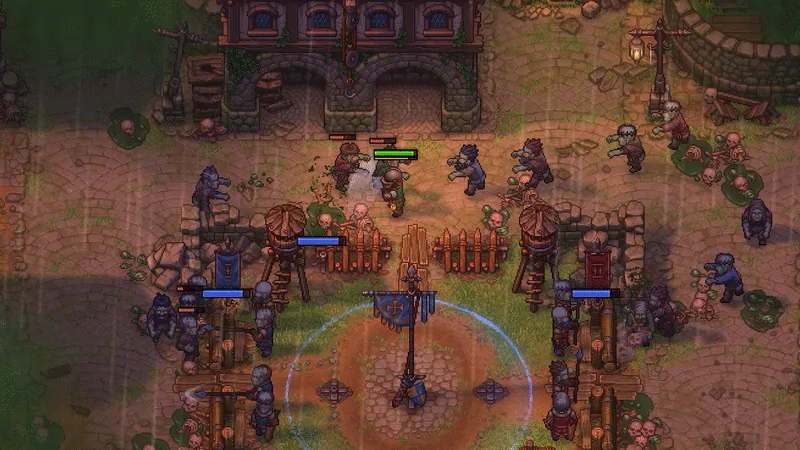 The sequel's official combat material puts zombie squads and built defenses inside the Town management loop.
GODEEPER: The Graveyard Keeper 2 zombie army battle guide follows the sequel's named battle systems, while the patch notes tracker records fixes that affect squads, red tech points, and Defender's Emblems.
Difference 4: the world is larger and the presentation is 3D
The visual contrast is one of the clearest sourced differences. The original Steam listing uses 2D and Pixel Graphics tags. The official sequel announcement describes the new world in a short line: “A world now made in 3D.” That statement comes from the developer update, not from a visual guess based on screenshots.
The presentation change supports the world change. The official story post says the original showed only a small part of the world, while the sequel opens a larger section with new settlements and biomes. It also says eight years have passed since the original release and that the same amount of time has passed in the world. The sequel is therefore both a technical presentation shift and a narrative continuation.
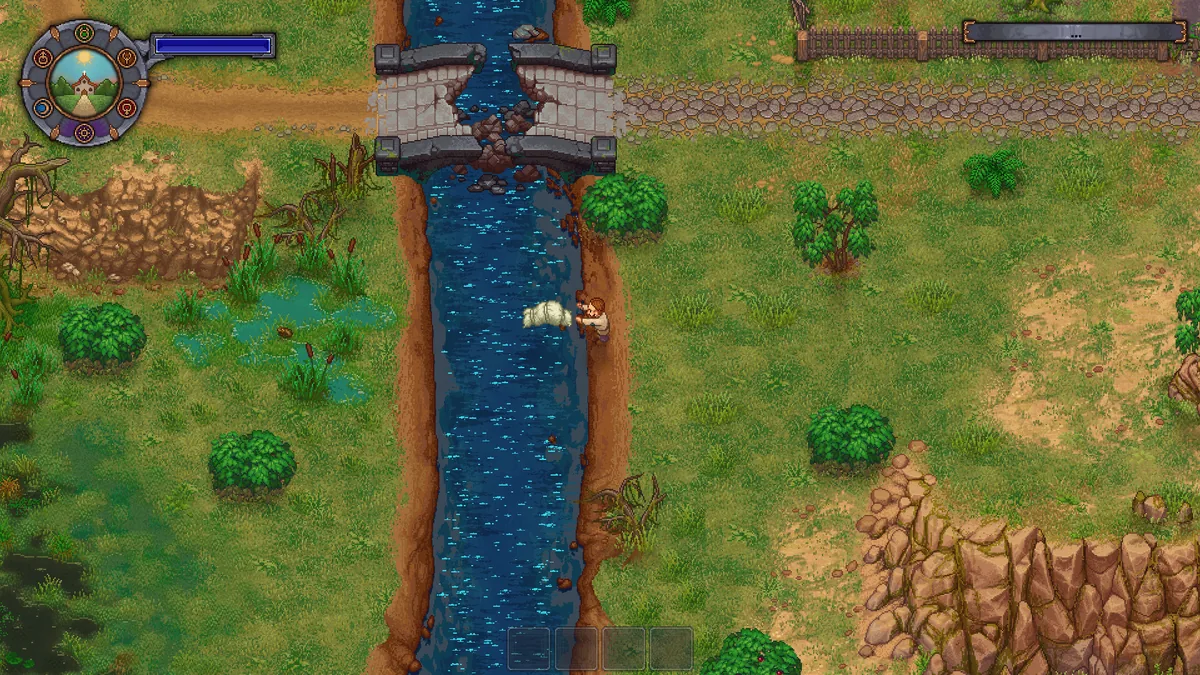 The original's official Steam screenshot shows the smaller 2D pixel-art presentation that the sequel expands into a 3D world.
This does not make the sequel automatically more atmospheric. It makes the comparison different. The original's pixel-art presentation concentrates attention on readable tiles, rooms, and the cemetery. The sequel can make the restored Town feel more spatial and explorable, but players who value the first game's visual identity may see the move to 3D as a change in character rather than a simple upgrade.
Difference 5: the player role and pacing shift
The original's store framing is that of a graveyard keeper who expands a strange business. Graveyard Keeper 2 calls the player the Grand Inquisitor and ties that role to restoring the Town and saving the realm with an undead army. That framing changes the destination of the work. You are still processing resources and tending a cemetery, but the sequel gives the job a larger civic and military brief.
The pacing tools change too. The official developer post says the sequel keeps the Technology Tree, adds talents, reduces grinding, and uses Milestones for fast travel. It also says some character mechanics still happen on designated days. Those details suggest a revised rhythm, not a total rejection of the original's calendar-based structure.
The story is designed to welcome newcomers. The same announcement says the sequel should be interesting and understandable for players who begin with the second game, while old friends and new characters continue the story. That is why “play the original first” is a preference rather than a requirement supported by the available sources.
How to choose between the two
This is an editorial fit check based on the verified differences above. Demand for this exact comparison is unconfirmed, so the recommendation is a reading of the source-backed systems rather than a claim about what most players prefer.
1. Choose the original for the concentrated cemetery loop: Pick Graveyard Keeper if the appeal is corpses, graveyard quality, crafting, quests, ethical choices, and dungeon exploration without the sequel's explicitly advertised Town-defense layer.
2. Choose the sequel for settlement management: Pick Graveyard Keeper 2 if restoring businesses, rebuilding a Town, generating profits, and seeing the settlement respond to your work are the main draw.
3. Choose the sequel for automation and defense: Conveyor-belt factories, zombie production, barricades, towers, squads, and Town battles are the clearest reasons to move to the second game.
4. Start with either story if you prefer: The official developer statement says the sequel is designed to be understandable to new players. Starting with the original still gives more context for the Keeper, familiar faces, and the world that the sequel continues.
Review context: what players were comparing
Steam review snapshots help show the launch context, but they should not be turned into a definitive verdict. During the September 29 research check, the English Steam page showed the original at Very Positive with 84% positive from 17,378 reviews. The sequel showed Very Positive with 81% positive from 2,218 reviews.
Those numbers are not apples-to-apples. The original has had years to accumulate a much larger review pool, while the sequel's score reflects a launch window and a smaller sample. The comparison can fairly say that both pages showed positive reception at the time of research. It cannot fairly say that the two percentages measure the same stage of development or prove which game is better.
Community discussion on the Graveyard Keeper subreddit is useful for spotting questions about the sequel's map, combat, automation, and presentation. It is not used here as authority for a mechanic. Official store pages and developer announcements establish the differences; player discussion supplies context for what people are trying to compare.
Frequently Asked Questions
What is the biggest difference between Graveyard Keeper and Graveyard Keeper 2?
The original foregrounds the cemetery and nearby ventures. The sequel keeps that core but makes Town restoration, factory automation, zombie armies, and Town defense central advertised systems.
Do both Graveyard Keeper games manage a graveyard?
Yes. The sequel preserves the medieval graveyard premise, resource gathering, crafting, and Technology Tree while adding the Town, automation, talents, and defensive army systems.
Is Graveyard Keeper 2 3D?
Yes. The official developer announcement describes the sequel as a world made in 3D. The original Steam page uses 2D and Pixel Graphics tags.
Does Graveyard Keeper 2 add combat?
It adds a structured Town-defense loop with street arenas, waves, control points, barricades, towers, zombie squads, banners, and combat potions. The original page foregrounds dungeon exploration instead.
Do I need to play the original before Graveyard Keeper 2?
No requirement is stated. The developer says the sequel is designed to be understandable for new players, though the original can provide context for returning characters and the Keeper.
Which game should I play first?
Play the original for a more concentrated graveyard and corpse-management focus. Play the sequel for Town restoration, conveyor-belt automation, zombie armies, and a larger 3D world. That is an editorial recommendation.
Related Reading
- Graveyard Keeper 2 Release Date, Price, and Platforms: Confirm the sequel's launch date, Steam price, and available platform details.
- Graveyard Keeper 2 Calendar and Workshop Hours Guide 2026: See how the sequel's calendar and Workshop Hours shape its pacing and scheduled systems.
- Graveyard Keeper 2 Achievements Guide: The exact 38-achievement Steam roster, with unverified conditions marked.
- Graveyard Keeper 2 PR Machine Guide: Unlock and Use It: A focused look at the sequel's PR machine, quest progression, upgrades, and weekly runs.
- Graveyard Keeper 2 Factory Layout Guide: A practical sequel companion for production space and routing.
- Graveyard Keeper 2 Multiplayer: Is There Co-op in 2026?: Check the current single-player status before choosing the sequel for a shared playthrough.
- Graveyard Keeper 2 Zombie Army Battle Guide: The Town defense systems named in the official combat post.
- Graveyard Keeper 2 Beginner Guide: Early priorities for players starting with the sequel.
- Best Base-Building Colony Sims: A broader comparison of settlement and management loops.
- Best Indie Automation and Logistics Games: Genre context for conveyor-belt production and routing.
- Shapez 2 Advanced Automation Guide: A deeper belt-routing reference for factory-minded players.
- Romestead Trading Post Logistics Guide: Another example of settlement economy and production planning.
- Graveyard Keeper 2 Complete Guide: the hub linking every Graveyard Keeper 2 guide, from release facts to battles and Town reputation.
References
- Graveyard Keeper on Steam: Official original description, tags, features, and review snapshot.
- Graveyard Keeper 2 on Steam: Official sequel description, systems, platform details, and review snapshot.
- Lazy Bear Games: Graveyard Keeper 2: Developer overview of automation, Town restoration, fortifications, armor, and zombie troops.
- Old World: New Story: Official story and world-scope comparison, including the Technology Tree, talents, fast travel, 3D presentation, and new locations.
- Let's talk Combat: Official Town battle arenas, objectives, defenses, zombie squads, banners, and combat tools.
- Graveyard Keeper 2 official announcements: Official Steam news feed checked for developer statements and launch context.
- Graveyard Keeper subreddit: Community context checked for current comparison questions, not used as authority for mechanics.
- Graveyard Keeper 2 official launch video: Official tinyBuild launch context.
About the author

Critical game theorist with a background in film criticism. Writing for print and digital outlets since 2015. Specialises in genre analysis and design heritage.
- Background in film criticism
- 10 years games coverage
- Genre theory and design history specialist
Keep reading

Graveyard Keeper 2 Complete Guide: Town, Factory, Battles
General · 13 min
Graveyard Keeper 2 Guide: First Hours in Order (2026)
General · 14 min

Graveyard Keeper 2 Patch Notes: Updates Through 1.007
General · 11 min

Graveyard Keeper 2 Calendar and Workshop Hours Guide 2026
General · 13 min

Graveyard Keeper 2 Release Date, Price, and Platforms
General · 11 min

Graveyard Keeper 2 PR Machine Guide: Unlock and Use It
General · 17 min

Disclaimer
This article is published for informational and entertainment purposes. It does not constitute professional financial, legal, or technical advice. Game performance, online services, patch schedules, and store listings change. Verify critical details (pricing, system requirements, regional availability) with publishers and storefronts before you buy. Affiliate links, where present, help support our editorial work and are labelled in our affiliate disclosure.
Comments
Loading comments…