
GameBrief · General
Romestead Trading Post: Logistics and Routes Guide 2026

Reviewing
Romestead
The Romestead trading post is a late-unlock building that most players hit a wall trying to set up. The unlock chain is three steps deep, the batch-size bug that jams routes isn't explained anywhere in the UI, and the Logistics Tent mechanics that feed into it are distinct enough to deserve their own treatment. This guide covers both systems from scratch. The goal is to get you past stuck shipments and into a working multi-settlement economy.
TL;DR: The Romestead trading post requires Altar level 3, Mercury's quest, and 30 Research Papers at the University. Build one in each settlement, assign a citizen to each, and keep batches at 5 items or fewer to avoid the storage-jam bug. The Logistics Tent (unlocked by killing the Cyclops in the Desert biome) handles within-settlement automation; the Trading Post handles between-settlement transfers. Don't export food below your buffer or first-copy boss drops.
How does the Romestead trading post work? (quick answer)
The Trading Post transfers basic resources between your settlements. You build one in each town you want to connect, assign a citizen to each post, and then create a route that specifies what goods move, from where, and to where. Goods physically travel the route on a cycle. The prerequisite chain is Altar level 3 + Mercury's quest + University research at a cost of 30 Research Papers. The building itself costs 8 Lumber and 6 Stone and occupies a 10x11 footprint.
Romestead trading post and logistics: key takeaways
- Logistics Tent unlocks after the Cyclops boss (Desert biome); Trading Post unlocks via University research (30 Research Papers)
- Both systems are distinct: Tent = within one settlement, Trading Post = between settlements
- Send batches of 5 items maximum per route to avoid the storage-jam bug
- Assign a citizen to every Trading Post or routes do not process
- Never automate food below buffer, first-copy boss drops, or active building materials
- Fuel for Bakeries and Blacksmiths still requires manual management in the current EA build
- Delete a route by clicking directly on the arrow line on the map
The Logistics Tent: local automation first
Before the Trading Post becomes useful, your within-settlement logistics need to work. The Logistics Tent is what makes that possible.
You get the Logistics Tent as a reward for defeating the Cyclops boss in the Desert biome. Before that fight, every resource transfer in your town is manual. After it, you can connect buildings so goods move on their own.
Setup is simple: place the Logistics Tent near your production core, open the logistics menu, and draw a connection line from one building's output to another's input. The most common first chain is:
Farmstead output connected to Watermill input, Watermill output to Bakery input, Bakery output to Food Storage input. Once that chain is live, wheat becomes bread without a single manual haul.
A few mechanics worth knowing before you start linking everything:
Farmers and carpenters automate without the Tent. Farmers auto-plant and auto-harvest crops placed inside their work area. Carpenters carry materials to build sites automatically when set to construction mode. Everyone else needs Logistics Tent links to move goods.
Fuel is the exception. Bakeries, Blacksmiths, and Pottery buildings can't pull fuel from nearby wood or coal storage automatically. Brick Furnaces are the only fuel-consuming buildings that auto-draw wood. For everything else, position a dedicated quarry output connected directly to the fuel input, or manage fuel by hand. This came up repeatedly in Steam discussions during the May 2026 build, and there's no workaround beyond direct logistics chains.
Editing and deleting routes. Open the logistics menu to adjust connections anytime. To delete a route, click directly on the arrow line visible on the map. A popup appears with a delete option. A lot of new players miss this and assume routes are permanent.
GODEEPER: The Logistics Tent drops from the Desert biome Cyclops, but getting there means clearing the Plains biome first. Romestead Biome Guide: All 4 EA Biomes Explained
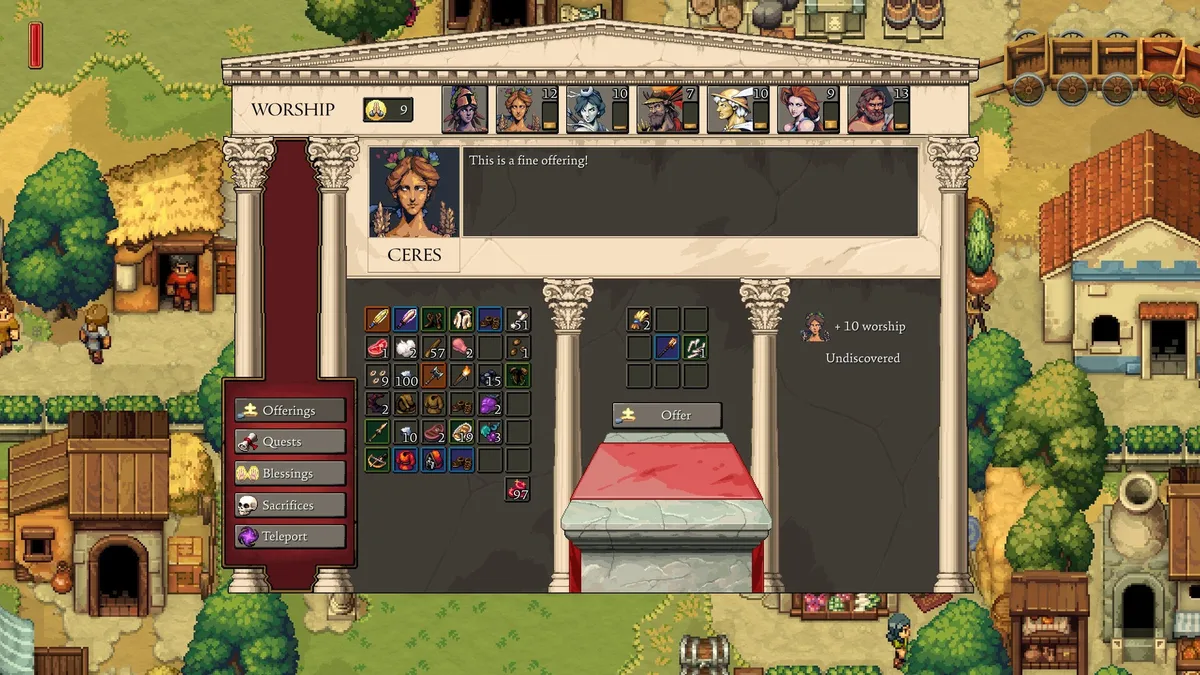 The Altar's worship menu. Getting the Trading Post built starts here: Altar level 3 is step one of the unlock chain covered below, well before the Logistics Tent or trade routes come into play.
Unlocking the Trading Post: three steps
The Trading Post sits behind a three-step prerequisite chain. Players who skip a step get blocked without a clear error message.
Step 1: Altar level 3. Upgrade your Altar through the god offering system. This isn't a build cost; it's cumulative worship investment. You need to reach level 3 on the Altar itself before the Mercury quest becomes available.
Step 2: Mercury's quest. At your Altar, accept Mercury's quest. The entry cost is 1 Traveler's Coin and 1 Research Paper. Completing this quest unlocks the University. Don't spend your only Research Paper here if you haven't found more yet. The quest takes one; hold at least two before you start so one stays available for University research momentum.
Step 3: University research. Build the University (1 Workbench + 4 Lumber + 6 Stone + 8 Brick, unlocked after Mercury's quest). Assign a citizen as a Philosopher inside. The Philosopher generates Research Papers steadily over time. Then research the Trading Post in the University's tech tree at a cost of 30 Research Papers.
After that research finishes, the Trading Post becomes a buildable structure. Build one in each settlement you want to connect (8 Lumber + 6 Stone per post), then assign a citizen to each. Without citizens assigned at both ends, routes won't process.
Step-by-Step: Setting Up Trade Routes Safely
Players figured this out through trial and error in Steam discussions. The short version: test small before automating at scale.
1. Verify local Logistics Tent links work first. If your within-settlement chain is broken, the Trading Post makes the problem harder to diagnose, not easier. Run one local production chain to completion before touching inter-settlement routes.
2. Pick one low-risk resource for the first route. Stone, Lumber, or surplus food after reserves are confirmed. Don't start with your primary food supply or rare materials.
3. Send small batches. Set the transfer amount to 5 items per cycle, not 15 or 25. The batch-size bug is real: if a batch arrives and no single storage building at the destination can hold the full amount, the shipment locks at the route's end and stops all subsequent deliveries on that route. Batches of 5 rarely exceed individual storage capacity. Once a route runs clean for several cycles, you can try increasing the batch size, but test one increment at a time.
4. Check destination storage before routing. The receiving settlement needs storage with room to accept incoming goods. A settlement with full chests jams any route pointed at it regardless of batch size.
5. Name a route owner in co-op. In multiplayer, designate one player as the route owner for each connection. Two players editing the same route simultaneously can corrupt the configuration. One player owns a route; the other checks the destination.
6. Save, quit, and reload after setting routes. Routes persist through a save-reload cycle. Confirm they do before relying on them for production.
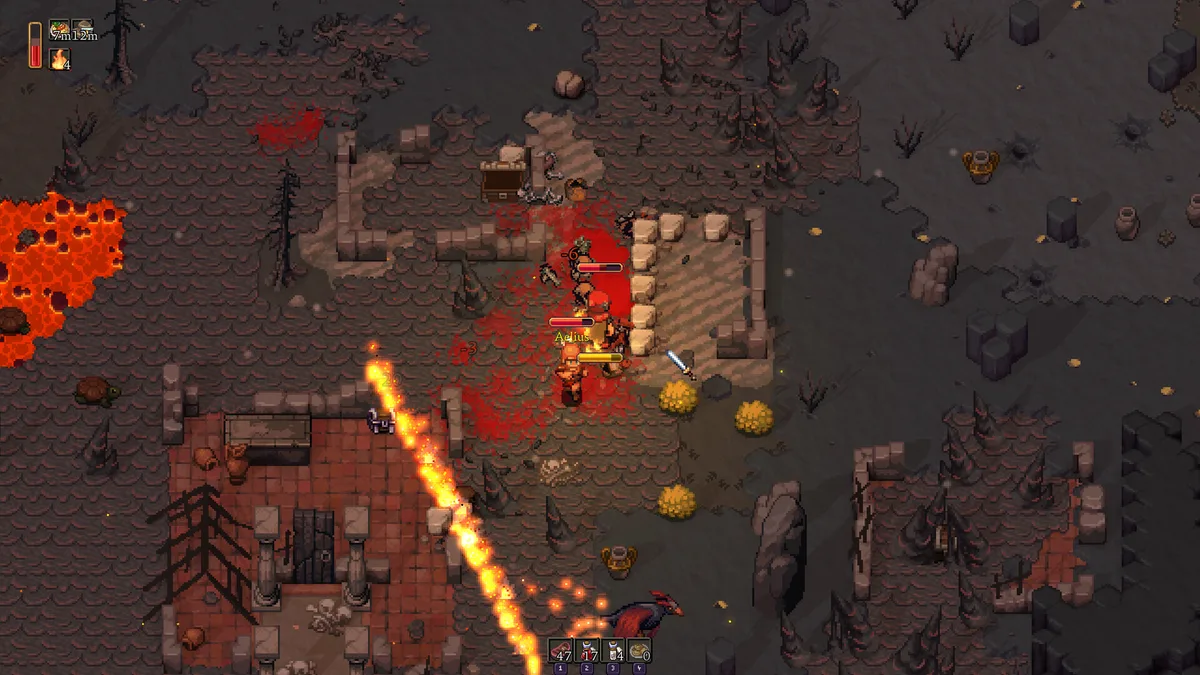
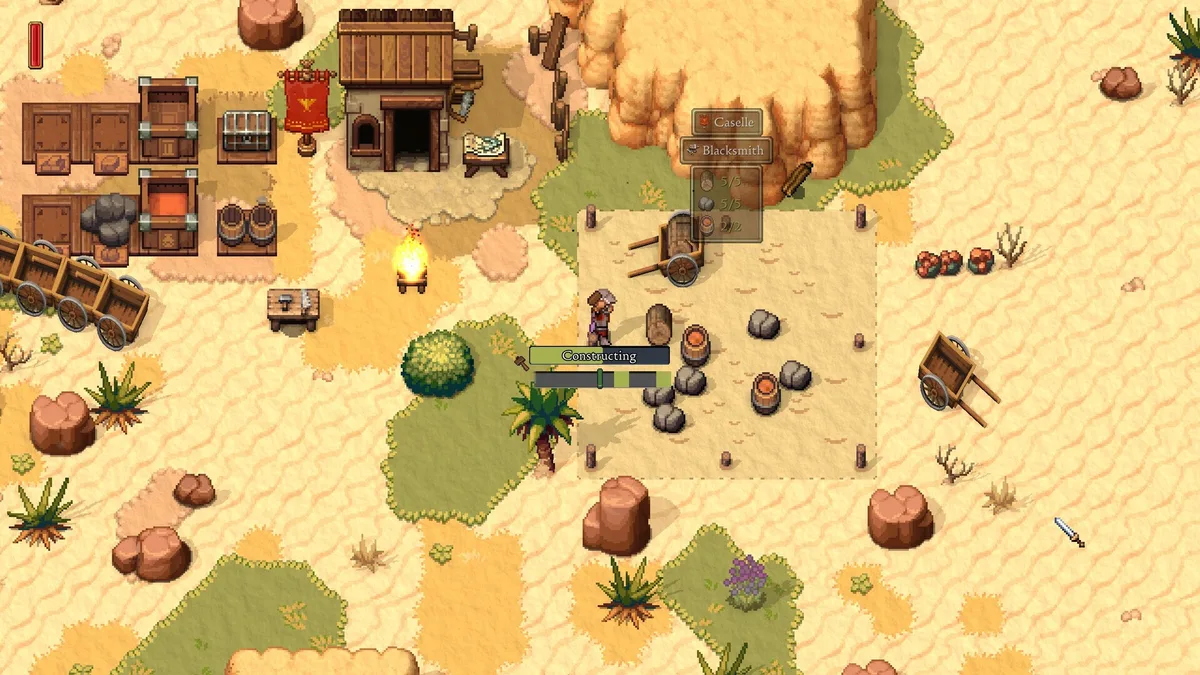 A Blacksmith going up in the desert biome. Buildings like this are exactly why the fuel automation gap matters: without a direct logistics chain, someone has to keep the furnace fed by hand.
What to export and what to protect
The Trading Post exports whatever you tell it to. A badly designed route can empty a settlement's food reserves while you're inside a dungeon.
Never export:
- Food below your buffer. Keep a two-day food reserve at the source settlement before any food routes run. If reserves dip below that floor, the route shouldn't be active.
- First-copy boss drops. New dungeon items may be needed for quests, god offerings, or building unlocks you haven't discovered yet. Store them manually until you understand each item's purpose.
- Active building materials. If you're mid-construction, keep that Lumber and Stone local. A route that exports your construction supplies stalls your build.
- God offering materials. These aren't surplus. Export them and you lose worship progress that takes days to rebuild.
Safe to export:
- Confirmed surplus after at least one full production cycle has run and reserves are intact
- Second and third copies of boss drops once you know what the first was used for
- Common materials that your source settlement regenerates faster than the route drains
GODEEPER: Understanding what each god wants keeps your offering materials safe from accidental export. Romestead God System Guide: All 7 Deities and Blessings
Common logistics mistakes
Linking everything before testing one chain. The appeal of a fully automated settlement is real. But build one chain, confirm it runs cleanly for three in-game days, then add the next. A broken link anywhere in a long chain is hard to locate when five routes are running simultaneously.
Sending full-stock batches. Setting a route to transfer "all available" Stone sounds efficient. If your second settlement's storage fills mid-delivery, the batch jams and subsequent routes on that connection stop. Cap transfers at a number your destination can actually absorb.
Forgetting citizen assignment. Building the Trading Post isn't enough. The post needs a citizen assigned, the same way a Blacksmith needs a worker. Players who build both posts and see nothing happening almost always find the issue here.
Treating the Trading Post as an emergency fix. If your main settlement is running out of food, routing food from a secondary settlement won't save it in time. The Trading Post handles planned, steady-state transfers. By the time you realize the main town is starving, the route cycle is too slow to help. It's a surplus-movement tool, not a crisis response.
Ignoring fuel chains. Because Bakeries and Blacksmiths don't auto-pull fuel, players who automate production chains without accounting for fuel end up with a Bakery that has wheat but no wood and simply stops. Set up a direct quarry-to-furnace logistics chain, or check fuel levels manually every session until the developers add automation for it.
Frequently Asked Questions
How do you unlock the Trading Post in Romestead? You need to do three things in order: upgrade your Altar to level 3, complete Mercury's quest (costs 1 Traveler's Coin and 1 Research Paper to accept), and then research the Trading Post at the University. That final research step costs 30 Research Papers. The build itself needs 8 Lumber and 6 Stone, and you must place one in each settlement you want to connect.
How does the Logistics Tent work in Romestead? The Logistics Tent links building outputs to other building inputs so resources flow automatically without you hauling them. You place the tent near your production core, open the logistics menu, and draw a connection line from one building's output slot to another's input. Resources then move on their own. You unlock it by defeating the Cyclops boss in the Desert biome.
Why are my trade routes getting stuck in Romestead? The most common cause is sending a batch larger than any single storage building at the destination can hold. If you send 15 Iron and no one storage chest can accept 15, the shipment stalls at the end of the route. Fix it by sending smaller batches of around 5 items, or by building more storage at the destination before adding high-volume routes.
What goods should I never export via trade routes in Romestead? Never export food below your settlement's buffer reserve, first-copy boss drops, current building materials mid-construction, fuel going to active Bakeries and Blacksmiths, and God offering materials. Export only confirmed surplus that the source settlement can replace within one game day.
Can citizens automatically haul fuel to Bakeries and Blacksmiths in Romestead? Not in the current Early Access build. As of May 2026, Bakeries, Blacksmiths, and Pottery buildings cannot automatically pull fuel from nearby wood or coal storage. You need to manage fuel manually or use a dedicated quarry-to-furnace logistics chain. Brick Furnaces are an exception and can pull wood fuel automatically.
What is the difference between the Logistics Tent and the Trading Post in Romestead? The Logistics Tent handles within-settlement automation: it connects buildings inside one town so resources flow from production to storage to the next production step. The Trading Post handles between-settlement automation: it creates routes that physically move goods from one town to another. You need both systems working for a fully automated empire.
Do I need a citizen assigned to the Trading Post in Romestead? Yes. A citizen must be assigned at each Trading Post for inter-settlement routes to function. Without an assigned worker, the route will not process. In co-op, one player should be designated as the route owner for each inter-settlement connection to avoid conflicting edits.
Related Reading
- Romestead Buildings Guide: All Buildings and Build Order: covers the Logistics Tent's position in the build order and every production building you will be connecting.
- Romestead Denarius Guide: How to Make Money Fast 2026: explains the olive oil export chain that becomes your primary trade income once logistics automation is running.
- Romestead Research Papers Guide: How to Get Them Fast 2026: the 30 Research Papers for Trading Post unlock are the biggest bottleneck; this guide shows the fastest farming path.
- Romestead Biome Guide: All 4 EA Biomes Explained: the Cyclops (Logistics Tent unlock) is the Desert biome boss; this guide covers the full progression path to reach it.
- Romestead Villagers Guide: Recruit, Assign and Keep Happy: Trading Posts and Logistics Tents both need citizens assigned; this guide covers how to recruit and match workers to buildings.
- Romestead Professions: All 8 Starting Classes Ranked: Romestead professions guide: all 8 starting classes ranked, what each gives at creation, and why.
- Romestead Bosses: All 5 Bosses and How to Beat Them: Romestead bosses guide: all 5 bosses ranked by order, from the Guardian of Minerva to.
- Romestead Roadmap 2026: What Beartwigs Has Confirmed: Romestead roadmap 2026: one more biome is confirmed for a winter release, still unnamed, plus everything else Beartwigs said.
- Romestead Review: Roman Survival That Earns the Raid: Romestead review: Beartwigs' Roman survival town-builder: undead night raids, god system tech trees, and 1-8.
References
- Romestead on Steam (app 1805320): store page, developer Beartwigs, publisher Three Friends, EA launch May 25 2026
- Steam discussion: How do I setup a trade route?: community-sourced batch-size fix and citizen assignment requirements
- Steam discussion: What exactly can NPCs move automatically?: NPC automation scope, farmer and carpenter behavior
- Steam discussion: Better logistics: fuel automation limitations confirmed
- Romestead Wiki: University: University build requirements and unlockable technologies list
Was this guide helpful?
About the author

Senior Critic & Analyst
Former game data analyst turned critic with 11 years covering indie and mid-tier games. Based in Austin. Runs spreadsheets on games most people just play.
- 11 years games criticism
- Former game economy analyst
- Roguelike and strategy specialist
Keep reading

Disclaimer
This article is published for informational and entertainment purposes. It does not constitute professional financial, legal, or technical advice. Game performance, online services, patch schedules, and store listings change. Verify critical details (pricing, system requirements, regional availability) with publishers and storefronts before you buy. Affiliate links, where present, help support our editorial work and are labelled in our affiliate disclosure.
Comments
Loading comments…