
GuideRomestead
Romestead Co-op Guide: 1 to 8 Players, Roles, Scaling
This Romestead co-op guide covers the mechanics most players discover through failure: the role split that actually works at each group size, what wave scaling means in practice, and why the Altar matters more in multiplayer than solo. Beartwigs designed Romestead to run 1 to 8 players, and that range produces very different games depending on how many people are at the table.
Sponsored

About the game
Romestead
TL;DR: Romestead co-op runs 1-8 players with difficulty that scales up, not down. Solo is hardest. Two players should split builder (Altar, construction, resources) and fighter (Blacksmith defense, perimeter patrol) cleanly. Four or more players need a dedicated god-system manager and at least one permanent Blacksmith defender during raids. Altar Level 2 unlocks settlement-to-settlement teleportation, which matters once the group is operating across multiple biomes.
Sponsored

Overview: Romestead co-op guide, how player count changes the game (quick answer)
Romestead scales difficulty to match your party size. More players means bigger waves, more enemies, and more ground to cover, not an easier time. The practical result: a solo player handles a focused but punishing challenge with no one to split tasks, while an eight-player group faces larger raids that require coordinated defense across more positions.
The solo-to-duo transition is the most meaningful change in the co-op design. Two players can establish a genuine builder-fighter split that removes the compromises solo forces on every decision. Every group size above two is a variation on that split, adding specialization as the session demands it.
Role split by player count: step-by-step
The scaling pressure pushes groups toward clear roles. Blurring those roles during raids is one of the main reasons settlements fall.
Solo (1 player) You're the builder, fighter, god manager, and production overseer simultaneously. Prioritize in this order during daylight: Altar first (required for god worship and Favor Point accumulation), Blacksmith second (gated behind the Guardian of Minerva quest), torch coverage around both before the first night. Roaming enemies before the first night don't drop anything worth the time cost; defer them unless they're actively threatening a building.
Two players The natural split: one player builds and manages god offerings, one handles perimeter patrol and Blacksmith defense. This is more efficient than both players splitting every task halfway. The builder owns the Altar entirely: Favor Point tracking, offering timing, and Blessing decisions. The fighter's sole priority during night raids is the Blacksmith position, not the perimeter walls.
The builder monitors the Blacksmith from a construction position and calls out breach direction. The fighter intercepts before the fallen reach the building. Agree on this pattern before the first raid; it holds together better when it's explicit than when players are improvising under pressure.
GODEEPER: Every god's domain, how Favor Points accumulate across both worship systems, and which god to invest in first after Minerva. Romestead God System Guide: All 7 Roman Gods Explained →
Three to four players Three players can add a dedicated god-system role to the builder-fighter split. This third player generates Favor Points specifically: completing god-specific tasks in the field, timing offerings to avoid Blessing overlap, unlocking divine knowledge as bosses go down. Their contribution shows up in the tech tree speed more than in immediate combat or construction output.
Four players is where production building defense becomes a full role. The fallen route toward the Blacksmith specifically. With four players, one defender can hold the Blacksmith position through an entire night raid while the others handle the wave perimeter. Torch coverage suppresses adjacent spawning but doesn't stop the fallen from targeting the building once they're in range. That defender is doing active combat, not just watching.
Five to eight players Eight-player sessions need multiple simultaneous operations. Day: split into a build team (Altar, production buildings, torch placement), a resource team (mining, lumber, food), and a scout team (biome exploration, boss preparation, enemy clearing). These aren't fixed roles; players rotate based on what's bottlenecking, but the coordination effort rises sharply above four.
At night, raid scale at eight players requires defenders at multiple priority positions. The Blacksmith stays the highest priority, but Lumberyard and Farmstead operations become secondary targets in later nights. Base defender positions on your current production infrastructure, not on wall perimeter spacing.
Four-player role split at night: one builder on torch and Blacksmith coverage, three fighters on perimeter. This is the cleanest configuration.
Wave scaling: more players, harder raids
Beartwigs confirmed during the Early Access lead-up to the May 25, 2026 launch that difficulty scales with player count. The wave composition adjusts for group size. Bringing more players doesn't reduce the challenge; it recalibrates it to match.
The practical consequence: a six-player raid is harder than a two-player raid in absolute terms. What changes is your capacity to manage that harder raid through role specialization: more builders means faster construction, more fighters means better Blacksmith coverage, a dedicated god manager means faster tech tree progression. The difficulty doesn't go away; you get better tools to handle it.
This differs from survival builders where multiplayer becomes low-stakes once you have enough bodies. Romestead doesn't have a player count at which night raids are irrelevant. Solo is genuinely the hardest configuration because there's no role division, but the solo game is calibrated for that: it's a harder experience, not an impossible one.
The first night is the highest-risk point regardless of group size. A two-player session that hasn't established torch coverage around the Blacksmith before nightfall is in the same danger as a solo player who skipped the same step. Scaling doesn't protect you from preparation failures.
Altar and god system: delegate before the first offering
In a co-op session, every player can interact with the Altar. This creates an efficiency problem: if two players independently make offerings toward different gods, the Blessing system activates only one god at a time, and the momentum built toward the non-active god is partially lost.
Assign one player as god-system manager before starting. That player makes all Altar offerings, tracks Favor Points for each god, and communicates which god is the current priority before any player takes an action that generates Favor. The god-system manager needs regular access to the Altar, which makes them builder-adjacent rather than fighter-adjacent.
Divine knowledge unlocks come from boss drops and advance god-specific progression. In co-op, the progression is shared; the knowledge unlocks for the settlement, not for the individual player who lands the final blow. The god-system manager should flag which boss drops which divine knowledge before major attempts, so the group knows what the next worship tree step is and can plan Favor Point allocation accordingly.
One god is active at a time through the Blessing system. In practice, early sessions should consolidate on Minerva (whose defeat unlocks the Blacksmith and provides the first divine knowledge drop) before diversifying. Post-Plains, the god investment decision becomes the most important strategic choice in co-op: it gates your tech tree direction, your available buildings, and your combat development. Make it deliberately, not by whoever happens to be at the Altar.
GODEEPER: Torch placement strategy, why walls-first is wrong for the first night, and how raid difficulty changes across multiple playthroughs. Romestead Night Raid Guide: Defend Against the Fallen →
Night raid co-op defense tips
The fallen navigate toward your Blacksmith as the priority target in every raid. Walls slow their approach; they don't redirect it. Defense positioning in co-op should put your highest-priority defenders between the raid entry and the Blacksmith, not along the outer perimeter.
Torch coverage around the Blacksmith is the builder's most important first-night task. Torches lit around the building reduce adjacent enemy spawning before the raid starts. If the Blacksmith doesn't have torch coverage by nightfall, enemies can spawn inside your production zone, not just outside the walls. This problem is harder to fix mid-raid than it is to prevent with twenty minutes of torch placement.
The fighter's night-raid job is Blacksmith protection. Not gate defense, not wall patrol, not chasing runners into the dark. The Blacksmith. In two-player sessions, the builder calls breach direction from a construction position with sightlines toward the Blacksmith approach. The fighter intercepts before contact.
In four-player sessions, rotate defenders through the Blacksmith position rather than stationing one player there through the full raid. Night raids run long enough that a single player holding position continuously loses combat effectiveness from resource depletion. Two-minute rotations keep all defenders at full fighting capacity through the wave.
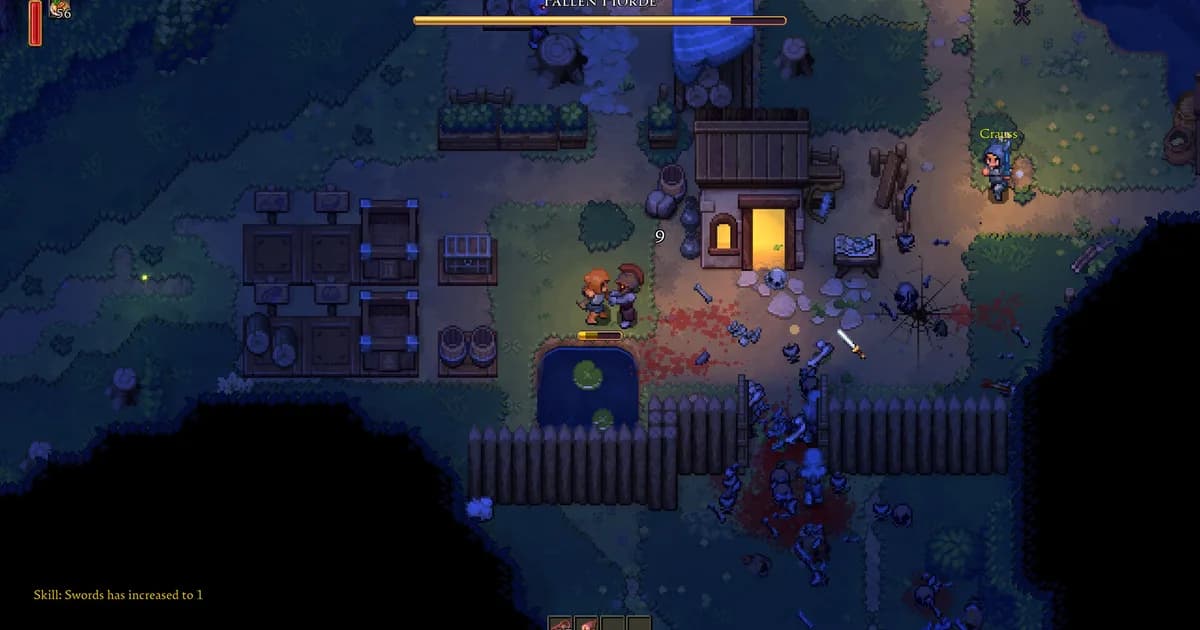
The Blacksmith under night raid pressure. Fallen navigate to it before targeting walls. Torch rings around the building cut adjacent spawning before the wave starts.
Altar Level 2: teleportation for multi-biome operations
Altar Level 2 unlocks settlement-to-settlement teleportation. This becomes significant once the group is operating across multiple biomes simultaneously.
Without it, a player working in the Forest on Lumberyard infrastructure while the main group holds the Plains has to travel the full biome distance to reach a raid response position. That travel time is raid time. In an eight-player session where some players are always at biome boundaries, this travel gap matters.
Altar Level 2 changes the logistics: players can commit to remote biome work without accepting that they'll be absent from raids. The teleport returns them to the main settlement in seconds. After the raid clears, they teleport back to the remote position.
Timing: prioritize Altar Level 2 before major Forest or Desert expansion pushes. It provides little value while operations are concentrated in the Plains, but becomes a significant force multiplier the moment the group starts splitting between biomes.
Key takeaways
- Romestead supports 1-8 players. More players increases wave size. The game gets harder with more people, not easier.
- Solo is the hardest configuration: you manage both building and combat with no role division.
- Two players: split builder (Altar, construction, resources) and fighter (Blacksmith defense, perimeter) cleanly. Keep the split consistent during raids.
- Four or more players: add a dedicated god-system manager and at least one permanent Blacksmith defender.
- The fallen target the Blacksmith first. Defense positioning should reflect this.
- One player should own all Altar offerings in a co-op session. Multiple players making conflicting offerings toward different gods wastes Favor momentum.
- Prioritize Altar Level 2 before expanding into the Forest or Desert biomes to unlock teleportation.
Related Reading
-
Romestead Night Raid Guide: Defend Against the Fallen: Torch placement strategy, Blacksmith targeting logic, and how raids scale across multiple nights.
-
Romestead God System Guide: All 7 Roman Gods Explained: All 7 gods, the two-system worship mechanic, and which to prioritize after Minerva.
-
Romestead Biome Guide: All 4 EA Biomes, Bosses, Resources: Biome-by-biome breakdown with boss HP values, gear tiers, and Lumberyard building restrictions.
-
Romestead Survival Tips Guide 2026: First-session advice, resource timing, and the early mistakes that end settlements.
-
Romestead Complete Guide Hub: All Romestead guides for the current Early Access build in one place.
-
Romestead Denarius Guide: How to Make Money Fast 2026: Romestead denarius is the coin you pull from dungeons and treasure, not trading. Here is how to make....
-
Romestead Research Papers: How to Get Them Fast 2026: Romestead research papers drop from volcano dungeon chests. Here is where to farm them, the University build cost,.
References
- Romestead on Steam: store page, EA launch details, patch notes
- Romestead Wiki: community-maintained mechanics documentation
- r/Romestead community: player co-op strategies and role advice
- Romestead Devlog VIII (Beartwigs): EA launch announcement confirming difficulty scaling with player count
Frequently Asked Questions
How many players can play Romestead at once? Romestead supports 1 to 8 players in co-op, with difficulty scaling for all group sizes. Developer Beartwigs confirmed the challenge adjusts to player count, not stays flat.
Is Romestead harder with more players? Yes. Adding players scales up wave size proportionally. Solo is hardest (no role division), duo gets a natural builder-fighter split, and larger groups manage bigger raids through specialization.
What is the best role split for 2 players? Builder (construction, Altar, resources) and fighter (Blacksmith defense, perimeter patrol). Keep the split clean during raids. Both players doing half of everything is less effective than each owning one role.
Does Romestead have cross-platform co-op? Not applicable. Romestead launched on PC via Steam only in May 2026. No console versions exist, so all players must be on Steam.
What does Altar Level 2 unlock in Romestead? Altar Level 2 unlocks settlement-to-settlement teleportation. In multi-biome co-op sessions, this lets players working remotely return to the main settlement for raids instantly, then teleport back.
Why do enemies always attack the Blacksmith first? The fallen navigate toward the Blacksmith as the priority production building; destroying it halts all metalwork and crafting. Defense positioning should place defenders between the raid entry and the Blacksmith, not just along outer walls.
How should the god system work in co-op? Assign one player as god-system manager before the first offering. They make all Altar offerings, track Favor Points, and communicate which god is being prioritized. Multiple players making independent offerings toward different gods wastes momentum since only one Blessing is active at a time.
Was this guide helpful?
About the author

Systems & Economy Desk
GameBrief's byline for roguelikes, strategy and simulation. Reads patch notes, wiki tables and Steam stats and puts the numbers on the page.
- Roguelikes, strategy and simulation
- Builds, progression and economy
- Sources listed per article
Keep reading
Romestead Updates: Every Patch Since Launch & What's Next
General · 4 min
Romestead Iron: Where to Find It and How to Farm It
Guides · 8 min
Romestead Villagers Guide: Recruit, Assign & Keep Happy
General · 9 min
Romestead Buildings Guide: All 25 Buildings & Build Order
General · 17 min
Romestead Roadmap 2026: What Beartwigs Has Confirmed
General · 7 min
Romestead Bosses: All 5 Bosses and How to Beat Them
General · 9 min
Sponsored
Disclaimer
This article is published for informational and entertainment purposes. It does not constitute professional financial, legal, or technical advice. Game performance, online services, patch schedules, and store listings change. Verify critical details (pricing, system requirements, regional availability) with publishers and storefronts before you buy. Affiliate links, where present, help support our editorial work and are labelled in our affiliate disclosure.
Comments
Loading comments…