
GameBrief · General
Slay the Spire 2 Complete Guide: 5 Characters and Co-op
Slay the Spire 2 complete guide: verified roster, co-op teams, Defect and Silent builds, Ascension 10, Early Access status, and current Steam reviews.
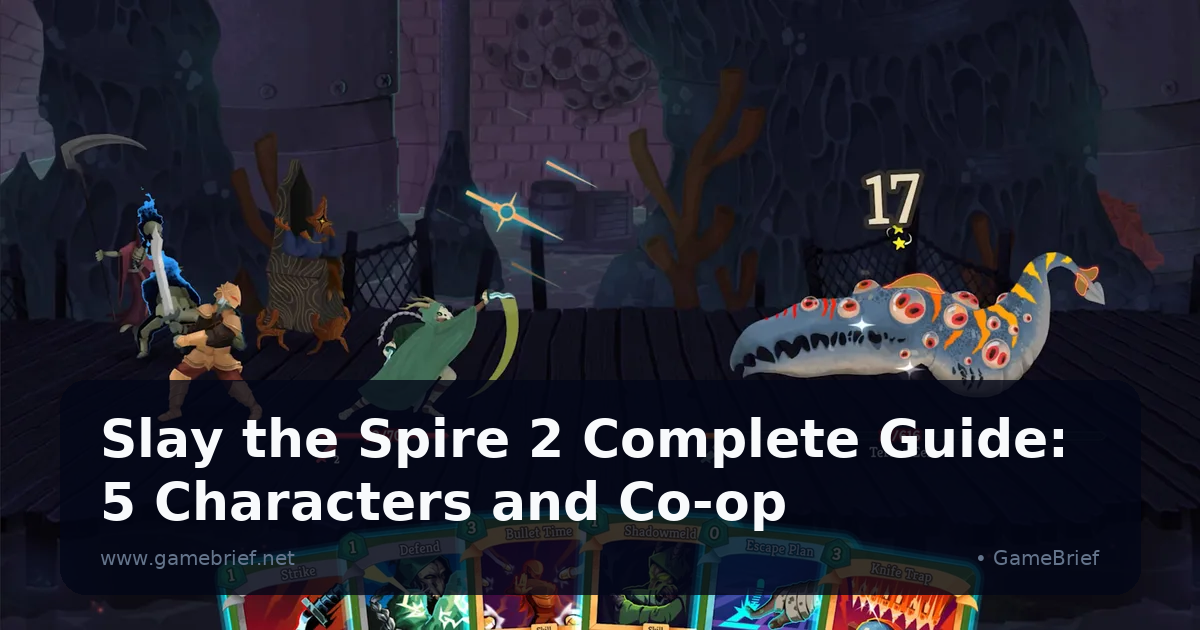
This Slay the Spire 2 complete guide is the entry point for the site's coverage of Mega Crit's Early Access deckbuilder. The sequel keeps the climb, card rewards, relic decisions, and failed-run learning loop that made the original a genre benchmark, then adds two new characters and online co-op for up to four players. The hard part is not learning one fixed build. It is knowing which facts are stable, which cards are patch-sensitive, and which character actually fits the run in front of you.
The roster needs special care. Mega Crit's official release post names five launch characters: Ironclad, Silent, Defect, Necrobinder, and Regent. The current Steam page still says five, while the August official newsletter discusses another character as work in progress. This hub uses the shipped five-character roster and treats future character work as roadmap context, not as a sixth playable choice.
The leaf guides then take different lanes. The co-op guide ranks starting pairs and explains what the new characters ask from a team. The Defect guide covers Orbs, Focus, Frost, Dark, Lightning, and Claw. The Silent guide builds a Poison plan for Ascension 10. The beginner guide explains the sequel's ten-level Ascension ladder, relic filters, potion drops, and events. The review separates the strong deckbuilding core from Early Access balance churn and the noisy Steam review history. Start with the Slay the Spire 2 Beginner Guide: All 10 Ascension Levels if you want the run systems before choosing a character.
Key takeaways
- Slay the Spire 2 launched in Early Access on March 5, 2026, developed and published by Mega Crit, at $24.99 in the US Steam store.
- The verified current roster is five characters: Ironclad, Silent, Defect, Necrobinder, and Regent. This list comes from Mega Crit's official release material and matches the current Steam page.
- Up to four players can climb together online. Steam highlights multiplayer-specific cards and team synergies, but exact interactions can change as the Early Access build evolves.
- Defect's most stable starting lane is Frost and Focus, while Dark, Lightning, and Claw are legitimate pivots when the reward stream supports them.
- Silent's Ascension 10 plan centers on Poison, Mirage, card control, and flexible answers to Scarcity and the level 10 Double Boss modifier.
- The current beginner framework has 10 Ascension levels, seven relic categories, a potion pity system, and 69 events spread across the game's zones.
- Steam currently shows 91% positive from 69,420 English reviews and 73% positive from 4,194 recent reviews. Steam also notes that off-topic review activity has been excluded from the displayed score.
- Early Access is still active. More cards, events, environments, enemies, modes, a true ending, and another character remain development context rather than promises already present in the current roster.
Current status: September 2026
The live US Steam listing currently shows Slay the Spire 2 at $24.99. Its English review panel is Very Positive at 91% from 69,420 reviews, while the recent review window is Mostly Positive at 73% from 4,194 reviews. Steam flags periods of off-topic review activity and excludes those reviews from the displayed score. Those numbers can move during Early Access, so the Slay the Spire 2 Steam page is the source to check before buying.
The game remains Early Access. Steam says Mega Crit plans more gameplay content, a true ending, additional modes, improved balance, bug fixes, wider hardware compatibility, and more languages. It also says the price will increase after Early Access. The store does not promise a fixed 1.0 date, instead describing a development window of roughly one to two years based on the original game's experience.
Mega Crit's August 14 official newsletter says the team is moving away from the previous biweekly patch rhythm while it works on larger pieces of content. It lists Steam Workshop support, initial Bestiary work, the Badge and Score system, new localization, new cards and relics, experimental modes, an alternate Act 2, and another character. The important roster distinction is that “another character” is a development item, not a sixth character you should select in the current build. For a current team recommendation, use the Slay the Spire 2 Best Duo Characters: All 5 Ranked alongside the roadmap notes.
The current build is therefore best understood as a strong run engine under active construction. A card effect, balance tier, or co-op interaction can change without making an older guide dishonest. Read patch dates, use the current in-game text, and separate a stable strategy principle from a number that belongs to one beta version.
For the purchase question, the Slay the Spire 2 Review: What the Steam Score Misses is the right companion. It evaluates the deckbuilding loop, five-character scope, co-op, technical launch, balance volatility, and the three review-bomb waves that shaped the historical score.
What is Slay the Spire 2? (quick answer)
Slay the Spire 2 is a roguelike deckbuilder in which each run builds a new deck while you climb a hostile, changing tower. Encounters offer cards, relics, potions, shops, campfires, and route choices. A run can fail because the deck lacks damage, defense, scaling, draw, or a solution to one enemy pattern. The lesson is not to memorize a winning list. It is to read the rewards and map well enough to solve the next problem.
The sequel keeps that core loop but adds a new cast around three returning characters. Ironclad, Silent, and Defect come from the original game's identity, while Necrobinder and Regent create different resource problems through Osty, Doom, Souls, Stars, Minions, and the Forgeable Sovereign Blade. The two new characters are not cosmetic variations on the old three, which is why the roster matters to a new player's first purchase and first co-op session.
Co-op lets up to four players face the Spire together. The official store specifically promises multiplayer-specific cards and team synergies. The safest way to plan around that promise is to coordinate decisions without inventing an MMO party system. “Frontline,” “engine,” “debuff,” and “resource specialist” are useful descriptions of what a player is trying to do. They are not fixed classes, threat rules, or proof that one character must absorb every hit. The Slay the Spire 2 Best Duo Characters: All 5 Ranked expands those team calls into practical two-player openings.
The sequel also asks new players to unlearn a few assumptions from the original. Ascension stops at 10 in the current guide rather than 20. The relic filter has seven categories. The event and potion pools have their own distribution rules. Current beta patches can change cards that once felt automatic. Start with principles, then let the current text and reward stream choose the specific deck. The Slay the Spire 2 Defect Build Guide: Orbs and Focus shows how that principle changes when the reward stream points toward an Orb engine.
The five-character roster and co-op roles
The official Mega Crit release article verifies this exact five-character roster:
- Ironclad
- Silent
- Defect
- Necrobinder
- Regent
Ironclad, Silent, and Defect are the returning characters. Necrobinder and Regent are the two new characters introduced for the sequel's launch roster. This is the roster used by the Slay the Spire 2 Best Duo Characters: All 5 Ranked. Mega Crit's August newsletter mentions a new character in development, but no official source used for this pillar says that character has shipped. Do not turn roadmap language into a sixth current option.
Ironclad is the most readable first anchor for a new player. The exact card pool will change, but the character's direct pressure and defensive decisions are easier to explain while another player learns the shared map and enemy intents. In a duo, Ironclad can own the question “what keeps us alive this turn?” without becoming a fictional tank class.
Silent is the sequencing specialist. Poison, Weak, draw, and evasive tools make the character strongest when the player knows whether the current turn is for setup or conversion. In a team, Silent should call out when a debuff is being built for a later turn and when the enemy is close enough that more setup is wasteful.
Defect is the engine choice. Orbs, Focus, Evokes, Powers, and several possible damage lanes ask the player to think a turn or two ahead. Defect works well in co-op when the partner can survive while the engine develops, but it is a poor choice for someone who wants every hand to be immediately obvious.
Necrobinder revolves around the reanimated hand Osty. Mega Crit's official preview describes Osty as an independent companion that can attack, take damage for the Necrobinder while it has HP, and be summoned again. The character also uses Doom, Souls, Summon, and transformation cards. Tell the team whether the current plan protects Osty as a defensive body or spends the companion for a stronger line.
Regent manages Stars, creates disposable Minions, and builds the retained Sovereign Blade with the Forge keyword. The official preview says Stars do not deplete at the end of the turn and that the Forge sequence grows the weapon's damage. A Regent player should communicate when Stars are being saved, when a Minion line is worth creating, and when delaying a Forge action is better than taking a smaller immediate reward.
For a first two-player run, the co-op leaf recommends Ironclad plus Silent. That is an editorial starting point, not Mega Crit's official tier list. Choose Defect plus Silent when both players enjoy technical engines. Choose Ironclad plus Regent when someone specifically wants to learn the new resource system with a readable partner. Choose Necrobinder when the player is interested in Osty's protection and sacrifice choices, not because the team needs a made-up healer slot.
With three or four players, give each person a decision job instead of assigning permanent MMO roles. One player can call the primary target, another can read the dangerous intent, another can explain a new card interaction, and another can watch the recovery margin for the next fight. Rotate those jobs as players learn. The more people are in the run, the more valuable a short call before spending a rare card becomes.
GODEEPER: The official five-character roster, duo recommendations, new-character mechanics, team-size advice, and patch-safe co-op habits are in the Slay the Spire 2 Best Duo Characters: All 5 Ranked →
Defect Orbs, Focus, and flexible build lanes
Defect starts with a resource engine rather than one mandatory deck. Current character data gives the starting character a Cracked Core that channels a Lightning Orb at combat start. Orbs then produce a passive effect over time and an Evoke effect when manually triggered or pushed out of the last slot. Focus improves Orb values, which means a good Defect run is usually deciding how much of the deck should support slots, draw, Focus, and Evokes rather than collecting every Orb card available.
The safest opening lane is Frost and Focus. Frost gives a defensive foundation, and Focus makes that foundation scale. Do not read “defensive” as “take only Block.” Defect still needs a way to end fights, enough draw to assemble the engine, and a plan for enemies that punish slow setup. One strong Frost card with a reliable damage line is more useful than a hand full of defensive effects that cannot close the encounter.
Dark is the burst lane. A Dark Orb asks you to protect a charge until the Evoke is worth the delay. That creates a natural co-op call: tell the partner whether the next turn is about defending the Dark Orb, adding another source of damage, or cashing it out now. The exact numbers are patch-sensitive, so preserve the principle rather than memorizing a fixed threshold from an older run.
Lightning is the group-pressure lane. It is attractive early because it does work without requiring a long setup chain, but it can become less impressive if the deck never adds draw, scaling, or a way to control the board. The right question is whether Lightning solves the current zone's enemy pattern, not whether a card was highly rated in a previous beta.
Claw is the deliberate low-cost lane. It rewards repeated plays and a deck that can keep drawing and generating Energy efficiently. It is not a reason to draft every Claw card. If the reward stream does not offer enough draw, scaling, or defense, pivot back toward a broader Orb plan before the deck becomes a novelty list.
Relics and potions decide which lane is real. A run that offers early Frost, Focus, and defensive relics can commit sooner. A run that offers Dark support but no defense needs to solve survivability before it spends every reward on burst. A run with repeated zero-cost opportunities can test Claw, but it still needs a way to survive a bad draw. Use the map to decide how many speculative fights the deck can afford while it assembles the engine.
Defect also works in co-op when the partner respects setup turns. Call out when the Orb slots are full, when an Evoke will change the enemy target, and when a rare card is being held for the next cycle. Do not assume another player can see the same future line you see. A ten-second explanation is cheaper than having two decks spend the same turn on incompatible setup. The Slay the Spire 2 Review: What the Steam Score Misses puts that co-op coordination in the wider context of the current Early Access build.
GODEEPER: The Defect's Orb and Focus fundamentals, Frost, Dark, Lightning, Claw, relic choices, common mistakes, and co-op adjustments are in the Slay the Spire 2 Defect Build Guide: Orbs and Focus →
Silent Poison and Ascension 10 planning
Silent's strongest current solo lane in this cluster is Poison supported by card control. Outbreak and Haze establish pressure, Mirage converts the total Poison on enemies into Block, and Well-Laid Plans or Expertise help keep the right card available. The point is not to copy a fixed list. The point is to create a loop in which applying Poison also gives you time to survive while the damage grows.
The deck still needs immediate answers. Poison is a scaling plan, not permission to skip direct damage, draw, Block, or potions. Early fights can kill a run before the engine matters, and a high Ascension run cannot assume a rare card will appear exactly when the guide says it should. Take the card that solves the next elite or boss when the reward stream does not support the dream deck.
Ascension 10 changes the shape of the climb. The beginner guide's current ladder ends at ten, and level 10 adds Double Boss, which forces the run to solve two Act 3 boss encounters without treating the first as the final finish line. Scarcity, at level 7, reduces the odds of finding upgraded or rare cards. That makes a flexible Poison shell more valuable than a plan that collapses if Outbreak is missing.
The right Silent habit is to ask whether a card improves the deck's next three fights, not whether it belongs to the final archetype. An early defensive card can buy the health needed to find Mirage later. A draw card can be better than another Poison source when the deck cannot assemble its existing pieces. Well-Laid Plans matters because holding the right card is a form of scaling when the encounter punishes a blind draw.
In co-op, Silent should call out whether Poison is being applied for this turn's damage or for Mirage's future Block. That distinction prevents a partner from spending a vulnerable enemy too early or from treating a setup card as wasted Energy. The Slay the Spire 2 Silent Solo Build Guide for Ascension 10 covers the solo version in more detail, including the cards that are absent from multiplayer-specific play.
Early Access patch notes matter particularly for Silent. The official beta notes have already changed Mirage, Haze, Outbreak, and other card behavior during the current development cycle. Keep the stable lesson, which is Poison plus control needs both setup and defense, but verify the exact current text before you publish a number or promise a particular upgrade. For the broader map, potion, and Ascension decisions behind that plan, use the Slay the Spire 2 Beginner Guide: All 10 Ascension Levels.
GODEEPER: Poison, Mirage, Well-Laid Plans, Ascension 10's Scarcity and Double Boss modifiers, solo mistakes, and current card caveats are in the Slay the Spire 2 Silent Solo Build Guide for Ascension 10 →
Ascension, relics, potions, and run fundamentals
New players often lose a run because they choose a build before they understand the map. Slay the Spire 2 asks you to solve the next encounter, preserve enough health to reach the next campfire, and keep the deck small enough that its important cards appear. That means the best beginner plan is a sequence of modest decisions rather than a promise that every run will become a perfect archetype.
The current beginner guide covers 10 Ascension levels. Each level adds a specific penalty, including more Elites, weaker healing, less gold, fewer potion slots, a starting curse, more expensive card removal, rarer upgraded cards, tougher enemies, and the second Act 3 boss. Do not import the original game's 20-level expectations into the sequel. The shorter ladder changes how you judge the final difficulty and how much you need to reserve for the end.
Relics are split into seven categories in the current game filters: Starter, Common, Uncommon, Rare, Ancient, Shop, and Event. Ancient relics come from Ancient encounters, Shop relics belong to the Merchant, and Event relics come from event outcomes. The category tells you where a relic can appear, not whether it belongs in every deck. A relic that is excellent for Defect Orbs can be dead weight in a Silent run that has no way to exploit it.
Potions use a pity system that makes hoarding less attractive. The beginner guide records a starting drop chance of 40 percent per fight, a decrease after receiving a potion, and an increase after missing one, with Elites adding another chance. Exact values can be adjusted in Early Access, but the durable lesson is to use a potion when it solves a fight rather than saving it for an imagined perfect emergency. A potion slot that stays full cannot receive the next useful drop.
The game has 69 events in the current beginner snapshot: four that can appear broadly plus pools of 16, 14, 21, and 14 for the four zones. You will not see every event in one run, so do not build a route around one event unless the map gives you multiple chances. Events can offer relics, cards, upgrades, curses, transformations, or information. Read the current choice and price instead of trusting an old universal answer.
At campfires, upgrade before resting when the upgrade improves a card you already play every fight and your current health can survive the next path. Rest when the next Elite or boss would kill you without the extra health. A strong upgrade compounds through the run, but a dead character gets no value from it. The correct choice depends on the map, enemy intents, potion inventory, and whether the deck has solved its next damage check.
Before each combat, read the full hand and enemy intent. Decide which enemy must die, how much damage the group can accept, and which card is being held for the next turn. In co-op, say that plan before playing the card. In solo, say it to yourself. This small pause prevents the most expensive beginner error: spending Energy on a setup line that leaves no answer to the attack already visible on screen.
GODEEPER: The current 10-level Ascension ladder, seven relic categories, potion pity system, 69-event snapshot, map choices, campfires, and beginner mistakes are in the Slay the Spire 2 Beginner Guide: All 10 Ascension Levels →
Early Access, review volatility, and what to buy
Slay the Spire 2 is easy to recommend when the question is “do you want more of this deckbuilder right now?” The core run loop is strong, the five characters are meaningfully different, and co-op adds a new way to think about card rewards and enemy intents. The harder buying question is whether you want to watch a live balance process change a card you learned last week.
The store score needs context. The current English panel is Very Positive at 91 percent, but recent reviews are 73 percent Mostly Positive. Steam explains that one or more periods of off-topic review activity have been excluded from the displayed score. The historical review waves included disputes around balance changes, a regional review surge, and a credited consultant controversy. Those events explain why old screenshots can look dramatically worse than the current lifetime panel, but they do not replace testing the cards or co-op yourself.
Mega Crit's official roadmap language is also unusually clear about unfinished scope. More cards, events, environments, enemies, modes, a true ending, balance changes, bug fixes, and hardware compatibility work are planned. The August newsletter adds Workshop support, Bestiary scaffolding, a Badge and Score system, an alternate Act 2, and another character under development. Buying at $24.99 means buying a good current loop plus the right to follow that evolution, not buying a finished content set.
The release is technically approachable for a deckbuilder audience. It supports Windows, macOS, and SteamOS or Linux on the store page, and online co-op is the major structural addition. If you play alone, the returning and new characters already offer a long learning runway. If you play with friends, the best early sessions come from treating the run as a conversation about targets, card timing, and reward specialization rather than trying to reproduce a fixed class composition.
My current verdict matches the Slay the Spire 2 Review: What the Steam Score Misses: buy now if you want more Slay the Spire and accept Early Access churn; wait for 1.0 if changing balance, missing content, or an unfinished true ending would bother you. Neither choice is a judgment about the quality of one run. It is a preference about when you want to enter Mega Crit's development process.
GODEEPER: The current $24.99 value question, review-score history, co-op performance, Early Access roadmap, and purchase recommendation are in the Slay the Spire 2 Review: What the Steam Score Misses →
All Slay the Spire 2 guides on this site
- Slay the Spire 2 Best Duo Characters: All 5 Ranked: official roster verification, duo recommendations, new-character mechanics, and team habits.
- Slay the Spire 2 Defect Build Guide: Orbs and Focus: Frost, Focus, Dark, Lightning, Claw, relics, pivots, and Defect co-op.
- Slay the Spire 2 Silent Solo Build Guide for Ascension 10: Poison, Mirage, card control, Ascension modifiers, and flexible substitutes.
- Slay the Spire 2 Beginner Guide: All 10 Ascension Levels: Ascension, relic categories, potion drops, events, map choices, and campfires.
- Slay the Spire 2 Review: What the Steam Score Misses: deckbuilding quality, co-op, Early Access volatility, roadmap, and current value.
Frequently Asked Questions
What characters are in Slay the Spire 2? The official Mega Crit launch roster has five characters: Ironclad, Silent, Defect, Necrobinder, and Regent. Ironclad, Silent, and Defect return from the original, while Necrobinder and Regent are new.
How many players can play Slay the Spire 2 co-op? Steam says up to four players can climb together online. The game includes multiplayer-specific cards and team synergies, while exact card interactions and balance can change during Early Access.
What is the best two-player team in Slay the Spire 2? Ironclad plus Silent is the editorial starting recommendation because the two roles are easy to separate for a first co-op run. It is not an official Mega Crit ranking, and card rewards can make another pair better.
What is the best Defect build in Slay the Spire 2? Start with a defensive Frost and Focus plan, then follow the rewards into Dark, Lightning, or Claw when the run supports it. Do not force every Orb card or rely on a remembered first-game list.
What is the best Silent build for Ascension 10? A Poison plan using Outbreak and Haze, with Mirage for Block and Well-Laid Plans or Expertise for card control, is the current guide's stable route. Scarcity makes flexible substitutes important.
How many Ascension levels are in Slay the Spire 2? The current beginner guide covers 10 Ascension levels. That is not the original game's 20-level ladder, so do not import the sequel's difficulty rules from memory.
How much does Slay the Spire 2 cost? The US Steam listing showed $24.99 when checked on September 18, 2026. The game is in Early Access, and Mega Crit says the price will increase after Early Access.
Is Slay the Spire 2 still Early Access? Yes. Steam says more cards, events, environments, enemies, modes, balance work, and a true ending are planned. Mega Crit's August update also mentioned Workshop support, an alternate Act 2, and another character in development.
Related Reading
- Best Roguelike Games 2026: more deckbuilders and roguelikes to compare with Mega Crit's sequel.
- Deep Rock Galactic Rogue Core Co-op Guide: a contrasting co-op structure built around team decisions.
- Mortal Shell II Complete Guide: 8 Shells, Seals, and Gates: another complete hub for build choices, route planning, and completion goals.
References
- Slay the Spire 2 on Steam: official price, review snapshot, five-character count, co-op, Early Access plan, and platform support.
- Mega Crit release date and trailer: primary source for the shipped five-character roster and four-player co-op.
- Slay the Spire 2 Steam announcements: current beta patches, August roadmap update, Workshop, alternate Act 2, and new-character context.
- Mega Crit Neowsletter: The Necrobinder: Osty, Doom, Souls, Summon, and transformation mechanics.
- Mega Crit Neowsletter: The Regent: Stars, Minions, Forge, and Sovereign Blade mechanics.
- Mega Crit Neowsletter: August 2026: official roadmap and current development cadence.
About the author

Senior Critic & Analyst
Former game data analyst turned critic with 11 years covering indie and mid-tier games. Based in Austin. Runs spreadsheets on games most people just play.
- 11 years games criticism
- Former game economy analyst
- Roguelike and strategy specialist
Keep reading


Disclaimer
This article is published for informational and entertainment purposes. It does not constitute professional financial, legal, or technical advice. Game performance, online services, patch schedules, and store listings change. Verify critical details (pricing, system requirements, regional availability) with publishers and storefronts before you buy. Affiliate links, where present, help support our editorial work and are labelled in our affiliate disclosure.
Comments
Loading comments…