
FeatureStatic Dread: The Submarine
Static Dread: The Submarine Launch: What We Know So Far
Static Dread: The Submarine launch puts a crew inside a nuclear sub facing the dread that haunted The Lighthouse. What shipped, and what's still unclear.
About the game
Static Dread: The Submarine
solarsuit.games · Polden Publishing
Static Dread: The Submarine launch day was August 14, and it landed carrying a kind of pressure most horror debuts don't have: a sibling game to live up to. solarsuit.games' first Static Dread title, The Lighthouse, built a small but genuinely devoted following on Papers Please style decision-making wrapped in Lovecraftian dread, and it's still sitting at Very Positive on Steam a year after release. The Submarine trades a static beacon for a sealed hull and asks whether the same formula holds when the walls can't stop moving.
TL;DR: Static Dread: The Submarine launched August 14, 2026, from solarsuit.games and Polden Publishing, the team behind Static Dread: The Lighthouse. It's Windows-only, single-player, and puts you in charge of assigning a named crew to shifts aboard the USS Ares while reading sonar contacts and managing a Hull Integrity and Biohazard meter. The live Steam snapshot lists $11.99 and Very Positive at 80% from 305 reviews, with recent reviews also at 80% from 278.
Static Dread: The Submarine launch, in one paragraph (quick answer)
solarsuit.games' second Static Dread game puts you aboard a nuclear submarine, the USS Ares, after an aurora event severs contact with the surface and something ancient starts showing up on sonar. You're not the captain. You're the captain's right hand, assigning crew members to duty stations each shift, listening to sonar contacts to figure out what they are before deciding whether to engage, and keeping the crew's collective sanity from collapsing under Hull Integrity and Biohazard pressure that only gets worse. It launched Windows-only on Steam, single-player, with achievements and cloud saves.
Static Dread: The Submarine current status: September 2026
The live Steam page snapshot checked on September 18 lists $11.99, 80% positive from 305 reviews, and 80% from 278 recent reviews. The official Patch 1.0.1 notes fixed a rest-autosave Captain interaction bug, a mission-menu soft-lock, dialogue state errors, and the Mutiny-ending terminal lock; the same feed also confirms the pre-launch demo closed on August 3 and its saves did not carry to the full game. This is now a post-launch feature, not a pre-release price forecast.
Key Takeaways
- Static Dread: The Submarine launched August 14, 2026 on Steam, developed by solarsuit.games and published by Polden Publishing.
- It's a direct follow-up to Static Dread: The Lighthouse (2025), the earlier game in the same franchise.
- Confirmed mechanics: a shift-based duty roster assigning named crew to ship sections, sonar contact classification with locked communication and torpedo options, and Hull Integrity and Biohazard meters that track the whole submarine, not just one person.
- Windows only at launch, single-player, full controller support, Steam Achievements, Steam Cloud, and Family Sharing.
- The live Steam snapshot shows Very Positive at 80% from 305 reviews, with recent reviews also at 80% from 278.
Overview
The pitch is close to what The Lighthouse already proved works: put the player in a role of limited authority (a keeper, a first officer) inside a confined, isolated setting, then force choices that trade efficiency against the crew's wellbeing. Where The Lighthouse had you managing a radio and a beacon from one fixed post, The Submarine moves that same tension into a vessel you can walk through, with an actual named ship (the USS Ares) and named crew instead of a lone keeper.
Steam's own screenshots show the duty roster in detail: a shift-assignment screen labeled "USS Ares Duty Roster, Shift 3," listing ship sections including Reactor Control, the Bridge, the Torpedo Room, Engineering, and the Mainframe, each flagged with task icons for inspection, repair, or other jobs. Four named crew members (Zack, Kelly, Michael, Sharon) plus the player character each carry an individual Energy stat out of 10, while the ship as a whole tracks Hull Integrity and Biohazard, also out of 10, with a "Submit Roster" button locking in the shift. That's a meaningfully more systemic management layer than The Lighthouse's single-keeper setup, closer to a crew logistics sim wrapped around the horror.
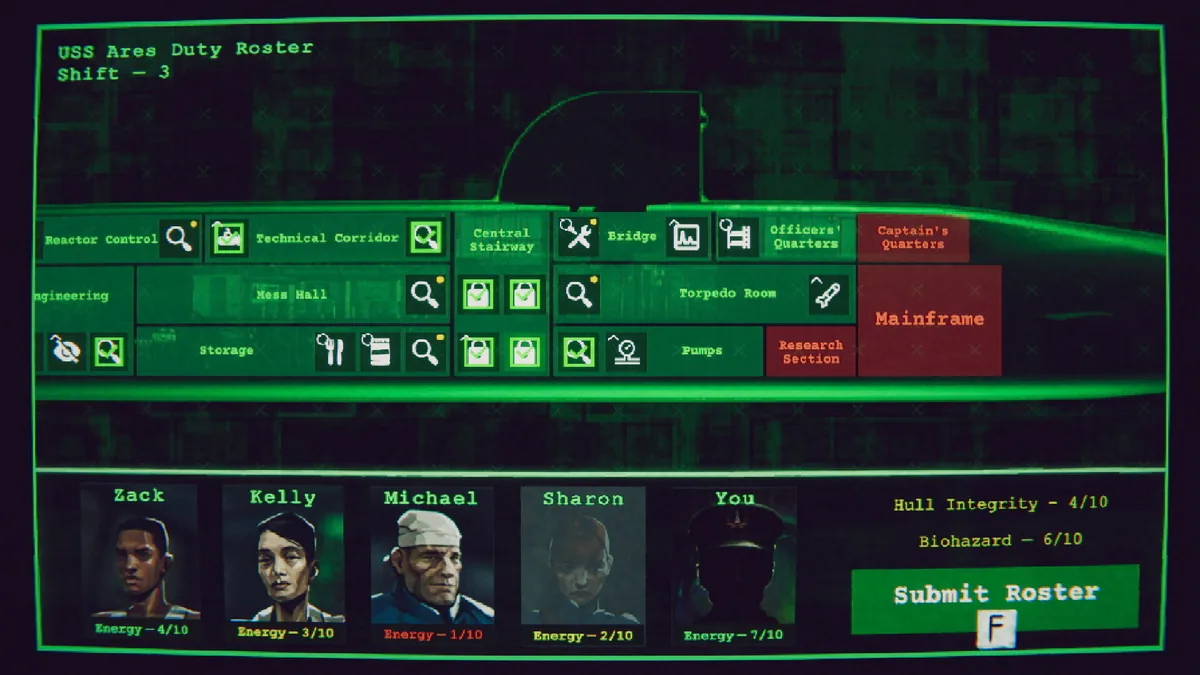 Caption: the shift-assignment interface from Static Dread: The Submarine's own Steam screenshots, naming the ship (USS Ares) and tracking crew Energy alongside ship-wide Hull Integrity and Biohazard.
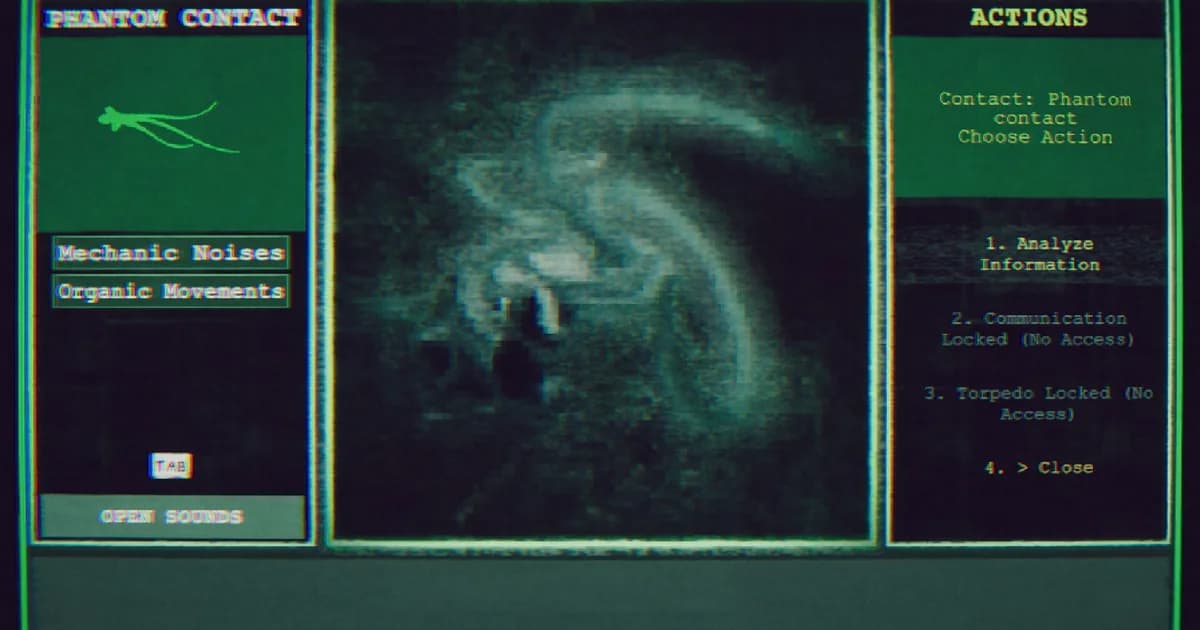
The sonar side works differently but serves the same "figure out what you're looking at before it's too late" instinct. A sonar contact screen shown on Steam labels an unidentified return "Phantom Contact," complete with a blurry, tentacled shape on the display, two sound categories to cross-reference ("Mechanic Noises" and "Organic Movements"), and a locked action menu: Analyze Information is available, Communication and Torpedo are both flagged "No Access" until conditions change. It's the same core idea as Security 51's Papers Please style checkpoint interrogation, verifying an ambiguous signal against imperfect information before you're allowed to act on it, just moved underwater instead of behind a border desk.
GODEEPER: If checkpoint-style verification horror under time pressure is your thing, Security 51 runs the same idea through an Area 51 gate instead of a submarine hull. Security 51 Review: Papers Please Meets Area 51 Horror →
The Static Dread universe: what The Lighthouse already proved
This isn't a stretch of a connection. solarsuit.games' own site groups Static Dread: The Submarine and Static Dread: The Lighthouse together as one franchise, and describes the new game's setup as following "a catastrophic aurora event" that "changed the world and awakened an ancient dread," language that extends The Lighthouse's own cataclysm rather than starting a fresh continuity. The clearest confirmation isn't marketing copy, though: it's a post on the official r/StaticDread subreddit, titled "Our new game in a Static Dread universe was just announced," linking straight to the Submarine's Steam wishlist page. That's the developer's own community treating this as a sequel in the same setting, not a spin-off that happens to share a naming scheme.
The Lighthouse is worth taking seriously as a track record rather than just a footnote. It launched in August 2025 as a lighthouse keeper sim: guide ships to harbor over the radio, survive whatever's circling the island, and don't let the isolation break you. A year later it holds a Very Positive rating across 1,463 Steam reviews (roughly 90% positive) and a 75 on Metacritic, with outlet blurbs on its own store page calling it everything from "Lovecraftian Papers, Please" to an "excellent resource management horror game." That's a real, durable niche audience for a very specific pitch: management-under-pressure horror where the threat is mostly implied rather than shown.
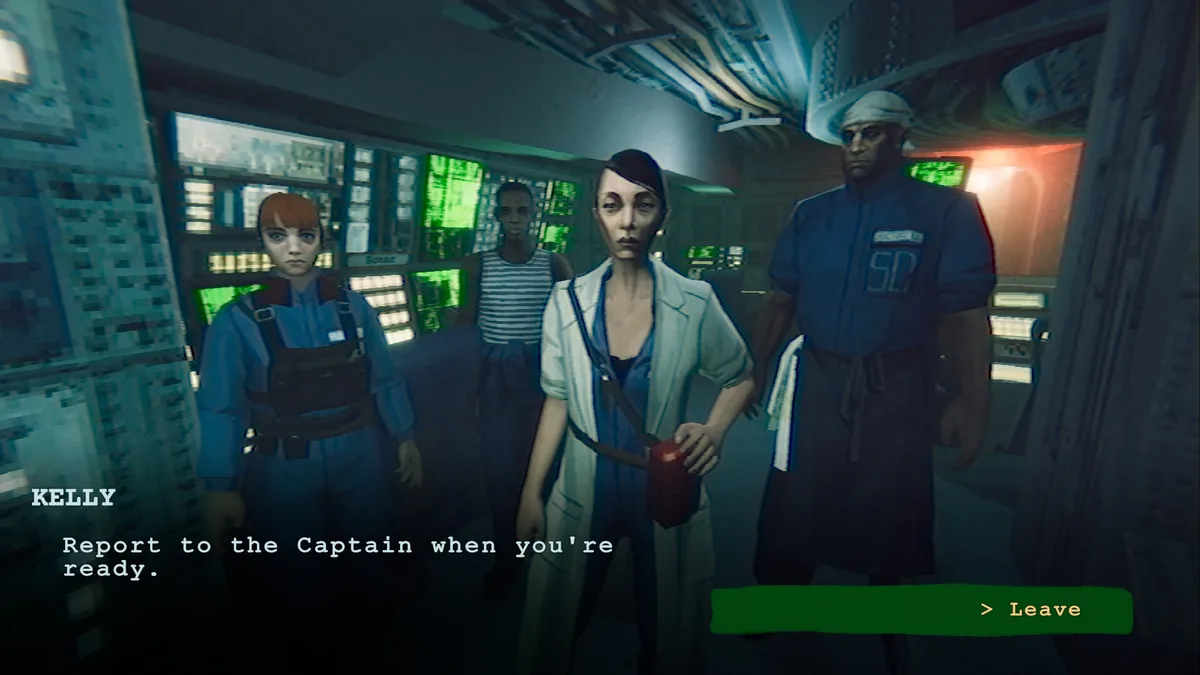 Caption: a dialogue scene from the Submarine's own screenshots, the crew gathered near the sonar station as one officer, Kelly, hands off an instruction.
What carries over cleanly: the small development team, the North Atlantic Lovecraftian setting, full controller support, Steam Achievements, and the studio's habit of shipping a public demo well ahead of launch (The Submarine's Demo Trailer went up in May, two months before the Release Date Reveal Trailer confirmed August 14). What doesn't carry over as cleanly: platform reach. The Lighthouse shipped with native macOS support alongside Windows; The Submarine's Steam listing shows Windows only at launch, no Mac, no Linux, a narrower rollout than its predecessor for reasons solarsuit.games hasn't stated publicly. Our away from life early access analysis covers a similar case of a sequel-adjacent release narrowing scope rather than expanding it, useful context for reading launch-week platform decisions.
Analysis: does moving underwater change what made this work
Our Scriptorium review and TetherGeist review both cover other atmosphere-first indies worth reading if this kind of restrained, mood-driven pacing is what you come to these games for. Here's the question worth asking: does swapping a fixed lighthouse post for a submarine crew roster actually change what made the first game land with players, or is this just the same spooky management sim wearing a new coat of paint? The Lighthouse's tension came from a single point of failure. You, alone, deciding who gets guided safely to harbor and who doesn't, with no one to delegate to. The Submarine structurally can't replicate that. A duty roster with five named crew members and Energy stats is a distribution problem, not a solitary one, closer in DNA to a crew-logistics sim than a lonely-keeper story.
That's not automatically a downgrade. Distributing the pressure across a crew you have to manage (and can presumably lose, given a Biohazard meter that tracks ship-wide contamination) opens a different kind of dread: not "am I strong enough to survive this," but "did I put the wrong person in the wrong room." Whether that lands depends on execution details Steam's screenshots can't answer: how meaningfully crew assignment choices ripple forward, whether losing a crew member is a hard fail state or a survivable cost, and how much narrative weight the game gives characters like Zack, Kelly, Michael, and Sharon before asking players to gamble with their safety.
The reception question has since been answered. The live Steam snapshot shows Very Positive at 80% from 305 reviews, with 278 recent reviews also at 80%. Whether the duty-roster system reads as a genuine evolution of the original's tension or a mechanically busier version of the same idea, wearing a submarine's hull instead of a lighthouse's walls, is a question the early reception suggests the game answered well.
GODEEPER: For another Lovecraftian horror release worth stacking against this one on pure atmosphere and puzzle design, Cthulhu Cosmic Abyss is the closest recent comparison on this site. Cthulhu Cosmic Abyss Review: 9/10 Lovecraftian Horror →
Price, platforms, and what's still unconfirmed
Steam currently lists Static Dread: The Submarine at $11.99. Three pieces of DLC went up alongside the base listing: an Original Soundtrack, a Supporter Pack, and a Digital Art Collection, the standard bundle pattern for a small studio's launch-day monetization rather than anything unusual.
Confirmed at launch: Windows only, single-player, full controller support, Steam Achievements, Steam Cloud, and Family Sharing. Not confirmed anywhere in official materials: an exact playtime estimate, a difficulty option, or how many endings the game supports (The Lighthouse had multiple; whether The Submarine matches that isn't stated on its store page). The pre-launch demo was useful for checking the roster-and-sonar loop, but its saves did not carry into the full game. Our Industria 2 launch analysis covers another small-studio atmospheric release with a similarly limited pre-launch information trail.
Related Reading
- Security 51 Review: Papers Please Meets Area 51 Horror: Alawar's checkpoint verification horror runs the closest structural comparison to The Submarine's sonar-analysis loop.
- Cthulhu Cosmic Abyss Review: 9/10 Lovecraftian Horror: a puzzle-driven Lovecraftian horror release worth comparing on atmosphere and restraint.
- The Mermaid Mask Review: SFB's Locked-Room Mystery: another 2026 release built around a submarine setting, though the genre is closer to detective mystery than horror.
- Yunyun Syndrome Review: Infectious Denpa Horror: a different take on the psychological horror angle The Submarine leans on with its crew sanity system.
- The Sinking City 2 Review: A Genre Swap That Pays Off: another Lovecraftian horror release worth comparing on tone and pacing.
Frequently Asked Questions
What is Static Dread: The Submarine? A single-player psychological horror game from solarsuit.games. You're the captain's right hand aboard a nuclear submarine in the North Atlantic, assigning crew to shifts, reading sonar contacts, and keeping people sane after contact with the surface is lost.
Is Static Dread: The Submarine connected to Static Dread: The Lighthouse? Yes. Same developer, same publisher, and the studio's own site groups both under one Static Dread banner. The Lighthouse's community even posted announcing the Submarine as set in the same universe.
What platforms is Static Dread: The Submarine on? Windows only at launch, confirmed via Steam's own platform listing. No Mac or Linux support is listed, unlike The Lighthouse, which shipped with native Mac support.
How much does Static Dread: The Submarine cost? Steam had not published a price as of the days before launch. Check the store page directly for the current figure; The Lighthouse launched at $10.90 for comparison.
Does Static Dread: The Submarine have multiplayer? No. Steam's category listing confirms single-player only, with full controller support, Steam Achievements, Steam Cloud, and Family Sharing.
Was there a demo for Static Dread: The Submarine before launch? Yes. solarsuit.games published a Demo Trailer in May 2026, ahead of a Release Date Reveal Trailer in July, giving players a hands-on preview before the full launch.
What is the submarine in the game called? The USS Ares, based on the duty roster screen shown in the game's own Steam screenshots, which names the submarine directly above the shift-assignment interface.
References
- Static Dread: The Submarine on Steam
- Static Dread: The Lighthouse on Steam
- Static Dread: The Submarine, Release Date Reveal Trailer (Polden Publishing, YouTube)
- solarsuit.games, official developer site
- Static Dread: The Submarine official announcements: launch, demo-closure, and Patch 1.0.1 notes
- r/StaticDread on Reddit
About the author

Games Critic
Games writer and reluctant optimist who has reviewed over 400 titles across 9 years. Irish, currently in Berlin. Has strong opinions about tutorial design.
- 400+ games reviewed across 9 years
- Platformer and horror specialist
- Narrative design focus
Keep reading
Yunyun Syndrome Review: Infectious Denpa Horror in 2026
General · 7 min
Steam Autumn Sale 2026: 9 Indie Deals Worth Buying
Features · 6 min
Tainted Grail update: Fists of Fury and Patch 1.30
General · 5 min
Abiotic Factor Entropic Break Delayed to Q1 2027 DLC
General · 3 min

Risk of Rain 2 Hallowed Concepts Reveals Acolyte, Enforcer
General · 3 min
CRACK Co-Op Game: Giant Egg Mystery Arrives October 26
News · 8 min
Game deals · affiliate links

Disclaimer
This article is published for informational and entertainment purposes. It does not constitute professional financial, legal, or technical advice. Game performance, online services, patch schedules, and store listings change. Verify critical details (pricing, system requirements, regional availability) with publishers and storefronts before you buy. Affiliate links, where present, help support our editorial work and are labelled in our affiliate disclosure.
Comments
Loading comments…