
ReviewWanderburg
Wanderburg Early Access Review: A Castle That Grows
Wanderburg early access review: the castle-eating hook lands, but players say progression is thin. Buy on sale for the novelty, or wait for Q1 2027.
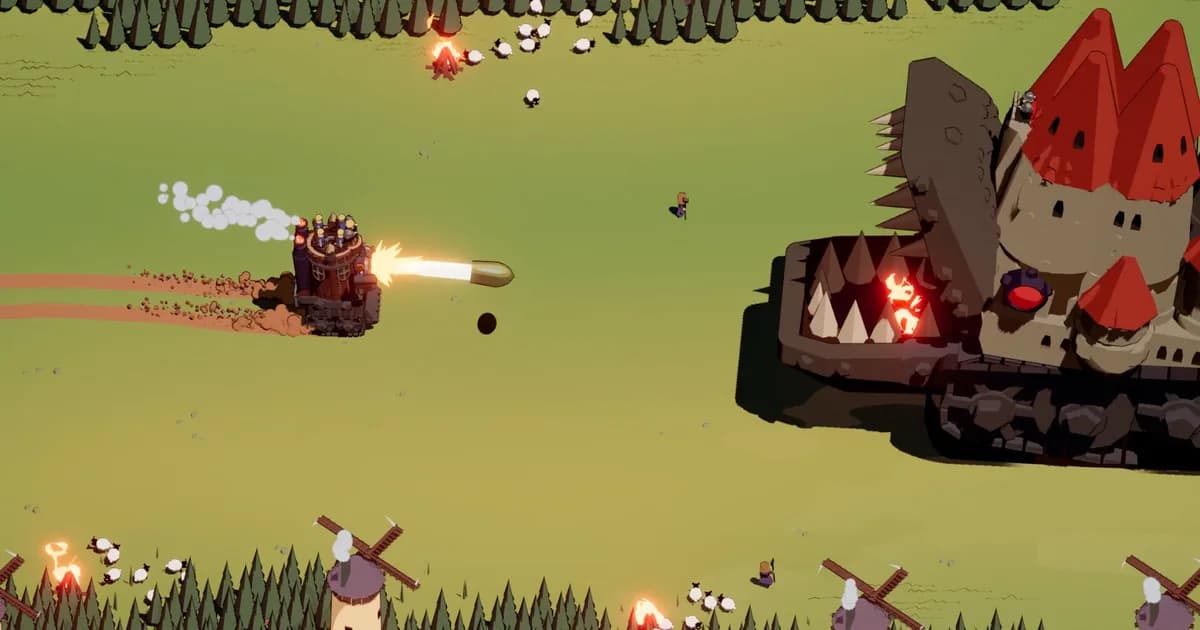
Wanderburg early access review, short version: a great joke with thin systems underneath; buy it on sale for the novelty, or wait for the Q1 2027 content update. The pitch is disarmingly simple: what if your castle could walk. The whole fortress rolls across the map on wheels, eats villages and smaller castles whole, and grows a little more monstrous with every run. Steam players rate it Mostly Positive, and the split in their reasoning tells you almost everything you need to know before buying.
Sponsored

About the game
Wanderburg
Randwerk · Sidekick Publishing
Reception
Pros
- Genuinely funny, distinct enemy and unit design (knights on bicycles, steam-powered siege engines, arcane artillery)
- The core hook, rolling a castle across the map and physically consuming villages and smaller fortresses, feels great and nothing else on Steam does it
- Hotfixes 0.9.13 and 0.9.14 added damage numbers, better boss fights and a second artifact reroll within two weeks of launch
- Strong art direction and sound design, praised even by players otherwise critical of the build depth
Cons
- Modules (the game's weapon system) barely combo with each other, so most runs collapse into stacking one weapon type instead of building a real strategy
- Ability and upgrade depth is thin compared to genre leaders, a specific, repeated community complaint since day one
- Negative Steam reviews say there are no permanent upgrades, so later runs feel no stronger than early ones
Verdict
Wanderburg suits bullet-heaven fans who want a funny, novel castle-on-wheels hook for a few evenings, ideally on sale; players who need deep build-crafting or real meta progression should wait for the Q1 2027 content update.
Updated 2026-10-15: dropped the old review counts and launch discount (the price is back to $14.99), added hotfixes 0.9.13 and 0.9.14 and the September 30 roadmap, and rewrote the verdict from Steam reviews.
TL;DR: Wanderburg is a bullet-heaven roguelike from Randwerk (Sidekick Publishing) where you pilot a growing castle-on-wheels instead of a single character. Launched Early Access September 8, 2026, at $14.99. The art, sound, and central "devour everything" hook land well. The build system and progression are the specific, repeated complaint from players who've put in a few hours. A deeper update is due in Q4 and a bigger content update in Q1 2027.
BESTPRICE: Want Wanderburg? These stores list it: Buy on Eneba (NA key) → Buy on Humble Bundle → Buy on Loaded →
Key takeaways
- Wanderburg is a bullet-heaven roguelike where the "character" you control is a modular castle that physically grows by consuming villages, flocks, and smaller fortresses.
- Steam players rate it Mostly Positive; the most upvoted negative review is about missing permanent upgrades.
- The genre-comparison community keeps pointing to the same gap: modules don't combo across weapon types, so build variety is thin right now.
- $14.99 on Steam; the 35% launch discount has ended.
- Randwerk (developer) and Sidekick Publishing (publisher); this is the studio's first Early Access launch under this title.
Sponsored

Overview: what Wanderburg actually is
Strip away the castle theming and Wanderburg is a bullet-heaven, the Vampire Survivors school of auto-firing, wave-based, run-ending-in-death roguelike. What's different is the avatar: instead of a single character walking through a horde, you're piloting an entire fortress that rolls forward, and everything in its path either feeds it or fights back. Fleeing villages and wandering flocks get consumed for growth. Smaller enemy castles get fought and, if you win, absorbed into your own expansion. The studio's own framing, "your castle does not just upgrade, it expands," is accurate: the thing you're driving at the end of a good run looks nothing like the modest fortress you started with.
The tone leans into the absurdity on purpose. Steam-powered siege engines roll beside arcane artillery staffed by wizards. Knights ride bicycles into battle. Enemy design gets specifically called out as funny in player feedback, not just competent, and that's a harder thing to land than raw power fantasy.
GODEEPER: If the appeal here is watching a small thing become a genuinely absurd war machine through iterative unlocks, Rune Dice's class and relic system scratches a similar itch with a very different core loop. Rune Dice complete guide →
Gameplay: the hook works, the depth doesn't yet
The moment-to-moment loop is genuinely good. Rolling forward and watching a village disappear into your growing structure, then immediately having to fight off a rival castle before you can digest it, creates real tension that a standard bullet-heaven's "walk and shoot" loop doesn't have. Between runs, you unlock new modules, vehicles, artifacts, and captains that are supposed to open up fresh strategies.
That's where the honest problems start. A player who put four to five hours into the launch build (haven't touched the earlier demo) summarized it directly: graphics, sound, music, and enemy design are all strong, but "the core components of a fun survivors roguelite are completely lackluster," specifically because modules don't combo with each other. A second player, replying in the same thread, described running well into overtime on multiple runs and still not being able to build anything beyond stacking whatever counts as one weapon category, cannons or mortars in one pile, arrows or ballistas in another, with no real synergy layer connecting them. A third commenter's only addition was a direct suggestion that the developers study how Magic Survival handles upgrade and ability design. Three separate players, same specific complaint, within days of launch, not vague "needs more content" griping but a precise diagnosis of what's actually thin.
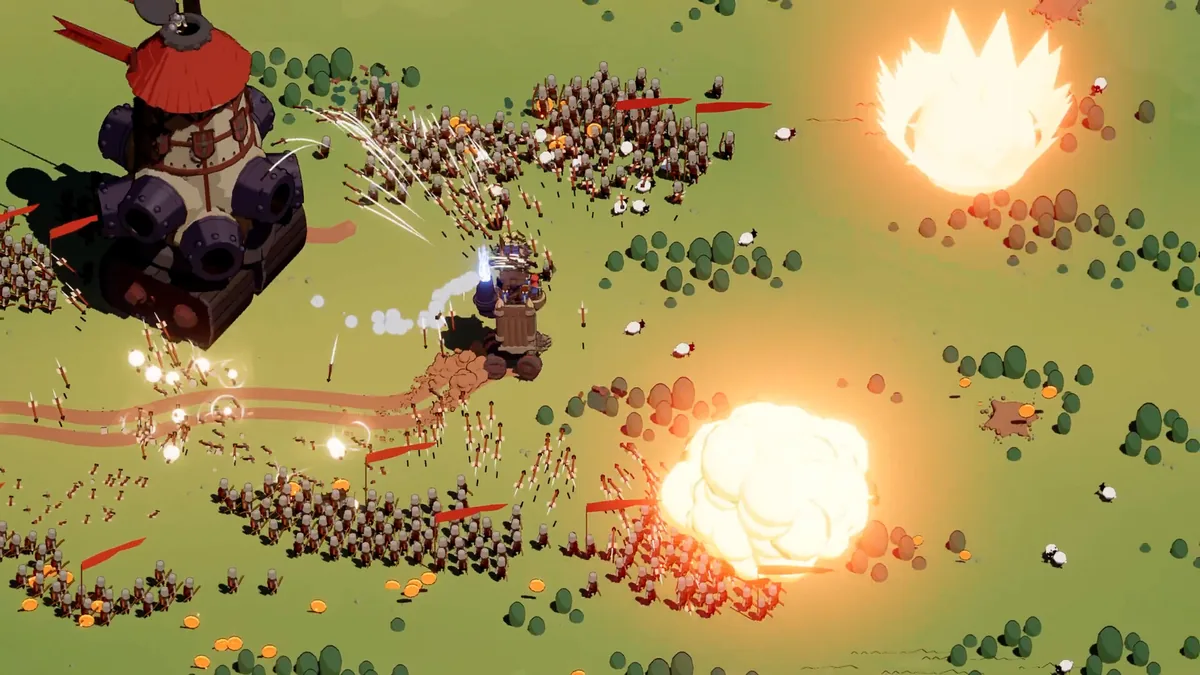 Caption: The combat itself is loud and chaotic in a good way. The complaint isn't what's on screen here, it's that most of the weapons producing this chaos come from the same one or two module categories.
That's a fixable Early Access problem, not a fundamentally broken game. The bones (rolling castle, consumption mechanic, absurdist unit design, accessibility options including full controller support, camera comfort settings, and a keyboard-only or mouse-only mode) are all in place. What's missing is the cross-system depth that turns a roguelike from "fun for one sitting" into "worth 40 hours."
Stability was mostly fine at launch, with exceptions: one early negative review reports that pausing caused a slowdown to "4-6 fps" that ended the run (Steam review). Randwerk has shipped steady hotfixes since. 0.9.13 (September 19) added an optional damage-numbers display, leaderboard options and Overtime balancing; 0.9.14 (September 21) improved boss fights, added a second artifact reroll, buffed the Electric Mage and capped the menu and overworld at 240 FPS.
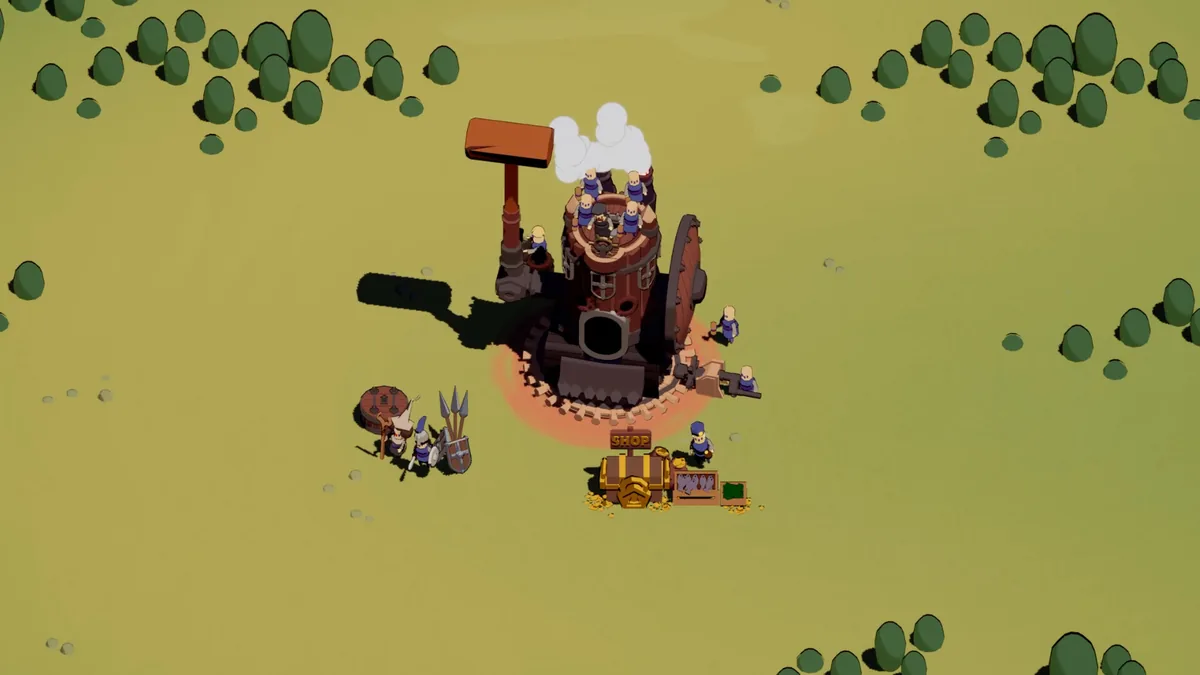 Caption: Between fights, a run-local shop lets you spend whatever you've consumed. It's a normal roguelike economy layer, functional, but it's also where the shallow build variety shows up again: there just aren't that many meaningfully different things to buy toward yet.
GODEEPER: Wanderburg isn't the only recent Early Access title built around a growing, modular structure instead of a fixed character. Scrap Mechanic's advanced building guide covers a different but related design space, mechanical creation as the core gameplay loop. Scrap Mechanic advanced building guide →
Price, and the old "Free To Play" tag
Wanderburg is $14.99 on Steam; the 35% launch discount has ended. Around launch, the Steam genre list carried a misleading "Free To Play" tag, but the current genre list (Action, Casual, Indie, RPG, Simulation, Strategy, Early Access) no longer shows it. It is a paid Early Access game.
Roadmap
Randwerk posted its first Early Access roadmap on September 30. It promises a deeper update in Q4 2026 and a bigger content-focused update in Q1 2027, with performance and stability work continuing alongside. That bigger update is the one to watch for anyone waiting on build depth.
What critics and the community are saying
Beyond the module-depth critique, community sentiment splits cleanly along the same line as the Steam rating itself. Players praise the art direction, sound design, and the core "your castle eats the map" fantasy almost universally, even in otherwise critical posts.
Verdict
Wanderburg earns its hook. A castle that physically grows by devouring the world around it is a genuinely fresh spin on a crowded genre, and the presentation, sound, art, and the humor in enemy and unit design back it up.
Steam's fans sell it in one line each. "It's 'Mortal Engines - the game' when it doesn't take itself seriously," says one, who adds "Watch the trailer - that's the game" (Steam review). Another compares it to "those phone games where you are a blob and roll around eating stuff to get bigger," only "instead of a blob you are a castle" (Steam review). Even a positive review hedges: "Get on sale. For the price of a movie ticket it's kind of worth it," with "not allot of meat on these bones" (Steam review).
The most upvoted negative review, from a Vampire Survivors and Mortal Engines fan, says "The biggest issue for me is progression, or lack thereof. There are no permanent upgrades" (Steam review). Another got "almost all of the upgrades" in five hours and says "you'll never be stronger then you were last run" (Steam review), while a 15-hour player calls it "horribly unbalanced" and a "'meta build only' game" (Steam review).
Who it suits: bullet-heaven fans who want a funny, novel hook for a handful of evenings, Mortal Engines fans, and players who enjoy driving skill (one fan notes that "movement speed is SO much better than tankiness" (Steam review)). Best bought on sale.
Who should wait: players who want meta progression that makes each run stronger, anyone comparing it to Vampire Survivors or Brotato for build depth, and players who dislike meta-build balance. The Q1 2027 content update is the point to re-check.
Frequently Asked Questions
Is Wanderburg worth buying in Early Access? If the core fantasy of a rolling, growing castle appeals to you and you're fine with limited build variety right now, it's worth it on sale. If you want deep build-crafting or meta progression, wait for the bigger content update Randwerk has planned for Q1 2027.
Is Wanderburg free to play? No. It's a paid Early Access title at $14.99 on Steam. An earlier version of the store page showed a Free To Play genre tag, but the current genre list no longer includes it.
What genre is Wanderburg? A bullet-heaven roguelike (the Vampire Survivors style of auto-firing, run-based combat) built around piloting a growing, modular castle instead of a single character.
Does Wanderburg have build variety? Not much yet. Players consistently report that modules don't combo meaningfully across weapon categories, so most runs come down to stacking one type of weapon rather than mixing strategies.
What do Steam reviews say about Wanderburg? Steam players rate it Mostly Positive. Fans praise the Mortal Engines-style premise and humour; the most upvoted negative reviews say progression is missing because there are no permanent upgrades, and that difficulty scaling pushes everyone into meta builds.
Who developed Wanderburg? Randwerk developed Wanderburg, published by Sidekick Publishing. It launched into Early Access on September 8, 2026.
Related Reading
- Rune Dice complete guide: another roguelike where iterative unlocks turn a modest start into an absurd endgame build.
- Lost Castle 2 builds guide: a different castle-themed roguelike, this one a dungeon crawler with a much more developed build-crafting layer already in place.
- Legionbound classes and synergies: for readers weighing Wanderburg against other class/build-driven roguelikes currently active on Steam.
- Beastro flavor system guide: a deck-building roguelike with its own take on combining systems for build variety, useful context for what Wanderburg is still missing.
- Anomaly President Review: Rough Edges, Real Potential: another Early Access roguelite review from the same stretch, for readers comparing how two different studios are handling a rough launch build.
References
- Wanderburg on Steam
- Wanderburg news on Steam: hotfixes 0.9.13 and 0.9.14 and the Early Access roadmap
- Wanderburg official Early Access launch trailer
- r/WanderburgGame community discussion
About the author

Systems & Economy Desk
GameBrief's byline for roguelikes, strategy and simulation. Reads patch notes, wiki tables and Steam stats and puts the numbers on the page.
- Roguelikes, strategy and simulation
- Builds, progression and economy
- Sources listed per article
Keep reading
Slay the Spire 2 Review: What the Steam Score Misses
General · 12 min
RIFTSTORM Review: Early Access Extraction Shooter Verdict
General · 13 min
Moonlighter 2 Review: Why the 3D Leap Actually Works
Reviews · 8 min
Miss Killer Dream Rhythm Island Beginner Guide: Combat
Guides · 9 min

BeastLink Review: Mixed Now, Is Early Access Ready?
General · 11 min
Masters of Albion Review: Still Mixed After Five Months
General · 12 min
Sponsored
Disclaimer
This article is published for informational and entertainment purposes. It does not constitute professional financial, legal, or technical advice. Game performance, online services, patch schedules, and store listings change. Verify critical details (pricing, system requirements, regional availability) with publishers and storefronts before you buy. Affiliate links, where present, help support our editorial work and are labelled in our affiliate disclosure.
Comments
Loading comments…