
GameBrief · General
Witchspire Beginner Guide: All 6 Covens Explained 2026

This Witchspire beginner guide starts with the thing most players notice first: the game removed the pressure systems every other survival game relies on. No hunger meter, no thirst bar, no stamina cost for basic movement.
What it has instead is six Covens, a creature collecting system built around incense and spirit balls, and a broom that changes how you move through the world once you get it. This guide covers which Coven to pick for your play style, how the familiar system works mechanically, and the Luminary tree progression that unlocks flight.
TL;DR: Coven choice currently only sets your starting weapon and element, not a lasting combat bonus, so pick based on Spellblade-vs-Wand preference. Always use incense before fighting creatures you want to recruit. Your first Hearth upgrade is your most important early investment. The broom is behind a Luminary unlock and a cave key, but it fundamentally changes how you play.
Witchspire beginner guide: what changes in the first hour
The biggest adjustment for players coming from other survival games is the absence of resource attrition. No food cooldown, no dehydration, no stamina penalty for doing normal things. This removes a pressure layer but doesn't reduce the game's challenge. The threat comes from creatures, progression gates, and the resource economy around building and upgrading your Hearth.
Your Coven sets your starting toolkit, your Hearth sets your progression rate, and your familiars determine how well you handle combat at scale. Get all three working together and the early game opens up quickly. Ignore any one of them and you'll find yourself stuck at the same encounter for longer than necessary.
Witchspire is in Early Access and Envar Games has stated it expects to remain there for at least a year. Specific numbers mentioned in this guide (perk values, drop rates) reflect the June 2026 launch build and may shift with updates.
All 6 Covens explained: which to pick
Your Coven is Witchspire's character class system. It sets your starting weapon, your elemental affinity, and your visual identity going into the game. One thing worth knowing before you pick: Envar Games said in a pre-launch dev blog that permanent Coven-specific passive bonuses are planned, but as of the June 2026 Early Access launch they aren't implemented yet. Right now, your Coven choice affects your starting weapon type and element and your outfit palette: nothing more. Both weapon types become available to everyone through normal loot and crafting within the first few hours, so the practical gap between Covens is smaller than a tier list would suggest. The Luminaries progression tree also lets you branch into other disciplines later regardless of which Coven you start as.
There are 6 Covens total, split evenly across the two starting weapon types.
Spellblade Covens:
Cloudpiercers (Lux affinity): The classically heroic pick. Brave, optimistic tone, warm browns-oranges-golds palette, starting Spellblade carries a Lux (light) affinity.
Starsmiths (Crystal affinity): The builder-crafter Coven, themed around magical construction and crafted artifacts. Bright purple and lavender palette, starting Spellblade carries a Crystal affinity.
Foretellers (Ethereal affinity): The mystical, omen-reading Coven. Dark purple and light blue palette, starting Spellblade carries an Ethereal affinity.
GODEEPER: Murim Survival uses a completely different approach to companion systems: recruiting human companions with unique martial arts skills rather than magical creatures. Murim Survival Companion Guide: Recruitment and Synergies →
Wand Covens:
Nightscribes (Astral affinity): The astronomer archetype, tied to stargazing, telescopes, and the game's "Age of Rediscovery" lore. Starting Wand carries an Astral affinity.
Wildroots (Nature affinity): The herbalism witch, green-brown-maroon palette. Envar's own "Introducing a Coven" video confirms the starting Wand lets you snare enemies with nature magic. Starting Wand carries a Nature affinity.
Tomekeepers (Nox affinity): The forbidden-knowledge scholar, deep blue and bright pink palette, themed around dark magic and lost texts. Starting Wand carries a Nox affinity.
Practical advice for picking: since there's no lasting combat bonus yet, base the choice on which starting weapon type you'd rather use for your first few hours (Spellblade for melee-leaning play, Wand for ranged-leaning play) and whichever elemental theme appeals to you. Nothing here is a permanent lock-in.
Step-by-Step: your first hour in Witchspire
Upgrade your Hearth first. The Hearth is not just your spawn point. It's the progression unlock system. Building radius, recipe access, skill tier requirements, the broom, and fast travel all gate behind Hearth levels. Everything else can wait. Pour early resources into your first Hearth upgrade.
Gather resources aggressively before exploring. Wood, stone, and basic materials drop from the environment immediately around your starting area. Clearing your immediate zone before heading out means you're not making resource trips constantly during exploration. A half-hour of gathering at the start prevents several interruptions later.
Identify which creatures you want as familiars before engaging them. Familiar recruiting works best when you plan it. Creatures you're indifferent to don't need incense. Creatures you want to recruit do. Using incense reactively, after the creature is already low health, wastes your supply and often fails because the fight ends before the spirit lingers.
Don't ignore the crafting side of the Hearth. The Hearth's crafting recipes unlock as you level it, and many early upgrades require materials you collect passively. Running back to check what unlocked after each gathering run is worth the habit.
How to recruit familiars (and why incense matters)
The familiar system is what separates Witchspire from standard survival crafting. Most creatures in the world can theoretically be recruited. When you kill an enemy, there's a chance its spirit lingers as a hovering sphere. Hold F near the sphere to attempt recruitment.
Without intervention, the baseline spirit linger chance is low. This is where incense changes the math significantly. Using incense before you kill a creature substantially increases the chance the spirit appears and remains long enough to capture. Incense is not a guaranteed recruit, but the difference between incensed and non-incensed attempts is meaningful.
Incense comes from three sources: chests scattered through the world, boss drops, and the Witchcraft Circle (a crafting station that unlocks via Hearth progression). Building a Witchcraft Circle early gives you a sustainable incense supply and removes the randomness from your familiar recruitment strategy.
The Spirit Charmer perk takes this further. It grants a +10% probability bonus for 20 seconds, applying on top of base incense effects. According to the launch build data, it requires taming skill level 5 and Hearth level 3. These requirements are achievable within your first few hours of consistent play if you prioritize the Hearth. The perk is worth pursuing specifically if familiar collecting is a core part of how you want to play.
One hard limit: corrupt story bosses cannot be recruited. They drop items but don't produce spirit balls.
 Using incense before the killing blow dramatically increases the chance a spirit ball appears. Keep incense on your hotbar so you're not fumbling through the inventory mid-fight.
GODEEPER: Abiotic Factor takes companion mechanics in a completely different direction with a Peccary pet system built around emotional bonding and DBNO resurrection. Abiotic Factor Pets Guide: Peccaries, DBNO, and Companions →
Familiar modes: combat squad vs crafting station
Every familiar you recruit chooses between two exclusive roles: combat squad or crafting station assistance.
Combat squad supports a maximum of 3 familiars. These creatures follow you into fights, targeting enemies and supplementing your damage. The squad composition matters. Some familiar types are better at absorbing hits, some deal more damage, some have range. Experimenting with different species in your squad is part of how the creature collecting depth expands.
Crafting station assistance assigns familiars to your base structures, where they speed up production, reduce material costs, or unlock recipe variations depending on the creature type. You can't send a combat familiar to assist a station at the same time it's in your squad.
The practical split for early play: keep 2-3 strong melee familiars in your combat squad while you're actively exploring and fighting, then swap them to station duty during extended base sessions. The modes switch instantly and there's no cooldown, so there's no reason not to optimize based on what you're about to do.
How to unlock your broom
The broom doesn't come early, but it transforms exploration once you have it. Before unlocking it, moving across the map involves walking, which is fine for the immediate area around your Hearth but becomes limiting once you're trying to reach distant biomes or set up multiple Hearths as fast travel nodes.
Unlocking the broom requires two things: progression in the Luminary skill tree (specifically the branch that handles movement), and an upgraded Hearth. The exact path also involves finding a key hidden in an underground cave, which functions as a short quest gating the unlock. The cave and key aren't marked on the map by default.
Once you have the broom, you can fly. Flight enables reaching elevated platforms, crossing terrain gaps, and traversing the map at speeds that make everything feel different. The more important unlock is what comes after: placing multiple Hearths throughout the world creates a fast travel network. Flying to a Hearth and teleporting instantly is the movement system Witchspire builds toward.
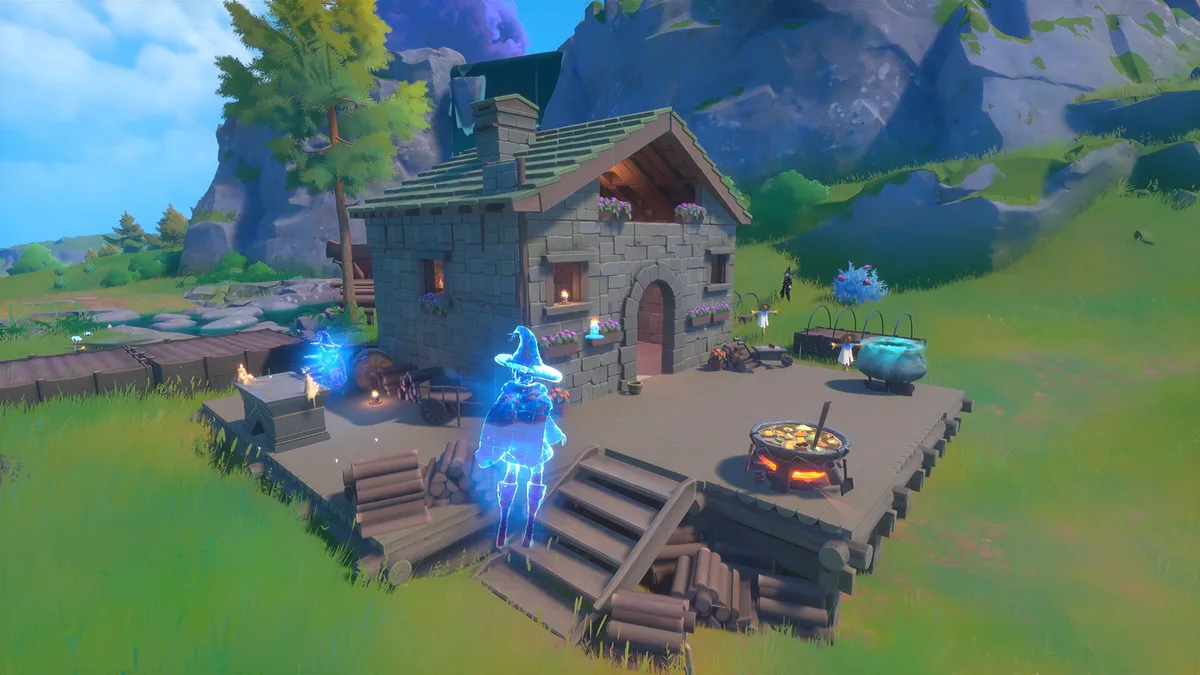 The broom requires the Luminary movement branch and a Hearth upgrade, plus a key from an underground cave. Once unlocked, it changes how you access the entire map.
Tips for Witchspire solo and co-op play
Upgrade the Hearth before anything else, every session. If you log off with Hearth upgrade materials sitting in storage, you're leaving progression unlocks on the table. The Hearth gates almost everything.
Farm Froblin Camps for early experience and Slime drops. Froblin Camps are one of the more reliable early XP and material sources. Slime from Froblins has crafting uses and the camps respawn consistently.
Verdantbloom Petals are your cheapest healing source. These drop from flowers found commonly throughout the world and provide healing at significantly less cost than crafted consumables. Stock them while gathering.
In co-op, Coven picks don't need to be coordinated. Since Coven passives aren't implemented yet, there's no real synergy or specialization benefit to splitting Wand and Spellblade Covens across a group. Pick whichever appeals to you and coordinate on gear and Hearth upgrades instead, since those actually affect your group's early-game pace.
Adjust the spirit delay chance in difficulty settings. If you find familiar recruiting frustratingly low-frequency, the difficulty settings include a spirit delay chance slider that increases how often spirits linger after kills. This is not considered cheating. It's there specifically for players who prioritize the creature collection aspect of the game.
Related Reading
- Murim Survival Companion Guide: Recruitment and Synergies: A different take on companion mechanics in a survival game, with human allies and martial arts skill trees instead of magical creatures.
- Cursemark Tips: 10 Things to Know Before Your First Run: Another magic-based Early Access game from June 2026 with a fundamentally different structure, built around roguelite rune-crafting.
- Abiotic Factor Pets Guide: Peccaries, DBNO, and Companions: How companion mechanics work in the science-horror co-op survival game, including the pet bond system and combat interactions.
- Lost Castle 2 Beginner Guide: Weapons, Build & First Run: Lost Castle 2 beginner guide: pick from 6 weapon types, set Serena's chest odds, mix Alchemy Amulets, and....
- Witchspire Familiar Locations: All 31 Familiars (2026): Where to find all 31 confirmed familiars sorted by island, once incense and the Witchcraft Circle have you actively recruiting.
Frequently Asked Questions
How many Covens are in Witchspire? There are 6 Covens: Cloudpiercers, Starsmiths, Foretellers, Nightscribes, Wildroots, and Tomekeepers. Coven currently sets your starting weapon and element; the Luminaries progression tree lets you branch into other disciplines later.
What is the best Coven for solo players in Witchspire? There isn't a mechanically best one yet. Envar Games has said permanent Coven passives are planned but aren't live as of the June 2026 Early Access launch, so pick based on Spellblade vs Wand preference and elemental theme.
How do you recruit familiars in Witchspire? When you kill an enemy, a spirit ball sometimes appears. Hold F to attempt recruitment while the sphere stays stationary. Incense significantly increases the chance the spirit lingers after death. Incense drops from chests, bosses, or can be crafted at the Witchcraft Circle.
Can familiars fight and do crafting at the same time? No. Familiars operate in two exclusive modes: combat squad (maximum 3) or crafting station assistance. You cannot assign the same familiar to both roles simultaneously. Switch modes based on whether you're about to fight or do base maintenance.
How do you unlock the broom in Witchspire? The broom unlocks through the Luminary skill tree and requires an upgraded Hearth plus a key found in an underground cave. Once you have it, the broom enables flight and lets you place Hearths across the map as fast travel nodes.
Is Witchspire like Palworld? The comparison comes up often because both games involve creature collecting, base building, and survival. Witchspire replaces Palworld's industrial labor angle with magic and co-op adventure. Familiars are companions, not workers. The tone is significantly more whimsical and there's no monster factory element.
Does Witchspire have a hunger or thirst meter? No. Witchspire has no hunger or thirst mechanics, by design. This removes a pressure loop common in survival games and allows for a more adventure-focused gameplay loop without constant consumption management.
References
- Witchspire on Steam: developer and publisher Envar Games; Early Access launched June 10, 2026; over 500 reviews in its first three days
- Witchspire Early Access Launch Trailer: official Early Access launch trailer, via GameTrailers
- Witchspire Tips and Tricks for Starters: mechanics reference for familiar recruitment and Hearth system
- Covens - Witchspire Wiki: official Coven roster reference
- Witchspire Early Access Review, Checkpoint Gaming: critical reception
Was this guide helpful?
About the author

Indie & JRPG Critic
Indie game evangelist and lifelong JRPG fan covering small studios since 2017. Mumbai-born, London-based. Writes the way she talks.
- 7 years indie games coverage
- JRPG and visual novel specialist
- Narrative design focus
Keep reading



Disclaimer
This article is published for informational and entertainment purposes. It does not constitute professional financial, legal, or technical advice. Game performance, online services, patch schedules, and store listings change. Verify critical details (pricing, system requirements, regional availability) with publishers and storefronts before you buy. Affiliate links, where present, help support our editorial work and are labelled in our affiliate disclosure.
Comments
Loading comments…