
GameBrief · General
Tainted Grail Fall of Avalon Guide: All 14 Guides Hub
Tainted Grail Fall of Avalon guide hub: real builds, bosses, NG+, regions, and survival tips. Very Positive with over 35,000 Steam reviews, all verified.

This Tainted Grail Fall of Avalon guide hub covers the complete RPG from Questline: it dropped out of Early Access on May 23, 2025, and more than a year later it's sitting at Very Positive on Steam with over 35,000 reviews. That kind of staying power in an indie RPG is uncommon, and it holds up even with a well-documented drop in polish during the game's third act.
This hub collects every Tainted Grail guide on GameBrief, all checked against the game's own wiki and real community discussion rather than repeating invented zone names or a fabricated tier list that circulated in earlier coverage of this game, including some of our own older articles.
TL;DR: Tainted Grail Fall of Avalon is a first-person open-world RPG set in a dying Arthurian world, 600 years after Arthur's fall, with 50-70 hours of content for a thorough playthrough. Very Positive with over 35,000 Steam reviews. No official build tier list exists, real community favorites include a spellsword hybrid and a fragile-but-powerful full mage build. New Game Plus carries your level and gear but adds a stacking armor penalty of 50 per cycle. The real regions are Island Asylum, Horns of the South, Cuanacht, Forlorn Swords, and Sarras.
Tainted Grail Fall of Avalon guide: what kind of game is this? (quick answer)
Tainted Grail is a first-person open-world RPG from Questline and Awaken Realms, set 600 years after the fall of King Arthur in a world stuck in everlasting autumn, where something called the Wyrd is spreading. There's no class picker. Your build comes from six stats (Strength, Endurance, Dexterity, Spirituality, Practicality, Perception), the skills you choose, and the gear you equip. The Skyrim comparison is one both players and press make constantly, and it's a genuine comparison, not just marketing shorthand. At $44.99, with 50-70 hours of content for a thorough run and a community still active more than a year after launch, it's worth the price for RPG players who don't need constant quest guidance.
Key takeaways
- Developer/Publisher: Questline / Awaken Realms
- Release date: May 23, 2025 (full release after Early Access)
- Price: $44.99
- Steam reviews: Very Positive, over 35,000 reviews as of August 2026
- Playtime: 9-15 hours rushed, 50-70 hours thorough, 75+ hours completionist
- Platform: PC, PlayStation 5, Xbox Series X|S
- Real regions: Island Asylum, Horns of the South, Cuanacht, Forlorn Swords, and Sarras (DLC)
- DLC: eight releases total, two paid (Sanctuary of Sarras, Supporters Pack) and six free
- Latest patch: 1.25 (July 20, 2026), shipped with the free Bonus Content #4, an Ultra+ graphics preset, new archer and mage gear, and a new romance option
Three things to understand before starting: Spirituality governs spells, not alchemy, that's Practicality's job. Side quests in each region provide gear and XP you'll want before moving on. The game doesn't hold your hand on quest locations, so reading every book and note you find pays off.
Character builds and progression
There's no class selection in Tainted Grail. Your build is the combination of stats you've raised, skills you've chosen, and gear you're carrying, across six real stats. No official tier list exists anywhere in the game's own systems or verified community sources, despite what some guides confidently claim.
Real, well-documented community builds include a spellsword hybrid (a one-handed weapon plus a spell in the off-hand, switching between them mid-fight), a full mage build that hits hard but that players consistently describe as fragile, "made of rice paper" in one reviewer's words, a stealth archer leaning on Perception and Dexterity for sneak-attack multipliers, and Perception-driven crit builds that some players push toward 80% crit chance.
Spirituality is worth understanding regardless of build direction, it governs spell power, max mana, and mana regeneration. It does not affect alchemy, a mix-up that shows up in a lot of guides for this game. Alchemy potency comes from Practicality instead.
What each of the six stats actually governs: Strength drives melee damage, stamina, and a reduced armor weight penalty. Endurance covers health, carry capacity, and stamina regeneration. Dexterity affects attack speed, stealth effectiveness, and ranged damage. Spirituality, as above, is the spellcasting stat. Practicality governs crafting bonuses, weak-spot damage, resource cost reduction, sell prices, and alchemy potency, all in one stat, which is exactly why the Spirituality mix-up is so common: players expect the "magic-adjacent" system to sit under the magic stat, and it doesn't. Perception governs critical chance, critical damage, and sneak-attack damage.
None of these stats are wasted picks. Even a build centered on one or two primary stats benefits from a handful of points elsewhere, a spellsword needs enough Strength to swing a weapon effectively, and a pure mage still wants some Endurance to survive the windup on their bigger spells. The six-stat system rewards a light spread more than most RPGs' stat systems do.
Origin Potions allow a full respec of stats and skills, so an early build mistake isn't permanent.
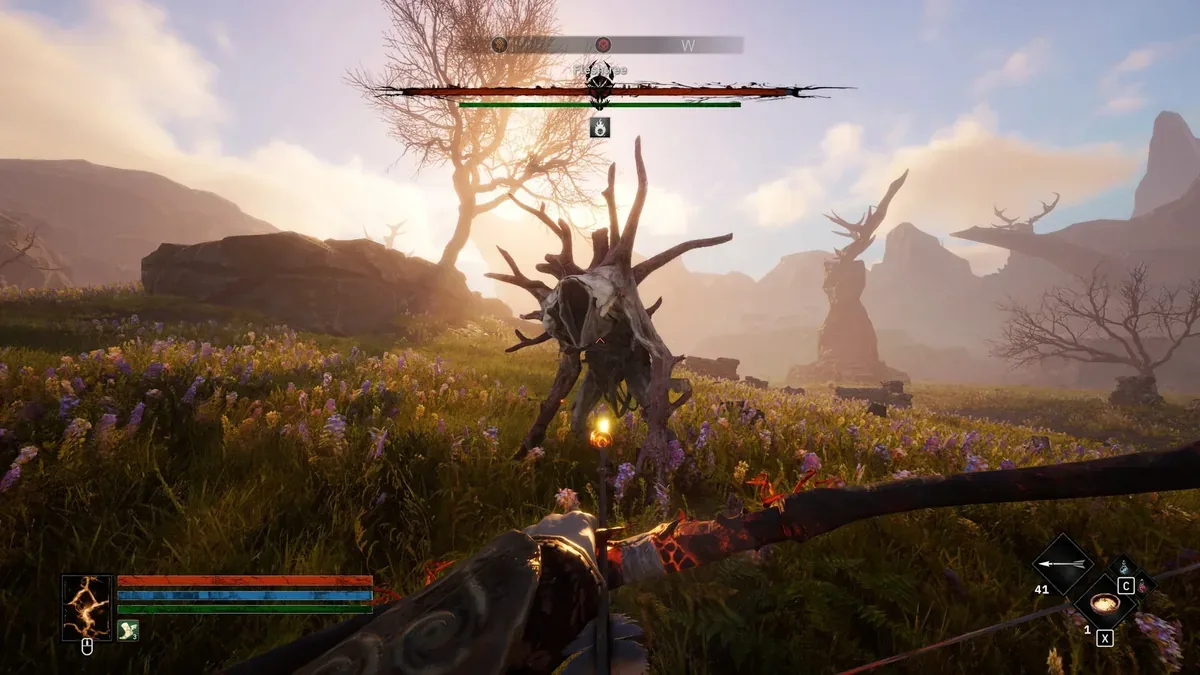 A story dialogue scene from the main campaign. Build choice affects how you handle fights like the ones that follow encounters like this, but it never changes the dialogue options themselves.
GODEEPER: Five build patterns documented from real player discussion, with stat allocations and specific gear. Tainted Grail Best Builds: 5 Real Community Setups 2026 →
- Tainted Grail Summoner Build: Spirituality Minion Guide: Tainted Grail summoner build guide: stat priority, which summons to run, and the one skill that makes minion builds sustainable in longer fights.
Combat system and mechanics
Tainted Grail's combat is first-person and real-time, mixing dodge, parry, and block with melee weapons, bows, throwables, and spells. Stamina governs how much you can dodge and block before attacks start landing directly on your health, which makes stamina management as important as raw damage output.
The Wyrdstalker is a nighttime-only threat that hunts outside protected areas once darkness falls. It's not a fixed encounter, it's a threat state, and it vanishes at dawn along with any progress made against it in that attempt. Alchemy fills the gap between your primary damage output and whatever a specific fight requires, and even builds that don't specialize in it want a basic set of combat consumables on hand.
Blacksmithing sits alongside alchemy as the other crafting system worth real investment. It produces gear with stats you can actually target, which random loot rarely matches at the same tier. Between the two systems, a character who's put even modest time into crafting tends to have noticeably more consistent gear than one relying entirely on drops, especially heading into Cuanacht and Forlorn Swords where enemy damage output climbs faster than early-game loot tables can keep up with.
Parrying and dodging both draw from the same stamina pool as blocking, so a fight against a fast, low-damage enemy can drain a character just as fast as a slow, hard-hitting one, the stamina reserve, not raw health, is usually what runs out first. Community discussion consistently treats stamina management as the actual skill ceiling in Tainted Grail's combat, separate from build choice or gear quality. A well-built character with poor stamina discipline still dies to the same multi-enemy scenarios that punish an under-leveled one.
Patches, DLC, and the current 2026 state
Tainted Grail launched May 23, 2025, and the patch cadence since has been close to monthly. Patch 1.20 in March 2026 added third-act bosses. Patch 1.21 in April shipped the free Merlin's Tomb DLC. Patch 1.22 added the free Challenge Mode DLC on April 30, 2026, a separate ruleset with adjusted enemy damage and spawn rates for players who've finished the base game and want more resistance. Patch 1.23 in May 2026 shipped alongside Bonus Content #3: Anniversary, a free release adding a side quest and new gear rather than a new region or story chapter.
Two hotfixes followed: 1.23a fixed a fish-journal popup that fired on every catch even after the entry was already unlocked, plus a "sell all garbage" error triggered by stolen items in inventory. 1.23b fixed the Electric Golem boss fight in the endgame dungeon, where its invulnerability shield had been refusing to drop. All three bugs are confirmed against the game's own official patch notes, not secondhand community reports.
The current build as of this writing is patch 1.25, released July 20, 2026 alongside a fourth free Bonus Content DLC, a new Ultra+ graphics preset, new archer and mage gear, and a new romance option.
Total DLC count now sits at eight: two paid releases (Sanctuary of Sarras at $14.99, and a smaller Supporters Pack) and six free ones (Bonus Content #1 through #4, Merlin's Tomb, and Challenge Mode). That's a more active post-launch cadence than a lot of indie RPGs manage in their first year, and it's a meaningful part of why the game has held Very Positive for this long.
- Tainted Grail Sanctuary of Sarras Guide: What's New: the paid DLC's underwater region, three swappable skill trees, and the Sir Lohengrin boss fight.
New Game Plus and endgame
NG+ starts after you complete the main story. What carries over: your character level, attribute points, skill points, inventory, equipment, consumables, crafting materials, and money. What resets: world state and quest-based powers, including King's Powers and access to locations locked by the King's soul, plus learned recipes and keys.
The armor penalty is the main balancing mechanism, confirmed at -50 armor at NG+1, -100 at NG+2, and -150 at NG+3, stacking cumulatively per cycle. High-armor builds feel this more than agility-focused builds, worth considering before committing to a heavy armor stack if you're planning multiple cycles. Loot quality reportedly improves by roughly the equivalent of 10 character levels per cycle.
GODEEPER: Full breakdown of what carries over, the armor penalty math, and how it interacts with different build types. Tainted Grail New Game Plus: What Carries Over (and Resets) →
Boss guide overview
Tainted Grail has a set of story-critical bosses and optional encounters that drop strong loot. The Wyrdstalker works best as a threat to prepare for and avoid until you're ready, not something to stumble into. In Island Asylum, the Frantic Berserker fights with fast jabs that are hard to parry, and drops the Thorn Helmet as a reward. The room layout gives you an opening to snipe it with a bow or spell instead of trading melee hits, which is the safer approach against its attack speed. Queen Sagremor, an undead lich, and Perceval, a fallen Knight of the Round Table, both wait in Cuanacht, with Perceval fought at the top of the Corrupted Temple after clearing a legion of tainted priestesses.
The final confrontation splits between two story-driven outcomes, Caradoc and Arthur, based on choices made across the whole playthrough rather than a single dialogue branch. Players heading into either ending report that a rest point sits just before the split, so a repeated failure there is a build or preparation problem rather than a fight you're locked out of retrying.
Exploration and world tips
The real regions are Island Asylum, Horns of the South, Cuanacht, Forlorn Swords, and Sarras, in that order, with Sarras added separately through the paid Sanctuary of Sarras expansion. Each region has its own gear tier, enemy roster, and quest density. Progression isn't hard-gated by the game itself, but enemy difficulty effectively creates a recommended order, players who push ahead underleveled hit a real difficulty wall.
Fast travel works through gates you discover by exploring, plus a separate bonfire system fueled by Ethereal Cobwebs, not a network of standing stones as some guides describe. The world map is accessible from the menu and shows region boundaries, but quest markers stay minimal by design. Books and notes scattered through ruins and NPC homes carry both lore and, occasionally, practical mechanics the game doesn't explain elsewhere, so it's worth stopping to read them instead of skipping past.
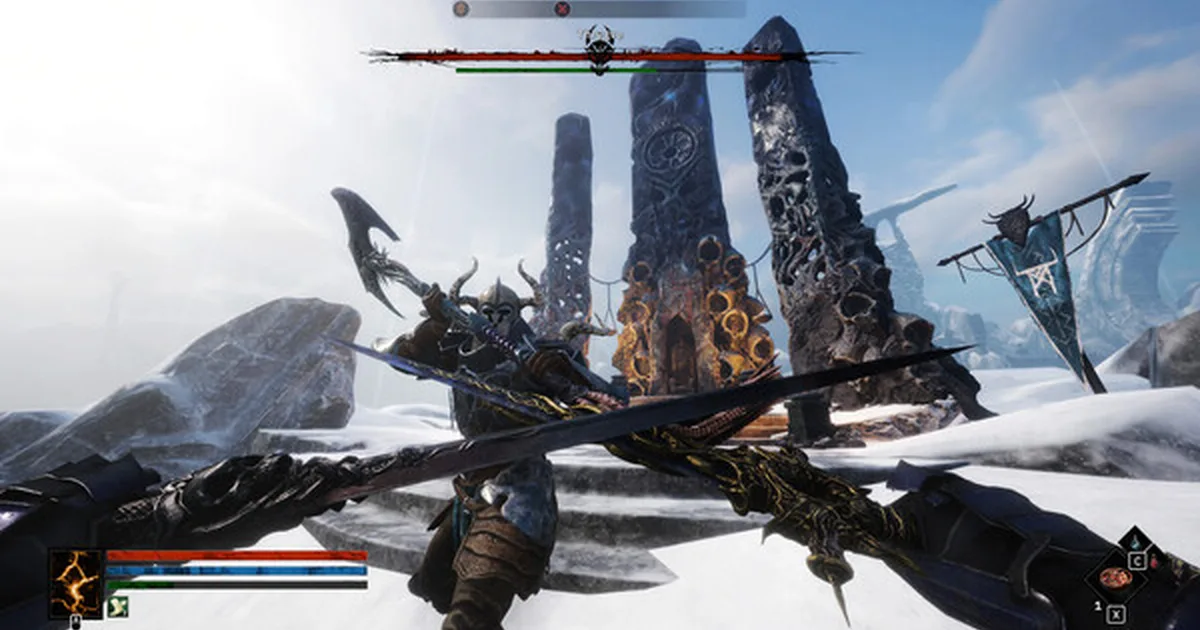
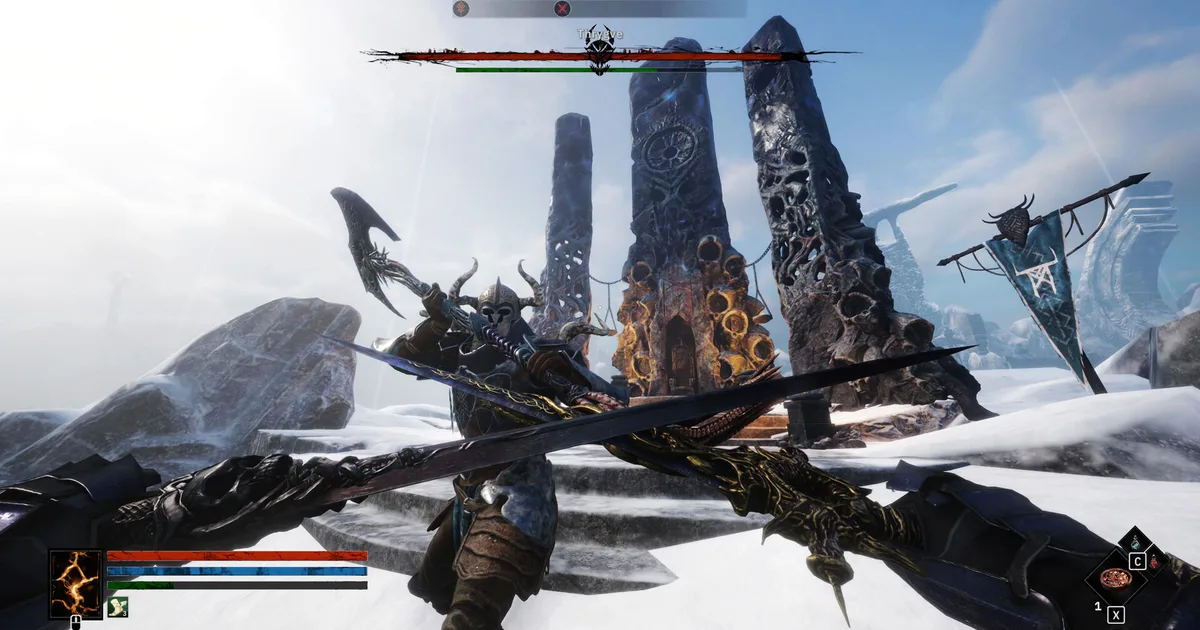
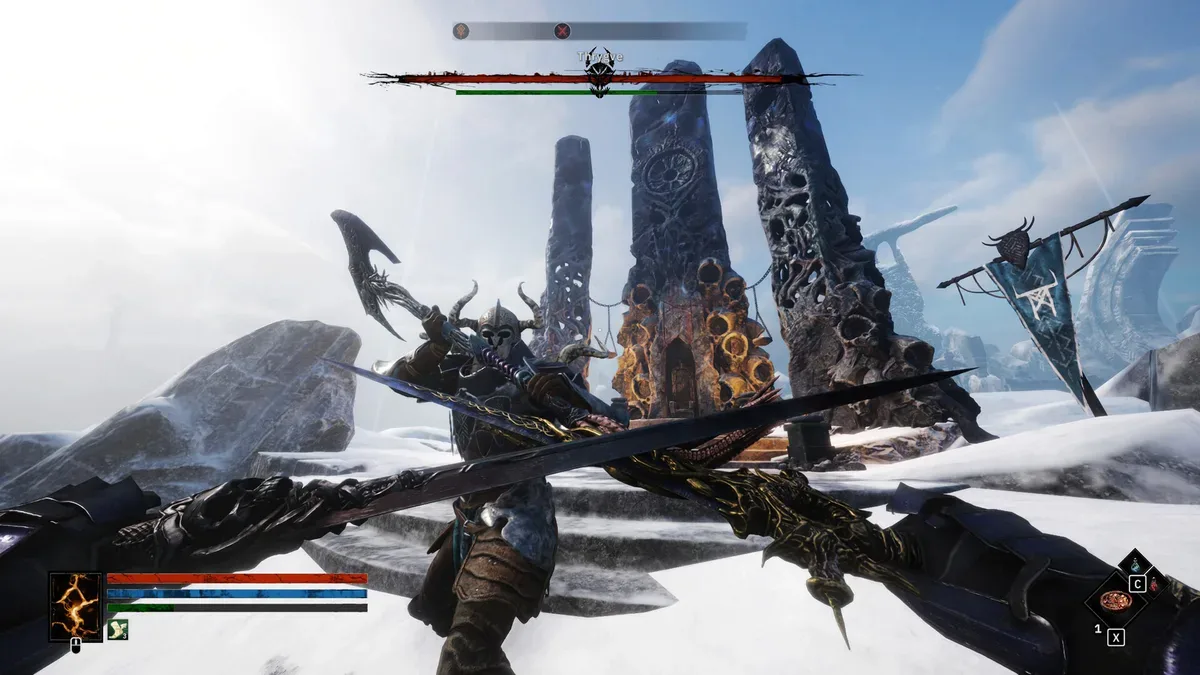 A snowy combat encounter shows the first-person weapon and stamina decisions that carry through Tainted Grail's later regions.
- Tainted Grail Best Gear: Weapons, Armor, and Jewelry Guide: Tainted Grail best gear picks for every build: exact weapon damage, armor perks, and ring effects
- Tainted Grail Tips: 12 Things to Know Before You Start: 12 things the game never explains, including the one stat beginners ignore.
All Tainted Grail guides on this site
- Tainted Grail Review: Dark Arthurian RPG Worth Playing?: full review covering the real build system, the honest Act 3 drop-off, and whether the $44.99 price holds up after a year.
- Tainted Grail Best Builds: 5 Real Community Setups 2026: five build patterns sourced from real Steam and Reddit discussion, not an invented tier list.
- Tainted Grail Regions Guide: The Real 5 Areas: Island Asylum through Sarras, verified against the official wiki.
- Tainted Grail Boss Guide: Key Fights and Strategies: Wyrdstalker timing, the Frantic Berserker's reflect mechanic, Perceval, and the Caradoc vs Arthur final-boss split.
- Tainted Grail New Game Plus: What Carries Over (and Resets): what persists into NG+, the confirmed armor penalty math, and the improved loot pool per cycle.
- Tainted Grail Survival Guide: Combat, Rest, and Threats: stamina as your real combat resource, Wyrdstalker preparation, and threat-by-threat advice.
- Tainted Grail Alchemy Guide: Recipes and Stations 2026: recipe book locations, crafting stations, and why Practicality (not Spirituality) drives alchemy potency.
- Tainted Grail Crit Build: Perception and Bleed 2026: Perception-driven crit stacking, bleed coatings, and specific skill combos.
- Tainted Grail Lore Guide: Arthurian World Explained: how Fall of Avalon remixes Arthurian myth and what the Wyrd corruption means to the world.
- Tainted Grail Achievements: All 65 Unlocks Explained: all 65 achievements, 22 with confirmed unlock conditions and an honest list of the 43 that stay hidden.
Frequently Asked Questions
Is Tainted Grail: Fall of Avalon worth playing in 2026? Yes. The game sits at Very Positive on Steam with over 35,000 reviews after more than a year on the market. At $44.99, with genuine build depth and eight DLC releases (six of them free), it's a strong indie RPG, especially through its first two acts.
Is there an official best-build tier list in Tainted Grail? No official tier list exists. Real community discussion favors a spellsword hybrid (weapon plus spell), a fragile but powerful full mage build, and Perception-driven crit builds, all documented from actual Steam and Reddit discussion rather than an invented ranking.
How long is Tainted Grail: Fall of Avalon? It varies by playstyle: roughly 9-15 hours for a rushed main-story run, 50-70 hours for a thorough playthrough, and 75+ hours for full completion.
Does Tainted Grail have New Game Plus? Yes. After completing the main story, you can start NG+ carrying your level, attribute points, skill points, and inventory. World state and quest-based powers, including King's Powers, reset. Each NG+ cycle adds a cumulative armor penalty of 50.
What are the real regions in Tainted Grail? Five: Island Asylum (prologue), Horns of the South, Cuanacht, Forlorn Swords, and Sarras (added by the paid Sanctuary of Sarras DLC). Progression isn't hard-gated between them.
How does the Spirituality stat work in Tainted Grail? Spirituality governs spell power, max mana, and mana regeneration. It does not affect alchemy, that's governed by Practicality instead, a common mix-up in older build guides.
Does Tainted Grail have paid DLC? Yes, eight releases total: two paid (Sanctuary of Sarras at $14.99, and a Supporters Pack) and six free, most recently Bonus Content #4 alongside patch 1.25 on July 20, 2026.
Who made Tainted Grail: Fall of Avalon? Tainted Grail: The Fall of Avalon was developed by Questline and published by Awaken Realms. It launched in full release on May 23, 2025, after a period in Early Access.
Related Reading
- Rune Dice Complete Guide Hub: hub for Rune Dice, another indie roguelite with a class-based build system and an active community making tier lists.
- Fatekeeper Complete Guide Hub: all Fatekeeper guides in one place, covering archetypes, skill tree ring-branching, and early access build routes.
- Die in the Dungeon Complete Guide: a dungeon-crawl contrast to Tainted Grail's open world, for players who want shorter runs.
- Far Far West Complete Guide: a western-themed indie RPG with a similarly open-ended character progression system.
References
- Tainted Grail: The Fall of Avalon on Steam: official store page, patch notes, current price, and DLC listing
- Tainted Grail official wiki (wiki.gg): full patch history verifying the bugs and features referenced across this hub
- r/TaintedGrail on Reddit: community discussion, build threads, and real player reports
About the author

Senior Critic & Analyst
Former game data analyst turned critic with 11 years covering indie and mid-tier games. Based in Austin. Runs spreadsheets on games most people just play.
- 11 years games criticism
- Former game economy analyst
- Roguelike and strategy specialist
Keep reading

Disclaimer
This article is published for informational and entertainment purposes. It does not constitute professional financial, legal, or technical advice. Game performance, online services, patch schedules, and store listings change. Verify critical details (pricing, system requirements, regional availability) with publishers and storefronts before you buy. Affiliate links, where present, help support our editorial work and are labelled in our affiliate disclosure.
Comments
Loading comments…