
GameBrief · General
Tainted Grail Lore Guide: Arthurian World Explained
Tainted Grail lore guide: Avalon is a dark Arthurian reimagining shaped by Wyrdness, with current DLC, patch context, and story interpretations checked.
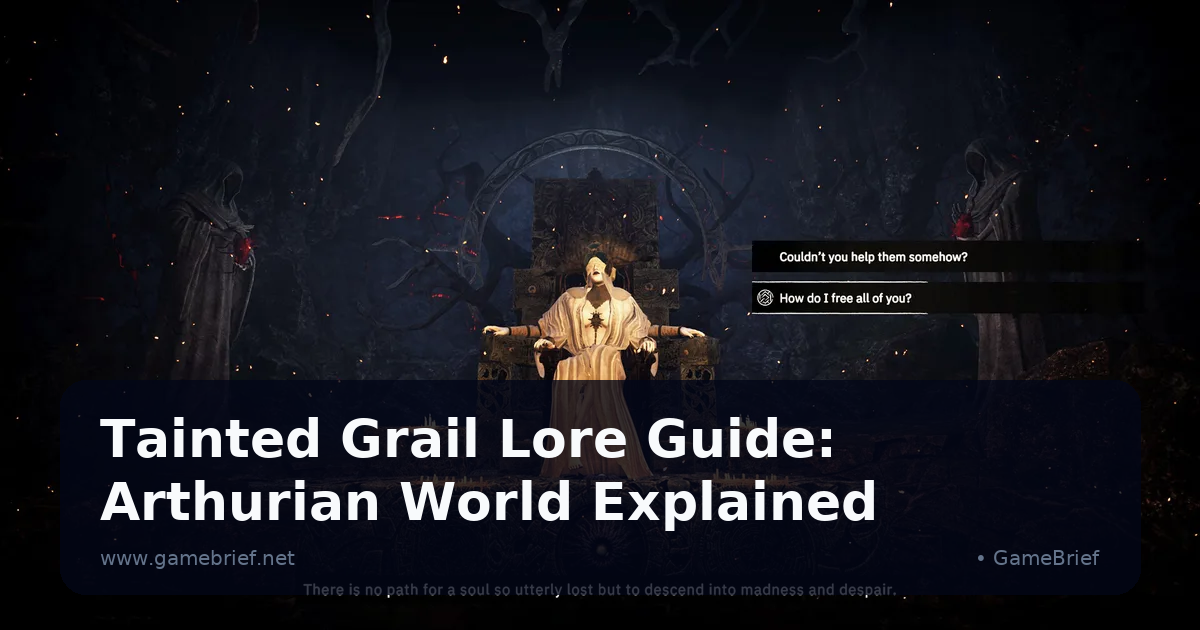
This Tainted Grail lore guide covers how the game reworks Arthurian legend into something darker and more complicated than most players expect. For gameplay guides, the best builds guide covers combat and builds, and the survival guide covers threat mechanics. For the full game overview, the Tainted Grail tips guide covers mechanics and what to know first.
The core premise of Tainted Grail: Fall of Avalon is a dark reimagining of Arthurian legends. Avalon is unstable, Wyrdness changes the world, and surviving communities are caught in conflict. The store page supplies that broad frame; the more specific readings below are separated into confirmed setup and editorial interpretation.
TL;DR: Tainted Grail is an official dark reimagining of Arthurian legends. The store uses the term Wyrdness for the force that alters reality and makes foes fiercer. Current bonus content adds more quests and gear, while the faction and ending explanations in this article are clearly labeled as interpretation where the public sources do not provide a complete table.
Tainted Grail lore guide: what the game actually is (quick answer)
Fall of Avalon is set in a dark version of Arthurian Britain. The official store frames the world around Avalon, conflict, and Wyrdness, a force that alters reality and makes foes fiercer. The communities, figures, and endings below are discussed as game-world readings rather than a complete official lore database.
The game uses familiar Arthurian names and places as a dark-fantasy foundation. The article's comparison to Welsh and Celtic traditions is useful cultural context, but it is an interpretive lens rather than a claim that the developer published a two-source lore taxonomy.
Current status: September 2026
Fall of Avalon is a full release, not an Early Access build. The Steam snapshot checked on September 17, 2026 was about 87% positive across roughly 19,793 English reviews, with about 83% positive across 568 recent reviews. Those figures are volatile and should be refreshed from the official store before publication.
The official patch hub lists Bonus Content #4 and Patch 1.25 from July 20, 2026, including archer and sorcerer gear, romance content, Ultra+ PC graphics, accessibility work, and fixes. The free Anniversary bonus content released on May 22 adds a post-Cuanacht birthday quest, a Qrko hat, five armor sets, a wand, and a bow. The current DLC listing also includes Sanctuary of Sarras, Challenge Mode, Merlin's Tomb, and Bonus Content 1 through 4. This update therefore treats the article's old "Anniversary adds a quest and gear" line as incomplete.
The official store uses Wyrdness. This article sometimes says Wyrd as shorthand for the same broad force, but the term is not a license to invent an origin story, a complete faction system, or a canon ending.
Key takeaways
- Tainted Grail uses Arthurian legends as a dark-fantasy foundation, not a faithful retelling
- The official store calls the reality-altering force Wyrdness
- The resistance, adaptation, and compromise labels below are editorial lenses for reading communities
- Notes, books, NPC dialogue, and environmental details are useful lore-reading channels, but no single public source gives a complete hierarchy
- Specific ending and final-boss claims require current-build verification
- The Anniversary bonus content adds a quest and gear, including five armor sets, a wand, a bow, and a Qrko hat
The Wyrd: what the corruption actually is
The Wyrd is not explained in a single exposition dump. It reveals itself over the course of play through what it does to the land and to living beings.
What the environment can suggest about Wyrdness, as an editorial reading:
- The landscape in corrupted zones has a visual signature: dead vegetation, dark mist, transformed terrain that doesn't look like it was always this way
- Layers of corruption can suggest a history rather than prove that the force spread in discrete waves
- Standing stones and ancient structures can invite a connection to older magical history, but the public sources checked here do not confirm that relationship
What happens to creatures exposed to Wyrdness is partly an in-game reading. Enemy design and behavior can suggest a before-and-after history, while the official store only gives the broader point that Wyrdness makes foes fiercer. The Wyrdstalker discussion below is therefore interpretation, not an official origin entry.
The lore question Fall of Avalon doesn't answer immediately is how to interpret the force behind the altered world. Books, notes, NPC dialogue, and environmental details can be read together, but this article does not claim that one source proves a single authoritative origin.
GODEEPER: The boss guide covers the Wyrdstalker's encounter mechanics for players who want combat help. Treat its story implications as separate from this article's interpretation. Tainted Grail Boss Guide 2026 →
The Arthurian framework: what carried over and what changed
The Arthurian legend provides the world's skeleton. Fall of Avalon uses the names and places but transforms their meaning.
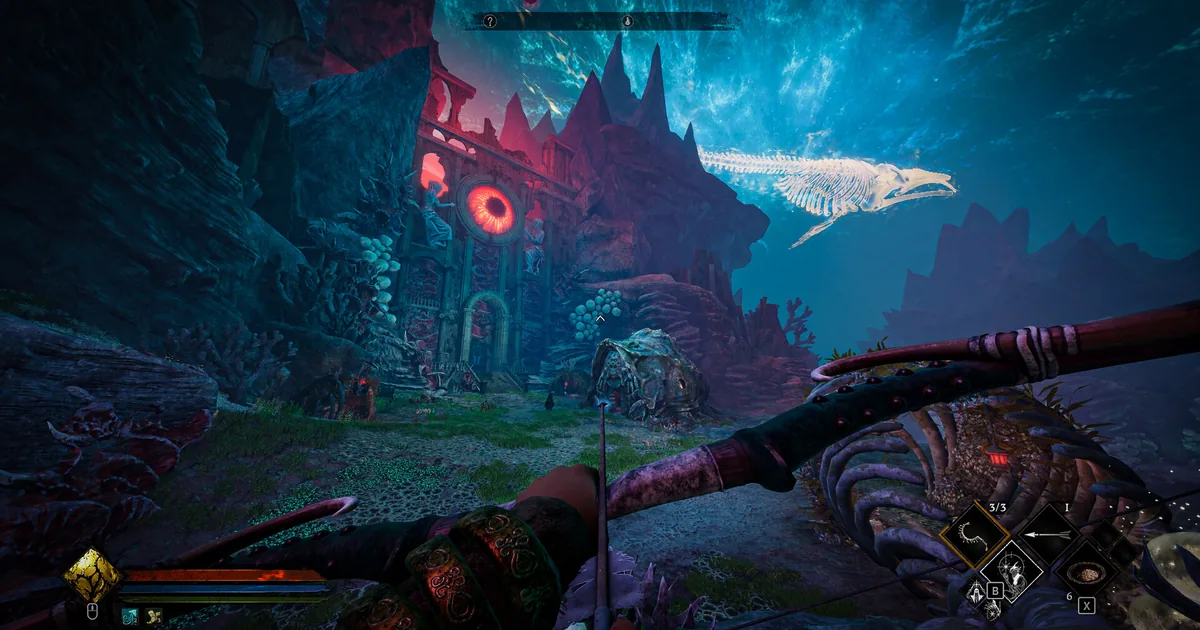
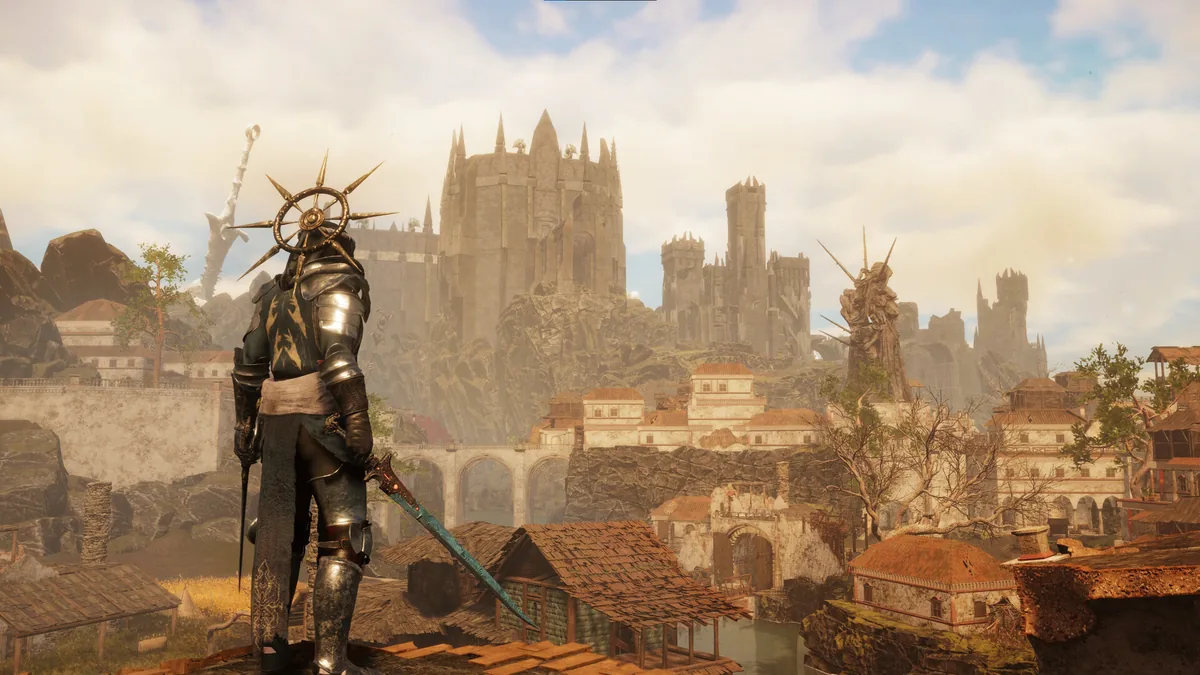 Existing gameplay artwork used for broad setting context. It is not an authoritative map, faction chart, or proof of a particular ending route.
Avalon in standard Arthurian myth is a mystical isle of healing where Arthur was taken after his final battle. In Fall of Avalon, it's the setting of the whole game, and it's actively dying. The mythological association with healing and restoration is inverted: this Avalon needs saving, and the player's actions determine what, if anything, can be preserved.
Arthurian figures and places are discussed here as transformed references, not as a complete ending guide. The article's older Caradoc-versus-Arthur wording was too definitive for the sources checked in this audit, so do not use it as a universal final-boss or canon-ending claim without verifying the current quest state.
The Round Table tradition is a useful comparison for the article's discussion of fallen Arthurian institutions. Whether every ruin or character reference should be read as a direct Round Table continuity claim is interpretive, not a published roster.
Welsh and Celtic mythology can be used as a reader's comparison point, but the developer materials checked here present the game primarily as a dark reimagining of Arthurian legends. Keep the comparison labeled as cultural interpretation rather than a confirmed lore source list.
The factions: how communities survived the Wyrd
The surviving communities across Avalon can be read as different approaches to living with Wyrdness. The game materials checked here do not provide a complete faction roster, so the categories below are interpretive rather than in-game faction classes.
Communities that resist: Some settlements can be read as holding out against the altered world. This is a narrative lens for comparing quests, not a claim that every settlement has an official resistance tag.
Communities that adapted: Other groups can be read as surviving through practical accommodation. The exact boundaries between adaptation and corruption are part of the article's interpretation, not a published faction taxonomy.
Communities that compromised: Some questlines invite a reading about compromise with Wyrd-adjacent forces. Keep that reading attached to the specific quest and dialogue you saw instead of turning it into a claim about a universal faction system.
Do not treat the absence of a visible reputation meter as proven by this feature alone. Quest outcomes and dialogue choices may shape how communities respond, but the public sources checked here do not support a complete trust formula or faction-join roster.
GODEEPER: The New Game Plus guide covers how faction outcomes and story choices carry over into subsequent playthroughs, including which elements reset and which persist. Tainted Grail New Game Plus Guide →
How the lore is delivered
Fall of Avalon's lore delivery method is worth understanding if you want to actually follow the story rather than experience the world atmospherically.
Books and notes are useful lore channels alongside NPC dialogue and environmental storytelling. The article recommends reading them because they add historical and personal context, not because this audit can prove they are the sole or primary source for every plot answer.
NPC dialogue provides current-state information and personal perspective. Treat the split between present-tense dialogue and historical notes as a reading aid, not an official content taxonomy.
Environmental storytelling: Zone design communicates history visually. Areas that were clearly once settlements but are now corrupted tell their own story. The contrast between what places look like they were and what they've become is itself lore about the rate and pattern of the Wyrd's spread.
Quest outcomes: When a quest changes a character or location, record the result from your current save. This feature can discuss the narrative significance, but it does not claim a complete survival matrix for every quest.
Preparing for the final act
The final act is the game's most direct engagement with Arthurian source material. To get meaningful context from it:
- Follow the questlines associated with both characters through their full available arcs before the final act
- Read the lore items in the late-game regions you reach, then compare them with the current quest log rather than assuming a fixed "last region" ordering
- Use the boss guide for combat mechanics and this feature for interpretation; do not infer a canon ending from either page alone
The NG+ guide may add useful context for a second playthrough, but verify carryover details against the current build before treating them as a fixed world-state rule.
Related Reading
- Tainted Grail Crit Build: Perception and Bleed 2026: Tainted Grail crit build uses perception, bleed coatings, and alchemy buffs. How to stack critical
- Tainted Grail Summoner Build: Spirituality Minion Guide: Tainted Grail summoner build guide: stat priority, which summons to run, and the one skill
- Tainted Grail Achievements: All 65 Unlocks Explained: Tainted Grail achievements guide: all 65 confirmed via Steam, grouped by leveling, crafting, and Sanctuary
Frequently Asked Questions
Is Tainted Grail connected to the Arthurian legend? Yes. The official store describes it as a dark reimagining of Arthurian legends, while this feature explains how familiar names and places are interpreted in the game world.
What is the Wyrd? The official store uses the term Wyrdness for a primordial force that alters reality and makes foes fiercer. This feature uses Wyrd as shorthand and keeps the deeper origin discussion interpretive.
Are there factions in Tainted Grail? There are competing communities and interests, but this feature does not claim a complete official faction roster or trust formula. Its resistance, adaptation, and compromise labels are reading lenses for quest outcomes.
Does lore matter for gameplay? No, but it provides context for why quests matter and what the world is. The game functions as an action RPG without deep lore investment. The story is richer with it.
Does the Anniversary DLC extend the story? The free Anniversary bonus content adds a post-Cuanacht birthday quest and gear, including five armor sets, a wand, a bow, and a Qrko hat. It is additional content within the existing game, not a confirmed post-ending continuation.
Is there a canon ending? This feature does not establish a complete ending tree or a developer-designated canon ending. Verify specific final-boss and quest outcomes in the current build before treating an interpretation as definitive.
References
- Tainted Grail: Fall of Avalon on Steam: official store page with current version and DLC details
- Tainted Grail official site: developer and game information
- Tainted Grail Steam News: Bonus Content #4, Patch 1.25, and current update history
- Anniversary bonus content on Steam: official quest and gear listing
- Tainted Grail DLC list: current paid and free content list
- r/taintedgrail community: player discussions on story interpretation and lore theories
About the author

Critical game theorist with a background in film criticism. Writing for print and digital outlets since 2015. Specialises in genre analysis and design heritage.
- Background in film criticism
- 10 years games coverage
- Genre theory and design history specialist
Keep reading

Disclaimer
This article is published for informational and entertainment purposes. It does not constitute professional financial, legal, or technical advice. Game performance, online services, patch schedules, and store listings change. Verify critical details (pricing, system requirements, regional availability) with publishers and storefronts before you buy. Affiliate links, where present, help support our editorial work and are labelled in our affiliate disclosure.
Comments
Loading comments…