
GameBrief · Guides
Subnautica 2 Gold Farming: 4 Locations That Work (2026)
Reviewing
Subnautica 2
Unknown Worlds Entertainment · Unknown Worlds Entertainment
Subnautica 2 gold farming has two opposite failure modes: three stacks of it sitting dead in the crafting locker, or an empty gold slot and a recipe that won't complete. Both come from the same root problem. Gold spawns in exactly four places, and the game never tells you that up front. This guide covers where it actually is, what it actually crafts, and the one base structure that turns the whole question into a non-issue.
TL;DR: Gold spawns in the Graveyard, Graveyard Caves, Root Canyon, and the Thermal Vent Clusters inside Root Canyon, which the wiki calls the primary Gold and Sulfur source in the Karakorum region. It's obtained from regular nodes by hand or tool, and from larger deposits with the Sonic Resonator. Only four recipes consume it: Advanced Wiring Kit, Gold Ingot, Strong Acid, and the Thermal Plant, all needing 1 to 3 gold. Once you unlock the Metal Farm by scanning the structures already standing in the Karakorum Metal Farms biome, one gold sample becomes three every 10 minutes for free.
Where do you find gold in Subnautica 2? (quick answer)
Gold is confirmed in four locations: the Graveyard and the Graveyard Caves beneath it, Root Canyon, and the Thermal Vent Clusters that sit inside Root Canyon. It doesn't appear in the Shallows, Sparse Plains, or any of the other shallow Coral Gardens biomes, which is why new players searching near their starting base come up empty.
Subnautica 2 gold farming: key takeaways
- Gold spawns in four confirmed biomes: Graveyard, Graveyard Caves, Root Canyon, and the Thermal Vent Clusters
- The Thermal Vent Clusters (255 to 455m, inside Root Canyon) are the primary Gold and Sulfur source in the Karakorum region, per the wiki's own description
- Regular nodes break by hand or tool; larger resource deposits need the Sonic Resonator
- Only four recipes use gold: Advanced Wiring Kit, Gold Ingot, Strong Acid, and the Thermal Plant, each needing 1 to 3 gold
- The Metal Farm turns 1 gold into 3 over 10 minutes, and its blueprint unlocks by scanning existing metal farm structures at the Karakorum Metal Farms biome
- Gold is a mid-game resource: every recipe needing it also needs a Processor, Habitat Builder, or Advanced Wiring Kit unlocked first
Overview
This guide reflects the Early Access build through the August 19 "Buddy System" update (EA 1.2), the current state of the game at the time of this freshness check. That update added proximity voice chat, player revives, trading, and emotes; nothing in it touched gold's location, recipe costs, or the Metal Farm's output rate.
What this Subnautica 2 gold farming guide covers: where gold spawns, how to break it out of the seafloor, what it crafts into, and how to stop manually farming it once you have a base. What it doesn't cover: the full resource list for each biome (the Subnautica 2 resources guide already handles that) or the depth-by-depth biome breakdown (that's the Subnautica 2 biomes guide).
Prerequisites: a Sonic Resonator if you want deposits instead of just nodes, and eventually a Habitat Builder for the Metal Farm. Neither is required for your first gold pickup. Time investment: a single trip to the Graveyard nets a small stockpile in under 10 minutes; setting up an automated Metal Farm loop takes an afternoon once you've got the blueprint and the base power to run it.
Step-by-step: building a repeatable gold loop
Early game: the Graveyard and Graveyard Caves
The Graveyard is where most players see gold for the first time, usually without meaning to. It shares space with Silver and Sulfur, so if you're already farming there for something else, gold nodes are sitting in the same rock faces. The Graveyard Caves sit just beneath the surface biome and repeat the same three materials at slightly higher density, which makes them worth a short detour if you've already got a base nearby.
Neither location demands special gear. Nodes break with your starter tool, and you don't need pressure-rated hull sections to survive a Graveyard dive the way you would for Root Canyon. This makes it the correct place to grab your first handful of gold, even if you don't have a use for it yet. You will.
Deep water: Root Canyon and the Thermal Vent Clusters
Root Canyon runs from roughly 364 to 750m, and it's where gold farming actually gets efficient. Inside it, the Thermal Vent Clusters, five of them mapped near landmarks like the Karakorum Power Plant and Research Outpost, are described by the wiki as the primary source of Sulfur and Gold in the whole Karakorum region. If you're specifically trying to stock up rather than picking gold up incidentally, this is the destination.
Don't go in undergeared. Root Canyon's depth means you need hull sections rated for the pressure, and the vent clusters themselves range roughly 255 to 455m within that larger band, deep enough that a bare oxygen tank won't get you there and back on one breath. A Tadpole with decent cargo space turns this from a risky one-way trip into a repeatable farming loop: fill it at the vents, surface toward a forward base, empty, repeat.
Most of what you'll break here comes out as resource deposits rather than simple nodes, the larger mineral clusters that don't yield to a bare tool. That's where the Sonic Resonator earns its slot in your inventory: it's built from 2 Titanium Ingots, 2 Lead, 1 Wiring Kit, and 1 Basic Battery at a Fabricator, and its sonic blast breaks deposits that would otherwise sit there untouched. It doubles as a way to stun aggressive fauna, so carrying it into Root Canyon is worth doing regardless of whether you're there for gold specifically.
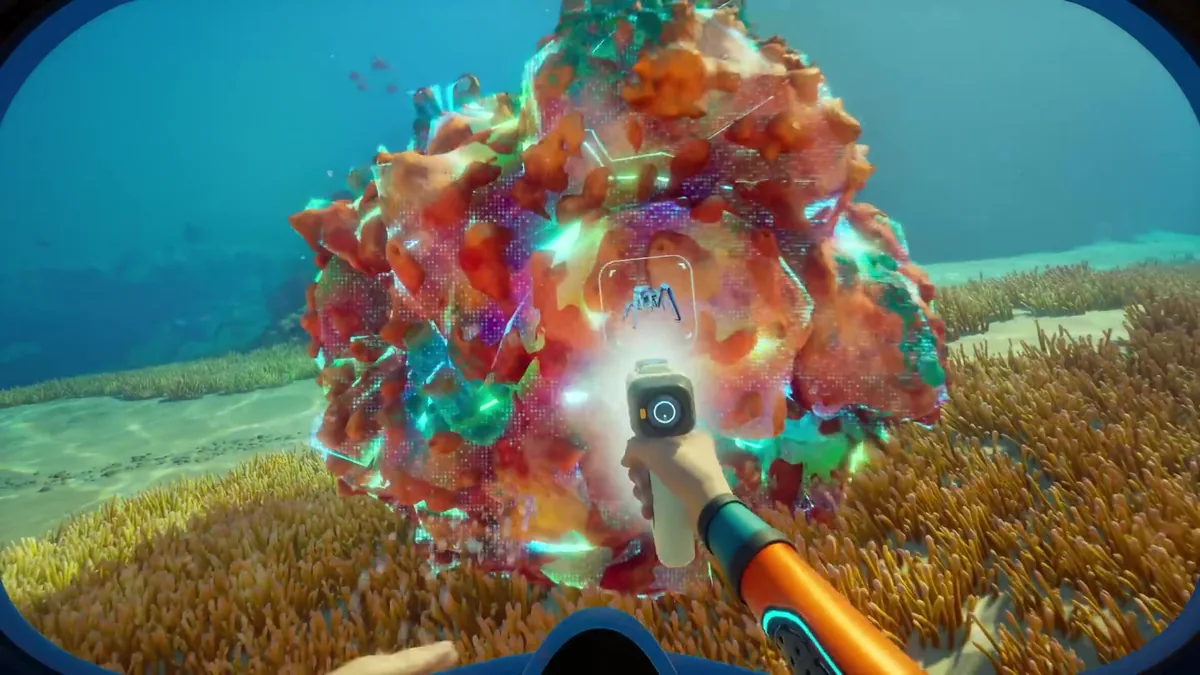 Scan first, then decide whether it's worth breaking. The habit matters more in Root Canyon, where deposits and creature-adjacent nodes look similar from a distance.
Automating it: build a Metal Farm
Once you're tired of the round trip, the Metal Farm removes it. It's a base structure built at the Habitat Builder from 1 Mangalloy Ingot and 1 Axum Bacterial Culture, and the blueprint itself doesn't come from a store or a story beat: you unlock it by scanning the metal farm structures that are already standing in the Karakorum Metal Farms biome. That's a detail worth knowing before you go looking for a fragment drop that doesn't exist here.
Once it's placed and powered (it draws 20 units of electricity and pauses if your base can't supply that), interact with it and insert one gold sample into the internal storage slot. That sample isn't consumed. Over 10 minutes, the farm converts it into three gold, and production restarts automatically the moment you retrieve the output. Swap the sample for Sulfur, Silver, or any other mineral it accepts and it produces that instead. One Metal Farm running continuously outpaces a hand-farming trip to Root Canyon within a couple of hours of real playtime.
GODEEPER: Getting a Metal Farm actually running means solving your base's power budget first, especially if you're placing it at depth near Root Canyon. Subnautica 2 Advanced Base Building: Power and Depth →
What gold actually crafts
Here's the part that explains both complaints at once. Gold feeds exactly four recipes:
| Product | Machine | Cost |
|---|---|---|
| Advanced Wiring Kit | Fabricator | 1 Wiring Kit + 1 Gold + 1 Sulfur |
| Gold Ingot | Processor | 3 Gold |
| Strong Acid | Processor | 1 Sulfur + 1 Gold |
| Thermal Plant | Habitat Builder | 3 Titanium + 3 Copper + 3 Gold |
None of these are cheap on gold specifically (3 is the highest single ask), and none of them are things you're crafting repeatedly. A Thermal Plant is a one-time base structure. Strong Acid and the Gold Ingot are used sparingly elsewhere in the crafting tree. The Advanced Wiring Kit is the one you'll actually make more than once, and even that only needs a single gold per craft.
That mismatch, four biomes' worth of a material against four low-quantity recipes, is exactly why the "I have too much gold" complaint shows up as often as the "where is gold" one. If you're farming Root Canyon for Celestine or the vent clusters for Sulfur, gold rides along as a byproduct whether you want it or not. The fix isn't to avoid picking it up. It's to stop treating it like a resource you need to actively hunt, because you almost never do.
The Processor itself is worth building before you worry about any of this. It's unlocked by scanning one of five Processor units scattered around the map (55 to 92m depth), built from 2 Titanium, 1 Mild Acid, and 1 Copper Wire at a Habitat Builder, and it's the only machine that turns raw Gold into a Gold Ingot or Strong Acid at all. Skipping it means those two recipes stay permanently locked no matter how much gold you're sitting on.
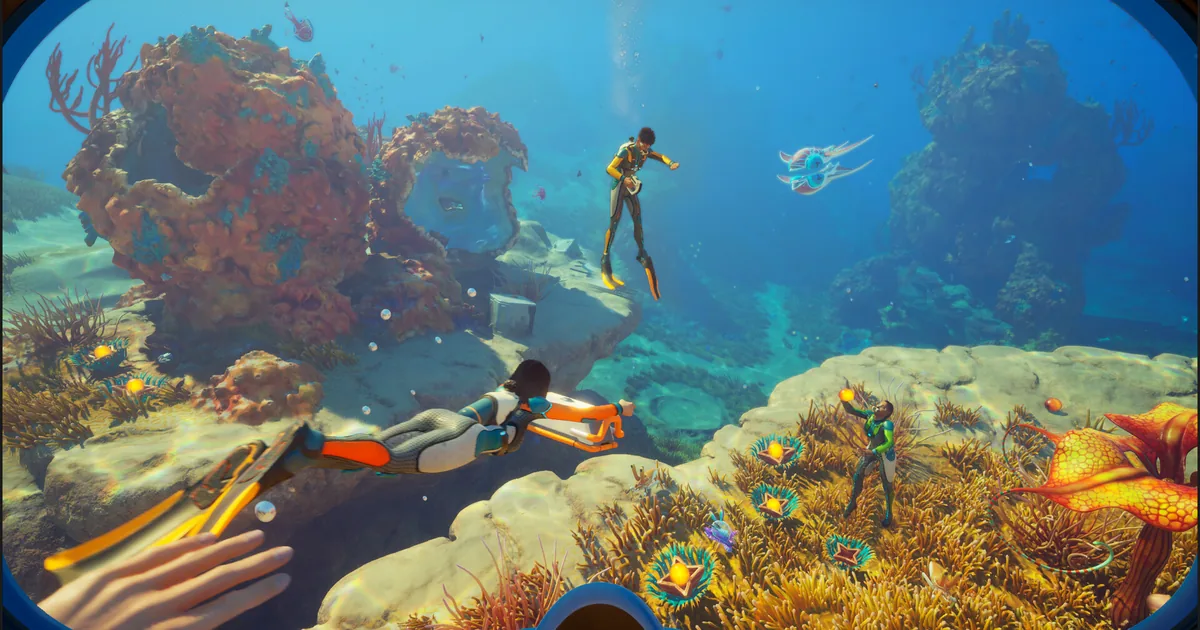
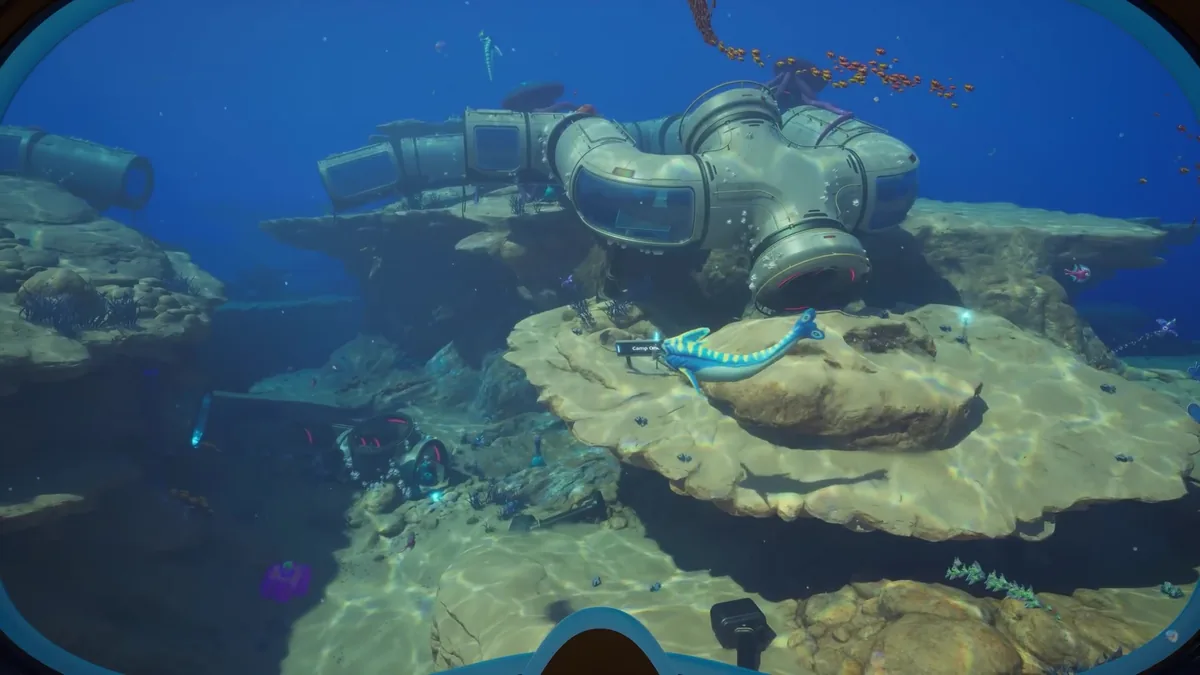 Wreck sites and rocky ledges like this one tend to sit near mixed mineral deposits. Worth a scan pass even when you're not actively farming.
GODEEPER: The scan-first habit that unlocks the Processor blueprint is the same one that gates most of the mid-game recipe tree. Subnautica 2 Resources: Biome Farming Guide for Early Access →
Tips
Don't make a dedicated gold trip your first Root Canyon goal. You'll pick up plenty on the way to Celestine, which the biome is actually worth the depth risk for. Treat gold as a byproduct until you've confirmed you need more than what's riding along.
Carry the Sonic Resonator into Root Canyon regardless of your gold plans. Deposits down there outnumber simple nodes, and the same tool that cracks them open also buys you a few seconds against aggressive fauna if something notices you.
Scan the Karakorum Metal Farms structures early, even before you're ready to build one. The blueprint unlock doesn't cost anything extra once you're already in the biome for its Atacamite and Celestine, and having it ready means you can drop a Metal Farm the moment your base power supports it.
Stock a small gold buffer, not a large one. Two or three trips' worth covers the entire crafting list. Anything beyond that is dead weight in a locker slot that could hold something you're actually short on, like Lead or Lithium.
Common mistakes
Assuming every mineral node yields to a bare hand or basic tool. Root Canyon and the vent clusters lean toward resource deposits, and swinging at one without a Sonic Resonator just wastes a trip. Confirm what you're looking at before committing to the dive.
Hunting for a Metal Farm fragment like it's a typical blueprint unlock. There isn't one. The only way in is scanning the structures already built into the Karakorum Metal Farms biome, which some players miss because they're expecting a wreck or a databank pickup instead.
Building the Thermal Plant before checking whether you actually need it yet. At 3 Gold, 3 Titanium, and 3 Copper, it's not expensive, but it's also not something most solo bases need in the first several hours. Confirm the recipe's actually gating something you want before spending materials on it.
Ignoring the Processor because gold "isn't a priority." Two of the four gold recipes run through the Processor specifically. Without it built, that gold in your locker has even fewer places to go than the short list above already implies.
Frequently Asked Questions
Where do you find gold in Subnautica 2? Gold spawns in four places: the Graveyard, Graveyard Caves beneath it, Root Canyon, and the Thermal Vent Clusters inside Root Canyon. The vent clusters are the primary source in the Karakorum region. There's no gold in the Shallows, Sparse Plains, or any of the shallow Coral Gardens biomes.
What is gold used for in Subnautica 2? Four crafted items need it: the Advanced Wiring Kit (Fabricator), Gold Ingot (Processor, 3 gold), Strong Acid (Processor, 1 gold plus sulfur), and the Thermal Plant (Habitat Builder, 3 gold). That's a short list, which is why gold piles up in storage faster than it gets used.
Do I need the Sonic Resonator to mine gold? Only for resource deposits, the larger mineral clusters. Regular gold nodes break by hand or with a basic tool. The Resonator matters more in Root Canyon and the vent clusters, where deposits are more common than in the shallower Graveyard.
How does the Metal Farm produce gold? Insert one gold sample into a built Metal Farm and it converts that sample into three gold over 10 minutes, without consuming the original sample. It draws 20 power and pauses if the base is underpowered. The blueprint unlocks by scanning the metal farm structures already standing in the Karakorum Metal Farms biome.
Is gold worth farming early in Subnautica 2? Not urgently. Every recipe that needs gold also needs the Processor, Habitat Builder, or Advanced Wiring Kit unlocked first, which happens well after your first base. Grab gold opportunistically in the Graveyard on your way to other resources rather than making a dedicated early run for it.
Why do I have way more gold than I need? Gold appears in four biomes but only feeds four recipes, most of which need small quantities (1 to 3 gold each). Players who farm Root Canyon or the vent clusters for Celestine or Sulfur pick up gold as a byproduct and end up with far more than the crafting tree ever asks for.
Related Reading
- Subnautica 2 Creature DNA Guide: Biosampler Tips 2026: Subnautica 2 creature DNA: alien eggs aren't in the EA build. Biosampler targets, ability trade-offs,
- Subnautica 2 Early Access: May 14 Launch Details and Price: Subnautica 2 Early Access launches May 14 at $29.99: 1-4 player co-op, no map, and
- Subnautica 2 DNA Modification Guide: Scan to Upgrade: Subnautica 2 DNA modification turns creature scans into upgrades: each biome unlocks different mods, and
- Subnautica 2 Scanner Room Guide: Upgrades and Efficient Use: how to spot resource nodes in range before committing to a dive.
- Subnautica 2 Complete Guide Hub: every system guide on the site in one place.
References
- Subnautica 2 on Steam: Unknown Worlds Entertainment, Early Access since May 14, 2026
- Subnautica 2 Wiki: Gold: crafting recipes, obtaining methods, and biome locations
- Subnautica 2 Wiki: Metal Farm: build cost, power draw, and production rates
- Subnautica 2 Early Access Gameplay Trailer: official Unknown Worlds trailer, source for the diver and wreck-site screenshots used in this guide
- Unknown Worlds Entertainment: developer site and Early Access roadmap updates
Was this guide helpful?
About the author

Indie & JRPG Critic
Indie game evangelist and lifelong JRPG fan covering small studios since 2017. Mumbai-born, London-based. Writes the way she talks.
- 7 years indie games coverage
- JRPG and visual novel specialist
- Narrative design focus
Keep reading

Disclaimer
This article is published for informational and entertainment purposes. It does not constitute professional financial, legal, or technical advice. Game performance, online services, patch schedules, and store listings change. Verify critical details (pricing, system requirements, regional availability) with publishers and storefronts before you buy. Affiliate links, where present, help support our editorial work and are labelled in our affiliate disclosure.
Comments
Loading comments…